
7 Coaching Session Examples, With Annotated Dialogue
The coaching session examples below show what actually happens in a good session: the client sets the focus, the coach spends most of the time asking and reflecting rather than advising, and the session ends with a specific next step the client chose. There are seven, across life, career, executive, health, business and group coaching, plus a midpoint review, each with the session's goal, a minute-by-minute flow, an annotated excerpt and what to copy.
Every example here is illustrative. The clients are fictional composites written for teaching, not real people or real sessions, and the dialogue is condensed. Real sessions are slower, messier and full of pauses. For the very first session with a new client, see our separate guide to running a first coaching session; these examples are from later in an engagement.
The 7 coaching session examples at a glance
| # | Session | Length | Main approach | Client leaves with |
|---|---|---|---|---|
| 1 | Life coaching: a decision about moving | 50 min | GROW, values questions | A two-week test before deciding |
| 2 | Career coaching: weighing a job offer | 45 min | Scorecard, scaling | Two questions to ask the employer |
| 3 | Executive coaching: after stakeholder feedback | 60 min | Feedback debrief, experiment design | One behavior and a four-week experiment |
| 4 | Health coaching: ambivalence about exercise | 30 min | Motivational interviewing | A small walk plan they chose |
| 5 | Business coaching: raising prices | 50 min | Assumption testing, rehearsal | A script and a date for the first conversation |
| 6 | Group coaching: one laser round | 12 min | Laser coaching, group reflection | One action, and lessons for the observers |
| 7 | Midpoint review | 50 min | Scaling re-rate, re-contracting | A revised plan for the second half |
1. Life coaching: a decision about moving
Illustrative client: Maya, 34, a graphic designer offered the chance to move from Chicago to Denver with her partner. She has been going back and forth for a month. Session goal she set: "Get clear on what's actually stopping me."
Flow: 0 to 5 minutes, check-in and agreeing today's outcome. 5 to 20, exploring what matters (values). 20 to 35, options and a test. 35 to 45, choosing a next step. 45 to 50, takeaway and feedback.
Excerpt:
Coach: "You said you want to get clear on what's stopping you. What would clear look like by the end of today?"
Maya: "Knowing whether it's a real reason or just fear."
The coach contracts the session outcome in the client's words before exploring.
Coach: "When you imagine your first Saturday in Denver, what do you notice?"
Maya: "Honestly? I'm on my own. My friends are all here. That's it, I think."
Coach: "So it's less about the city and more about the people."
A reflection names the theme. The coach doesn't reassure her that she'll make friends.
Coach: "What would you need to know about making friends there to decide?"
Maya: "Whether I'd actually do it. I'm not great at starting from scratch."
Outcome: Maya chooses to spend two weekends in Denver over the next month and join one local design meetup while she's there, then decide.
What to copy: the session didn't try to make the decision. It found the real question (friendship, not geography) and designed a cheap test. Our GROW model questions give you the structure.
2. Career coaching: weighing a job offer
Illustrative client: Daniel, 41, an operations manager with an offer from a smaller company: more pay, less security. He has three days to answer. Session goal: "Decide what I need to know before I say yes or no."
Flow: 0 to 5, check-in. 5 to 20, comparing the offer with his next-job scorecard (written earlier in the engagement). 20 to 35, naming what's unknown. 35 to 45, planning the questions and the reply.
Excerpt:
Coach: "On your scorecard, growth was a 5 and stability a 3. How does the offer score on each?"
Daniel: "Growth is a 5. Stability is maybe a 2. They're Series B."
Coach: "What would move stability from a 2 to a 3?"
Daniel: "Knowing how much runway they have. And whether my role exists if the next round slips."
Scaling turns a vague worry into two specific questions.
Coach: "Who could answer those?"
Daniel: "The CFO, I suppose. I haven't met her."
Outcome: Daniel asks to speak with the CFO before accepting, with two questions written down, and agrees a walk-away condition with himself.
What to copy: the coach used a tool the client had already built, so the decision rested on his criteria. Our list of career coaching activities includes the next-job scorecard.

3. Executive coaching: after stakeholder feedback
Illustrative client: Priya, a newly appointed VP of engineering. Her coach interviewed six stakeholders; the themes were "technically excellent", "decisions take too long" and "hard to disagree with in meetings". Session goal: "Choose what to work on, without trying to fix everything."
Flow: 0 to 10, reading the themes and first reactions. 10 to 30, exploring what's behind the two development themes. 30 to 50, choosing one behavior and designing an experiment. 50 to 60, what to tell her manager.
Excerpt:
Coach: "What's your first reaction?"
Priya: "Annoyed, honestly. I ask for input all the time."
Coach: "You ask for input, and people still say you're hard to disagree with. What do you make of that?"
A reflection that holds both her view and the data, without siding with either.
Priya: "...Maybe it's that I've usually decided before I ask."
Coach: "If that's true, what would change in a meeting?"
Priya: "I'd ask before I've made up my mind. And actually wait."
Outcome: for four weeks, in her weekly staff meeting, Priya will raise one decision before she has a view, ask two people for theirs first, and note what happens. Her coach will check with two stakeholders at the end of the month.
What to copy: one behavior, not three, and an experiment the leader runs at work. Our guide to leadership coaching skills covers feedback debriefs and experiment design.
4. Health coaching: ambivalence about exercise
Illustrative client: Robert, 58, whose doctor has recommended more activity for his blood pressure. He knows he should; he hasn't. Session goal: "Figure out if I'm actually going to do this."
Flow: 0 to 5, check-in. 5 to 20, exploring both sides of the ambivalence. 20 to 27, planning, only once he's ready. 27 to 30, summary.
Excerpt:
Robert: "I know walking would help. I just hate it. And I'm wiped out after work."
Coach: "Part of you knows it would help, and part of you is exhausted by 6pm and the last thing you want is a walk."
A double-sided reflection, the motivational interviewing move for ambivalence. No pushing.
Robert: "Exactly. Although weekends are different."
Coach: "Tell me about weekends."
Robert: "I used to walk the dog with my daughter on Saturdays. I liked that."
Coach: "What did you like about it?"
Robert: "Talking to her. Not the walking."
The coach follows his change talk rather than her own plan.
Outcome: Robert decides to ask his daughter about restarting Saturday walks, and to walk ten minutes after lunch on two workdays. On a 0 to 10 scale he rates his confidence at 8.
What to copy: the plan came from his reasons. See our motivational interviewing guide and health coach skills.

5. Business coaching: raising prices
Illustrative client: Lena, who runs a two-person bookkeeping firm and hasn't raised prices in three years. Session goal: "Decide on a new price and stop dreading the conversation."
Flow: 0 to 5, check-in on last session's action. 5 to 20, the numbers and the assumptions. 20 to 35, testing the fear. 35 to 45, rehearsing the conversation. 45 to 50, commitment.
Excerpt:
Coach: "What do you expect will happen if you raise prices?"
Lena: "Half my clients leave."
Coach: "Which half?"
Lena: "...Probably the three smallest ones. Who are also the most work."
A simple follow-up turns a catastrophe into a specific, testable prediction.
Coach: "If those three left and everyone else stayed at the new price, what happens to your month?"
Lena: "I'd earn about the same and work less. Huh."
Coach: "Want to practice how you'd tell your longest client?"
Outcome: Lena rehearses the opening twice, writes a two-paragraph email, and commits to telling her two longest-standing clients in person next week.
What to copy: the coach didn't recommend a price. She helped Lena test her own prediction against her numbers, then rehearse. Our benefits of a business coach covers what this kind of coaching can and can't do.
6. Group coaching: one laser round
Illustrative setting: week four of a six-week group program for new managers, eight people on a call. Each member gets a seven-minute laser round. This is Sam's.
Flow: 0 to 1, Sam names the situation. 1 to 6, coaching. 6 to 7, Sam's next step. 7 to 12, observers share what they learned for themselves.
Excerpt:
Sam: "My team misses deadlines and I end up doing the work."
Coach: "What do you want from the next six minutes?"
Sam: "One thing to do differently this week."
Coach: "When a deadline slips, what's the first thing you do?"
Sam: "Take it back. It's faster."
Coach: "And what does your team learn when you do that?"
Sam: "That I'll take it back." (Laughter in the group.)
One question surfaces the pattern. The group's laughter is recognition, not mockery, and the coach lets it land.
Outcome: Sam will ask "What do you need to finish this?" before taking any task back this week. Two observers say they do the same thing.
What to copy: short rounds keep everyone engaged, and observer reflections ("what I learned for me") stop the group from piling advice on one person. Our list of group coaching activities has the full laser round format.

7. Midpoint review
Illustrative client: Jordan, six sessions into a twelve-session engagement focused on getting their evenings back from work. Session goal: "See if this is working, and what to change."
Flow: 0 to 10, re-rating the original goal. 10 to 25, what worked and what didn't. 25 to 40, re-contracting the second half. 40 to 50, feedback on the coaching itself.
Excerpt:
Coach: "In our first session you rated your evenings a 3 out of 10. Where are they today?"
Jordan: "A 6. Mondays to Wednesdays are fine. Thursdays fall apart."
Coach: "What's different about Thursdays?"
Jordan: "Client reports are due Friday."
Re-rating the same scale makes progress visible and points to where the remaining work is.
Coach: "Before we plan the next six sessions: what's been most useful about how we work, and what should change?"
Jordan: "The check-ins help. The sessions sometimes feel too long when I'm tired."
Outcome: the second half focuses on Thursday report work, and sessions move to 40 minutes, earlier in the day.
What to copy: asking for feedback on the coaching, not just the goal, and changing the format in response. The ICF lists revisiting the coaching agreement "when necessary to ensure the coaching approach is meeting the client's needs" as part of its agreements competency (3.12 in the 2025 Core Competencies). Scaling questions make the re-rate easy.

What the examples have in common
- The client sets the session outcome. Every session starts by agreeing what would make today useful.
- More questions and reflections than advice. Where the coach shares an idea, it's offered, not imposed.
- One theme, not five. Each session finds the real question and stays with it.
- A specific next step the client chooses, with a date and, often, a confidence check.
- Something to check next time. The next session starts with what happened.
Those habits map closely to the ICF Core Competencies, particularly agreements, listening, evoking awareness and facilitating growth. Our guides to coaching techniques, which includes a full 50-minute session, and ending a coaching session fill in the rest.
Session notes for examples like these
Good notes are short. For each session, capture: the client's stated outcome, the key theme or insight in the client's words, the agreed next step and date, anything to follow up, and anything that needs care (a referral, a boundary). The free session notes template generator builds a version for your style of coaching.
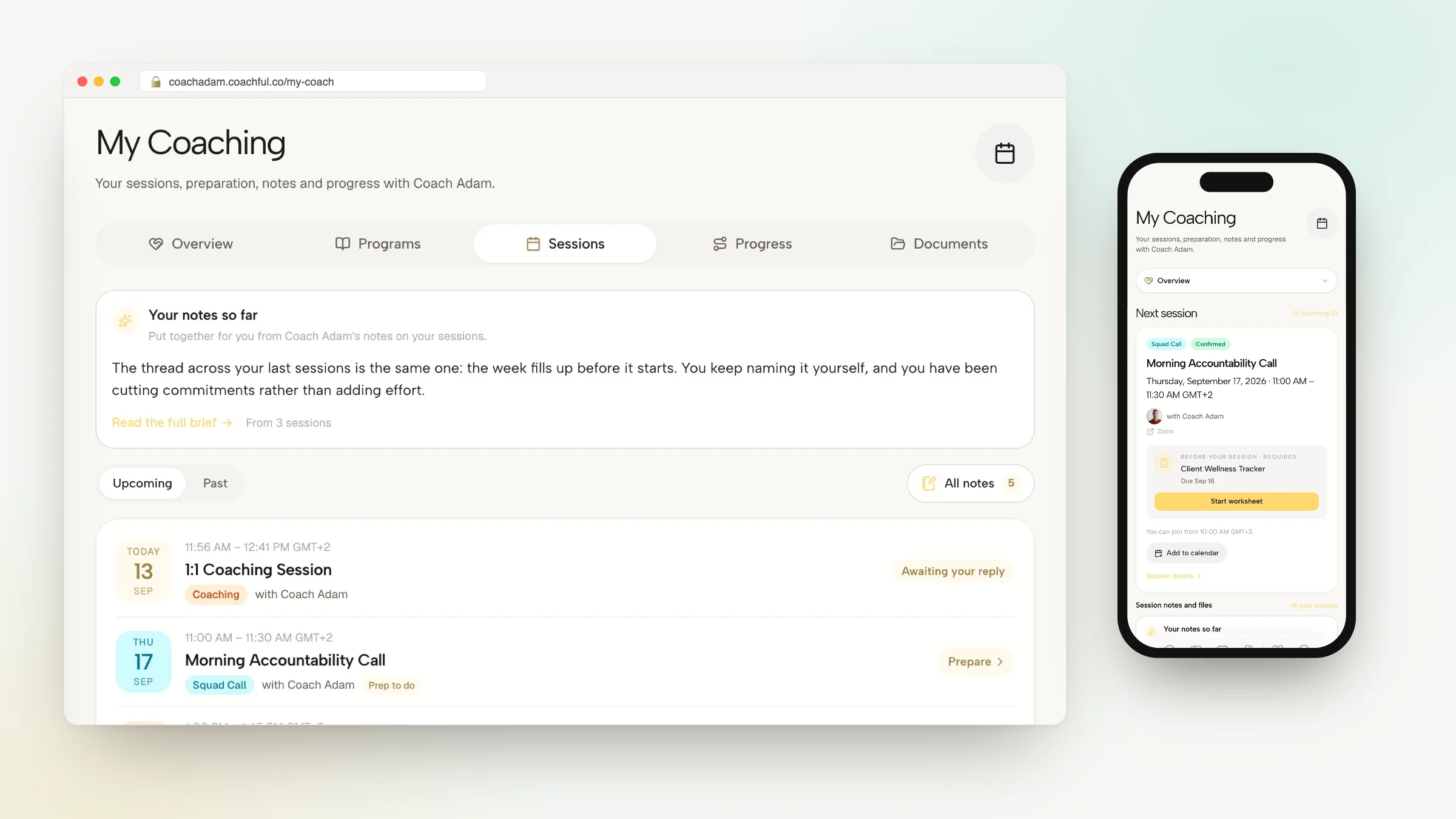
In Coachful, notes live on the client record next to their goals, check-ins and upcoming sessions, and clients see a running summary of what has come up across sessions, so the next step from session 5 is in front of them before session 6. Recorded sessions can be summarized by Michelle, Coachful's AI assistant, which drafts the client-facing summary; tell clients about recording and AI notes first, as our guide to AI session notes and consent explains. You can also require a short worksheet before a session type, so the client arrives having reflected.


If you'd rather not build your own website, offer pages or program while you work on your sessions, Coachful's team builds them for free on every plan, inside your account. Coachful is a paid subscription, with a free trial. Choose We'll build it for you · FREE under Create; the team replies by email, usually within about 24 hours. See what the free build covers.
The bottom line
Coaching sessions across niches look different on the surface (a job offer, a blood pressure goal, a pricing decision) and similar underneath: the client sets the outcome, the coach listens for the real question, reflects more than advises, and the client leaves with one specific step they chose. Use these illustrative examples as patterns, not scripts. The best way to improve your own sessions is to record a few with consent, review them against those habits, and change one thing at a time.
Frequently asked questions
What does a typical coaching session look like?
Most follow a similar arc: a short check-in on last time's action, agreeing what the client wants from today, exploring the situation with questions and reflections, generating options, choosing a specific next step, and a brief close with takeaways. Lengths of 30 to 60 minutes are common.
Are these real coaching session transcripts?
No. Every example here is illustrative, with fictional clients and condensed dialogue written for teaching. Real sessions include more silence, more tangents and longer answers.
How do you structure a coaching session?
A common structure is check-in, agree the session outcome, explore, options, next step and close. Models such as GROW or CLEAR give you a frame, but the client's goal for the session should decide where you spend the time.
What should a coach say at the start of a session?
Something like: "What would make today's session most useful for you?" or "What would you like to have by the end of our time?" If there was an action last time, ask how it went first.
How long should a coaching session be?
Thirty to sixty minutes covers most one-to-one sessions; group sessions often run 60 to 90 minutes. Our guide to how long a coaching session should be compares the options.
What is a good example of a coaching question?
"What would clear look like by the end of today?" "What's different about Thursdays?" and "What would move that from a 2 to a 3?" all appear in these examples. Good coaching questions are short, open and built from the client's own words.
Will Coachful build my coaching website for free?
Yes. Coachful's team builds coaching websites, offer pages, programs and funnels for free on every plan, inside your account. Request it from Create, and the team replies with next steps, usually within about 24 hours. Coachful is a paid subscription.












