
12 Group Coaching Activities With Step-by-Step Instructions
The best group coaching activities give every person a turn to think, a turn to speak and a commitment to carry out of the room. The twelve below do that in different ways: some are fast warm-ups for a whole cohort, some are deep peer-coaching formats for small groups, and two are built for the last session. Each one comes with its purpose, time, group size, step-by-step instructions, debrief questions and a version for online groups.
They are written for coaches running cohorts, masterminds and group programs, not for team-building days. If you want the bigger picture first, our guides to what group coaching is and how to run a group coaching session cover structure and facilitation. And if the program around these activities still needs building, Coachful's team will set up the program, worksheets and sign-up page in your account for free, which we cover near the end.
The 12 group coaching activities at a glance
| # | Activity | Time | Group size | Best moment |
|---|---|---|---|---|
| 1 | 1-2-4-All on a shared challenge | 15 min | 4 to 30 | Any session, to warm up thinking |
| 2 | Laser coaching rounds | 40 to 60 min | 4 to 8 | Core of a regular call |
| 3 | Peer coaching triads | 45 min | 6 to 18, in threes | Week 3 onward |
| 4 | Troika consulting | 30 to 35 min | Trios | Stuck goals mid-program |
| 5 | Fishbowl demo coaching | 30 min | 6 to 20 | Early, to model the method |
| 6 | Goal pre-mortem | 25 min | 4 to 12 | Right after goal setting |
| 7 | Wheel of Life compare and choose | 30 min | 4 to 20 | Session 1 or 2 |
| 8 | Appreciative interviews | 40 min | 6 to 20, in pairs | Early, to build trust |
| 9 | Commitment and report-back loop | 10 min a session | Any | Every session |
| 10 | Rehearsal in threes | 30 min | 6 to 15 | Before a real conversation |
| 11 | Silent gallery walk | 20 min | 6 to 25 | Midpoint review |
| 12 | Letter to future self | 20 min | Any | Final session |
A rule of thumb before you pick: one main activity per call. A 75-minute session that crams in three structured exercises leaves no time for the coaching, which is the part people paid for.
1. 1-2-4-All on a shared challenge
Purpose: get everyone thinking before the loudest person speaks. Time: about 15 minutes. Group size: 4 to 30.
1-2-4-All comes from Liberating Structures, the facilitation collection created by Henri Lipmanowicz and Keith McCandless. It works because the first minute is silent, so the quiet half of your cohort has an answer ready by the time the room opens up.
- Pose one question tied to this week's theme, for example "What is one thing that keeps pulling you off your plan?" (1 minute).
- Everyone writes their own answer in silence (1 minute).
- Pairs share and build on each other's ideas (2 minutes).
- Pairs join into fours and pick the idea worth hearing (5 minutes).
- Each four shares one idea with the whole group (about 7 minutes).
Debrief questions: Which idea surprised you? What did you hear that you could test this week? Who had the same obstacle in different words?
Online variation: run the pairs and fours in breakout rooms if your call runs on Zoom, or skip them and use the chat: everyone types their answer at the same moment and hits enter together, then you read the pattern aloud.
2. Laser coaching rounds
Purpose: give every member real coaching time without turning the call into a string of one-to-ones. Time: 40 to 60 minutes. Group size: 4 to 8.
- Before the call, each member posts one line: the situation they want help with today.
- Set a visible timer for 6 or 7 minutes per person.
- Coach the first member live: clarify what they want from the next six minutes, ask two or three questions, and end on one next step.
- After each round, invite the group to share one thing they noticed for themselves, not advice for the person coached.
- Rotate until everyone has had a turn, or carry the rest to next week.
Debrief questions: What did you learn from someone else's round? Which question would you ask yourself this week?
Online variation: works as is on video. Ask observers to stay on mute and type reflections in the chat, which you read out after each round. For the longer, structured version used in masterminds, see our mastermind hot seat template.
3. Peer coaching triads
Purpose: let members practice coaching each other, so progress continues between your calls. Time: 45 minutes (three rounds of 15). Group size: 6 to 18, split into threes.
- Give each trio three roles: coach, client and observer.
- Hand the coach a short question set (what do you want, what is happening now, what could you try, what will you do).
- Run a 10-minute coaching conversation.
- The observer gives 3 minutes of feedback on what helped, using only what they heard.
- Rotate roles twice so everyone plays each part.
Debrief questions: Which role taught you the most? What was hard about not giving advice? What did your coach do that helped?
Online variation: breakout rooms of three, or assign the trios as buddy groups so they can run the next round on their own between sessions. Our guide to running a peer coaching group has a full agenda if a cohort wants to keep going after your program ends.

4. Troika consulting
Purpose: unstick one goal per person with fresh eyes. Time: 30 to 35 minutes. Group size: trios, as many as you like.
Another Liberating Structures format, and one of the most useful for groups past the halfway mark, when goals start to stall.
- Everyone takes a minute to name their current challenge and the help they want.
- Client presents the challenge (1 to 2 minutes).
- The two consultants ask clarifying questions only, no solutions (1 to 2 minutes).
- The client turns their back (or turns off their camera) while the consultants discuss ideas as if the client were not there (4 to 5 minutes).
- The client turns back and shares what was most useful (1 to 2 minutes). Rotate so each person is the client once.
Debrief questions: What was it like to listen without defending yourself? Which idea will you test? What did you assume about your own challenge that the consultants did not?
Online variation: the camera-off step translates well; the client mutes and stops video during the silent consultation.
5. Fishbowl demo coaching
Purpose: show the group what good coaching looks like, so their peer work improves. Time: 30 minutes. Group size: 6 to 20.
- Ask for a volunteer with a real, low-stakes topic. Agree beforehand what stays in the room.
- Coach them for 15 minutes while everyone else watches.
- Give observers one thing to track each: questions asked, moments of silence, the moment the client's energy shifted.
- Thank the volunteer and ask them first how it felt.
- Open the floor to observers' notes on the process, never on the volunteer's problem.
Debrief questions: Where did the conversation turn? What did the coach not do? What will you copy in your triad?
Online variation: spotlight the coach and volunteer's videos and ask everyone else to turn cameras off, so the volunteer feels less watched.
6. Goal pre-mortem
Purpose: find the likely failure points of each goal before they happen. Time: 25 minutes. Group size: 4 to 12.
The pre-mortem, described by Gary Klein in the Harvard Business Review in 2007, asks people to imagine a project has already failed and work back to why. It works as well on a personal goal as on a project.
- Say: "It's the last week of the program and your goal didn't happen. Write down why."
- Give 5 minutes of silent writing.
- In pairs, each person reads their list and circles the one reason most likely to be true.
- Each person writes one action that would prevent that reason, with a date.
- Collect the prevention actions in one shared place.
Debrief questions: Which failure reason was about you and which about circumstances? What will you do the first time it shows up?
Online variation: run the writing as a worksheet everyone fills in before the call, then use the call for the pairs and the prevention step.
7. Wheel of Life compare and choose
Purpose: help each member pick one area to work on and see that others face similar trade-offs. Time: 30 minutes. Group size: 4 to 20.
- Before the call, everyone completes the free Wheel of Life assessment and saves their wheel.
- On the call, give 3 minutes to look at the wheel and mark the area that would change the others if it improved.
- In pairs, each person explains their choice for 3 minutes while the other only asks questions.
- Each person writes what a one-point improvement in that area would look like by the next session.
- Back in the full group, ask for three volunteers to share their one-point change.
Debrief questions: Why that area and not the lowest score? What would a one-point gain change this month?
Online variation: members screenshot their wheel and post it to the cohort feed with the area they chose, which gives you a record to revisit at the midpoint.
8. Appreciative interviews
Purpose: build trust and surface strengths the group can use. Time: 40 minutes. Group size: 6 to 20, in pairs.
- Pair people who know each other least.
- Each partner interviews the other for 8 minutes: "Tell me about a time you handled something like this well. What did you do? What made it possible?"
- Swap roles.
- Each person tells their partner the strengths they heard in the story.
- In the full group, collect the strengths on a shared list and look for patterns.
Debrief questions: Which strength did you not expect to hear? How could you use it on your current goal?
Online variation: breakout pairs, or run it asynchronously: each pair gets a week and a private chat to complete the interviews. Our guide to appreciative inquiry coaching explains the method behind it.
9. Commitment and report-back loop
Purpose: make what people promise visible, so the next session starts with evidence instead of good intentions. Time: 10 minutes at the end and 10 at the start of each session. Group size: any.
- In the last 10 minutes, each person names one action they will take before the next call, phrased so someone else could check it.
- Post the commitments where the group can see them.
- At the next session, open with a round: done, partly done, or not done, plus one sentence on what got in the way.
- For anything not done, ask what would make it doable, not why it was missed.
Debrief questions: What pattern do you notice in what got in the way? Which commitment would you shrink next time?
Online variation: this one works better online than in person, because the commitments live in the community and members can mark them done during the week. Our guide to coaching accountability covers why reporting progress helps.

10. Rehearsal in threes
Purpose: practice a real conversation (a raise, a boundary, a sales call) before it happens. Time: 30 minutes. Group size: 6 to 15, split into threes.
- Each person writes the opening line of a conversation they have been avoiding.
- In threes: one plays themselves, one plays the other person, one observes.
- Run 4 minutes of the conversation.
- The observer names one moment that worked and one to try differently.
- Run it again with the change, then rotate.
Debrief questions: What changed between the first and second take? What will you say in your first ten seconds for real?
Online variation: breakouts of three. If you run role plays often, our guide to role play in coaching has scripts and safety notes.
11. Silent gallery walk
Purpose: let a group see everyone's progress at the midpoint without a long round of updates. Time: 20 minutes. Group size: 6 to 25.
- Before the session, each person makes one "poster": their goal, what has moved, what is stuck.
- Put the posters around the room, or in one shared thread.
- Everyone walks (or scrolls) in silence for 10 minutes and leaves one comment on at least three posters: a question, an idea or a resource.
- Each person reads the comments on their own poster and picks one to act on.
Debrief questions: What did you notice across the room? Which comment changed how you see your goal?
Online variation: a pinned community post where each member replies with their poster, and everyone comments on three others. It also works asynchronously over a weekend.
12. Letter to future self
Purpose: close the program by turning learning into something that lasts after the calls stop. Time: 20 minutes. Group size: any.
- Ask each person to write a letter to themselves three months from now.
- Prompts: what you learned, what you want to keep doing, what to do when the old pattern returns.
- Give 12 minutes of quiet writing.
- Invite volunteers to read one line aloud.
- Deliver the letters back to each person in three months.
Debrief questions: What do you want your future self to remember about this group? Who will you stay in touch with?
Online variation: collect the letters through a private worksheet, then schedule a reminder or follow-up email for the three-month mark. Pair it with an alumni plan so the group has somewhere to go next.
How to run these activities in Coachful
Most of these activities need four things: a group space, a live session, a worksheet and a place where commitments stay visible. In Coachful they are all part of the same program.
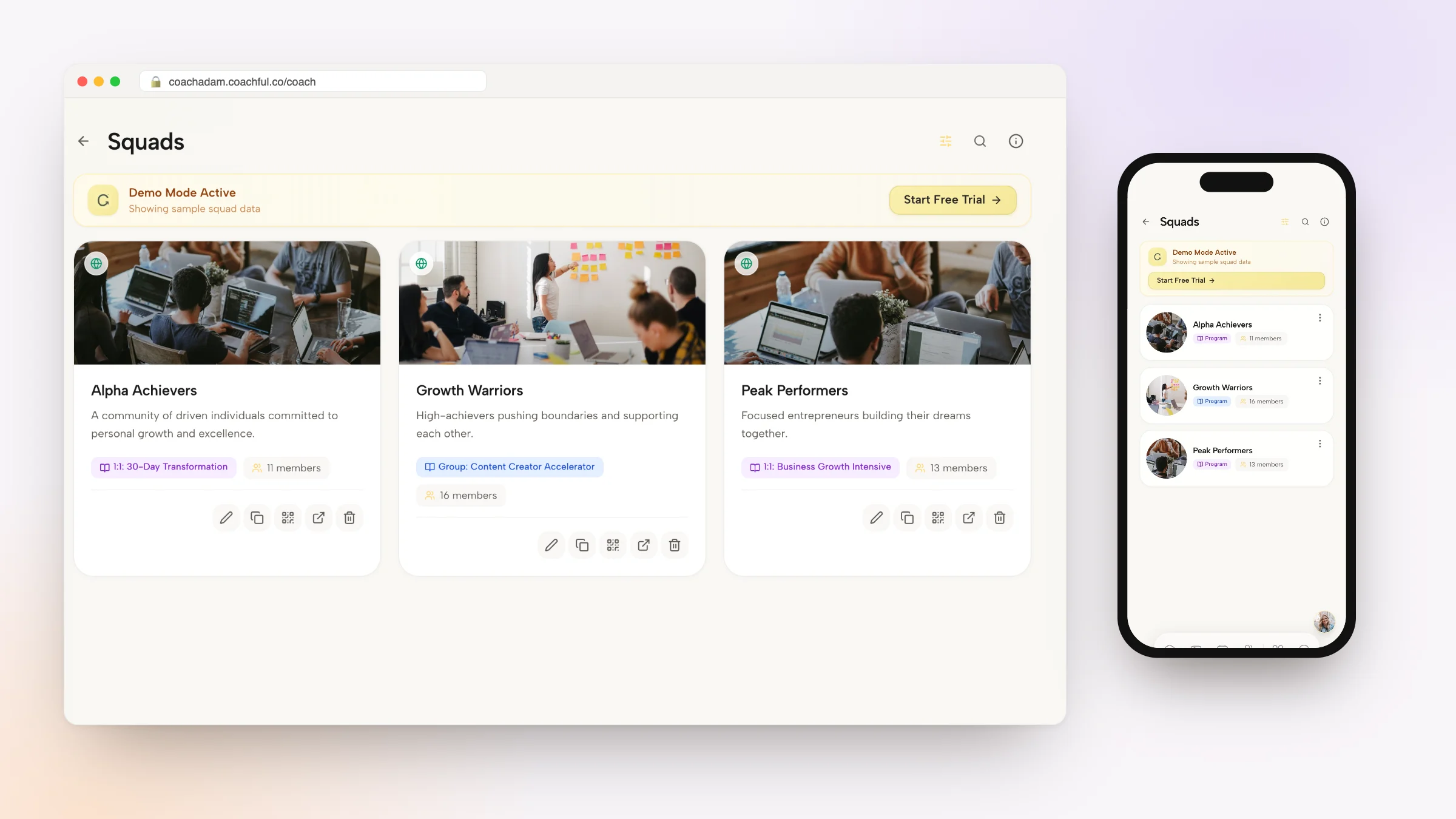
- Squads. When someone enrols in a group program, Coachful places them in a cohort group with its own member list, feed and chat. That is where gallery walks, pre-call posts for laser rounds and report-backs live.
- Live sessions. Schedule each call from the program as a Group call (everyone on camera), a Livestream (you present, members watch and ask in the chat) or a Focus room (co-working with a shared Pomodoro timer). Attendance is recorded per member. If you prefer Zoom, Google Meet or Teams, Coachful creates the link from your connected account, and features such as breakout rooms follow that account.
- Engage in the community. The community post composer has an Engage menu with Poll, Q&A, Commitment (members tap "I'm in", with an optional deadline and Mark done) and Pulse (a quick 1 to 5 scale, anonymous by default). Commitments are made for activity 9.
- Worksheets. Build pre-mortems, posters and future-self letters in Forms & worksheets, choosing the Worksheet experience so each answer is saved as a reviewable document. You can require a worksheet before a session type, so it shows up on each member's session card.
- Buddy groups. In a program's settings, Connections between clients can put members into pairs or groups of three or four with their own chat, which suits triads and troikas between calls.


Each member still has an individual record with goals, habits and check-ins, so you can see who is moving and who has gone quiet in a group of fifteen. The group coaching software page and our guide to creating a group coaching program go further on setup. If you're working toward an ICF credential, read how group coaching hours count.
Have the program built for free
If you'd rather spend your time designing sessions than setting up pages, Coachful's team builds programs, worksheets, sales pages and event pages for free on every plan, inside your own account. Coachful itself is a paid subscription, and you can start with a free trial. Open Create and choose We'll build it for you · FREE, say what you need and add up to 8 links and 10 files, such as your session outline. The team replies by email, usually within about 24 hours. Nothing is invented: the team doesn't add credentials, testimonials or prices you don't have. Here's what the free build covers.

The bottom line
Good group coaching activities are less about novelty than about turns: a turn to think in silence, a turn to be coached, a turn to coach someone else and a turn to commit in front of people who will ask. Start a new cohort with 1-2-4-All and appreciative interviews, build the middle around laser rounds, triads and the commitment loop, use troika consulting and the gallery walk when goals stall, and close with letters. Set confidentiality expectations before the first deep activity, and keep one main activity per call. For the format and theme of the whole program, see our companion list of group coaching ideas, and for openers, the icebreakers for group coaching.
Frequently asked questions
What are good activities for group coaching?
Activities that give every member structured airtime work best: laser coaching rounds, peer coaching triads, troika consulting, goal pre-mortems and a commitment and report-back loop. Warm-ups such as 1-2-4-All help quieter members contribute, and closing activities like a letter to your future self help learning last after the program.
How many activities should I use in one group coaching session?
Usually one main activity plus a short opening and closing. A 60 to 90 minute call can hold a 10-minute check-in, one 30 to 45 minute activity, open coaching time and a 10-minute commitment round. More than that and the group spends the session following instructions rather than thinking.
How do you keep group coaching activities from feeling like team building?
Tie every activity to each person's own goal and end it with a specific next step. Team-building games are about the group; coaching activities use the group to move individual goals forward. If an activity doesn't change what someone does before the next call, drop it.
What group coaching activities work online?
1-2-4-All, troika consulting, laser coaching rounds and the commitment loop all translate well to video. Pair and trio work needs breakout rooms or a separate chat. Gallery walks and pre-mortems often work better online, as a shared thread or a worksheet completed before the call.
How big should a group be for these activities?
Most of these work best with 6 to 12 people. Laser coaching rounds need a small group (4 to 8) so everyone gets a turn; 1-2-4-All and gallery walks scale to 25 or more. For larger cohorts, split into trios or buddy groups for the deep work.
Can I use these activities in a mastermind?
Yes. Troika consulting, laser rounds and the commitment loop suit masterminds especially well, because members bring their own expertise. Our guides to running a coaching mastermind and the hot seat template show how to structure the call around them.
Will Coachful build my group coaching program for free?
Yes. Coachful's team builds programs, worksheets, sales pages and event pages for free on every plan, inside your account. Request it from Create with the We'll build it for you · FREE chip, and the team replies with next steps, usually within about 24 hours. Coachful itself is a paid subscription.












