
15 Group Coaching Ideas for Programs People Join
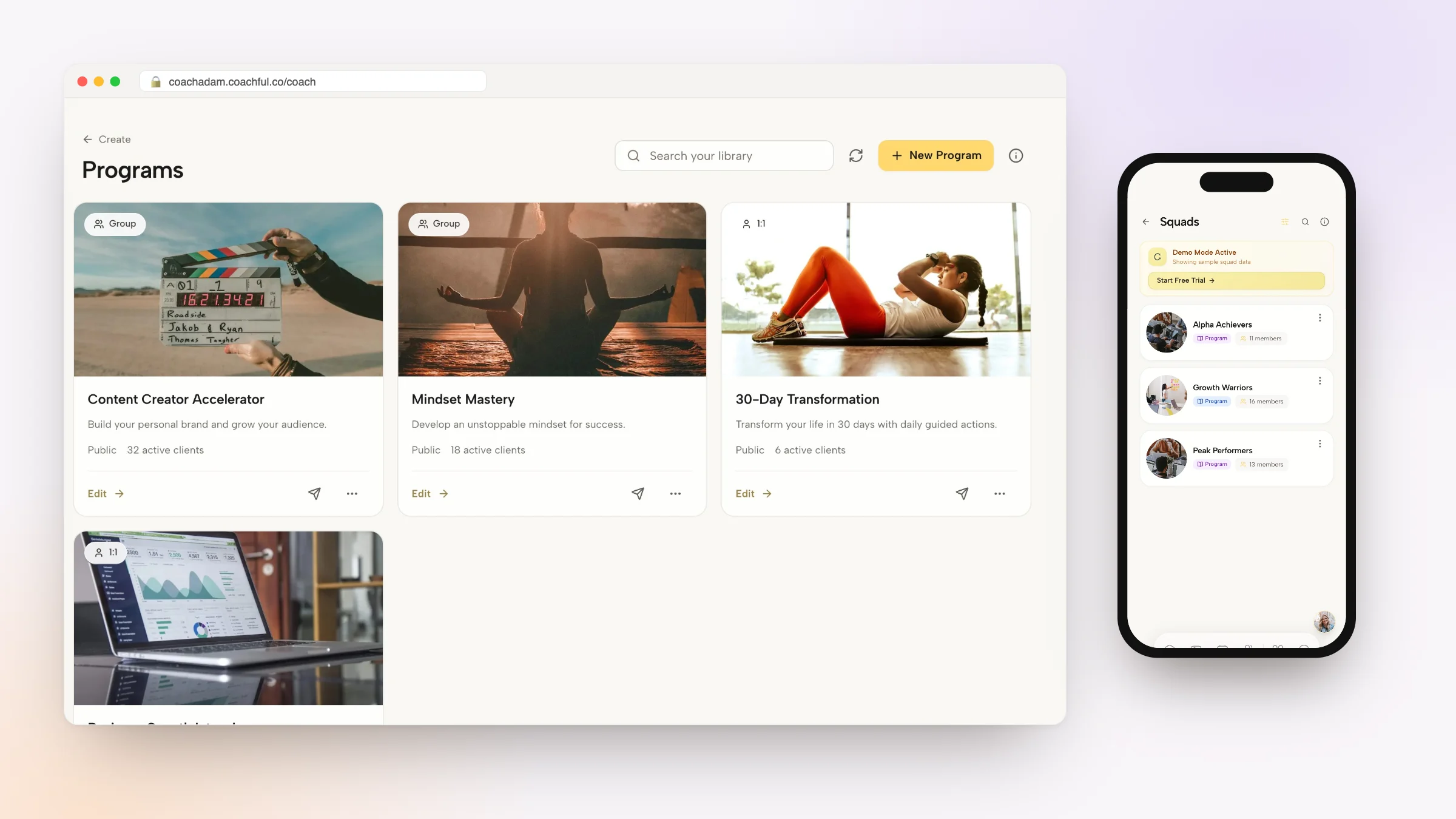
The best group coaching ideas start from one question: what change do these people share, and how often do they need to show up to make it? Answer that, and the format follows, whether that's a six-week cohort, a rolling monthly circle, a five-day challenge, a co-working room or a mastermind. The fifteen ideas below are formats and program shapes you can build a group offer around, each with who it suits, how it runs, what happens between calls and how to set it up.
They're about the shape of the program, not single events; for one-off sessions, see our 30 coaching workshop ideas, and for what to do inside each call, our group coaching activities. If you'd rather hand the build to someone, Coachful's team will set up the program, sales page and sign-up for free in your account, which we cover at the end.
The 15 group coaching ideas at a glance
| # | Idea | Group size | Length | Best for |
|---|---|---|---|---|
| 1 | The single-outcome cohort | 6 to 12 | 6 to 8 weeks | A first group offer |
| 2 | The rolling monthly circle | 8 to 30 | Ongoing | Recurring revenue, alumni |
| 3 | The five-day challenge | Any | 5 days | Filling a paid cohort |
| 4 | Co-working sprints | 4 to 20 | Ongoing, weekly | ADHD, writers, founders |
| 5 | The same-stage cohort | 6 to 12 | 6 to 12 weeks | A shared transition |
| 6 | Book-and-practice club | 6 to 15 | 6 to 10 weeks | Light, affordable entry point |
| 7 | The peer mastermind | 5 to 8 | 6 to 12 months | Experienced members |
| 8 | Group plus private sessions | 6 to 12 | 8 to 12 weeks | Clients who want both |
| 9 | The alumni group | Any | Ongoing | Keeping finished clients |
| 10 | Course plus live coaching | Any | 4 to 12 weeks | Coaches with a course |
| 11 | Accountability pods | Pods of 3 or 4 | Ongoing | Large communities |
| 12 | The employer cohort | 6 to 15 | 3 to 6 months | Selling to companies |
| 13 | The quarterly planning cohort | 6 to 20 | Four touchpoints a quarter | Business and career clients |
| 14 | The couples or pairs group | 3 to 6 pairs | 6 weeks | Relationship and co-founder coaching |
| 15 | The hybrid retreat | 8 to 20 | One day plus online calls | Deep, memorable change |
1. The single-outcome cohort
Who it suits: almost every coach launching a first group. Shape: 6 to 12 people, 6 to 8 weekly calls of 60 to 90 minutes, one start date.
The cohort promises one specific change everyone shares: "Book your first ten clients", "Sleep seven hours on weeknights", "Have the salary conversation". One promise makes the curriculum easy (each week moves toward it) and the marketing easier. The common mistake is promising five outcomes so more people qualify; the group then has nothing in common.
Between calls: one task a week, a commitment posted in the group, and a wins thread.
In Coachful: create a group program; members land in a cohort group with its own feed, chat and calls when they enrol, and each one keeps an individual record of goals, habits and check-ins. Our guide to creating a group coaching program walks through the build, and why a small audience should use a start date explains the timing.
2. The rolling monthly circle
Who it suits: coaches who want recurring revenue, and clients who want ongoing support rather than a finish line. Shape: 8 to 30 members, two calls a month, join any time.
Give each month a theme (boundaries in March, energy in April) so newcomers can join without missing a foundation, and a regular structure so the circle doesn't drift into a chat. It works well as the place finished one-to-one clients go next.
Between calls: a monthly prompt, peer replies and a resource tied to the theme.
In Coachful: any custom community channel can be sold one time or monthly through Stripe, with a built-in sales page, or run the circle as a membership program. Our guide to running a coaching circle has a peer format to borrow.

3. The five-day challenge
Who it suits: coaches who need to fill a paid cohort. Shape: any size, five short daily tasks, one or two live calls, a clear invitation to the paid program at the end.
A challenge lets people experience your coaching in a week. Keep each day's task under 20 minutes, make day five the moment they see what's possible with more support, and open the cohort's doors the same day.
Between calls: daily posts and a progress count.
In Coachful: run the challenge as a short program with daily tasks, or try the free challenge tracker. Our guides to the five-day coaching challenge and the five-day challenge funnel cover the build.
4. Co-working sprints
Who it suits: ADHD coaches, writing coaches, coaches of founders and students: anyone whose clients struggle to start. Shape: 4 to 20 people, recurring sessions of 60 to 120 minutes, mostly quiet work.
The coaching is light: each person says what they'll do at the start, works alongside others with cameras on, and reports back at the end. Add a short coaching segment once a week. The value is the shared start and the public finish.
Between calls: a thread where people post what they finished.
In Coachful: schedule sessions as a Focus room, Coachful's co-working format with a shared Pomodoro timer, alongside regular group calls.
5. The same-stage cohort
Who it suits: coaches whose clients go through a predictable transition: new managers, first-year founders, people returning after parental leave, career changers over 45, newly retired. Shape: 6 to 12 people, 6 to 12 weeks.
When everyone is at the same stage, the group becomes the curriculum: one person's week three is the next person's week four. Screen for stage, not just interest, and keep the cohort small enough that everyone gets airtime.
Between calls: pairs or trios who check in on each other.
In Coachful: a group program per stage, with buddy groups switched on in the program's Connections between clients settings. See our group career coaching pilot plan for a worked example.
6. Book-and-practice club
Who it suits: a low-cost entry point for coaches with a clear method. Shape: 6 to 15 people, one chapter a week, one experiment a week.
The book provides the content; the group provides the practice. Each call covers one chapter in 15 minutes, then spends the rest on how members tried it. Managers might work through Michael Bungay Stanier's The Coaching Habit (our guide to its seven questions helps), and habit-change groups might pick a habits book.
Between calls: each member posts their experiment and result.
In Coachful: a short group program with a weekly task and a discussion prompt.
7. The peer mastermind
Who it suits: experienced professionals who can help each other: established business owners, senior leaders, coaches. Shape: 5 to 8 members, every two to four weeks, six to twelve months.
The members are the main resource; the coach runs the process, usually built around hot seats. Selection matters more than in any other format, because one mismatched member changes the room.
Between calls: a private chat, and commitments reviewed at the next meeting.
In Coachful: a group program with an application step, and a private channel. Our guides to running a coaching mastermind and the hot seat template cover structure.

8. Group plus private sessions
Who it suits: clients who want peer learning and some individual attention, and coaches who want a higher-priced tier. Shape: weekly group calls, plus two or three private sessions during the program.
Use the private sessions at the start (to set an individual goal) and the middle (to adjust). The group carries the rest.
In Coachful: an Offer can sell two to six tiers inside one offer, each with its own price and content, so "Group" and "Group plus private sessions" sit side by side on one page. Group calls can also be scheduled for members of an individually timed program, without creating a cohort.
9. The alumni group
Who it suits: any coach whose clients finish a program and ask "what now?" Shape: one call a month, an open community, low price or included for a period.
Alumni groups keep relationships warm, generate referrals and give you a natural place to announce new cohorts. Decide in advance what alumni keep (recordings, community, materials) and for how long.
In Coachful: a community channel restricted to past participants, or a membership program. Our guide to alumni access after a cohort ends covers the decisions.
10. Course plus live coaching
Who it suits: coaches who already have, or want, an online course. Shape: self-paced lessons plus weekly live Q&A or coaching calls for 4 to 12 weeks.
Courses on their own have a completion problem. Weekly live coaching gives buyers a reason to keep going and a place to apply the lessons. Keep the calls about application, not repeating the lesson.
In Coachful: host the course with modules and lessons, and schedule live sessions for its buyers; a livestream format suits large groups, where members watch and ask in the chat. See the course platform page.

11. Accountability pods
Who it suits: coaches with a large program or community where individual attention is thin. Shape: pods of three or four inside the bigger group, meeting or messaging weekly.
Pods give each member a few people who notice when they go quiet. Give them a simple weekly script (win, struggle, commitment) and rotate them every few weeks so they don't go stale.
In Coachful: buddy groups in a program community create pairs or groups of three or four with their own chat, and can reshuffle every two or four weeks. Buddy check-ins, which are opt-in, ask a buddy to say hello when someone goes quieter than usual.
12. The employer cohort
Who it suits: coaches selling to organizations: a cohort of one company's new managers, or a women-in-leadership group. Shape: 6 to 15 participants, 3 to 6 months, with a sponsor.
This is group coaching for individuals from one employer, which is different from coaching an intact team. Agree confidentiality and what the sponsor sees before the first call. Our guide to team coaching explains the difference, and group coaching confidentiality covers the agreements.
In Coachful: a private group program per company, with invoices for company-paid engagements.
13. The quarterly planning cohort
Who it suits: business owners, freelancers and career-focused clients who plan in quarters. Shape: a planning session at the start of each quarter, a midpoint check-in and a review, with light weekly accountability in between.
The rhythm suits busy people who won't commit to a weekly call. Members come back each quarter, which makes this a natural ongoing offer.
In Coachful: a membership program with quarterly sessions scheduled in advance and goals with milestones for each member.
14. The couples or pairs group
Who it suits: relationship coaches, co-founder coaches and parenting coaches. Shape: three to six pairs, six weekly sessions.
Pairs practice a skill together (a weekly check-in conversation, a conflict repair) and hear how other pairs handle the same thing. Keep personal disclosure optional and use structured exercises.
In Coachful: programs support enrolment for a person or a pair.
15. The hybrid retreat
Who it suits: coaches whose clients value an in-person experience. Shape: an online kickoff, one in-person day, then four weeks of online follow-up calls.
The retreat day creates momentum; the follow-up calls turn it into change. Without the follow-up, most retreat insight fades within weeks.
In Coachful: sell the retreat as an event, and run the before and after as a short group program.
Group coaching ideas by niche
| Niche | Group idea | Format from the list |
|---|---|---|
| Career | Six-week job search sprint for career changers | Same-stage cohort |
| Health and wellness | Eight-week habits cohort with a weekly check-in | Single-outcome cohort |
| Business | Revenue mastermind for owners past their first hire | Peer mastermind |
| ADHD and productivity | Weekly co-working with a Friday review | Co-working sprints |
| Leadership | New managers cohort sponsored by one employer | Employer cohort |
| Relationship | Six-week communication series for couples | Pairs group |
| Life and mindset | Monthly direction circle with a theme each month | Rolling monthly circle |
| Fitness | 30-day strength challenge leading to a coached block | Five-day challenge, scaled up |
How to choose your group coaching idea
- Name the shared change. If you can't say it in one sentence, the group isn't ready.
- Decide how often people need you. Weekly for building a habit; monthly for ongoing support; quarterly for planning.
- Pick the smallest group that works. Six to eight people is enough to run a first cohort and see if the format works.
- Plan what happens between calls. Most groups succeed or fail there.
- Price for the outcome, not the hours. Our guide to early-bird pricing for group coaching covers launch pricing.
If you're working toward an ICF credential, group sessions count once toward your hours and each attendee once as a distinct client, as our guide to ICF group coaching hours explains. Coachful counts them the same way.
Running any of these in Coachful
Every idea above runs on the same building blocks: a group program that creates a cohort group on enrolment (and opens a new group when the current ones are full), a community with channels you can open to everyone or restrict to a program or paying members, live sessions as group calls, livestreams or focus rooms with attendance per member, buddy groups, courses and offers with tiers. See the group coaching software and community pages, or compare options in our best group coaching platforms roundup.


Have your group program built for free
Coachful's team builds programs, sales pages, sign-up funnels, worksheets and event pages for free on every plan, inside your account. Coachful itself is a paid subscription, with a free trial. Choose We'll build it for you · FREE on the Create page, or use the "Want us to build it for you?" card at the bottom of the Programs list, and describe the group you want to run. You can add up to 8 links and 10 files, such as an outline or an old sales page. The team replies by email, usually within about 24 hours, and nothing gets invented: no testimonials, credentials or prices you don't have. Coachful doesn't record your videos. Read what the free build covers.

The bottom line
The right group coaching idea is the one that matches a change your clients share and the rhythm they need. Start with a single-outcome cohort of six to twelve people if you've never run a group; add a rolling circle or alumni group so finished clients have somewhere to go; use challenges and course-plus-coaching to fill cohorts; and reach for masterminds, pods, employer cohorts or retreats when your audience is ready. Whatever you choose, design the week between calls as carefully as the calls themselves. Our group coaching programs playbook goes further on curriculum and pricing.
Frequently asked questions
What are some good group coaching ideas?
Proven formats include a six-to-eight-week single-outcome cohort, a rolling monthly circle, a five-day challenge that leads into a paid program, co-working sprints, same-stage cohorts, book-and-practice clubs, peer masterminds, group-plus-private tiers, alumni groups, course-plus-live coaching and accountability pods.
What is the best first group coaching program to run?
A single-outcome cohort: six to twelve people, six to eight weeks, one start date and one specific promise everyone shares. It's simple to plan and sell, and it tells you quickly whether your audience wants group work.
How many people should be in a group coaching program?
Six to twelve is a good range for most cohorts, so everyone gets airtime. Masterminds work best with five to eight. Larger communities can work if you split people into pods or small groups for the deeper work.
How do I keep a group coaching program engaging between calls?
Give one task a week, ask members to post commitments and wins, pair people into buddies or pods, and open each call by reviewing what people tried. A short weekly prompt in the group feed helps too.
Should a group coaching program be cohort-based or evergreen?
Start cohort-based if your audience is small: a start date creates urgency and a shared experience. Evergreen formats such as monthly circles work once you have a steady flow of members or alumni.
Can I combine group coaching with one-to-one sessions?
Yes. A common structure is weekly group calls plus two or three private sessions, sold as a higher tier. Use the private sessions to set and adjust individual goals.
Will Coachful build my group coaching program for free?
Yes. Coachful's team builds programs, sales pages, sign-up funnels and worksheets for free on every plan, inside your account. Request it from the Create page, and the team replies with next steps, usually within about 24 hours. Coachful is a paid subscription; the build costs nothing extra.












