
12 Leadership Coaching Skills, Mapped to ICF Competencies
The leadership coaching skills that matter most are the core coaching skills applied to a leader's world: contracting with both the leader and their sponsor, turning feedback into one development goal, listening for the system around the person, challenging someone senior without taking over, and designing practice the leader can run at work. Most of them map directly onto the ICF Core Competencies, and the rest come from working inside organizations, where other people judge whether the coaching worked.
This list is for coaches who work with managers and leaders, or want to. Each skill has what it is, where it sits in the 2025 ICF Core Competencies, a scenario and how to practice it. For the general craft, start with our guide to coaching skills; for what leaders bring to sessions, see leadership coaching topics. And if your website is the thing slowing down your first corporate client, Coachful's team will build it for free, which we cover at the end.
The 12 leadership coaching skills, mapped to the ICF
| # | Skill | ICF competency (2025) | The test of it |
|---|---|---|---|
| 1 | Three-way contracting | 3. Establishes and Maintains Agreements (3.02 to 3.04) | Sponsor, leader and coach describe the goal the same way |
| 2 | Turning feedback into one goal | 8. Facilitates Client Growth (8.02) | The leader can say the goal in one sentence a colleague would recognize |
| 3 | Listening for the system | 6. Listens Actively (6.01, 6.06) | You can name who else is in the story and what they want |
| 4 | Challenging a senior person | 7. Evokes Awareness (7.02, 7.11) | The leader pushes back, and the conversation gets better |
| 5 | Staying steady with strong emotion | 5. Maintains Presence (5.04, 5.05) | You don't rush to fix when a leader is angry or upset |
| 6 | Observing leadership in action | 6. Listens Actively (6.04, 6.05) | Feedback uses moments you saw, not stories you heard |
| 7 | Rehearsing hard conversations | 8. Facilitates Client Growth (8.01) | The leader leaves with an opening line they've said out loud |
| 8 | Designing leadership experiments | 8. Facilitates Client Growth (8.02, 8.04, 8.05) | Each experiment has a situation, an action and a way to learn from it |
| 9 | Coaching the leader to coach | 7. Evokes Awareness (7.09) | The leader starts using your questions with their team |
| 10 | Holding confidentiality with sponsors | 1. Demonstrates Ethical Practice (1.05) | Everyone knows what is and isn't reported |
| 11 | Measuring change with stakeholders | 3. Establishes and Maintains Agreements (3.08) | You can show what changed and who noticed |
| 12 | Knowing when it isn't coaching | 1. Demonstrates Ethical Practice (1.06, 1.07) | You can say "this needs a consultant, HR or a therapist" without losing the client |
The competency numbers refer to the ICF's 2025 update, released in September 2025, which kept the eight competencies and added five sub-competencies. Our guide to the ICF Core Competencies explains each one.
1. Three-way contracting
A leadership coach usually has two clients: the leader and the organization paying. The skill is agreeing goals, roles, confidentiality and logistics with both before coaching starts, and revisiting the agreement when things change. The 2025 competencies make the sponsor explicit: the coach "partners with the client and relevant stakeholders to establish an overall coaching plan and goals" (3.04).
Scenario: HR says the new head of sales needs "executive presence". The leader thinks the problem is an unrealistic target. A three-way meeting turns both into one goal: run the weekly forecast meeting so decisions get made in it.
How to practice it: write a one-page agreement template that covers goals, who sees what, how progress will be judged and what happens if the leader leaves. Our guide to stakeholder alignment meetings has an agenda.
2. Turning feedback into one development goal
Leaders often arrive with a 360 report, an engagement survey or a performance review. The skill is helping them digest it and choose one or two behaviors to change, not a list of twelve. It matters because research suggests feedback alone isn't the active ingredient: in a meta-analysis of workplace coaching, coaching that used multisource feedback had smaller effects than coaching that didn't (Jones, Woods and Guillaume, 2016, Journal of Occupational and Organizational Psychology). A study of 1,361 senior managers who received 360 feedback found that those who worked with a coach were more likely to set specific goals, and improved more in later ratings (Smither and colleagues, 2003).
Scenario: a leader's report says "doesn't listen", "too detailed" and "great with clients". You help her see that the first two are the same behavior in different meetings, and she chooses one: let people finish before responding.
How to practice it: after any feedback debrief, ask the leader to write the goal as an observable behavior and to name who will notice. If they can't, you're not done.
3. Listening for the system
A leader's challenge almost always involves other people: their manager, their peers, their team, the board. The ICF's listening competency asks coaches to consider the client's context and to notice "trends in the client's behaviors and emotions across sessions" (6.01, 6.06), and its glossary defines client systems as the relationships and environments that shape the client's decisions.
Scenario: a director says her team won't take ownership. Listening for the system, you ask what happens when someone does take ownership. The answer: her own manager overrides them in the Monday meeting.
How to practice it: in each session, map who else appears in the story and what they want. Our guide to the levels of listening helps you hear what isn't said.
4. Challenging a senior person
Senior leaders are surrounded by people who agree with them. A coach who only reflects and affirms becomes another one. The 2025 competencies name it directly: the coach "challenges the client as a way to evoke awareness or insight" (7.02) and "shares observations, knowledge, and feelings, without attachment" (7.11). The skill is challenge that serves the leader's goal, offered with permission, and dropped if it doesn't land.
Scenario: "You've said three times that your team isn't ready for more responsibility. What evidence would change your mind?"
How to practice it: use a permission line ("Can I offer an observation?") and then say the observation in one sentence. Our guide on how to challenge a coaching client has seven steps.
5. Staying steady with strong emotion
Leaders bring anger at a peer, fear about a restructure, grief after layoffs they had to deliver. The presence competency asks coaches to manage their own emotions and to show "confidence in working with strong client emotions" (5.04, 5.05). The skill is staying with the emotion long enough for the leader to think, instead of moving them quickly to action because you're uncomfortable.
Scenario: after a board meeting, a CEO says, "I'm done with this." You pause, reflect what you hear, and ask what "done" means today, before discussing next steps.
How to practice it: notice your own urge to fix and name it to yourself. If emotion points to something beyond coaching, see skill 12.
6. Observing leadership in action
Everything you know about a leader in sessions is their account. Observing them in a real meeting (with consent from everyone present) gives you direct evidence: how they open, who they interrupt, what happens to energy when they speak. The listening competency's attention to words, tone and body language (6.04, 6.05) applies here.
Scenario: you sit in on a leadership team meeting and notice the leader asks for input, then answers before anyone responds. Afterwards, you share the moment, not a judgment.
How to practice it: agree in advance what you'll watch for and how you'll share it, and use the situation-behavior-impact format when you debrief.
7. Rehearsing hard conversations
Leaders don't change in sessions; they change in the conversation with the underperformer, the peer, the board member. Rehearsal moves learning into that moment, which is what the ICF means by integrating insight "into their worldview and behaviors" (8.01). Use the Situation-Behavior-Impact model from the Center for Creative Leadership to structure feedback conversations.
Scenario: a manager rehearses telling a strong performer that their behavior in meetings is shutting others down. You play the report, push back, and run it again until the opening is clear.
How to practice it: end rehearsals with the leader saying their first two sentences without notes. Role play in coaching covers safety and setup.
8. Designing leadership experiments
An experiment turns a development goal into a small, real-world test: a situation, an action and a way to learn from it. The growth competency asks the coach to partner on "goals, actions and accountability measures" and to help the client identify "potential results or learning from identified action steps" (8.02, 8.04).
Scenario: to work on delegation, a leader hands one decision a week to her team for four weeks, notes what happened each time and reviews the pattern with you.
How to practice it: write every experiment as "In [situation], I will [action], and I'll know it worked if [evidence]." Review each one at a set date.
9. Coaching the leader to coach
One of the most useful outcomes of leadership coaching is a leader who coaches their own team. In a controlled trial, a coaching-based leadership program of one group workshop and three individual sessions raised participants' coaching-based leadership skills, work engagement and performance, as rated by supervisors and employees (Peláez Zuberbühler, Salanova and Martínez, 2020).
Scenario: at the end of a session, you ask the leader which question helped most, and how they could use it in their next one-to-one.
How to practice it: make your method visible occasionally. Our coaching tips for managers are a ready handout.

10. Holding confidentiality with sponsors
The ICF requires coaches to maintain confidentiality "per stakeholder agreements and pertinent laws" (1.05), and its Code of Ethics asks for a clear agreement about what information is exchanged among all parties. In practice, the skill is saying no, politely, when a sponsor asks how the leader is really doing, and pointing back to what was agreed.
Scenario: the HR director calls: "Between us, is he going to make it?" You answer: "That's a conversation for the three of us. I'm happy to set it up."
How to practice it: agree progress reports that the leader writes or approves, and stick to them.
11. Measuring change with stakeholders
Organizations want evidence. The agreements competency asks the coach to partner on "measures of success" (3.08). The simplest version is a short mini-survey at the start and end: two or three stakeholders rate the leader on the chosen behavior, and say what they've noticed.
Scenario: at month four, three stakeholders say the leader's meetings now end with decisions, and one says they still feel interrupted. Both are useful.
How to practice it: keep the questions about the agreed behavior, use the same questions at the start and end, and agree in advance who sees the answers.
12. Knowing when it isn't coaching
Leaders bring problems that need a consultant (a broken strategy), HR (a legal or performance process), or a therapist (anxiety, depression, trauma). The ICF asks coaches to maintain "the distinctions between coaching, consulting, psychotherapy and other support professions" and to refer when appropriate (1.06, 1.07). The skill is recognizing the line and having the conversation without the leader feeling dropped.
How to practice it: keep a short referral list, and a sentence ready: "That sounds important, and it's beyond what coaching should handle. Can we talk about who could help?" Our guide to coaching supervision covers where to take your own hard cases.
How to build these skills
- Train and get mentored. ICF-accredited training and mentor coaching give you feedback on the competencies themselves.
- Record and review. With consent, review recordings against the competencies. Our 10-minute reflective practice template makes it routine.
- Coach inside organizations. Contracting, confidentiality and measurement are learned by doing them with sponsors, so take a few internal or pro bono engagements early.
- Read the leader's world. Learn how budgets, performance reviews and org charts work in the industries you coach.
Where Coachful supports leadership coaching
Several of these skills depend on structure between sessions, which is where Coachful helps. The Executive Coaching power-up gives each client a workspace with leadership goals, stakeholders, leadership practice (experiments), a decision journal, a first 90 days plan, conversation prep that includes situation-behavior-impact feedback, and stakeholder check-ins: choose a goal and up to 20 people, and each gets a private, single-use feedback link valid for 30 days. A weekly leadership check-in asks for one win, an experiment update and energy for the week.
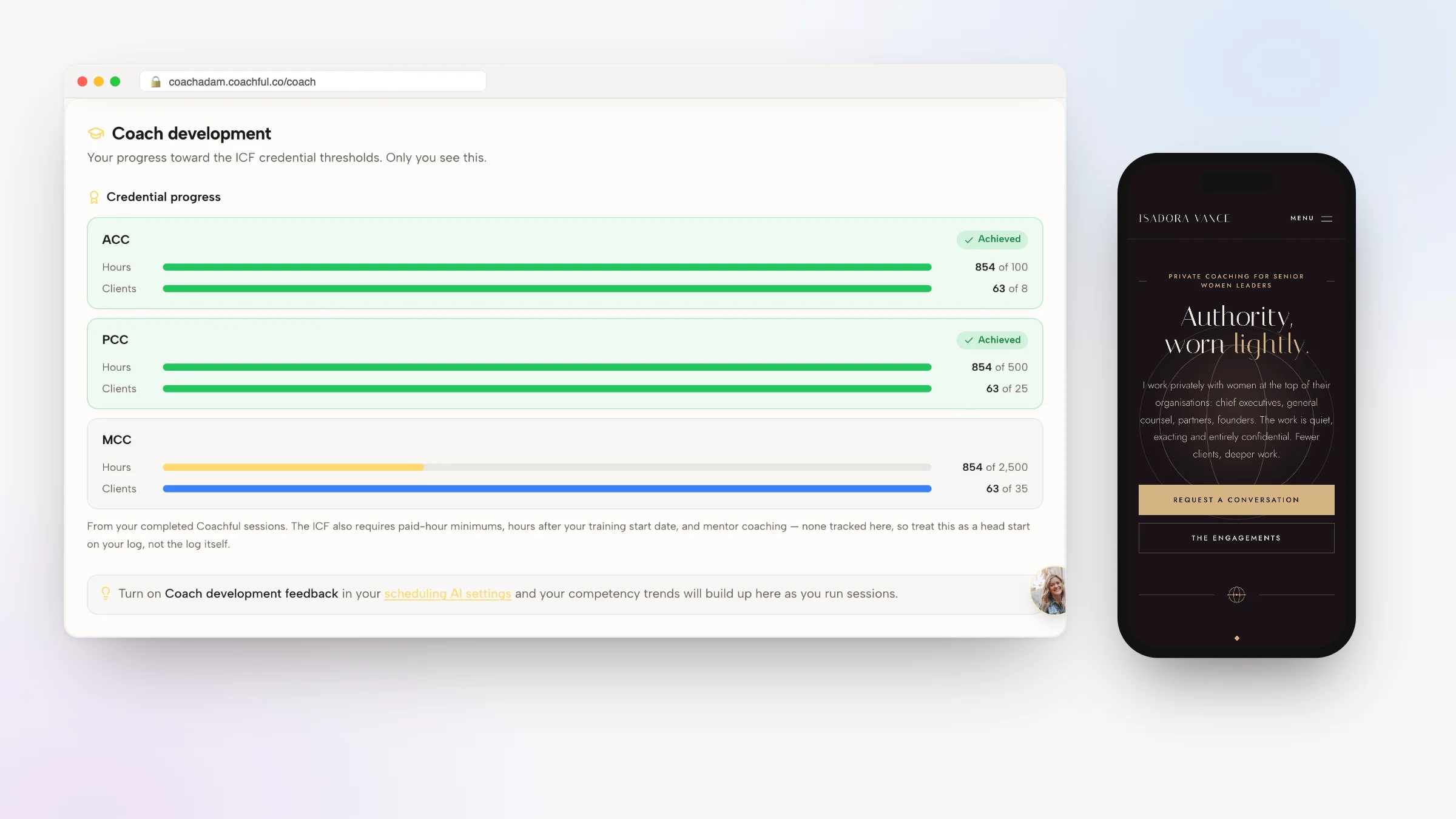
For your own development, coaching hours from completed sessions count toward ICF ACC, PCC and MCC thresholds, and Michelle, Coachful's AI assistant, can give you private feedback on your recorded sessions against ICF Core Competencies 3 to 8 when you turn it on. It's a self-development aid, not an ICF assessment or a substitute for mentor coaching.


See the page for executive coaches, ICF hour tracking and the AI coaching assistant for details.
Get your leadership coaching website built for free
HR buyers often read your website before they meet you. Coachful's team builds coaching websites, offer pages and funnels for free on every plan, inside your account. Coachful is a paid subscription, with a free trial. Choose We'll build it for you · FREE under Create or Fill in a form on the Website page, describe your offers and audience, and add up to 8 links and 10 files. The team replies by email, usually within about 24 hours, and won't invent credentials, client logos or testimonials. Here's what the free build covers.

The bottom line
Leadership coaching skills are coaching skills under organizational pressure. Contract with the leader and the sponsor, turn feedback into one observable goal, listen for the system, challenge with permission, stay steady when emotion runs high, and turn insight into rehearsals and experiments the leader runs at work. Hold confidentiality firmly, measure change with the people who will notice it, and know when a problem belongs to someone else. For the business side of this work, read our siblings on executive coach skills and becoming a leadership coach.
Frequently asked questions
What skills does a leadership coach need?
Core coaching skills (listening, questioning, presence and agreements) plus leadership-specific ones: three-way contracting with sponsors, turning 360 feedback into a goal, challenging senior people, observing leaders at work, designing leadership experiments, holding confidentiality with the organization and measuring change with stakeholders.
How do leadership coaching skills map to the ICF Core Competencies?
Most map directly: contracting and measurement to Competency 3 (agreements), challenge and reframing to Competency 7 (evokes awareness), experiments to Competency 8 (facilitates growth), and confidentiality and referral to Competency 1 (ethical practice). The 2025 update made stakeholders more explicit in agreements.
What is the difference between leadership coaching skills and coaching skills for leaders?
Leadership coaching skills are what a professional coach uses to coach leaders. Coaching skills for leaders are what managers use to coach their own teams: asking before telling, follow-up, feedback. See our coaching tips for managers for the second.
Do I need business experience to be a leadership coach?
It helps you understand the client's world and earns credibility with sponsors, but it isn't required, and it can tempt you to advise instead of coach. Strong coaching skills plus a good understanding of how organizations work matter most.
How do I use 360 feedback in leadership coaching?
Help the leader read it calmly, look for patterns, and choose one or two behaviors to work on. Research suggests feedback alone isn't the active ingredient, so the goal setting and practice that follow matter more than the report.
Which leadership coaching skill is hardest to learn?
Many coaches find challenge hardest, because senior clients are intimidating and challenge can feel rude. It gets easier with permission lines, short observations and practice in supervision or mentor coaching.
Will Coachful build my leadership coaching website for free?
Yes. Coachful's team builds coaching websites, offer pages and funnels for free on every plan, inside your account. Request it from Create or the Website page, and the team replies with next steps, usually within about 24 hours. Coachful is a paid subscription; the build itself costs nothing extra.












