
11 Executive Coach Skills Companies Look For
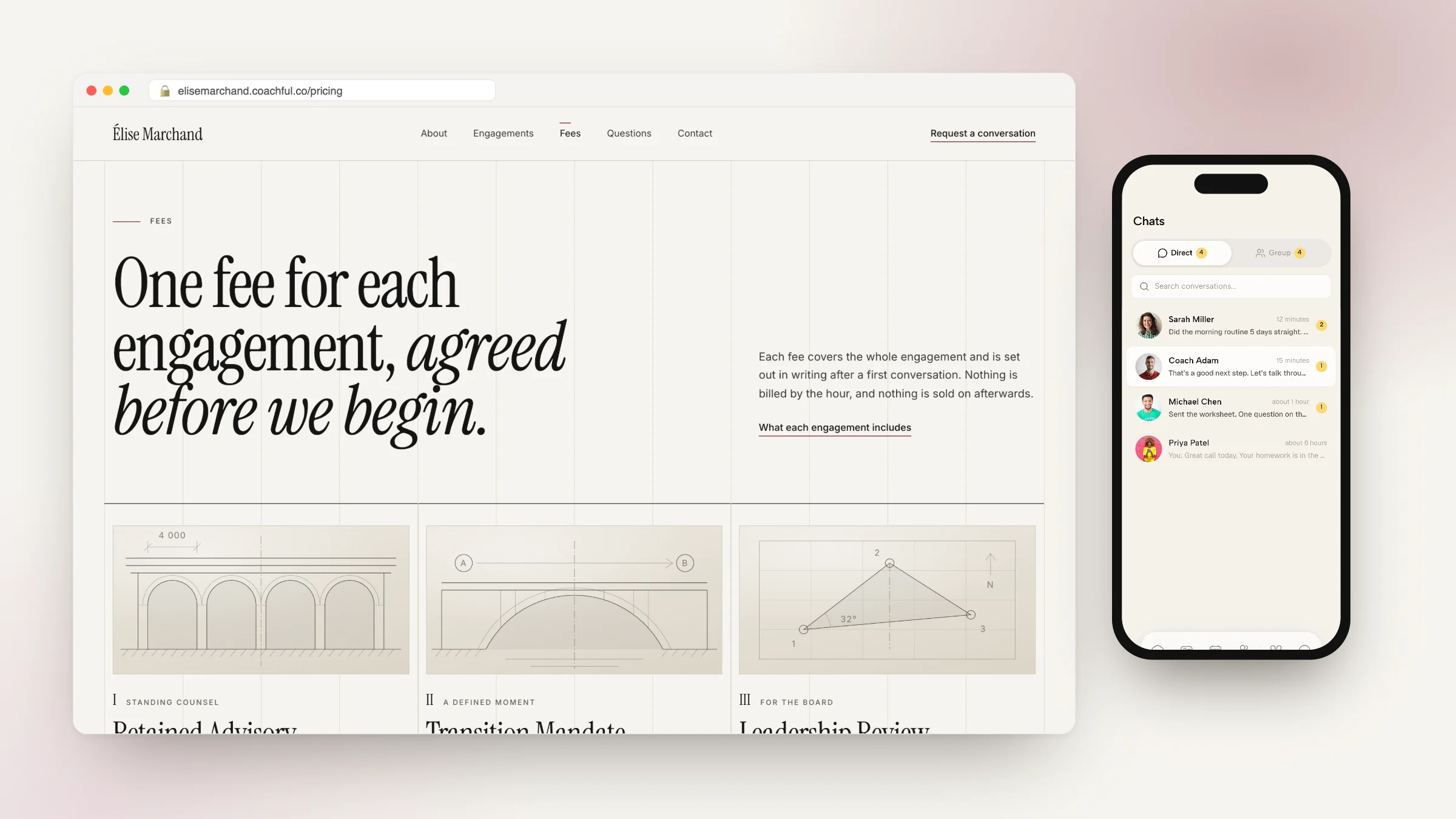
The executive coach skills companies look for go beyond good coaching. Buyers assume you can listen and ask questions; what wins and keeps executive work is business fluency, clean contracting with sponsors, confident use of assessments and stakeholder feedback, steady presence with senior people, firm confidentiality and the ability to show what changed. The eleven skills below are the ones that separate an executive coach from a coach who happens to have executive clients.
Where a skill maps to the 2025 ICF Core Competencies, we say which one. For the in-session craft of coaching leaders, our sibling guide to leadership coaching skills goes deeper; this list leans toward what HR, L&D and the executives themselves judge you on. If you also need a website that senior buyers take seriously, Coachful's team will build it for you for free, which we cover near the end.
The 11 executive coach skills at a glance
| # | Skill | Who judges it | ICF link |
|---|---|---|---|
| 1 | Business fluency | The executive | Supports 6.01 (client context) |
| 2 | A chemistry meeting that answers the real question | The executive | 3.01, 3.05 |
| 3 | Proposals and three-way agreements | HR, procurement | 3.02 to 3.04 |
| 4 | Assessment literacy | HR, the executive | 2.02 |
| 5 | Stakeholder interviews and feedback rounds | The sponsor | 3.04, 6.01 |
| 6 | Presence with senior people | The executive | 5. Maintains Presence |
| 7 | Thinking partnership without consulting | The executive | 1.06, 7.04, 7.11 |
| 8 | Coaching transitions | The executive, HR | 8.02, 8.05 |
| 9 | Confidentiality and ethical judgment | Everyone | 1.05, ICF Code of Ethics |
| 10 | Evaluating and reporting outcomes | The sponsor | 3.08, 8.07 |
| 11 | Reflective practice and supervision | You | 2.03, 2.08 |
1. Business fluency
An executive will test, usually in the first ten minutes, whether you understand their world. You don't need to have run a company, but you do need to read a P&L, follow a strategy discussion, understand what a board does and know how budgets, headcount and performance reviews shape a leader's choices. That's what lets you hear the context the ICF's listening competency describes (6.01), rather than just the words.
What it looks like: a CFO says the board is "nervous about the margin story". You ask whether that's about pricing, cost or how she's presenting it, instead of asking her to explain what a margin is.
How to build it: read the annual reports and earnings calls of the companies your clients work for, learn the vocabulary of the two or three industries you coach most, and ask clients to teach you their business model in the first session. Curiosity reads as credibility; bluffing doesn't.
2. A chemistry meeting that answers the real question
Many executive engagements start with a short "chemistry" meeting, often with two or three coaches being considered. The executive is asking one question: can I trust this person with what I'm really dealing with? The skill is answering it by coaching briefly, not presenting. The 2025 competencies ask coaches to describe their philosophy and what coaching is and isn't (3.01), and to partner with the client to determine compatibility (3.05).
What it looks like: 30 minutes in which you spend five on how you work and twenty asking about the challenge, and finish by saying honestly whether you're the right fit.
How to build it: write a two-sentence description of how you work, then practice short chemistry conversations with peers. Our list of things to know before becoming an executive coach explains why you'll lose some of these whatever you do.
3. Proposals and three-way agreements
Corporate buyers need a document: objectives, approach, timeline, stakeholders involved, what's reported, fees and terms. The coaching agreement then has to work for three parties. The ICF asks coaches to reach agreement on what is and isn't offered, responsibilities, logistics, fees, confidentiality and the inclusion of others, and to partner with "relevant stakeholders" on the coaching plan (3.02 to 3.04).
What it looks like: a two-page proposal HR can forward unchanged to procurement, and an agreement that spells out which progress information the sponsor will see.
How to build it: keep a proposal template and an agreement template, and adapt them rather than starting fresh. See our coaching proposal examples and how to scope assessments in an executive coaching contract.
4. Assessment literacy
Executive coaching often uses personality and leadership assessments and 360-degree feedback. The skill is choosing the right instrument, being properly trained in the ones you use, explaining results without overclaiming, and helping the executive turn data into a goal. The ICF asks coaches to keep learning best practices (2.02); assessment publishers usually require certification before you can administer their tools.
What it looks like: you tell a leader what an assessment can and can't say about them, and connect one finding to a behavior their team would notice.
How to build it: get certified in one personality instrument and one 360 tool, and learn to run qualitative 360 interviews yourself (skill 5). Note that in one workplace coaching meta-analysis, coaching that used multisource feedback had smaller effects than coaching without it (Jones, Woods and Guillaume, 2016), so treat feedback as a starting point, not the intervention.
5. Stakeholder interviews and feedback rounds
Interviewing six to eight people around an executive gives you richer data than any survey, and builds the stakeholders' investment in the change. The skill is asking the same short set of questions, protecting anonymity, finding themes and presenting them so the executive can hear them. Later, a brief follow-up round shows whether anyone noticed a change.
What it looks like: three questions per stakeholder (what should they keep doing, what should they do more of, what one change would make the biggest difference) and a one-page themes summary.
How to build it: script your interview, decide your anonymity rules in advance, and practice summarizing without quoting anyone identifiably.
6. Presence with senior people
Executives are used to people who defer, rush or perform. The ICF's presence competency asks for a style that is "open, flexible, grounded and confident", including being "comfortable working in a space of not knowing" and allowing silence (5.06, 5.07). With senior clients that translates into being unhurried, concise and willing to hold a pause without filling it.
What it looks like: a CEO tests you with a sharp "So what would you do?" You answer, "I'll share a thought if it helps. First, what are you leaning toward?"
How to build it: record sessions with consent and notice where you rush. Our guide to silence in coaching helps.
7. Thinking partnership without consulting
Executives often want a sparring partner on strategy and decisions. The skill is offering perspective without taking over the decision, and knowing when the engagement has drifted into consulting. The ICF asks coaches to maintain the distinctions between coaching and consulting (1.06), to ask questions that help the client "explore beyond current thinking" (7.04) and to share observations "without attachment" (7.11).
What it looks like: before a reorganization decision, you help the executive list the assumptions behind each option and who needs to be consulted, and ask what would change her mind. The decision stays hers.
How to build it: label your input when you give it ("This is a perspective, not a recommendation"), and if a client needs expert advice, say so and suggest where to get it.

8. Coaching transitions
A large share of executive coaching happens at transitions: a promotion, a new company, a merger, a first board role. The skill is helping the executive diagnose the new situation, decide who to meet first, secure early wins and set expectations with their new manager. Michael Watkins's The First 90 Days (2003) is the classic reference.
What it looks like: a 90-day plan with three phases (learn, contribute, lead), a stakeholder map and the conversations to hold in the first month.
How to build it: build a transition template you can adapt, and learn the specific traps of the transitions your clients make, such as peer to boss, or function head to general manager.
9. Confidentiality and ethical judgment
Executive coaching is full of pressure on confidentiality: a sponsor asking for an off-the-record view, two clients in the same company, a leader who reveals something the organization would want to know. The ICF Code of Ethics asks coaches to "maintain the strictest level of confidentiality with all parties involved" and to agree in advance what may need to be disclosed and to whom, such as in cases of illegal activity or risk of harm. The competencies add confidentiality "per stakeholder agreements and pertinent laws" (1.05).
What it looks like: you decline the sponsor's off-the-record question and offer a three-way meeting instead, and you disclose any conflict of interest before taking a second client in the same team.
How to build it: read the ICF Code of Ethics once a year, write your confidentiality rules into every agreement, and take dilemmas to supervision. Our guide to the coaching code of ethics covers common cases.
10. Evaluating and reporting outcomes
Sponsors want to know it worked. The skill is agreeing measures at the start, collecting evidence without breaching confidentiality, and reporting honestly, including what didn't change. The ICF asks coaches to partner with clients to define "measures of success" (3.08) and to "sustain progress throughout the coaching engagement" (8.07).
The research gives you realistic expectations. In a study of 1,361 senior managers, those who worked with a coach improved more in later ratings from their direct reports and supervisors than those who didn't, but the effect was small (Smither and colleagues, 2003, Personnel Psychology). A 2023 meta-analysis of 20 randomized trials found the largest effects of executive coaching on behavior (Nicolau and colleagues, 2023). Measure behavior, not just satisfaction.
What it looks like: a short stakeholder rating at the start and the end, a milestone that matters to the business, and a closing report the executive approves.
How to build it: agree two or three measures in the three-way meeting, and avoid promising ROI multiples you can't support.
11. Reflective practice and supervision
Senior clients bring heavy material: layoffs, scandals, burnout, career-ending decisions. The ICF asks coaches to develop "an ongoing reflective practice" (2.03), to look after their own well-being around sessions (2.07) and to seek "help from outside sources when necessary" (2.08). For executive coaches, that usually means regular supervision or a peer group.
What it looks like: a monthly supervision session where you bring the engagements where you felt pulled by the sponsor, out of your depth or too close to the client.
How to build it: book supervision before you need it. See our guides to coaching supervision and reflective practice.
Which executive coach skills to build first
If you're moving into executive coaching from general coaching, build business fluency, contracting and confidentiality first, because they decide whether you're hired and kept. If you're moving in from a senior corporate career, build presence and thinking partnership first, since the habit of advising is the hardest to unlearn. Credentials matter too: many corporate buyers look for an ICF credential. Our guide to executive coaching certification covers the options, and how to become an executive coach covers the path.
Running an executive coaching practice on Coachful
Several of these skills depend on structure around the sessions. Coachful's Executive Coaching power-up gives each client a workspace with leadership goals, stakeholders, leadership practice (experiments), a decision journal, a first 90 days plan, conversation prep with situation-behavior-impact feedback, and stakeholder check-ins: pick a goal and up to 20 people, and each gets a private, single-use feedback link valid for 30 days. A weekly leadership check-in asks clients for a leadership win, an experiment update and their energy.
- Intake and discovery calls tracked in one list, so chemistry meetings don't live in your inbox.
- Agreements sent for e-signature before the first session and stored on the client record.
- Session notes with a running summary the executive can read.
- ICF hours from completed sessions counted against ACC, PCC and MCC thresholds, as a head start on your log.
- Payments into your own Stripe account, with invoices for company-paid engagements.


See the Coachful page for executive coaches and our executive coaching rates guide for pricing your engagements.
Have your executive coaching website built for free
Senior buyers and HR teams read your site before they meet you. Coachful's team builds coaching websites, offer pages and funnels for free on every plan, inside your account; Coachful itself is a paid subscription, with a free trial. Click Fill in a form on the "Want us to build it for you?" card on the Website page, or choose We'll build it for you · FREE under Create. Describe the pages you want and what visitors should do next, and add up to 8 links and 10 files. The team replies by email, usually within about 24 hours, and won't invent credentials, client logos or testimonials. See what the free build covers.


The bottom line
Executive coaching rewards coaches who can work in the executive's world and the organization's at the same time. Learn the business, win the chemistry meeting by coaching, write agreements that work for three parties, use assessments and stakeholder feedback carefully, stay present with senior people, partner on thinking without consulting, guide transitions, guard confidentiality, measure behavior change honestly and get supervision for yourself. Those skills, more than any single framework, are what companies buy.
Frequently asked questions
What skills does an executive coach need?
Core coaching skills plus business fluency, contracting with sponsors, assessment and 360 literacy, stakeholder interviewing, presence with senior leaders, thinking partnership without consulting, transition coaching, strict confidentiality, outcome evaluation and reflective practice with supervision.
Do executive coaches need corporate experience?
Not necessarily, but they need business fluency: reading financials, understanding strategy and how organizations make decisions. Senior corporate experience helps credibility, though it can tempt coaches to advise rather than coach.
What certifications do executive coaches need?
None is legally required, but many corporate buyers look for an ICF credential (ACC, PCC or MCC), and assessment publishers usually require certification to use their instruments. See our guide to executive coaching certification.
How is an executive coach different from a leadership coach?
Executive coaches usually work with senior leaders, are often paid by the organization and manage more stakeholder and confidentiality complexity. Leadership coaches cover a wider range of managers. The core coaching skills overlap heavily.
What is a chemistry meeting in executive coaching?
A short first meeting where the executive, and sometimes HR, decides whether to work with you, often after meeting more than one coach. Coach briefly rather than presenting, and say honestly whether you're a fit.
How do executive coaches measure results?
Usually with goals agreed at the start, a short stakeholder rating before and after, and progress on a business milestone. Report what changed, including what didn't, and agree with the executive what the sponsor sees.
Will Coachful build my executive coaching website for free?
Yes. Coachful's team builds coaching websites, offer pages and funnels for free on every plan, inside your account. Request it from the Website page or Create, and the team replies with next steps, usually within about 24 hours. Coachful is a paid subscription; the build itself costs nothing extra.












