
9 Things to Know Before Becoming an Executive Coach
The things to know before becoming an executive coach are mostly about the company around the executive: there are usually two clients with different agendas, the sale runs through HR or procurement and takes months, fees are large but arrive in lumps, and you'll be asked to show the coaching worked. The coaching conversations are the best part of the job. The rest is a business-to-business sale, and people who come from senior roles often underestimate how different selling a service is from running a function.
These are the realities behind our step-by-step guide on how to become an executive coach, which covers training, ICF credentials, hours and the executive coaching toolkit. When you need a site that HR will take seriously, Coachful's team will build it for free on every plan (item 9).
The 9 things at a glance
| # | What to know | The practical consequence |
|---|---|---|
| 1 | Two clients, not always one agenda | Agree goals with both before session one |
| 2 | The chemistry meeting is an interview you'll often lose | Prepare for it like a pitch, run it like a session |
| 3 | Corporate buying is slow and procedural | Keep a pipeline of conversations months ahead |
| 4 | Fees are big, lumpy and often paid late | Plan cash flow around contracts, not months |
| 5 | Confidentiality is the product | Write down exactly what the sponsor sees |
| 6 | Executives cancel | Protect cadence in the contract and the format |
| 7 | You'll be asked to prove it worked | Set measures at the start, not the end |
| 8 | Your old title is a door, not a method | Coach training and a credential carry the work |
| 9 | HR reads your website before the executive does | Show structure, credentials and confidentiality clearly |
1. Two clients, not always one agenda
In most executive coaching the company pays and the executive is coached. Usually both want the same thing: a stronger leader. Sometimes they don't. A sponsor may quietly want "fix how she runs meetings or we'll move her," while the executive believes she's been offered a development perk. Or the executive wants help deciding whether to leave, which is the one outcome the sponsor is paying to avoid.
The ICF Code of Ethics asks coaches to explain the nature of coaching to clients and sponsors before it begins, to agree roles, confidentiality and finances, and to discuss the implications of multiple relationships and possible conflicts (ICF Code of Ethics). In practice that means a three-way conversation at the start where the goals are said out loud, written down and agreed by both.
What to do: ask the sponsor directly whether this is development or a performance concern, and say how you'll handle it if those turn out to be different. Our guide to stakeholder alignment meetings has an agenda, and our summary of the coaching code of ethics covers the conflict standards.
2. The chemistry meeting is an interview you'll often lose
Many companies shortlist two or three coaches and let the executive choose after a short "chemistry" call with each. It's usually short and unpaid, and the executive is judging one thing: can I think out loud with this person? New executive coaches tend to treat it as a credentials presentation and lose to someone who asked better questions.
You will lose some of these regardless. Fit is personal, and a leader may simply want someone with a different background. That's healthy. It does mean your pipeline needs more chemistry calls than you have slots.
What to do: spend two minutes on your background and the rest coaching a real (small) issue the executive brings, so they feel the work. Ask what they'd want to be different in six months and what's been tried. Follow up the same day with a short note. If you lose, ask the HR contact for one line of feedback; most will give it.
3. Corporate buying is slow and procedural
Coachful's 2026 Coaching Business Report compares consumer and corporate coaching side by side. Consumer sales cycles run one to three weeks; corporate ones run one to six months. The decision-maker is HR, L&D or the executive team rather than the person being coached, and credentialing is "often mandatory" rather than preferred. The main channels are LinkedIn, events and referrals.
What that looks like on the ground: a promising conversation in February, a proposal in March, vendor forms in April (insurance certificates, data protection questions, bank details), a purchase order in May and a first session in June. Nothing went wrong. That's just how organizations buy.
What to do: keep enough conversations going that a slow quarter doesn't empty your calendar, and prepare the paperwork once (insurance, a data and confidentiality summary, standard terms) so you're quick when a buyer is ready. Our guide to billing company-funded coaching covers the invoicing side, and scoping employer-funded work covers the contract.
4. Fees are big, lumpy and often paid late
Executive coaching pays well. Coachful's report puts executive coaches at $200 to $500 an hour (ICF Global Coaching Study 2025 and PayScale) and $96,000 to $98,000 a year (ICF 2025, PayScale, Salary.com), with corporate contracts typically running 6 to 12 months and $10,000 to $50,000 per executive (ICF 2025). A six-month contract with assessments and messaging comes in at $8,000 to $20,000 in practitioner reports.
The catch is timing. A practice with five engagements is doing well, but it's five invoices, each tied to a purchase order and a company's payment run. One contract ending without a renewal is a fifth of your income. Many companies pay on terms after the invoice rather than at booking, so a strong month on paper can be a thin month in your bank account.
What to do: invoice on a fixed schedule written into the contract (for example, half at the start and half at the midpoint), keep several months of expenses in reserve, and start renewal conversations well before the final session. Our executive coach salary guide models income by engagement count, and executive coaching rates breaks down pricing models.

5. Confidentiality is the product
Senior leaders often have no one inside the company they can be fully honest with. Their boss evaluates them, their peers compete with them and their team watches them. A coach may be the only person they can say "I don't know what I'm doing with this" to. If they suspect anything goes back to HR, the coaching becomes performance theater.
Sponsors still need something: are sessions happening, is the work on track? The usual answer is that the sponsor sees attendance and themes the executive has agreed to share, never session content, and any three-way update happens with the executive in the room.
What to do: put the information rules in the contract in one plain paragraph, repeat them in the first session, and stick to them even when a friendly HR partner asks "how's it going, really?" over coffee. Agree in advance, as the ICF code expects, what you would have to disclose (such as risk of harm or illegal activity).

6. Executives cancel
Your clients run budgets, boards and crises. A session gets moved because of a board meeting, then because of a site visit, and suddenly a twelve-session engagement has had four sessions in five months. The coaching loses momentum and the sponsor starts asking why progress is slow.
This is normal and fixable. Experienced executive coaches design for it: shorter sessions when weeks are heavy, a standing slot booked months ahead, a rule in the contract about late cancellations, and light contact in between so the thread doesn't break.
What to do: book the whole engagement's sessions at the start, use calendar sync so their assistant sees the slots, and offer a 30-minute "keep it moving" format for crunch weeks. Coachful's scheduling handles booking pages, two-way Google, Apple and Outlook calendar sync and email, SMS or WhatsApp reminders once messaging is enabled.

7. You'll be asked to prove it worked
At renewal, someone in HR will ask what the company got. Coachful's report cites ICF research for the figure that 86 percent of organizations report a positive return from coaching, but your buyer wants evidence about this executive, not the industry. "She feels more confident" won't survive a budget review. A line like "her team rated her delegation 2.8 out of 5 in month one and 4.1 in month six" (an invented example) will.
The trap is waiting until the end to think about measurement. If you didn't agree the measures at the start, you have nothing to compare against.
What to do: in the first month, agree two or three observable behaviors with the executive and sponsor, ask a handful of stakeholders to rate them, and repeat the same questions at the midpoint and the end. Keep evidence as you go: decisions made, conversations held, feedback received. In Coachful, the Executive Coaching power-up keeps goals, stakeholders, decisions, a first-90-days plan, impact evidence and stakeholder check-ins (with the client's consent) together with the client. Our list of executive coaching tools covers assessments and 360s.
8. Your old title is a door, not a method
The report rates executive coaching as very high on income, low to medium on saturation and high on difficulty to enter, summed up as "needs demonstrable credibility." Former executives have that credibility, and it gets them meetings. It doesn't make them good coaches. The pull for a former COO is to tell a new COO how they'd do it, which helps for a session and then creates dependence.
Credentials help bridge the gap with buyers. The report puts the average income of ICF PCC holders at $78,000, 50 percent above coaches without a credential, and calls the PCC "the level most corporate buyers treat as the working standard" (ICF 2025, as compiled). Rates also climb with experience: from $150 to $250 an hour for newer executive coaches to $250 to $500 for experienced ones and $500 to $1,500 at the top (ICF 2025 and practitioner estimates).
What to do: train properly, aim for the PCC education hours from the start, and log every session so the 500 hours don't become a reconstruction project. Our executive coaching certification guide compares programs, and Coachful counts completed hours and clients against the ICF thresholds as you go (see ICF hour tracking).

9. HR reads your website before the executive does
When an L&D lead is building a shortlist, they look at your site for a few specific things: who you coach, how an engagement is structured, your credentials, how confidentiality works, and whether you look like someone they can put in front of a vice president. A site that reads like a life coaching page, all feelings and no structure, gets skipped.
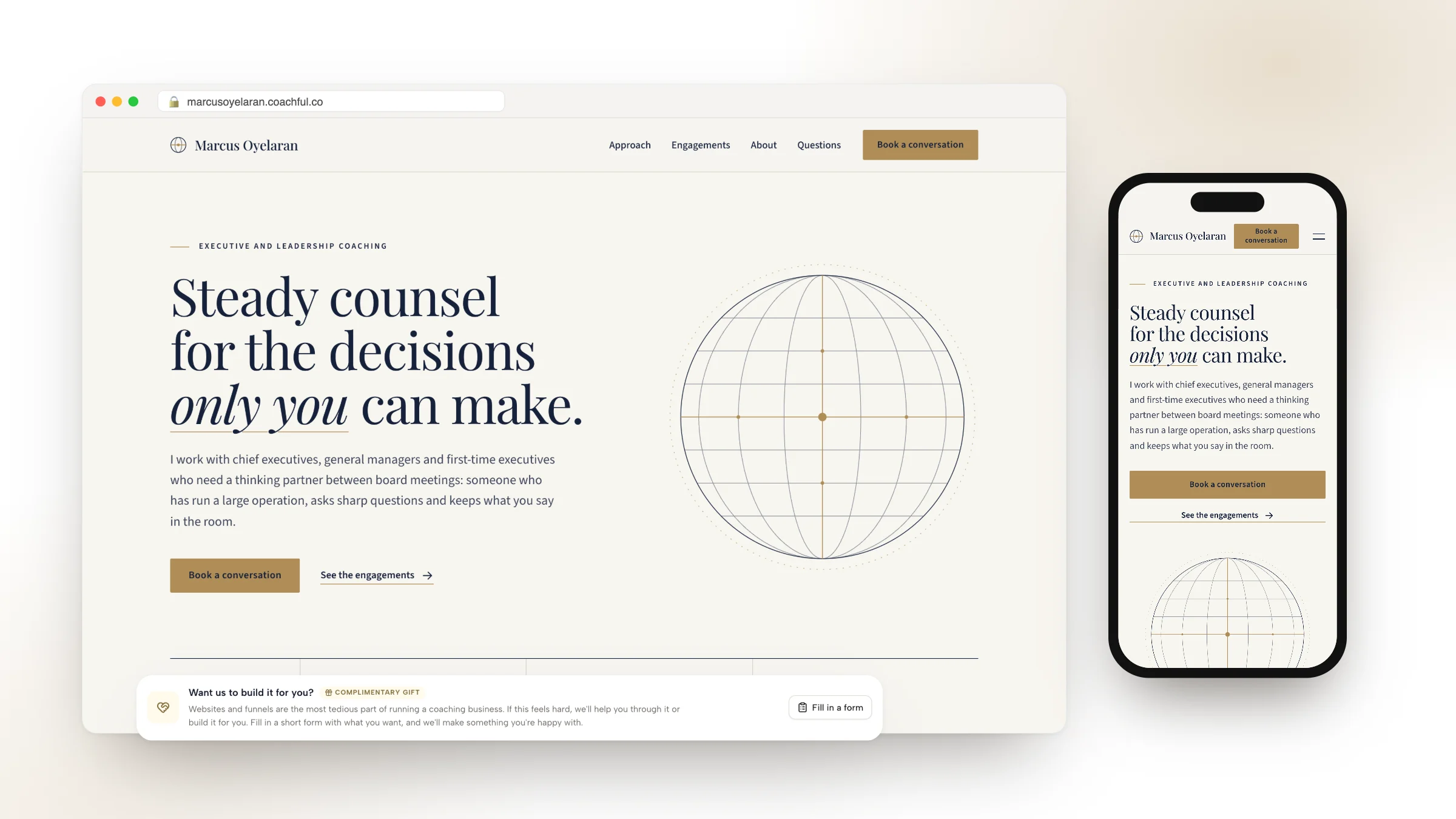
What to do: give the buyer what they're scanning for. One clear audience line, an "Engagements" page with length, format and what's included, a short note on confidentiality and reporting, your credentials, and one way to book a conversation. The Coachful page for executive coaches shows the practice setup behind it.
Have it built for free
Coachful's team builds coaching websites and engagement pages for free on every plan, inside your account. Coachful itself is a paid subscription with a free trial. Open Website, click Fill in a form on the "Want us to build it for you?" card, and describe the pages and what a visitor should do next. Add up to 8 links and 10 files, such as your bio and an engagement outline. A recent example: a leadership coach whose website renewal was days away got one clean, mobile-friendly homepage with a repeated "talk with me" button. The team replies by email, usually within about 24 hours (typical, not guaranteed), and invents nothing: no credentials, client logos or testimonials you don't have. See everything the free build covers.


The bottom line
Executive coaching is one of the best-paid corners of the profession because it's sold to organizations, and that's also what makes it hard. Expect two agendas to reconcile, slow procurement, lumpy cash, cancellations and a renewal meeting where you'll need evidence. Expect too that your seniority opens doors and your coaching skill keeps them open. Before you go further, read the companion pieces on executive coach skills and getting executive coaching clients.
Frequently asked questions
What should I know before becoming an executive coach?
Know that the company usually pays and the executive is coached, so you'll agree goals and confidentiality with both; that corporate sales take one to six months; and that buyers often require a credential. Expect to show evidence of progress at renewal.
Do you need to have been an executive to be an executive coach?
No, but you need credibility another way: deep experience in leadership development or HR, a narrow specialism, strong credentials, or results with leaders at that level. Former executives get meetings more easily but still need coach training to avoid simply advising.
How much do executive coaches make?
Coachful's 2026 report puts executive coaches at $200 to $500 an hour (ICF 2025 and PayScale) and $96,000 to $98,000 a year (ICF 2025, PayScale, Salary.com). Corporate engagements typically run $10,000 to $50,000 per executive over 6 to 12 months.
Is executive coaching hard to get into?
It's one of the harder coaching niches to enter. The report rates difficulty as high, noting that the niche "needs demonstrable credibility," and corporate buyers often make an ICF credential a condition of hiring. Competition is lower than in life or health coaching, though.
What credential do companies expect from an executive coach?
Many treat the ICF PCC as the working standard, according to the report, with the ACC as the entry rung and the EMCC as a common equivalent in Europe. Some buyers also expect certification in the assessments you use.
What does an executive coach report back to the company?
Usually attendance, agreed goals and themes the executive has chosen to share, not session content. The rules should be written into the contract and agreed by both the executive and the sponsor before coaching starts.
Will Coachful build my executive coaching website for free?
Yes. Coachful's team builds executive coaching websites and engagement pages for free on every plan, inside your own account. Coachful is a paid subscription; the build costs nothing extra. The team replies with next steps, usually within about 24 hours.












