
Executive Coach Salary in 2026: What Executive Coaches Earn
The typical executive coach salary in 2026 is $96,000 to $98,000 a year, according to the ICF Global Coaching Study 2025, PayScale and Salary.com as compiled in Coachful's 2026 Coaching Business Report. Executive coaches typically bill $200 to $500 an hour, and companies usually buy them by the engagement: $10,000 to $50,000 per executive coached, over six to twelve months.
That narrow salary band and that wide engagement range describe two different jobs. The first is mostly employed and internal coaches, the people salary aggregators see. The second is independent coaches selling engagements to companies, whose income depends on how many contracts they close in a year. This guide separates the two, shows the government figures for nearby corporate roles, and does the engagements-times-fee arithmetic so you can estimate your own number.
One cost you don't need to carry while you build that pipeline: Coachful's team builds your executive coaching website and engagements page for free on every plan.
Executive coach salary, by source
| Figure | Amount | Source | What it measures |
|---|---|---|---|
| Executive coach, yearly | $96,000 to $98,000 | ICF Global Coaching Study 2025, PayScale, Salary.com | Mostly salaried and self-reported pay |
| Executive coach, hourly rate | $200 to $500 | ICF 2025, PayScale | The billed rate, not hourly take-home |
| Senior coaches billing organizations | $300 to $800 an hour | ICF 2025 | Corporate engagements with senior leaders |
| Per executive coached | $10,000 to $50,000 | ICF 2025 | A whole engagement, usually 6 to 12 months |
| Enterprise programs | $50,000 to $500,000+ | ICF 2025 | Organization-wide coaching contracts |
All figures compiled in Coachful's 2026 Coaching Business Report for Q2 2026, US dollars, before tax and costs. More on the executive coaching rates page.
The report explains why executive work sits at the top of coaching pay in one line: it is "sold to companies rather than individuals, so the fee is measured against an executive's salary and not a household budget." It rates the niche's income potential as very high and its saturation as low to medium, with a high barrier to entry: buyers want "demonstrable credibility."

Internal, external or associate: three ways the money arrives
Executive coaches are paid in three main ways, and each has a different ceiling.
- Internal coach. The ICF's Code of Ethics defines one as an individual employed within an organization who coaches its employees, part time or full time. Pay is a salary, usually with benefits. It's the steadiest of the three, and the one the $96,000 to $98,000 band most likely reflects.
- External coach. In the ICF's words, a coach hired from outside the organization to coach its employees. Usually self-employed, selling engagements directly to companies. No salary; revenue is engagements times fee, minus costs and tax. The range is far wider in both directions.
- Associate coach. Self-employed, but taking engagements from a coaching firm that wins the corporate contract and pays you a share of the fee. Less selling, a lower cut. Firms set their own associate rates, and we couldn't find published figures we'd trust, so we haven't quoted any.
Some coaches move through all three: internal or associate work while logging hours toward a credential, then direct engagements once referrals start coming in. Our guide on how to become an executive coach covers that route, and the sibling piece on executive coaching certification compares the training.
Why the salary band is narrow and the income range is wide
A $2,000 spread for a whole profession looks oddly precise. It comes from salary aggregators, which report what people with that job title say they earn or what job postings offer. Coachful's notes on the sources flag that PayScale skews toward employed and hybrid coaches, and that posted-role data under-represents self-employed income.
The report's profession-wide bands show what's hidden behind it. Across all coaching, the top 10 percent earn $160,000 to $500,000, a band it labels "premium positioning, B2B clients," and the top 1 percent $500,000 to $1,000,000 or more, labelled "executive or enterprise focus." Those bands come from the ICF 2025 study, PayScale and practitioner estimates. The report ties the very top of that range to executive and enterprise work. It's also the niche where an independent coach with no contracts earns nothing at all.
Region matters too. North American coaches across all niches sit at $80,000 to $120,000 in the report's regional bands, the highest of any region, because the corporate coaching market there is the deepest.

Engagements times fee: an executive coach's income table
For an external coach, the salary question is how many engagements you close a year and at what fee. The table uses three fees inside the report's $10,000 to $50,000 range per executive. These are worked examples, not measured incomes.
| Engagements a year | At $10,000 each | At $20,000 each | At $35,000 each |
|---|---|---|---|
| 4 | $40,000 | $80,000 | $140,000 |
| 8 | $80,000 | $160,000 | $280,000 |
| 12 | $120,000 | $240,000 | $420,000 |
Our arithmetic: engagements times fee, revenue before costs and tax.
Two checks keep the table honest. First, capacity. The report's typical six-month contract is 12 sessions of 60 to 90 minutes, so eight engagements is about 96 sessions a year, roughly two a week, plus stakeholder meetings, assessments and messaging. That's a sane load. The limit on the bottom-right cell is rarely hours. It's winning twelve contracts at $35,000 in a year, which leans heavily on referrals and renewals.
Second, the sales cycle. The report puts corporate sales cycles at one to six months, against one to three weeks for individual clients, with HR, learning and development or the executive team making the decision. An external coach who wants eight engagements a year needs proposals in motion all the time, which is why the first year is often thin even for experienced leaders.
Renewals ease both problems. The report estimates corporate renewal likelihood at 55 to 65 percent, against 35 to 50 percent for individual clients. A renewed engagement costs no selling time, so a practice of eight engagements where five renew needs only three new contracts the following year.
The packages behind those fees, from a three-month leadership sprint at $3,000 to $8,000 to an annual retainer at $20,000 to $80,000, are set out in our guide to executive coaching rates, and the buyer's side is in how much executive coaching costs.

The hours nobody bills
An hourly rate of $400 doesn't mean $400 an hour of pay. Around every paid session, an external executive coach carries:
- Proposals, chemistry meetings and sponsor calls that may not turn into a contract.
- Stakeholder interviews, 360 feedback and assessment debriefs, which are sometimes billed and often bundled.
- Session preparation and notes, written for the coach and sometimes summarized for the sponsor within what confidentiality allows.
- Supervision or mentor coaching, continuing education and credential renewal.
- Invoicing, contracts and chasing late payment from accounts payable.
Before tax, the IRS sets self-employment tax at 15.3% of net earnings for Social Security and Medicare, which an internal coach shares with their employer. Add insurance, assessment licenses and travel. Our startup budget for a coaching business lists the lines.
What the BLS shows for nearby corporate roles
The BLS doesn't track executive coaches. Two corporate occupations sit close by, and both are useful context for an internal coach's salary or for someone leaving a corporate job to coach. Neither is an executive coach salary.
| Adjacent occupation (not a coach salary) | Median pay, May 2025 | Jobs, 2025 | Outlook, 2025 to 2035 | Worth knowing |
|---|---|---|---|---|
| Training and development managers | $133,000 | About 50,200 | 6% growth | Typically a bachelor's degree and 5 or more years of related experience |
| Management analysts | $101,860 | About 1,077,100 | 10% growth | 14% are self-employed |
Source: BLS Occupational Outlook Handbook pages for training and development managers and management analysts, fetched October 2026. Neither page mentions coaching.
If you're a leader earning more than $133,000 today, the table makes a practical point: replacing that salary from engagements at $20,000 each takes seven contracts a year, before costs and tax. Plenty of executive coaches build to that over two or three years while doing associate or internal work, rather than leaving a salary on a Friday and starting cold on Monday.

Where an executive coach's pay rises
- The credential. Across all coaching, the ICF 2025 study as compiled in the report puts ICF PCC holders at $78,000 on average, 50 percent more than coaches with no credential, and MCC holders at $95,000, 83 percent more. The report describes the PCC as the level most corporate buyers treat as the working standard, and credentials as often mandatory in corporate coaching. Our comparison of ICF ACC, PCC and MCC covers the hours each needs.
- Seniority of the client. The practitioner estimates for executive coaching run from $150 to $250 an hour for newer coaches to $250 to $500 for experienced ones and $500 to $1,500 at the top. The largest jumps come from coaching more senior leaders, not from charging the same leaders more.
- Your own background. The report's background-to-niche framework pairs corporate leadership or management experience with executive coaching. A buyer who has watched you run a business unit asks fewer questions about your fee.
- Retainers. An annual retainer at $20,000 to $80,000 replaces the need to resell a client twice a year.
The sibling guides to business coach salary and career coach salary show how these numbers compare with neighboring niches.

Running an executive coaching practice on Coachful
A Coachful membership includes the commercial and delivery side of an engagement in one account:
- Agreements sent for e-signature before the first session and stored on the client record, so scope and confidentiality are settled in writing.
- Payments and invoices for one-time fees, instalments and monthly retainers through your own Stripe or Razorpay account, with a 0% Coachful platform fee, plus manual invoices for a company's accounts team.
- Session notes and recorded-session summaries on each client's record, with a client-facing version you approve.
- ICF hour tracking that counts completed sessions toward the ACC, PCC and MCC thresholds and exports a client coaching log. See ICF hour tracking.
- A team workspace on the Pro plan, for coaches who bring in associates and want to see each coach's caseload.
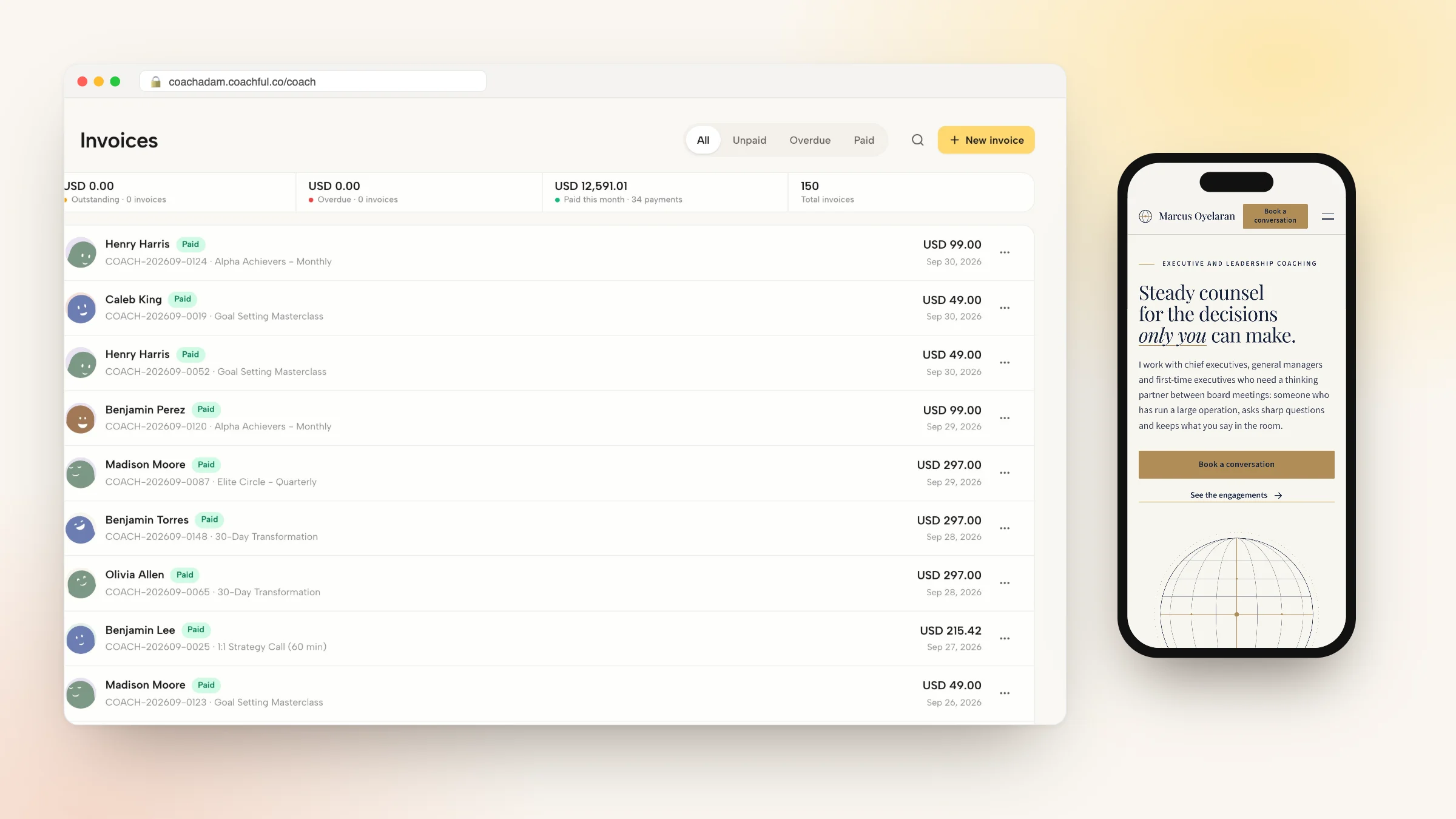
The Coachful page for executive coaches shows the setup. You also don't have to build the website that goes into every proposal. Coachful's team builds your website and engagements page for free on every plan, inside your own account; Coachful itself is a paid membership with a free trial to start. Choose We'll build it for you · FREE under Create, or Fill in a form on the Website page, and say which pages you want, what they should do and which sites you like.

The team replies by email with next steps, usually within about 24 hours, which is typical rather than guaranteed. A leadership coach whose Squarespace renewal was days away recently got one clean, mobile-friendly homepage with a repeated "talk with me" button. Nothing gets invented: no client logos, credentials or testimonials you don't have. See everything the free build covers.
Frequently asked questions
How much do executive coaches make a year?
Coachful's 2026 Coaching Business Report puts executive coaches at $96,000 to $98,000 a year, from the ICF Global Coaching Study 2025, PayScale and Salary.com. That band leans toward salaried coaches. Independent coaches selling engagements to companies can earn well below it in a slow year or several times it with a full book.
How much do executive coaches charge per hour?
Typically $200 to $500, with senior coaches billing organizations $300 to $800 and the top of the field $500 to $1,500, according to the report. Most executive coaching is sold as an engagement, so the per-executive fee of $10,000 to $50,000 is the number that drives income.
What is the difference between an internal and an external executive coach's pay?
An internal coach is an employee on a salary with benefits, which is what the $96,000 to $98,000 band mostly reflects. An external coach is self-employed and earns engagements times fee, minus costs and the 15.3 percent self-employment tax. External income varies far more, in both directions.
How many clients does an executive coach need to make $200,000?
Ten engagements a year at $20,000 each, or six at $35,000, before costs and tax. With six-month contracts, ten engagements a year means about five executives in coaching at any one time, plus a steady pipeline, because corporate sales cycles run one to six months.
Do ICF-credentialed executive coaches earn more?
On average, yes. Across all coaching, the ICF 2025 study puts PCC holders at $78,000 and MCC holders at $95,000, against lower averages for uncredentialed coaches. Corporate buyers often require a credential, so it also decides which contracts you can bid for.
Is executive coaching a good career financially?
It's the highest-paying coaching niche in the report, with very high income potential and low to medium saturation. It's also the hardest to enter, because buyers want demonstrable credibility. Coaches who do well usually bring years of leadership experience, a PCC and a network that refers them.
Will Coachful build my executive coaching website for free?
Yes. Coachful's team builds executive coaching websites and engagements pages for free on every plan, inside your account, usually within about 24 hours. Coachful is a paid membership; the build costs nothing extra.












