High Ticket Coaching: How to Design, Price and Sell It
High ticket coaching is a premium coaching offer, usually a program of three to twelve months, priced well above single sessions because it promises a bigger, more specific result and wraps more structure, access and accountability around it than a pack of calls. It works when your clients have an expensive problem, you have a clear path to solve it, and you can deliver that path well to a small number of people. It fails when the price goes up and nothing else about the offer changes.
This guide covers what high ticket coaching really is, who it suits, how to design and price the offer, how to sell it without pressure tactics, how to deliver it so clients finish and renew, and the mistakes that sink most first attempts. If you would rather build it with a method, a weekly working session and the software around you, that is what the Coachful Collective is for. The short video below explains how the year works.
The Coachful Collective in a few minutes: who it is for, the CLIMB method and how the year works.
What makes coaching high ticket
The price tag is the visible part, and it is the last thing that makes an offer high ticket. Three things carry the price:
- The size of the result. People pay a lot to get from a stalled career to a signed offer, from a burned-out founder to a business that runs on a normal week, from a scary diagnosis to a routine they can keep. They pay very little for "clarity" or "support" with no edges.
- The certainty of the path. A named method with phases, milestones and tools tells the buyer you have walked people down this road before and you know where the potholes are.
- The depth of access and accountability. More help between sessions, faster feedback, a group of people on the same road, and someone who notices when the client goes quiet.
Here is how the three tiers usually differ in practice.
| Low ticket | Mid ticket | High ticket | |
|---|---|---|---|
| What it sells | Information or a single session | A package of sessions | A defined transformation |
| Typical length | A day to a few weeks | Four to twelve weeks | Three to twelve months |
| Delivery | Course, template, workshop | Scheduled calls | Calls plus a program, support between sessions, check-ins and often a community |
| How people buy | A checkout page | A booking page or a short call | An application, then a conversation |
| The buyer's real question | "Is this useful?" | "Is this coach good?" | "Will this get me the result, and can I trust this person with it?" |
| What usually breaks it | Low perceived value | Clients counting sessions | Weak delivery after the sale |
The last row is the one to tape above your desk. A high ticket sale creates a high ticket expectation, and most of the work happens after the payment clears.
Who high ticket coaching suits, and who should wait
You are probably ready for a premium offer when most of these are true:
- You have already helped several people get the result, paid or unpaid, and you can describe what changed for them in plain numbers or events.
- Your client's problem costs them real money, time, health or relationships every month it continues.
- Your clients, or the employers who pay for them, can afford it without hardship. Selling a premium program to someone who would have to borrow money they cannot repay is a fast route to regret, refund requests and a reputation you do not want.
- You can explain your path in five to seven steps without notes.
- You have capacity: calendar space, energy, and a way to support people between sessions without living in your inbox.
Wait, or start smaller, when you are still learning what your clients actually need. A short paid pilot teaches you more than a polished sales page (our guide to validating a niche with a paid pilot walks through one). Wait too if nobody knows you exist yet. A premium offer sits on top of attention and trust, which is why the CLIMB method puts capturing attention and building trust before any big sale.
How to design a high ticket coaching offer
Design comes before price. A well-built offer makes the price feel obvious; a vague one makes any price feel like a lot. Work through these five building blocks in order. (If you have never written an offer at all, start with our guide to creating a coaching offer people say yes to, then come back for the premium version.)
1. Write the outcome in your client's words
Use this sentence and fill every bracket:
"In [time frame], [who] will [specific result] without [the thing they dread], so they can [the change that matters to them]."
For a career-transition coach it might read: "In six months, mid-career professionals who have outgrown their job will land a role in a new field without starting over at entry level, so they can stop dreading Sunday nights." Notice what is missing: the word "coaching", the number of calls, and any mention of mindset. Those are inputs. Buyers pay for the output.
2. Map the path into phases with visible milestones
Break the journey into three to six phases. Each phase ends with something the client can see or hold. For the same career offer:
- Direction (month 1): values and skills audit, three target roles. Milestone: a one-page target brief.
- Story (month 2): CV, LinkedIn profile and a 60-second pitch. Milestone: all three published.
- Market (months 3 and 4): a networking plan, applications and interview prep. Milestone: first interviews booked.
- Land (months 5 and 6): offers, negotiation and a plan for the first 90 days in the new role.
Milestones do two jobs. They give the client proof of progress before the big result arrives, and they give you natural checkpoints to review, adjust and, later, to offer a renewal.
3. Choose the delivery mix
Premium clients are buying speed and certainty, so the delivery should remove waiting and guessing. Pick from these components and say exactly how much of each the client gets.
| Component | What it does | How to state it |
|---|---|---|
| Live calls (1:1 or small group) | Decisions, unblocking, accountability | "Two 60-minute calls a month" |
| A program with weekly actions | Keeps momentum between calls | "A weekly plan inside your client app" |
| Support between sessions | Quick feedback on real work | "Message me on weekdays; replies within one business day" |
| Check-ins | An early warning when someone stalls | "A two-minute Friday check-in" |
| Community | Peer proof that the path works | "A private group of people on the same program" |
| Tools and templates | Less blank-page time for the client | "The worksheets, scripts and trackers we use together" |
Be careful with "unlimited access". It sounds generous on the sales page and becomes a trap by month two, when three clients are messaging at 11pm. Clear response times serve clients better than vague promises. Our guide to between-session support boundaries has wording you can borrow.
4. Add proof and a fair risk reversal
Proof can be case notes shared with permission, before-and-after work samples, or simply a precise description of what past clients did and what happened. A risk reversal can be a conditional guarantee (do the work and if it does not help, get a refund), a short satisfaction window, or no guarantee at all but very clear exit terms. The one thing you never do is guarantee an income, a job offer or a health outcome you do not control.
5. Set entry requirements
High ticket offers are applied for, not bought on impulse. Write down who it is for and who it is not for, then build an application that checks the two or three things that predict success: their starting point, their time, and their reason for acting now.
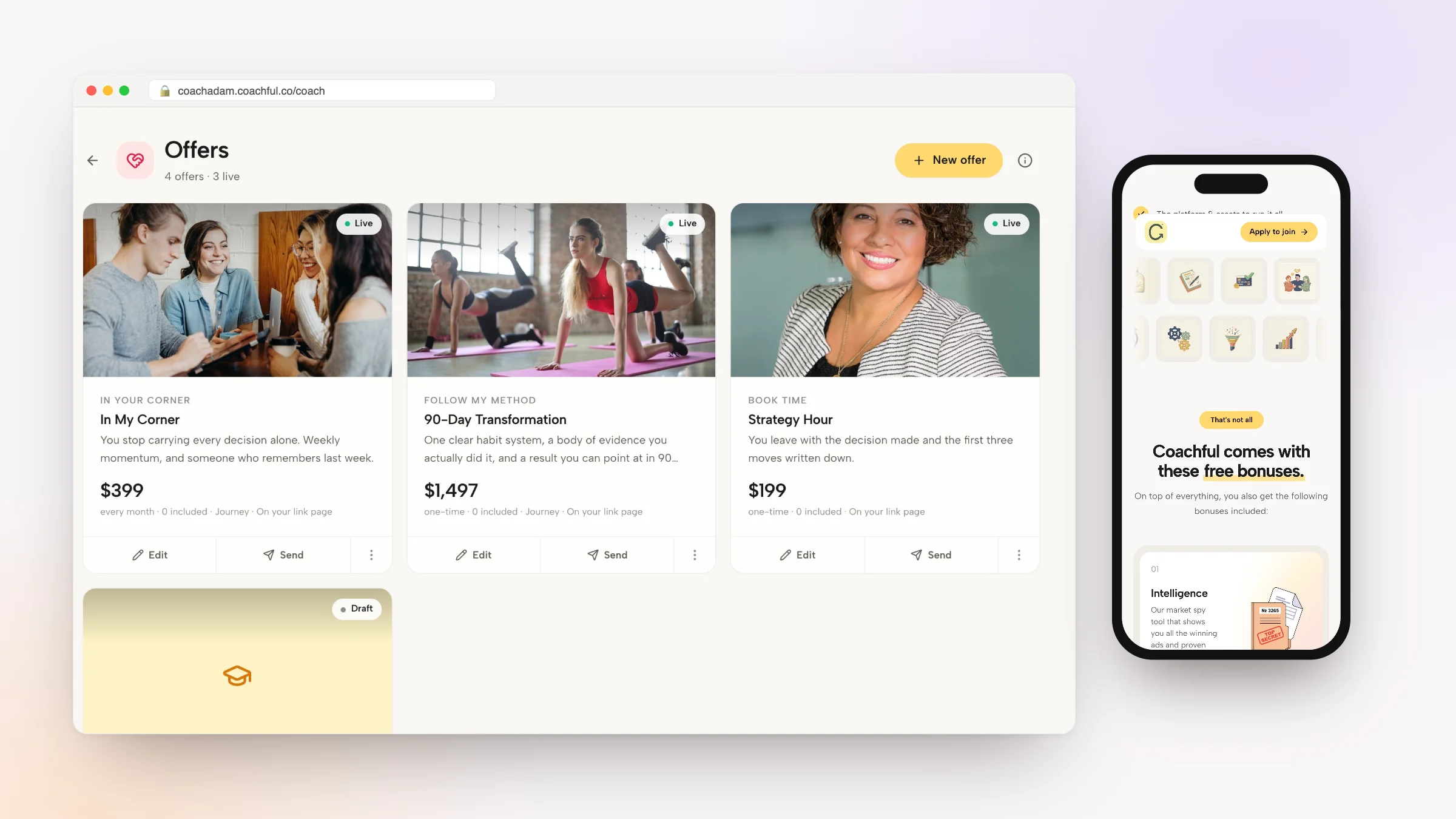
Once the five blocks are written, put them into one offer clients can buy. In Coachful, coaching packages hold the sessions, program and price together, and the Offers page shows every offer at a glance.

How to price high ticket coaching: the structure, not a number
We will not hand you a market rate here. The honest answer depends on your niche, your clients' budgets and the size of the result, and any number we printed would be wrong for most readers. What we can give you is the structure that gets you to a price you can defend on a call.
Step 1: Price the problem
Ask past clients and prospects what the problem costs them over a year: money lost, hours burned, opportunities missed, the health or relationship cost. Write it in their numbers. Your price should be a clear fraction of that figure. When the cost of staying stuck is obviously bigger than the cost of the program, the price conversation gets short.
Step 2: Do the capacity math
Work out the floor below which the offer cannot pay you properly:
Price floor per client = your annual revenue target ÷ the number of clients you can serve well in a year.
Say you can carry 12 clients at once in a six-month program. Each seat turns over twice a year, so you serve 24 clients a year, and your floor is your revenue target divided by 24. If that floor looks far above what your clients can pay, the fix is in the design (group components, a shorter core, a different buyer), not in working more hours.
Step 3: Add the cost of delivering it
Software, an assistant's hours, printed materials, payment processing, and the hours you spend between calls. Premium delivery costs more than a package of sessions, and the price has to carry it.
Step 4: Decide how people can pay
Offer pay in full and a payment plan, and state both plainly before anyone books a call. Some coaches charge a little more in total for the plan to cover the extra admin and risk; others keep the total identical to keep things simple. Either works if it is written down. Our guide to payment plans for high-ticket coaching covers the structures and the risks in detail, and Coachful's payments handle one-time, subscription and payment-plan checkouts on your own Stripe account.
Step 5: Test it in real conversations
Your price is a hypothesis until a few qualified people say yes to it. If almost everyone says yes, you are probably underpriced. If good-fit people keep saying no for money reasons, check the design and the buyer before you discount. Whether to show the price before the call is its own decision; this article weighs both sides.
How to sell high ticket coaching ethically
The usual path is simple: content or a referral, then an application, a conversation, an offer page and a decision. What separates an ethical premium sale from a pushy one is a handful of rules you hold yourself to.
- Say only true things. The ICF Code of Ethics asks coaches to make "verbal and written statements that are true and accurate" about what they offer (standard 5.2). It is a good rule whether or not you are a member.
- No invented scarcity. If you take eight new clients a quarter, say so. Do not run a countdown timer that resets every time someone opens the page.
- No income or outcome guarantees. Describe what past clients did. Never promise what a new one will earn.
- Put money terms in writing before anyone pays. Price, plan, refunds and cancellation belong in the agreement. The same ICF code asks coaches to agree financial arrangements before coaching begins.
- Make "no" easy. Say it out loud on the call: "If this is not the right fit, I'll tell you, and I'll point you somewhere better."
- Do not sell to someone who would be harmed by paying. If a prospect tells you the money is rent, the answer is no, however much they want it.
The call itself has five parts: understand where they are, where they want to be, what is in the way, then recommend (or not), and agree a decision. Our coaching sales script gives you the exact words for each stage, plus the objections and the follow-up emails. For a deeper look at the skill side, see high ticket sales training for coaches.

Behind the call sits a funnel: the page that explains the offer, the application, the booking step and the emails that confirm and remind. A discovery call funnel is the standard shape, and it is worth building properly once rather than patching it with three tools.

How to deliver high ticket coaching so clients finish and renew
Premium clients judge the purchase in the first two weeks. If they get a quick, visible win and a sense that someone is steering, they relax and do the work. If they get a welcome email and silence, the doubt starts.
The first 14 days
- Day 0: agreement signed, payment confirmed, welcome message with exactly what happens next.
- Days 1 to 3: intake form and the kickoff call, where you agree the first milestone.
- Days 4 to 14: one small win, chosen on purpose, that proves the path works. A rewritten LinkedIn headline. A first workout logged. A pricing page drafted.

The weekly rhythm
Give every client one call or check-in, one written action plan and one place to ask questions each week. Consistency beats intensity: a predictable Friday check-in does more for completion than an occasional heroic call.

Milestone reviews and early warnings
Every four to six weeks, review progress against the milestones you set in the design. Between reviews, watch for silence. A client who stops checking in for a week is usually stuck, embarrassed or busy, and a short, kind message fixes most of it if you send it early.

End well
Run a final review, capture what changed in the client's own words, and offer the next step: a renewal, a lighter alumni option, or a referral ask. Our guide to client retention covers renewal timing and wording.
High ticket coaching mistakes to avoid
| Mistake | What happens | Do this instead |
|---|---|---|
| Raising the price of the same package | Close rate drops and clients count sessions | Redesign around a bigger outcome and a clear path |
| Selling hours | Every missed call becomes a billing dispute | Sell the result, the phases and the support |
| Promising unlimited access | You burn out by month two | State response times and channels |
| No application | Calls with people who were never a fit | Three or four qualifying questions before booking |
| Income or outcome claims | Disappointed clients, refunds, legal risk | Describe what past clients did, with permission |
| Discounting on the call | Teaches buyers to haggle and undercuts trust | Offer a smaller scope or a payment plan instead |
| A thin onboarding | Buyer's remorse in week one | A planned first 14 days with an early win |
| Launching a premium offer with no audience | A beautiful page nobody visits | Build attention and trust first, then sell |
Building your high ticket offer inside the Coachful Collective
Most coaches can follow every step above. Fewer can do it alone while also coaching, marketing and keeping the lights on. The Coachful Collective is our 12-month implementation program for coaches and other experts who want to package what they know into an offer people buy, and to build the system that brings clients in and keeps them.
The program follows CLIMB: Capture attention, Lead people to trust, Initiate the first purchase, Multiply what works, and Build delivery that keeps them. A premium offer belongs in the later steps. People find you, come to trust you and make a small first purchase, and then the right ones step up into a real engagement that your delivery keeps. Building in that order is how a high ticket offer ends up with buyers instead of a waiting room.

What members get:
- 12 months of Coachful Pro, the platform where the offer, the application funnel, the checkout, the program and the client app all live.
- Coachful Intelligence, which shows live evidence of the offers, ads, funnels and messaging already working in your market, so you can position your offer from signals instead of guesses.
- The CLIMB curriculum and templates.
- Weekly live group sessions where you ask questions, clear blockers and build the next piece with the team.
- Community co-working and support.
- Bonuses, including a sales script for coaching calls and the Exit Playbook.
To be clear about what it is not: the Collective has no one-on-one onboarding call and no private coaching. The main support is the weekly live group sessions, plus personal daily feedback from the team in the private community. The guarantee is tied to the work: if you do the work with the team and it still does not help you build your business, you email support for a full refund. It is not a promise of clients or revenue. You can see current pricing and intake on the Collective page.
Frequently asked questions
What is considered high ticket coaching?
High ticket coaching is a premium offer built around a large, specific result, usually delivered over three to twelve months with calls, a structured program, support between sessions and often a community. It is sold through an application and a conversation rather than an instant checkout. There is no universal price line; what makes it high ticket is the size of the outcome and the depth of the delivery.
How do I know if I'm ready to sell high ticket coaching?
You are ready when you have already helped several people get the result, your clients' problem clearly costs them more than your program would, you can describe your method in five to seven steps, and you have the capacity to deliver it properly. If you are still figuring out what clients need, run a smaller paid pilot first.
How much should I charge for high ticket coaching?
Start from the cost of the problem to your client, then check your capacity math: your annual revenue target divided by the number of clients you can serve well in a year gives you a floor. Add delivery costs, decide on pay in full and a payment plan, and test the price in real conversations. We deliberately do not publish a market rate, because it varies too much by niche and buyer.
Do I need a big audience to sell high ticket coaching?
No, but you need some attention and trust. A premium offer can sell to a small, warm audience: past clients, referrals, a modest email list, or a LinkedIn network. What it cannot do is sell to nobody. If you have no audience yet, spend the first months on content, a lead magnet and conversations before you launch the big offer.
Should high ticket coaching include unlimited messaging?
We advise against the word "unlimited". Clients value fast, reliable help more than endless access. Say which channel they can use, on which days, and how quickly you reply. That protects your energy and makes the promise one you can keep for the whole program.
Can Coachful build my high ticket sales page or application funnel for me?
Yes. Coachful's white-glove service is free on every plan: you fill in a short form describing the sales page, funnel or program you want, and the Coachful team builds it in your account, usually within about 24 hours. You can edit everything afterwards. The white-glove service guide explains what to send.
Does the Coachful Collective include one-on-one coaching on my offer?
No. The Collective is a group implementation program: weekly live group sessions, personal daily feedback from the team in the private community, community co-working and support, the CLIMB curriculum and templates, Coachful Intelligence and a year of Coachful Pro. You bring your offer to the group sessions and build it with the team there. There is no private coaching or one-on-one onboarding call.