
Is a Business Coach Worth It? An Honest Look at the Return
Is a business coach worth it? For an owner whose business already has paying customers and one clear bottleneck, such as pricing, sales, hiring or a week that runs on heroics, usually yes, as long as you will act on what you decide. Business coaches typically charge $150 to $400 an hour, and a 90-day program costs $3,000 to $6,000. It is a poor buy when someone is selling a "proven system" for fast money, which the Federal Trade Commission specifically warns about.
Business coaching has the most measurable return of any kind of coaching, because the results show up in revenue, margin and hours. That also makes it the easiest to oversell. Below: the evidence, what it costs in 2026, a way to estimate your own return before you sign, the cheaper options, and how to spot the coaches to avoid.
The quick answer
| Where your business is | Is a business coach worth it? | What to look for instead, or as well |
|---|---|---|
| Steady revenue, owner doing everything, growth stalled | Usually yes | A coach who has helped businesses your size delegate, price and plan |
| Strong demand, weak sales process or pricing | Usually yes | A coach with a sales or pricing method you can see written down |
| Hiring your first employees or managers | Often yes | Coaching plus an employment lawyer or HR adviser for the paperwork |
| A pre-launch idea with no customers yet | Maybe, cheaply | A short engagement, free mentoring, or talking to 20 potential customers first |
| Cash flow is in crisis | Not first | An accountant, your bank and a hard look at costs |
| You need tax, legal or accounting answers | No | A licensed professional. A coach should refer you. |
| You were promised a six-figure system | No | Walk away and read the FTC's warning signs below |
Business coaches, consultants and mentors overlap. A consultant diagnoses and often does the work; a mentor tells you what worked for them; a coach helps you decide and then holds you to it, usually bringing frameworks of their own. Most good business coaches do a bit of all three. Our guide to what business coaching is covers the differences and what a typical engagement looks like.
What the research says
Rigorous studies of business coaching for small companies are rare, but the closest evidence is encouraging and comes with a useful caution.
- Outside help with management changes outcomes. In a randomized trial in Puebla, Mexico, 432 small and medium enterprises were randomly assigned either to receive a year of management consulting or to a control group. Treated firms improved productivity and return on assets, and social security records showed employment and total wage bill about 50 percent higher, still elevated five years later. The biggest practice changes were in marketing, financial accounting and long-term planning (Bruhn, Karlan and Schoar, Journal of Political Economy, 2018). That was consulting rather than coaching, so treat it as evidence that structured outside help with management works, not as a promise about any coach.
- Coaching in organizations works, with gaps. A systematic review of business, leadership and executive coaching research concluded that coaching is an effective development tool for organizations, while noting the research still has real holes in key areas (Grover and Furnham, 2016).
- Fit predicts results. A meta-analysis of 27 samples and 3,563 coaching processes found that a strong working alliance between client and coach was consistently linked to better outcomes, and to fewer unintended negative effects (Graßmann, Schölmerich and Schermuly, Human Relations).
The caution comes from the other side. The FTC's consumer alert "Not all business coaches are trying to help you" describes coaching programs that mainly profit the seller, and cites its lawsuit against a coaching company that claimed buyers could easily earn six-figure incomes from email marketing, ebooks and custom mugs, which the FTC said was untrue (FTC, September 2023). Business coaching works best when it improves a business that already exists, and worst when it sells the dream of one.

What a business coach costs in 2026
Business coaching is priced against the client's own revenue, which is why it sits near the top of coaching rates. These figures come from Coachful's 2026 Coaching Business Report for the second quarter of 2026, in US dollars.
| What you buy | Typical price | Source behind the range |
|---|---|---|
| An hour of business coaching | $150 to $400 | ICF Global Coaching Study 2025 and PayScale |
| Published session rates | $75 to $1,000, most between $150 and $400 | Rates collected from 60 or more business coaches' own pages |
| Newer, experienced and top coaches, per hour | $100 to $200, $200 to $400, and $400 to $1,000 or more | ICF 2025 and practitioner estimates |
| Strategy kickstart: 4 sessions over 4 to 6 weeks | $1,200 to $2,400 | Practitioner reports |
| 90-day accelerator: 8 to 10 sessions with chat | $3,000 to $6,000 | Practitioner reports |
| 6-month partnership: 12 to 16 sessions of 90 minutes | $6,000 to $15,000 | Practitioner reports |
| Monthly retainer: 2 to 4 sessions plus on-call access | $1,500 to $4,000 a month | Practitioner reports |
Compiled in Coachful's 2026 Coaching Business Report. Practitioner reports are estimates, not measured study results. More detail on coachingrates.com.
Group programs and masterminds cost less per person and add peers who face the same problems. For how coaches structure these offers, see how much business coaches charge.
How to estimate the return before you sign
Pick one number the coaching should move, then do the arithmetic with the coach on the discovery call. A good coach will happily do it with you. A bad one will change the subject to their testimonials.
- Choose the metric. Revenue, gross margin, close rate on sales calls, average project size, hours you work a week, or the number of decisions only you can make.
- Write the baseline. Where it is today, from your books or calendar, not from memory.
- Set a realistic target and timeline. What would have to be true in 90 days for this to be worth the fee?
- Value your hours. If you get eight hours a week back, what would those hours earn, or what would they be worth to you?
- Be strict about attribution. Would you have raised prices anyway? Count only the change you would not have made alone, or would have made a year later.
A worked example. Sam runs a two-person design studio billing $180,000 a year and has not raised prices in three years. A 90-day program costs $4,500. If the coaching gets Sam to raise rates 10 percent on new projects worth $90,000 over the next year, that is $9,000 of extra revenue at almost no extra cost, double the fee, before counting any hours saved by tighter scoping. If Sam would have raised prices next month regardless, the honest return is much smaller.
| Common goal | How to measure it | Checkpoint at 30 to 45 days |
|---|---|---|
| Raise prices | Average project or package value | New price list sent to new leads |
| Fix sales | Discovery calls to paying clients | A written sales process and three calls run with it |
| Get time back | Owner hours a week, tracked | Two recurring tasks delegated or dropped |
| Hire well | Time to hire, first-90-day retention | A role scorecard and an interview plan |
| Plan the year | A one-page plan you actually use | Quarterly targets with owners and dates |

Cheaper options worth trying first
- Volunteer mentoring. The US Small Business Administration says SCORE mentors offer advice on financing, HR and business planning at no cost, by email, phone or video (SBA resource partners).
- Small Business Development Centers. The same SBA page describes individualized business advising and technical assistance on funding, business plans, operations, financial management, marketing and exporting.
- A peer group. Four or five owners at a similar stage, meeting monthly with a simple agenda, can do a lot of what a mastermind does.
- One paid session. A single strategy hour with an experienced coach, to test fit before a bigger commitment.
The trade-off: free help is usually general, scheduled around volunteers and light on follow-through. What you pay a coach for is tailored attention, a method and someone who notices when you skip the hard task.
Red flags when hiring a business coach
The FTC's alert lists four warning signs: a "proven" system for fast money, promises of quick profit with little risk, pressure to sign now or lose out, and success stories that may be invented or untypical. Add a few more to watch for:
- Income screenshots instead of a method. Ask what they would do in your first month. Specific answers beat revenue charts.
- The ladder of upsells. A low-priced course that exists mainly to sell a five-figure "inner circle" on the next call.
- No business of their own, or only a coaching business. Coaching other coaches to sell coaching is a narrow skill. Ask what else they have built or run.
- Vague scope and automatic renewals. You should know the number of sessions, the access between them, the price, the cancellation terms and the end date before you pay.
- Advice outside their lane. A coach who gives confident tax or legal answers instead of sending you to an accountant or lawyer.

A good business coach, by contrast, asks for your numbers before pitching, describes how they would approach your bottleneck, admits when your problem is outside their experience, and puts the engagement in writing. The International Coaching Federation suggests meeting at least three coaches and asking each for two references (ICF guide for individuals). For a ready list, see questions to ask a business coach and our guide to red flags when hiring a coach.
What working with a good business coach feels like
By the end of the first month, you should be able to point at something that changed: a decision made, a price sent, a task handed off. Sessions should end with two or three actions you chose, and the coach should start the next one by asking about them. Notes, prep and the plan should live somewhere you can find them, not scattered across email.

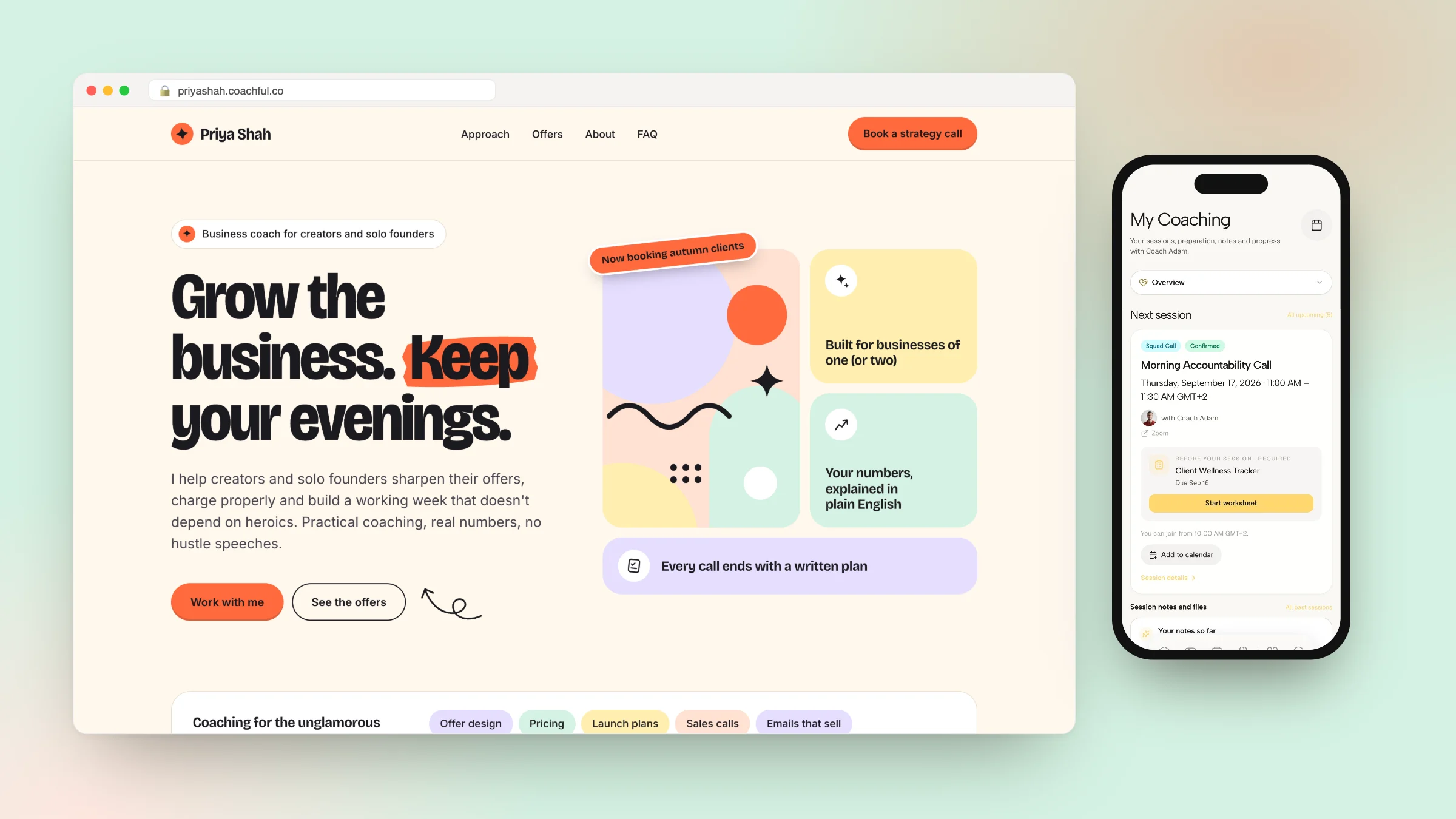
Many coaches now give clients a portal for this. In Coachful's client app, a client sees the next session and any prep that is due, notes from earlier sessions, and progress on the programs and goals the coach has set up with them.
Find a business coach on Coachful
Coachful's Find a Coach directory is open to anyone. Browse the Business category, search for your problem ("pricing", "sales", "hiring"), or switch to browsing programs instead of people. The Find My Coach quiz asks what you want to improve, where you are now, the style you prefer and your monthly budget, then suggests coaches. Each profile shows the coach's background and programs, with a calendar to book a discovery call or a form to send a message. Use the call to run the return arithmetic above.

Are you a business coach?
Prospects arrive with exactly these doubts, so your site should answer them with a clear method, honest proof and a written offer. Coachful's team will build that website or sales page for you for free on every plan, usually within about 24 hours: see how the free build works. There is more in what Coachful offers business coaches, and in our guide to becoming a business coach.

Frequently asked questions
Is a business coach worth the money for a small business?
Often, when the business already has customers and one clear bottleneck. A randomized trial of management help for 432 small firms found lasting gains in productivity and employment. With business coaching at $150 to $400 an hour and 90-day programs at $3,000 to $6,000, set a measurable target before you start.
How much does a business coach cost per month?
A monthly retainer with two to four sessions and on-call access typically costs $1,500 to $4,000 a month, and a 90-day accelerator $3,000 to $6,000 in total, according to practitioner reports compiled in Coachful's 2026 Coaching Business Report. Group programs and masterminds cost less per person.
What is the ROI of business coaching?
It depends entirely on the metric you choose and whether the change would have happened anyway. Pick one number, such as average project value or owner hours a week, record the baseline, and agree a 90-day target. Treat ROI multiples quoted on sales pages with care: ask where they come from and whether anyone was compared with a group that had no coaching.
Are business coaches a scam?
Most are not, but the title is unregulated. The FTC warns about coaches selling "proven" systems for fast money, pressure to sign now and testimonials that may not be real. Ask for a written agreement, references you can call and a specific plan for your business.
Business coach vs consultant: which do I need?
Hire a consultant when you want an expert to diagnose a problem and often fix it for you, such as setting up accounting or a sales system. Hire a coach when you know roughly what to do but keep not doing it, or need help deciding. Many business coaches combine both.
Can I get a business coach for free?
You can get free mentoring. The SBA says SCORE mentors offer advice at no cost, and Small Business Development Centers provide individualized advising. That help is valuable but usually general. A paid coach gives tailored, more frequent support and accountability.
How long should I work with a business coach?
Ninety days is a sensible first commitment: long enough to change a price, a process or a hire, and short enough to judge. Many owners then move to a lighter monthly arrangement. Be cautious about signing a 12-month contract before you have seen how the coach works.












