Pay-As-You-Grow Coaching Fees: How to Say Yes Without Losing Money

A business owner you would love to coach says your fee is a stretch right now. Then they offer a deal: a small payment today, and more each time the business hits a milestone. It sounds fair. It even sounds like a compliment. Saying no feels like admitting you do not trust your own coaching, and you have an open slot. Saying yes means that if they stall, you have spent six months coaching at a third of your rate while the mortgage stays the same size.
Agree to a pay-as-you-grow coaching fee only if the starting fee is one you could live on for the whole engagement. That means a base fee that pays for your delivery from month one, two to four step-ups tied to milestones that each have a number, a data source and a date, a cap on the top fee, and a review date written into the agreement. If the prospect's version starts far below your normal rate and only climbs back to it when everything goes right, it is a discount with extra paperwork, and the kind answer is no.
The offer is real. In a public r/Coaching thread titled “Business Coaches.... I have a legit question? Does anyone have a Pay as You Grow plan?”, a business owner looking for a coach put it like this: “Let’s agree on a clear roadmap with goals and milestones. Each time I hit a milestone, my monthly payment to you increases. If I win, you win. If I don’t, we reassess or pivot.” That is one prospect's proposal, not a standard way coaching is sold. It deserves a careful answer, because the last sentence is where the money goes missing.
Pay-as-you-grow coaching fees: what the prospect is really asking for
The same sentence can come from three different worries, and each one has a different fix. Ask before you negotiate: “What makes a fixed fee feel risky right now: the cash, or not knowing whether this will work?”
| What they mean | What it sounds like | Better answer than a contingent fee |
|---|---|---|
| Cash is tight | “I can afford you in six months, not today.” | The same price spread out. See payment plans for high-ticket coaching, or a limited reduced seat from a sliding scale. |
| They are not sure coaching works | “I have paid for advice before and got nothing.” | A shorter first commitment or a first-module guarantee, so the early risk is small and defined. |
| They want you invested | “If I win, you win.” | A base fee plus milestone step-ups. This is the only case where pay-as-you-grow is the right tool. |
Most coaches skip this question and start haggling over the starting number. Then they build a complicated fee to solve what was a cash-flow problem all along.
Who controls the result in performance-based coaching pricing
You run the sessions. The client runs the business. They decide whether to make the sales calls, fix the offer, hire the person or keep putting it off. A fee that rises only when the business grows puts your income behind decisions you can influence and cannot make.
Software companies have the same argument about outcome-based pricing. The Willingness to Pay channel, which covers SaaS pricing, describes it this way in the description of the video below: “The issue is control.” It lists “the three conditions required for true outcome-based pricing to succeed: measurable outcomes, clear attribution, and meaningful control”, and adds: “Miss one, and your revenue becomes unpredictable.”
“Outcome-Based Pricing: Why It Sounds Better Than It Is,” Willingness to Pay, published April 7, 2026. Source: watch the original video. It is about software pricing, so read “vendor” as coach and “customer” as client.
Run a coaching deal through those three conditions:
- Measurable. “Grow the business” fails. “Collected revenue of a set amount for three months in a row” passes.
- Attributable. In coaching this one rarely passes, because the client did the work. Do not try to prove your coaching caused the result. Agree that the fee follows the number, whatever caused it, and you never have that argument.
- Controllable. You control your preparation and your sessions. The client controls everything else. A milestone that depends on a funding round, one big buyer or the wider market is outside both of you.
There are two quieter costs. Once your pay hangs on one number, you are tempted to steer the client toward it even when the better coaching move is to slow down or change direction. And every step-up is a bigger bill for the client, so the person who reports the number is the person who pays more when it is good. Neither makes the deal wrong. Both are reasons to write it down properly.
What a stalled client costs you: the numbers
Illustrative example only. Say your normal fee is $1,500 a month for six months. The prospect proposes $500 a month, rising by $500 at each of three milestones. Your counter-offer is a base of $1,200 a month, rising by $400 at each milestone to a cap of $2,400. These are invented inputs for the arithmetic, not recommended coaching fees or Coachful prices.
| Six-month total (hypothetical) | Fixed fee | Prospect's version, no floor | Base fee plus step-ups |
|---|---|---|---|
| Stalled: no milestone reached | $9,000 | 6 × $500 = $3,000 | 6 × $1,200 = $7,200 |
| Expected: two milestones, confirmed at the end of months 2 and 4 | $9,000 | $1,000 + $2,000 + $3,000 = $6,000 | $2,400 + $3,200 + $4,000 = $9,600 |
| Strong: three milestones, confirmed at the end of months 1, 2 and 3 | $9,000 | $500 + $1,000 + $1,500 + $6,000 = $9,000 | $1,200 + $1,600 + $2,000 + $7,200 = $12,000 |
Look at the middle column. If the client stalls, you are $6,000 short of your normal fee. If everything goes perfectly, you finish exactly where a fixed fee would have put you. In this example the prospect's version gives you every bit of the downside and none of the upside.
The right-hand column is a real trade. You give up $1,800 if the client stalls, and you earn $600 or $3,000 more if they grow. Nobody knows in advance which row you will land in, so treat this as sharing risk on terms you chose. It does not reliably earn you more.
Two checks before you say yes to any version:
- Add up the stalled row. Could you take that total for this client and still cover your revenue target without resenting the work? If not, the base fee is too low.
- Add up the best row. Is it clearly above your normal fee? If it only gets you back to normal, you are giving a discount and calling it a partnership.
How to structure a pay-as-you-grow coaching fee that protects you
Five parts are not optional. Everything else is preference.

1. A base fee you could live on
Set the base at the lowest monthly fee you would accept for this client if it never rose. It is due in advance, every month, whatever the results. If you could not survive a quiet quarter on it, read how much cash reserve a coaching practice needs before you take on a deal that pays late by design.
2. Two to four milestones with a number, a source and a date
One milestone is a bet. Ten is an accounting job. Each one needs three things that nobody can reinterpret later.
| Vague milestone | Milestone you can bill on |
|---|---|
| “When the business is growing.” | Collected revenue at or above an agreed figure for three calendar months in a row, read from the client's accounting report on the 5th of each month. |
| “When I have more clients.” | An agreed number of paying clients on active contracts on the last day of the month, read from the client's billing system. |
| “Once the new offer takes off.” | An agreed number of signed sales of the new offer within 90 days of launch, counted from paid invoices. |
Use collected money, not booked or forecast. Pick numbers the client can move with their own actions. The idea is the same as defining a success signal before a coaching pilot: agree the evidence before the work starts.
3. A cap
Name the highest monthly fee and state that step-ups stop there. The client knows the most they will ever pay. You avoid the fight that starts when a client who is suddenly doing well looks at the bill and decides the deal was too generous.
4. Client commitments and shared numbers
Write down what the client does: attends sessions, completes agreed actions, and shares the named report by a fixed day each month. Then add a rule for silence, for example that the fee moves to your standard rate until the report arrives. Without it, the easiest way to avoid a step-up is to go quiet.

5. A review point, in writing
The prospect's “we reassess or pivot” is the right instinct with the detail missing. Set the date, often around day 90, and name the three possible outcomes: carry on as agreed, convert to your standard fixed fee, or end with a set notice period. If you want a longer runway before judging, read how to structure a minimum commitment around the three-month dip.

Plain-language terms you can adapt
- Base fee: [amount] per month from [start date], paid in advance for the full term, whatever the results.
- Step-ups: the monthly fee rises to [amount] from the first billing date after Milestone 1 is confirmed, to [amount] after Milestone 2 and to [amount] after Milestone 3. That is the cap.
- Milestone 1: [metric] reaches [number] for [period], measured in [named report], checked on [day] each month.
- Evidence: the client shares the report by [day] each month. If it is not shared within [number] days, the fee is [standard rate] until it is.
- Direction: a step-up does not reverse if the number later falls, unless both of us agree in writing.
- Review: on [date] we choose one of three: continue, convert to the standard fee, or end with [number] days' notice.
- End: step-ups stop when the engagement ends. No payments are owed on results after that date.
This is a starting point for a conversation with your own adviser, not legal wording. The coaching agreement template covers the clauses that sit around it.
When to say no to outcome-based coaching fees
Decline, or offer a fixed alternative, when any of these is true:
- The first month pays less than your floor. You would be financing the client's business with your time.
- You cannot see the numbers. No report you can both open means no milestone.
- The business has no baseline. With no revenue history, any target is a guess, and so is your income.
- The milestone depends on someone else. An investor, a regulator or one large customer decides it, not the client.
- They want you to do the work. If you are writing the sales pages and running the campaigns, that is consulting or contracting, and it is priced differently. See how to price consulting services.
- They want to pay a share of revenue or equity. Both can bring tax, legal and reporting duties that a monthly fee does not. Get professional advice before you consider either.
- You need this month's income. A deal that might pay later does not help with rent now.
A no can still be generous: “I do not tie my fee to results I cannot control, and I would rather not start our work with an argument about numbers waiting for us in month four. Here is what I can do: the same fee split into monthly payments, or a three-month start so you can judge the coaching before you commit to more.”
A yes with structure sounds like this: “I like that you want my fee tied to your progress. I can do it with a base of [amount] a month, three step-ups we define now, and a cap. We both look at the same report on the 5th, and we sit down on day 90 to decide whether to continue.”
Run the base fee and milestones in Coachful
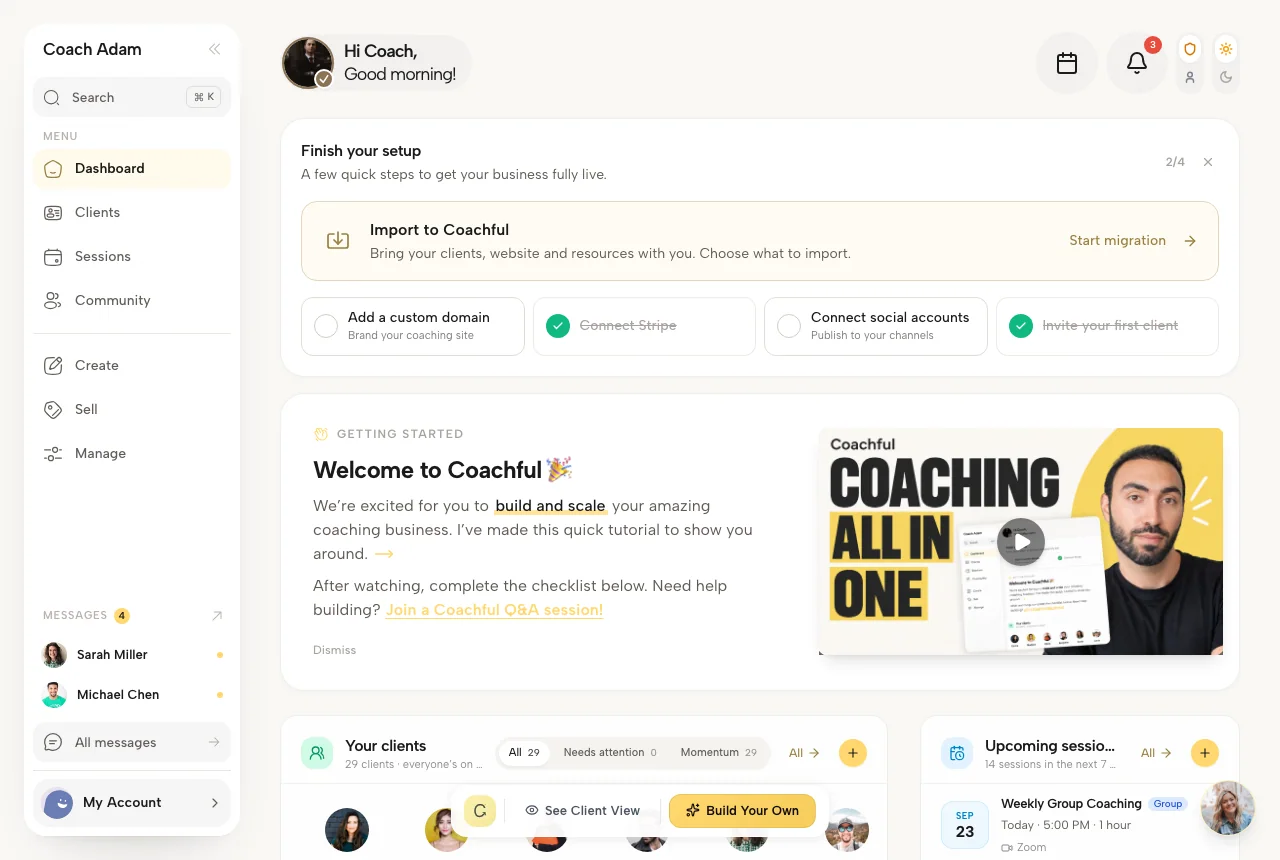
A hybrid deal is two simple pieces: a recurring base fee, and milestone terms both of you signed before the first session. Coachful handles both. You can take one-time payments, subscriptions and payment plans, and every transaction creates an invoice, so the fee history is never a matter of memory. Agreements with e-signature go out before the first call. See coaching contracts in Coachful and coaching payment software for the details.

For the milestones, Coachful gives each client goals with progress bars and weekly check-ins, so progress is visible to both of you between sessions. Sessions run on built-in video, which is part of the coaching-software subscription, so you are not paying for a separate video-call tool to hold the review meeting.

Be clear about the limit. Coachful does not read the client's revenue, decide whether a milestone was met or raise the fee for you. When a step-up is confirmed, you apply the new amount yourself. If you already have a clean payment record, a signed agreement and one shared place for progress, you can run this deal without changing tools.
Frequently asked questions about pay-as-you-grow coaching fees
Is performance-based pricing a good idea for business coaches?
Only as a hybrid. A base fee should pay for your delivery from the first month, with two to four milestone step-ups, a cap and a written review date on top. Pure pay-for-results puts your income behind decisions the client makes, and in the hypothetical example above it left the coach $6,000 short when the client stalled.
What is a pay-as-you-grow coaching plan?
It is a fee that starts lower and rises as the client's business reaches agreed milestones. In the r/Coaching post that prompted this guide, a business owner proposed that the monthly payment increase each time a milestone was hit. It is a stepped retainer, which is different from a revenue share or a one-time success bonus.
How much should the base fee be?
Set it at the lowest monthly amount you would accept for this client if no milestone were ever reached. A useful test is to add up the base fee across the whole term and ask whether that total still covers your costs and your time. In the example above the base was $1,200 against a $1,500 standard fee.
What milestones work for outcome-based coaching fees?
Ones with a number, a named data source and a date: collected revenue for three months in a row, paying clients on active contracts at month end, or signed sales of a new offer within 90 days. Avoid forecasts, booked revenue and anything decided by a third party such as an investor.
Should a business coach take a revenue share or equity instead of a fee?
Treat both with caution. A percentage of revenue needs ongoing access to the client's books and a clear definition of revenue, and equity makes you a part-owner of a business you do not run. Both can carry tax and legal consequences, so get professional advice first. A base fee with capped step-ups gives you alignment with far fewer moving parts.
What happens if the client stalls?
You keep the base fee and reach the review point. On that date, often around day 90, you choose between three written options: continue, convert to your standard fixed fee, or end with notice. Without a review clause, a stalled deal tends to drift for months at the lowest fee because nobody wants to raise it.
Does turning down a pay-as-you-grow offer make me look less confident?
No. You can be confident in your coaching and still refuse to underwrite decisions you do not make. Say that plainly, then offer something concrete: a payment plan, a three-month start or a base fee with step-ups. A clear counter-offer reads as more confident than a nervous yes.
Can I set up a pay-as-you-grow plan in Coachful?
You can run the pieces. Coachful takes subscriptions and payment plans for the base fee, sends agreements with e-signature before the first call, and tracks goals with progress bars and weekly check-ins. It does not calculate milestones or change the fee automatically. You apply each step-up yourself once the milestone is confirmed.
Sources and Coachful capabilities reviewed October 3, 2026. Fees, step-ups and totals in the examples are hypothetical. This is general business information, not legal, tax or financial advice.