
8 Signs You Need a Mindset Coach (Not Just More Motivation)
The clearest signs you need a mindset coach are moments where a belief, not a lack of skill, decides what you do: you freeze when it counts after doing well in practice, you feel like a fraud despite the evidence, perfectionism stops you shipping, or one sentence such as "I'm not a numbers person" keeps capping what you try. A mindset coach helps you name the belief, test it against what actually happens and practice acting differently in small, real experiments. If the thoughts come with persistent anxiety, low mood, panic or obsessive patterns, that is a job for a therapist, not a coach.
Below are eight situations where mindset coaching usually helps, each with an example and what the coaching would actually do. Then the honest research picture (more modest than social media suggests), when you need therapy instead, what it costs and how to find a coach who links beliefs to behavior.
The signs in one table
| Sign | The belief underneath, often | What a mindset coach does |
|---|---|---|
| 1. Great in practice, frozen when it counts | "If I mess this up, it proves something" | Pre-performance routines and self-talk you rehearse |
| 2. Feeling like a fraud | "They'll find out I got lucky" | An evidence log and asking for real feedback |
| 3. Perfectionism stops you shipping | "It has to be beyond criticism" | A "good enough" line and a release date |
| 4. One sentence caps your ambition | "People like me don't..." | A small experiment that tests the sentence |
| 5. A harsh running commentary | "Don't be an idiot" | Noticing it and practicing a more useful voice |
| 6. A setback made you stop trying | "I tried once, and look what happened" | Small wins that rebuild confidence in a specific task |
| 7. You avoid asking for what you want | "Asking will make it worse" | Rehearsed asks, starting small |
| 8. Motivation without change | "I just need the right mindset" | Tying each insight to a habit and a date |
1. You do well in practice and freeze when it counts
Your presentation is sharp in rehearsal and falls apart in front of the board. You play well in training and tighten up in matches. You know the material and blank in the exam. The skill is there. Something about the stakes changes how you think, and that changes how you perform.
Mindset coaching here is practical. You notice what you tell yourself in the minutes before the moment ("everyone is watching", "don't mess this up"), build a short pre-performance routine, and rehearse a more useful line of self-talk until it is automatic. Then you practice under conditions that feel a little more like the real thing: a dry run in front of colleagues, a timed mock exam, a scrimmage with something at stake.
Performers, athletes and speakers often work with specialists in this; our guide to mental performance coaching covers that version in depth.
2. You feel like a fraud, whatever the evidence says
You got the promotion and assume they made a mistake. Praise slides off you; criticism sticks for weeks. You over-prepare for everything because you are sure that one slip will expose you.
This experience has a name. The psychologists Pauline Clance and Suzanne Imes described the impostor phenomenon in 1978 as an internal experience of intellectual phoniness. It is not a mental disorder or a recognized diagnosis, which is part of why coaching can help with it (overview).
A mindset coach will typically ask you to keep an evidence log of what you actually did and how it landed, ask a few trusted colleagues for specific feedback, and notice the pattern of crediting luck for successes and yourself for failures. Then you try small changes, such as accepting a compliment without a disclaimer. Our list of coaching questions for imposter syndrome shows the kind of questions a coach will ask.

3. Perfectionism stops you shipping anything
The course you have been building for a year. The portfolio that needs one more piece. The book proposal on its eleventh draft. You hold your work to a standard nothing could meet, so nothing goes out.
A mindset coach usually starts by asking what "good enough" would look like, in writing, before you start. Then you set a release date and a smaller first version: publish the first module, send the proposal to two agents, show three pieces instead of twelve. The coaching session after the release is often the most useful one, because what actually happened rarely matches the disaster you predicted.
Our guide to perfectionism coaching includes a practical exercise for exactly this.
4. One sentence keeps capping what you try
"I'm not a numbers person." "People like me don't start businesses." "If I raise my prices, everyone will leave." Sentences like these shape decisions for years without ever being tested.
The core move in mindset coaching is to treat the sentence as a hypothesis. What is the evidence for it? What is the evidence against it? What would you tell a friend who said it? Then you design an experiment that tests it cheaply. For the freelancer afraid to raise prices, that might mean quoting the new rate to the next three enquiries only, and recording what happens.
The experiment is what separates coaching from a pep talk. A new belief you have not tested is just a nicer sentence.

5. A harsh inner critic runs the commentary
There is a voice that narrates your day in the worst terms: "Don't be stupid." "Everyone noticed." "You always do this." You would never speak to a friend that way, and you speak to yourself that way dozens of times a day.
Coaching helps you notice the voice in the moment, write down what it says and when, and practice an alternative that is accurate rather than cheerful ("That meeting was rough; the second half went better"). Many coaches borrow from cognitive-behavioral approaches here, examining thoughts and testing them against evidence.
A line to watch: if the critic is constant, comes with low mood or hopelessness, or tells you that you would be better off gone, that is not a coaching issue. See the box below and talk to a clinician.
6. A setback made you stop trying
A business that failed. A layoff. A rejection after years of work. An injury that ended a sport. The event is over, and you have not tried anything similar since, because the next attempt feels like a bet you cannot afford to lose.
Confidence after a setback is usually rebuilt in specific tasks, not in general. A coach helps you pick a small, winnable version of the thing you stopped doing, try it, and build from there: one freelance project before a new business, a 5K before a marathon, a single application before a full job search.
The research on executive coaching is relevant. A meta-analysis of 20 controlled studies found significant positive effects on self-efficacy, psychological capital and resilience, qualities the authors note are often considered fairly stable (Nicolau and colleagues, 2023).

7. You avoid asking for what you want
The raise you have not requested. The boundary you have not set with your mother. The help you need at work and will not ask for, because asking feels like admitting weakness or risking rejection.
Mindset coaching treats this as a belief to test and a skill to practice. What do you predict will happen if you ask? What has actually happened when you have asked before? Then you start small: ask a colleague for a favor this week, decline one request, practice the bigger conversation out loud with the coach first.
If the main goal is confidence across many areas, our list of confidence coaching questions shows how coaches approach it.
8. You consume motivation, and nothing changes
Morning affirmations, motivational videos on the commute, a mindset podcast at the gym. You feel great for an hour. A year later, your behavior is the same.
This sign deserves an honest look at the research. Two meta-analyses of growth mindset research, one of 273 studies and one of 43 intervention studies mostly in schools, found weak overall effects, with some benefit for students from low-income backgrounds or at academic risk (Sisk and colleagues, 2018). A later review of 53 randomized samples found small effects on academic achievement and somewhat larger ones on mental health, with wide variation between studies (Burnette and colleagues, 2023). Changing a belief on its own does modest things.
What the stronger evidence supports is coaching that ties beliefs to goals and behavior. A meta-analysis of workplace coaching found its largest effect on goal-directed self-regulation, the skill of pursuing a goal and adjusting when it slips (Theeboom, Beersma and van Vianen). So the useful mindset coach turns every insight into a habit, a deadline and an experiment you report back on.

When mindset coaching is not enough
Mindset coaching is for people who are generally steady and want to act differently in one area. It is not a treatment, and it is the wrong choice if you are being sold a promise.
- Money or manifesting promises. The US Federal Trade Commission warns that no one can guarantee you will make lots of money with little to no risk, and that "proven system" claims and pressure to act now are warning signs (FTC consumer alert).
- Blame dressed up as mindset. "You're choosing to stay stuck" ignores real constraints such as money, health and caring responsibilities. A good coach takes those seriously.
- Discouraging therapy or medication. A mindset coach who does this is outside their lane.
See a licensed professional instead, or first, when...
- Worry, panic or low mood affects your sleep, work or relationships most days, or has lasted weeks.
- Thoughts feel intrusive, repetitive or impossible to stop, or you feel driven to rituals to quiet them.
- You are dealing with trauma, an eating disorder or an addiction.
- Your negative thoughts include harming yourself. In the US, call or text 988 to reach the 988 Suicide and Crisis Lifeline (US Office for Victims of Crime); elsewhere, call your local emergency number.
Therapy treats these; coaching does not. Many people see a therapist and a coach at the same time, with each knowing about the other. Our guide to life coach vs therapist explains the difference.
What a mindset coach costs
Coachful's 2026 Coaching Business Report does not give a separate figure for mindset coaching; it groups mindset with life coaching. These are its life coaching benchmarks for the second quarter of 2026, in US dollars:
| What you buy | Typical price | Source |
|---|---|---|
| One session, typical coach | $75 to $200 | PayScale and practitioner reports |
| Newer coach | $50 to $100 an hour | Practitioner estimate |
| Experienced coach | $100 to $200 an hour | Practitioner estimate |
| Four sessions over four weeks | $400 to $600 | Practitioner reports |
| Three months, eight sessions | $1,200 to $2,500 | Practitioner reports and verified published rates |
| Group coaching | $100 to $300 a month | Practitioner reports |
More detail on coachingrates.com.
A single belief tied to a specific situation, such as freezing in presentations, often needs only a short package. A broader pattern, such as perfectionism across work and life, usually takes a few months.
How to pick a mindset coach
On a discovery call, ask three things. What methods do you use, and where did you train? How do you connect belief work to goals and behavior? And what do you do when a client needs therapy instead? Listen for experiments, tracking and a clear referral answer. Be wary of anyone who talks mostly about manifesting, energy or income. Our explainer on what mindset coaching is covers the methods, and our sibling guides to the questions to ask a coach before hiring and the red flags when hiring a coach go further.

Find a mindset coach on Coachful
Coachful's Find a Coach directory is public, so you can browse without an account. Start with the Mindset category, or search "confidence", "imposter", "perfectionism" or "performance" to find coaches whose headline or bio mentions it. The Find My Coach quiz asks what you want to improve (Mindset is one of the options), where you are now, your email, your preferred style and your monthly budget, then suggests coaches.

Profiles show each coach's background, credentials and method, their programs and prices, and either a calendar to book a discovery call or a form to send a message.

Are you a mindset coach?
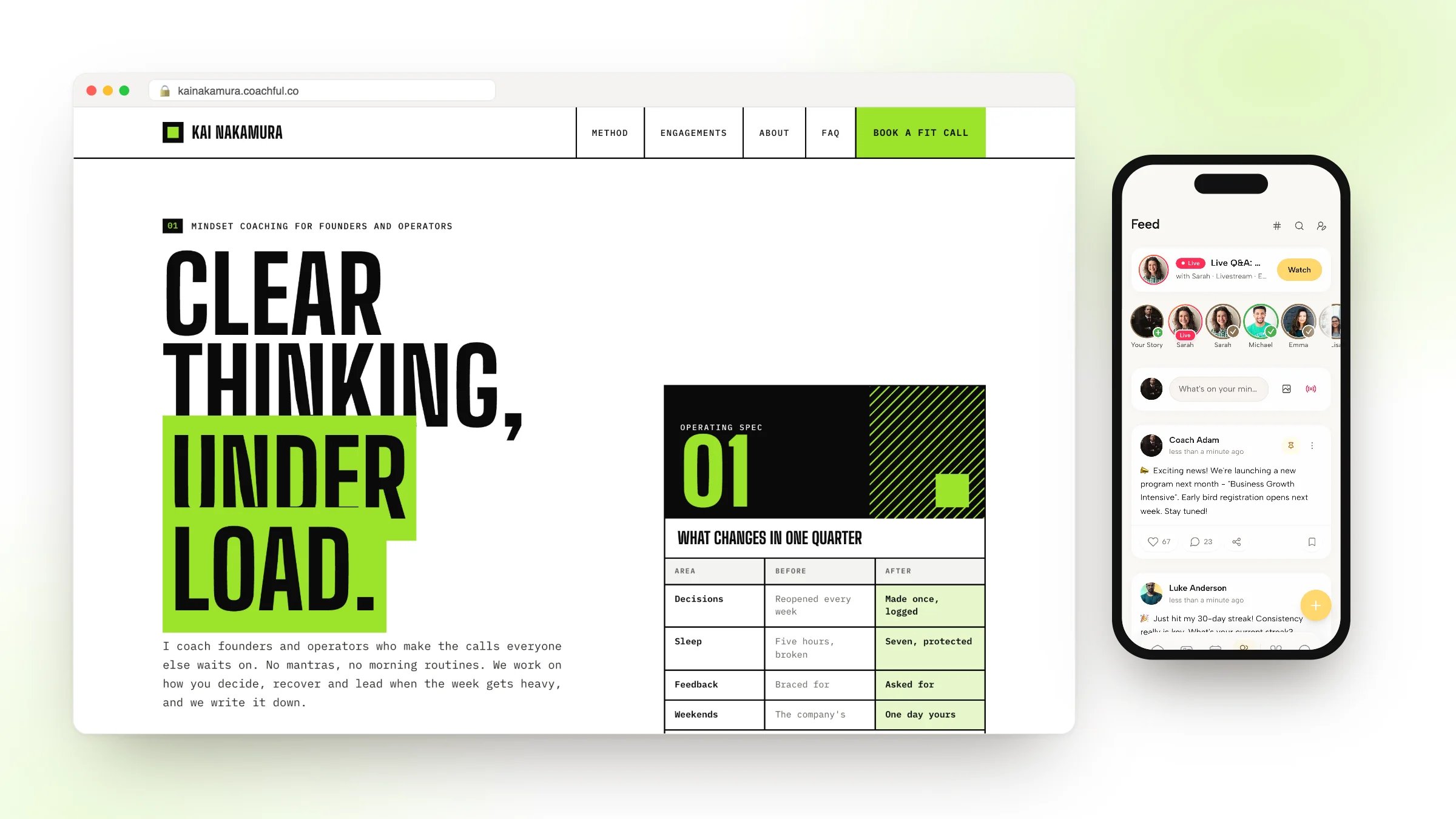
People rarely search for "limiting beliefs". They search for the situations above. Our guide on how to become a mindset coach covers training and first clients, and Coachful's page for mindset coaches covers the Life and Mindset power-up, which gives each client one place for a weekly review, reflections, wins, experiments, a life map and beliefs. The Coachful team will also build your website in your account at no extra cost through the free white-glove service, starting from a template such as Monolith.

The bottom line
You probably need a mindset coach if a belief, not a missing skill, keeps deciding what you do: the freeze under pressure, the fraud feeling, the perfectionism, the sentence that caps your ambition. You probably need a therapist first if the thoughts come with persistent anxiety, low mood or intrusive patterns. Choose a coach who turns each insight into an experiment and a habit, because the research says that is where the change comes from.
Frequently asked questions
How do I know if I need a mindset coach?
Look for situations where you have the skill but a belief stops you: freezing when it matters, feeling like a fraud, perfectionism that blocks finishing, a harsh inner critic, avoiding asks, or not trying again after a setback. If you are generally steady, coaching fits.
What does a mindset coach actually do?
A mindset coach helps you name the belief behind a stuck behavior, look at the evidence for it, find a more useful view and test it with a small experiment each week, then reviews what happened with you in the next session.
Is mindset coaching the same as therapy?
No. A therapist is licensed to diagnose and treat conditions such as anxiety and depression. A mindset coach works with reasonably steady people on beliefs that hold back a specific goal. If anxiety, low mood or trauma is the main issue, see a therapist first.
Does mindset coaching work?
Partly. Growth mindset interventions on their own show small to modest effects in large meta-analyses, mostly from schools. Coaching that ties beliefs to goals and behavior has stronger support, including gains in goal-directed self-regulation, self-efficacy and resilience.
How much does a mindset coach cost?
Coachful's 2026 Coaching Business Report groups mindset with life coaching, where a typical session costs $75 to $200 and a three-month package of eight sessions $1,200 to $2,500. Group programs typically run $100 to $300 a month.
Can a mindset coach help with imposter syndrome?
Often, yes. Impostor feelings are not a mental disorder, and coaching can help you gather evidence, ask for feedback and change how you respond to praise and mistakes. If the feelings come with persistent anxiety or low mood, involve a therapist.
How long does mindset coaching take?
A specific situation, such as freezing in presentations, may need four to six sessions. A broader pattern often takes about three months. You should notice yourself trying something different within the first few sessions.












