
9 Things to Know Before Becoming a Nutrition Coach
The things to know before becoming a nutrition coach start with the meal plan: almost every client will ask for one when what they need is a structure they can keep. Tracking food helps some people and wears others out, disordered eating will show up in your client list whether you advertise for it or not, and weight-loss medications have changed what many clients need from you. Add the state-by-state rules on nutrition advice, the pull of supplement deals and the fact that food is cultural and personal, and the job looks less like writing plans and more like careful, practical coaching.
Our step-by-step guide on how to become a nutrition coach covers the legal lines, certifications, cost and first clients. This list covers the day-to-day realities that guide only touches. When you're ready for a website, Coachful's team will build it for free on every plan (item 9).
The 9 things at a glance
| # | What to know | What to do instead |
|---|---|---|
| 1 | Everyone asks for a meal plan | Coach a structure they can repeat |
| 2 | Tracking helps some clients and burns out others | Offer levels of tracking, including none |
| 3 | Disordered eating will show up | Screen at intake and refer early |
| 4 | Weight-loss medications changed the work | Support habits; leave dosing to prescribers |
| 5 | Supplement and MLM deals cost trust | Keep your advice and your income separate |
| 6 | Clients bring headlines | Build a sourcing habit and a calm script |
| 7 | The plateau is where you earn your fee | Set expectations and track more than weight |
| 8 | Food is cultural, budget-bound and personal | Coach inside the client's real food life |
| 9 | Your pay sits beside licensed neighbors | Specialize and package; don't compete on hours |
1. Everyone asks for a meal plan
The first message from a new client is often some version of "Can you just tell me what to eat?" It's an understandable request. It's also the start of a familiar pattern: the client follows a detailed seven-day plan for nine days, has a chaotic Thursday, misses two meals on the plan, decides they've failed and stops.
There's a legal angle too. In some US states, writing individualized meal plans, especially for someone with a medical condition, is restricted to licensed dietitians or nutritionists, as the sibling guide explains. Even where it's allowed, a plan written by you is a plan the client depends on you for.
What to do: coach structures rather than menus. Two go-to breakfasts. A Sunday shopping list template. A "default dinner" for nights when everything goes wrong. A plate pattern the client can apply anywhere. These survive bad weeks, and the client owns them. If you want a library of recipes and guides alongside the coaching, put them in a resource folder rather than a rigid plan. Our nutrition coach certification guide includes a section on what your state may require.

2. Tracking helps some clients and burns out others
Food tracking is useful. It shows a client what they actually eat rather than what they think they eat, and some people love the data. Others find that weighing and logging every bite turns food into a test they fail daily, and they quietly stop logging, then stop replying.
New nutrition coaches often pick one method, usually the one they used themselves, and apply it to everyone. Experienced coaches offer a ladder and let the client choose a rung: full macro tracking, calories only, photo logging, hand-sized portions, a simple daily habit tick ("protein at breakfast," "vegetables at dinner"), or no tracking at all for a client who needs a break from numbers.
What to do: ask in the first session how the client feels about tracking and what happened last time they tried it. Start lighter than you think, and move up only if they want to. In Coachful, the Fitness & Nutrition power-up covers the heavier end, with nutrition targets up to calories and macros, meal plans, recipes, food lookup and private progress photos and measurements, while ordinary habits handle the lighter end.

3. Disordered eating will show up
You don't have to advertise for it. Nutrition and weight-loss coaching naturally attracts some people whose relationship with food is already in trouble: restricting, bingeing, compensating, or fixated on weight and shape. The US National Institute of Mental Health describes eating disorders as serious illnesses marked by severe disturbances in eating behaviors, notes that fixation on weight, body shape or controlling food intake can be a warning sign, and stresses that early detection and treatment matter for recovery (NIMH).
The risk for a coach is that some of these behaviors look like "commitment" at first. A client who cuts out food groups, logs obsessively and is delighted by rapid weight loss can seem like your best performer.
What to do: ask about eating disorder history at intake, in plain words, and agree in your coaching agreement that you'll pause nutrition coaching and suggest specialist help if warning signs appear. Avoid marketing that celebrates rapid loss or "clean" eating, which tends to attract the people most at risk. Keep a referral list that includes clinicians who treat eating disorders. Our coaching agreement template has a scope clause to adapt.

4. Weight-loss medications changed the work
Expect some of your weight-loss clients to arrive taking, or considering, medications such as semaglutide or tirzepatide. When the FDA approved Zepbound (tirzepatide) for chronic weight management in November 2023, it was approved for adults with obesity, or overweight with at least one weight-related condition, for use in addition to a reduced-calorie diet and increased physical activity (FDA). In other words, eating and activity habits remain part of the treatment.
That gives nutrition coaches a real role, and a clear boundary. You can help a client build regular meals when their appetite is low, plan around side effects their prescriber has told them to expect, keep up movement, and think about what happens to their habits if they stop the medication. You can't advise on whether to start, stop or change a dose, and you shouldn't contradict the prescriber's guidance.
What to do: ask at intake whether the client takes any weight-loss medication, note who prescribes it, and frame your coaching as supporting the care plan. Our consumer guide to weight loss coaching covers how clients think about medication and coaching together.
5. Supplement and MLM deals cost trust
Sooner or later a supplement brand, a meal-replacement company or a multi-level marketing distributor will offer you a commission to recommend their products to clients. It can look like easy extra income. It changes your advice from "what's best for you" to "what pays me," and clients notice.
The FTC's consumer guidance on multi-level marketing is blunt: most people who join legitimate MLMs make little or no money, some lose money, and distributors are often encouraged or required to buy product regularly (FTC). Separately, recommending supplements to treat a condition is clinical advice that belongs to a doctor or pharmacist, who can check interactions with what the client already takes.
What to do: keep your coaching income and product income separate, or don't take product income at all. If you do have an affiliation, disclose it every time. Point supplement questions to the client's doctor or pharmacist.
6. Clients bring headlines
A client opens a session with a video they saw last night: seed oils, fasting windows, a celebrity's protein number, a study claiming coffee does something alarming. Next week it'll be a different one. If you argue each claim on its merits, you'll spend every session on the internet. If you dismiss them, the client feels foolish and stops telling you what they're reading.
What to do: build a sourcing habit for yourself. Lean on government dietary guidance, recognized professional bodies and systematic reviews rather than single studies or influencers. Then build a calm script for clients: "That's interesting. Here's how I'd check it, and here's whether it would change anything about your next two weeks." Usually the honest answer is that it wouldn't, because consistency beats optimization for most people. Our sibling explainer on what a nutrition coach does sets out the role for clients, which helps reset expectations.
7. The plateau is where you earn your fee
The first weeks often go well. New habits, some early results, high motivation. Then progress slows, or the scale stalls, and the client's enthusiasm drops with it. This is the moment most self-directed plans fail, and it's the moment clients most need a coach.
New nutrition coaches often feel personally responsible for the stall and start changing everything: new targets, stricter rules, more tracking. That usually makes it worse. The coaching move is to look at the whole picture with the client, including the things that did change: energy, sleep, cooking more at home, fewer late-night snacks, clothes fitting differently.
What to do: warn clients about plateaus in the first session, before one happens. Track more than one number, and review progress at monthly checkpoints rather than daily weigh-ins. Group support helps here too, because seeing others push through a stall normalizes it.


8. Food is cultural, budget-bound and personal
A plan built around salmon, quinoa and three hours of Sunday meal prep doesn't work for a family on a tight budget, a shift worker eating at 3am, a client who fasts for religious reasons, or someone whose family's cooking is the center of their culture. New coaches often coach their own food world without realizing it.
Clients rarely say "this doesn't fit my life." They just don't do it. Or they feel judged for the foods they grew up with, and stop being honest about what they eat.
What to do: ask about budget, cooking time, who else eats at home, cultural and religious food practices and what they enjoy, before suggesting anything. Build from the meals they already eat. A small change to a family dish they love lasts longer than a replacement they resent. If you specialize, choose a group whose food life you understand, like shift workers, parents cooking for picky kids or endurance athletes.
9. Your pay sits beside licensed neighbors
There's no clean nutrition coach salary in public data, which our nutrition coach salary guide explains. The closest regulated neighbor is the dietitian: the US Bureau of Labor Statistics puts the median annual wage for dietitians and nutritionists at $76,400 in May 2025, an occupation that in many states requires a license (BLS). That's an adjacent occupation, not a coach's income. The nearest coaching benchmark in Coachful's 2026 report is health and wellness coaching, at $75 to $200 an hour (PayScale and practitioner reports) in a niche the report rates as very crowded and competing with apps.
The practical lesson: you won't win by being a cheaper dietitian. You win by being the coach who helps a specific kind of person actually change how they eat, sold as a program rather than hours. A three-month health program runs $900 to $2,000 in the report's practitioner figures.
What to do: package, specialize and make the between-session support the visible part of what clients buy. Our roundup of software for nutrition coaches compares tools, and the Coachful page for health and nutrition coaches shows the setup.
Have your nutrition coaching website built for free
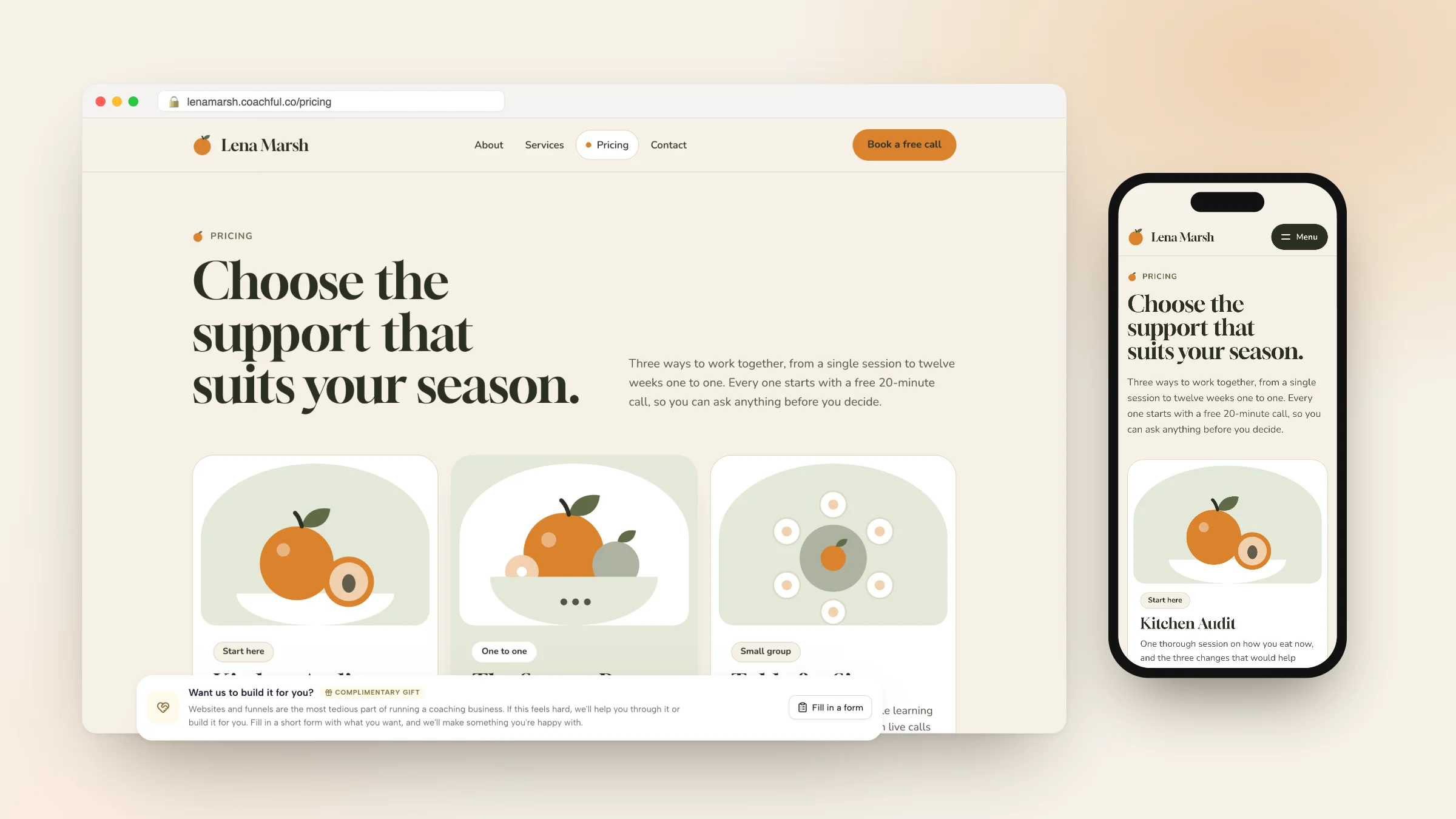
Coachful's team builds coaching websites, program pages and free-guide funnels for free on every plan, inside your own account. Coachful itself is a paid subscription with a free trial. Open Website, click Fill in a form, and describe your pages, your program and what you'd give away first, such as a short meal guide. The team replies by email with next steps, usually within about 24 hours (typical, not guaranteed), and invents nothing: no credentials, health claims or testimonials you haven't given. See what the free build covers, and our guide to a nutrition coach website lists the pages.


The bottom line
Nutrition coaching is less about knowing the right diet and more about helping someone eat a little better, consistently, in the life they actually have. Know the meal-plan trap, offer tracking as a choice, screen for disordered eating, work alongside prescribers, stay clear of product conflicts, handle headlines calmly, prepare clients for plateaus and respect their food culture. If you're still deciding whether you can do this work without a license, read our sibling piece on whether anyone can be a nutrition coach.
Frequently asked questions
What should I know before becoming a nutrition coach?
Know that clients usually need a repeatable eating structure more than a meal plan, that some states restrict individualized nutrition advice to licensed professionals, that disordered eating and weight-loss medications will come up and need careful handling, and that you'll compete by specializing rather than on price.
Can a nutrition coach make meal plans?
It depends on where you and your client live. Some US states restrict individualized meal plans, especially for medical conditions, to licensed dietitians or nutritionists. General guidance and helping a client follow their clinician's plan are usually within a coach's scope. Check your state's rules.
How much do nutrition coaches make?
There's no reliable public figure for nutrition coaches specifically. The BLS puts the median wage for licensed dietitians and nutritionists at $76,400 (May 2025), and Coachful's 2026 report puts health and wellness coaches at $75 to $200 an hour. Income depends on niche, packages and client numbers.
Can nutrition coaches work with clients on GLP-1 medications?
Yes, as long as they stay in their scope. A coach can support regular meals, movement and habits around the care plan, but decisions about starting, stopping or changing medication belong to the prescriber. The FDA approved tirzepatide for weight management for use alongside a reduced-calorie diet and more physical activity.
What should a nutrition coach do if a client shows signs of an eating disorder?
Pause nutrition coaching, share your concern kindly, and suggest the client see a doctor or a clinician who treats eating disorders. NIMH describes eating disorders as serious and potentially life-threatening, with early treatment important for recovery. Put this step in your agreement in advance.
Should nutrition coaches sell supplements?
It's risky for trust. Commissions change your advice, and supplement recommendations for a condition are clinical advice for a doctor or pharmacist. If you do have an affiliation, disclose it clearly every time.
Will Coachful build my nutrition coaching website for free?
Yes. Coachful's team builds coaching websites, program pages and free-guide funnels for free on every plan, inside your account. Coachful is a paid subscription; the build costs nothing extra. Fill in the form from the Website page, and the team replies with next steps, usually within about 24 hours.












