
How to Become a Nutrition Coach: Scope, Training and Pay
To become a nutrition coach, you complete a nutrition coaching course or health coach training, learn where your state draws the line between coaching and licensed nutrition care, choose a group of people to help, and coach eating habits rather than prescribing diets. In most places you don't need a degree to coach healthy eating. You do need a license or a dietitian credential to provide medical nutrition therapy, and in some US states to give individualized nutrition advice at all.
Anyone working out how to become a nutrition coach should start with that last point. Course sales pages skip it, and it shapes the whole business: who you can take on, what you can put in writing and what you call yourself. So this guide starts there, then covers training, cost and time, pay, packages and first clients. When you're ready to open the doors, Coachful's team will build your nutrition coaching website and the lead-magnet funnel behind it for free on every plan.
Nutrition coach, nutritionist, dietitian: who may do what
A nutrition coach helps someone change how they eat in real life: what goes in the shopping cart, what happens at 6pm on a Wednesday, how they handle the office cake and the weekend. The coaching is behavior change. The nutrition knowledge supports it. Here is how the role sits next to the titles that are regulated.
| Role | What they do | What it takes |
|---|---|---|
| Nutrition coach | Habits, meal planning with the client, accountability, follow-through on a plan | A course certificate, voluntary in most places |
| Health coach | Behavior change across food, movement, sleep and stress | Voluntary; US board certification through NBHWC |
| Certified Nutrition Specialist (CNS) | Personalized nutrition care where state law allows it | A master's in nutrition or a related health science, set coursework, 1,000 hours of supervised practice and an exam |
| Registered dietitian nutritionist (RDN) | Medical nutrition therapy, clinical and hospital nutrition | At least a master's degree and a dietetic internship |
The US Bureau of Labor Statistics puts it plainly: many states require dietitians and nutritionists to be licensed in order to practice, other states only protect certain titles, and a few have no rules at all. That patchwork is why two nutrition coaches with the same certificate can have very different legal room.
Florida is a useful example of how the line can look. Its statute, section 468.505 as published for 2024, lets people without a dietetics license give nutrition information, wellness recommendations or advice for pay, on two conditions: they don't do it for someone under a doctor's direct care for a disease or condition that requires nutrition intervention (obesity and weight loss are excluded from that condition), and they don't call themselves a dietitian, nutritionist or nutrition counselor. Other states are stricter, some are looser, and statutes change. Read your own state's law, and your client's if you coach across state lines. Outside the US, check which nutrition titles are protected where you and your clients live.
A scope check to run on every new nutrition client
The cleanest practices screen at intake and decide case by case. Ask about diagnosed conditions, medications, who is on their care team and any history of disordered eating. Then sort the request.
| What the client asks for | Coaching move | When to refer |
|---|---|---|
| "I want to stop ordering takeout four nights a week" | Build a weekly dinner rhythm with them, a shopping list and a Sunday batch-cook | Rarely needed |
| "My doctor says I have prediabetes" | Help them follow the plan their clinician gave them: habits, tracking, accountability | Any new diet prescription goes to their doctor or an RDN |
| "I'm on dialysis" or another condition with strict nutrition rules | Routines and support only, with their care team's knowledge | Their renal or clinical dietitian owns the plan |
| Signs of an eating disorder | Stop nutrition coaching | A clinician who treats eating disorders |
| "Which supplements should I take?" | Point them to their doctor or pharmacist | Always |
| "Help me eat for my marathon block" | General fueling habits, meal timing, hydration routines | A sports dietitian if they need an individualized plan and your state restricts it |
Write the scope into your coaching agreement and onto your website: what you do, what you don't, and that you work alongside medical care. Our coaching agreement template has a scope clause you can adapt, and what health and wellness coaching is covers the boundary from the health-coach side.
Nutrition coach certification options compared
No certificate turns a coach into a dietitian, so choose training for what it teaches you to do with clients. These are the main routes, with details as each provider publishes them in October 2026.
| Route | What it involves | Good fit for |
|---|---|---|
| Precision Nutrition Level 1 | A nutrition coaching certification; its page says it qualifies for continuing education credits with NASM, ACSM, ACE, CDR, NBHWC, NSCA and others | Trainers and coaches who want a coaching-first nutrition framework |
| NASM Certified Nutrition Coach | Self-paced online, five years of course access, an open-book online exam of 100 questions in 90 minutes; NASM says many finish in 4 to 6 weeks | Personal trainers adding nutrition to their sessions |
| NBHWC-approved health coach training | An approved program, then 50 logged coaching sessions, an associate degree or 4,000 hours of work experience, and the board exam | Coaches who want clinic, employer or digital-health work |
| CNS credential | Master's degree, nutrition and science coursework, 1,000 hours of supervised practice, a 200-question exam | People who want personalized nutrition care without the RDN route |
| RDN | Master's degree plus a dietetic internship | Anyone who wants to provide medical nutrition therapy |
NASM's own page is a good sign of how the industry sees scope: it describes its course as built for a coaching scope of practice and tells coaches to refer to an RDN for medical nutrition assessment or treatment. If you plan to sit the NBHWC exam, the program must hold NBHWC approval while you complete it; see NBHWC's eligibility rules. Our sibling guide to nutrition coach certification compares programs in more depth, and what a certificate of completion is explains why a school's certificate isn't a license.
How long it takes and what it costs
Time depends on the route more than on you. A self-paced nutrition coaching course can be done in a month or two of evenings. A board-certification route takes months, because the 50 sessions have to be coached after you pass the program's skills assessment. The CNS and RDN routes take years, since both start with a graduate degree.
We haven't printed course prices here because the big providers run frequent sales and payment plans, so a number we quote today will be wrong next month. Budget for the whole route instead: tuition, any exam fee, professional liability insurance, a website, a booking and payment setup, and the hours you'll spend coaching practice clients. Our guide to coaching insurance lists what to check before you buy a policy.

Choose who you'll help eat better
"Nutrition coach" on its own competes with every meal-plan app on the market. A specific person with a specific problem gives people a reason to pick you. Some that work:
- Parents who want one family dinner instead of three, cooked in 30 minutes.
- Women in perimenopause who want energy, sleep and strength back.
- Endurance athletes who keep bonking at the same point of a long run.
- Shift workers, nurses and pilots whose meals don't fit a 9-to-5 plan.
- Adults whose doctor has asked them to change how they eat and who want help following that plan.
Coachful's 2026 Coaching Business Report rates health and wellness as a very crowded niche and flags women's health as underserved and growing, with low saturation. That matches what you see in practice: generalists fight on price, specialists get referred. Test a niche with a few paid conversations first; validating a niche with a paid pilot shows how.

What nutrition coaches charge
Coachful's rates data has no separate figure for nutrition coaches, so the closest is health and wellness. The 2026 report puts health and wellness coaching at $75 to $200 an hour (PayScale and practitioner reports), with practitioner estimates of $50 to $100 for newer coaches, $100 to $200 for experienced ones and $200 to $400 at the top. Annual figures run $52,000 to $77,000 (PayScale, ZipRecruiter and Glassdoor).
| Package shape | What it includes | Typical price |
|---|---|---|
| 4-week reset | Four 60-minute sessions, a habit tracker, a food and movement plan | $400 to $800 |
| 3-month program | Eight to ten sessions, weekly check-ins, resources | $900 to $2,000 |
| Ongoing monthly | Two to four sessions a month plus messaging | $300 to $700 a month |
| App-based with a coach | Daily lessons and a weekly coach check-in | $17 to $149 a month |
Package prices from practitioner reports compiled in Coachful's 2026 Coaching Business Report.
That last row is your competition if you sell "healthy eating" in general, which is another argument for a niche. For context on the licensed side, the BLS reports a median of $76,400 a year for dietitians and nutritionists in May 2025; that is an adjacent, mostly employed occupation, not a coach salary. The arithmetic for a coach is simpler: ten clients on a three-month program at $1,200 is $12,000 a quarter before costs. More in our breakdown of what health coaches charge, the health and wellness rates page and our sibling piece on nutrition coach salary.

The tools a nutrition coaching practice runs on
Nutrition coaching lives between sessions: the Tuesday shop, the Thursday wobble, the photo of dinner. You need a screening intake, a signed agreement, a way to share meal plans and recipes, a habit tracker, a weekly check-in and somewhere to message. In Coachful, all of that is included in your membership:
- The Fitness & Nutrition power-up: nutrition targets up to calories and macros, meal plans, recipes, food lookup, and private progress photos and measurements. More on the Fitness & Nutrition page.
- Intake forms and worksheets attached to a booking, so the screening questions sit on the client record.
- Programs with weekly goals, daily habits with reminders and morning, evening or weekly check-ins, in a client app on iPhone and Android.
- Payments through your own Stripe or Razorpay account with a 0% Coachful platform fee, including payment plans and subscriptions for monthly coaching.

Two honest limits: Coachful is not HIPAA-certified (it is GDPR-ready with full data export), and it doesn't sync with wearables or Apple Health. If you work for a clinic that requires HIPAA, ask before you choose any tool. See the Coachful page for health coaches, our guide to a nutrition coach website, and the roundup of software for nutrition coaches if you're comparing options.

Have Coachful build your nutrition coaching website for free
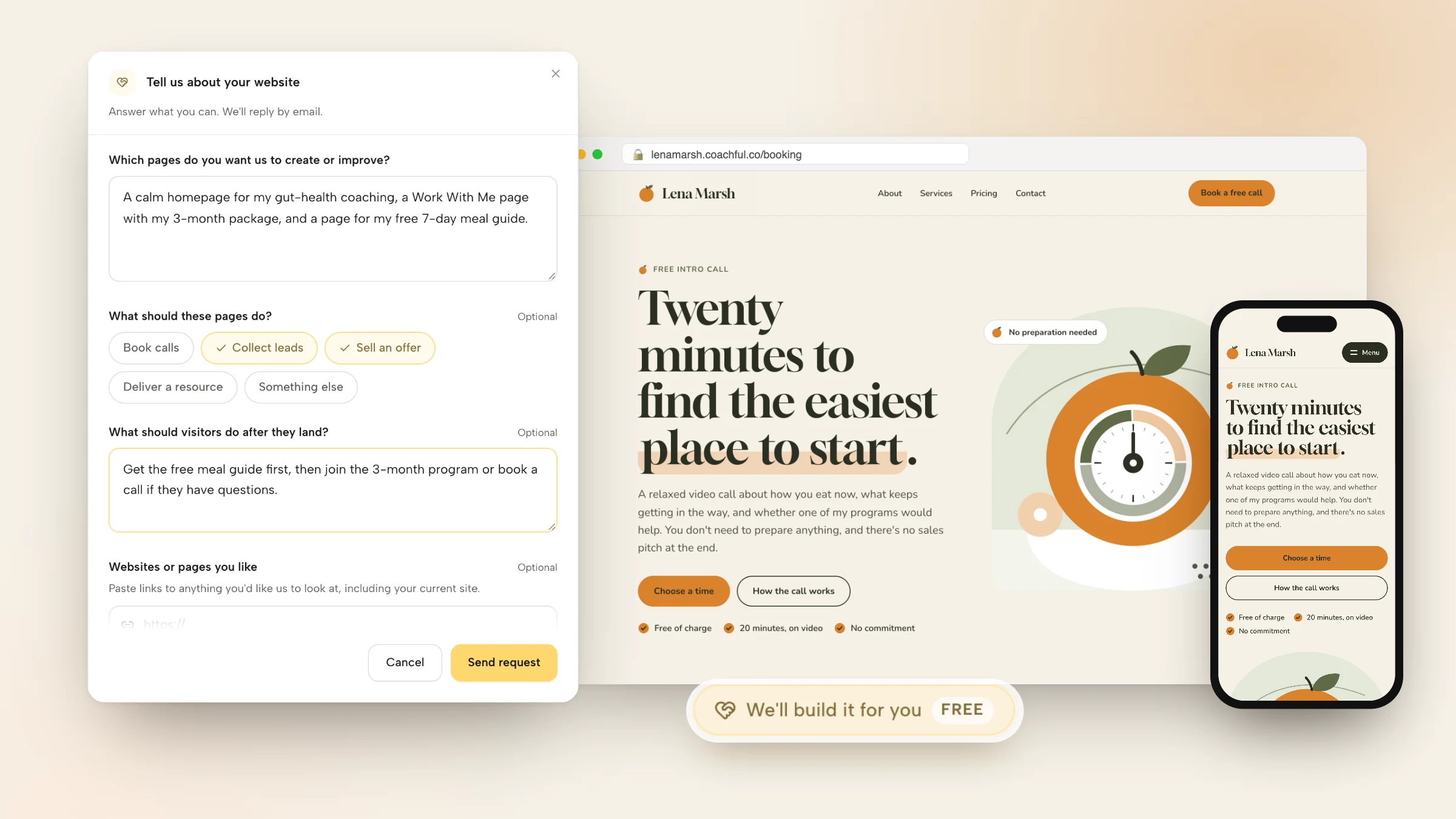
Plenty of new coaches lose a month to the website and never get to the funnel. Coachful's team builds both for free on every plan, inside your own account: the homepage, a program or sales page, a lead-magnet funnel such as a seven-day dinner guide, and the follow-up emails. Coachful itself is a paid subscription, and you can start with a free trial.
Open Website and click Fill in a form on the "Want us to build it for you?" card, or choose We'll build it for you · FREE under Create. Say which pages you want, what they should do and what a visitor should do next. Add up to 8 links to sites you like and up to 10 files, such as your logo, a photo and the PDF of your guide. Video files aren't accepted.

The team replies by email with next steps, usually within about 24 hours, which is typical rather than guaranteed. A recent build for a psychologist-turned-coach working on emotional eating produced a new homepage with three clear paths (book a call, join the free community, enroll in the program) and a community funnel that delivers a guide. Nothing gets invented: no credentials, testimonials or health claims you haven't made. The team doesn't design logos, record video or run ads. Here's everything the free build covers.
How to get your first nutrition coaching clients
- Run a short paid pilot. Five people, four weeks, a reduced price in exchange for honest feedback and permission to use their words if they're happy.
- Partner with personal trainers. Their clients ask about food every session, and many trainers would rather refer than improvise.
- Talk to clinicians. Physicians, physical therapists and dietitians often want somewhere to send patients who need help sticking to a plan. Bring a one-page description of your program and your scope.
- Teach one thing in public. A 30-minute lunch-and-learn at a workplace, "five dinners from one shop", with an invitation to a consultation at the end.
- Offer a useful guide. A seven-day dinner plan with a shopping list, delivered by email, followed by three short emails and a link to book.
- List yourself where people search. Coachful's Find a Coach directory takes an opt-in profile with a book-a-call button; what to expect from it is honest about its size.

For more channels, the 50-name outreach list is the fastest way to turn your network into first conversations.
Frequently asked questions
Do I need a license to be a nutrition coach?
Usually not to coach healthy eating habits, but it depends on the state. Many US states license dietitians and nutritionists, some protect titles only, and a few have no rules. Medical nutrition therapy always needs a licensed professional. Read your state's statute, and your client's if they live elsewhere.
Can a nutrition coach make meal plans?
For healthy adults, building a weekly meal plan with the client is common and allowed in many places. Individualized plans for a medical condition are often limited to licensed dietitians or nutritionists. Florida's 2024 statute, for example, excludes people under a doctor's care for a condition that needs nutrition intervention.
What is the difference between a nutrition coach and a dietitian?
A registered dietitian nutritionist has at least a master's degree and a dietetic internship and can provide medical nutrition therapy. A nutrition coach helps people change everyday eating habits and follow through. Good nutrition coaches keep a referral list of dietitians for anything clinical.
How long does it take to become a nutrition coach?
A self-paced certification can take four to eight weeks; NASM says many people finish its course in four to six. A board-certified health coach route takes several months because of the 50 logged sessions. The CNS and RDN routes take years.
How much do nutrition coaches make?
Coachful's rates data has no nutrition-specific figure. The closest, health and wellness coaching, runs $75 to $200 an hour and $52,000 to $77,000 a year (PayScale, ZipRecruiter, Glassdoor). A three-month program typically sells for $900 to $2,000.
Can I become a nutrition coach without a degree?
Yes. Most nutrition coaching courses have no degree requirement, and NBHWC accepts 4,000 hours of work experience in any field in place of an associate degree. The CNS and RDN credentials do require graduate degrees.
What software do nutrition coaches use?
Typically a booking and payment tool, intake forms, a meal-plan and recipe tool, a habit tracker and messaging. Coachful puts these in one account, with nutrition targets, meal plans, recipes and food lookup in its Fitness & Nutrition power-up, included in your membership.
Will Coachful build my nutrition coaching website for free?
Yes. Coachful's team builds coaching websites, sales pages and lead-magnet funnels for free on every plan. Fill in the form from the Website page or Create and the team replies with next steps, usually within about 24 hours. Coachful is a paid subscription; the build costs nothing extra.












