
9 Things to Know Before Becoming a Relationship Coach
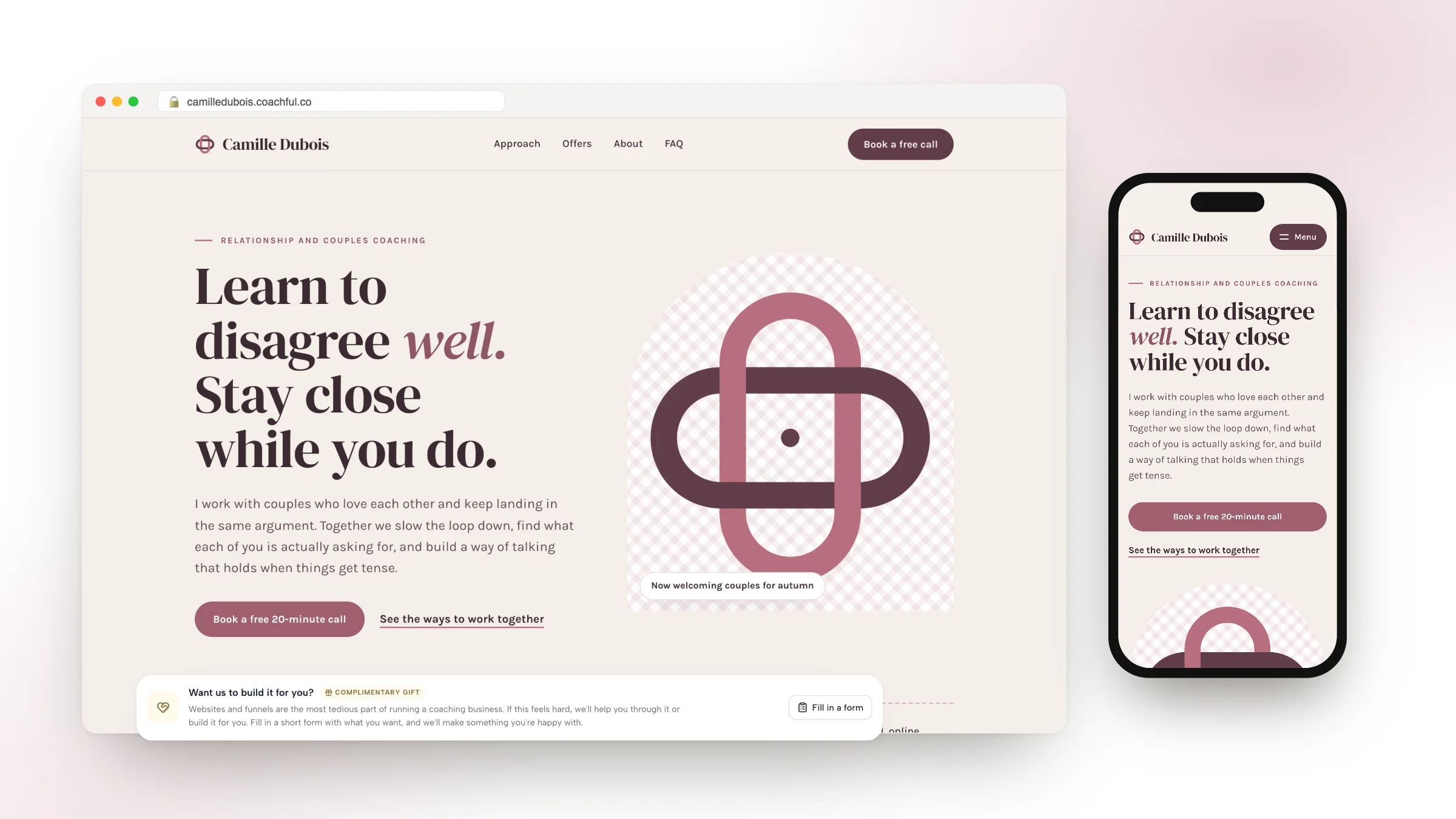
The things to know before becoming a relationship coach mostly come from having two people in the room: one partner usually wants coaching more than the other, both will try to get you on their side, and safety screening has to happen before any couples work starts. Clients tend to arrive in crisis and leave once things calm down, the sessions are long and emotionally heavy, they cluster in evenings and weekends, and who pays for coaching can become part of the conflict.
This is the practical companion to our guide on how to become a relationship coach, which covers who hires you, the line with couples therapy, training, research, how couples sessions run and what the work pays. Here we cover what the work feels like once couples start booking. When you want a website that makes the first call easy to book, Coachful's team will build it for free on every plan (item 9).
The 9 things at a glance
- One partner usually wants this more than the other.
- Both partners will try to recruit you.
- Safety screening comes before couples work, every time.
- Couples arrive in crisis and leave when it's calm.
- Your own relationship becomes part of your credibility.
- Singles, dating and couples are different businesses.
- Your calendar moves to evenings and weekends, and sessions run long.
- The work is heavy, so supervision and limits aren't optional.
- Who pays can become part of the conflict.
1. One partner usually wants this more than the other
The typical first contact is one partner, often the one who's been unhappy longer, booking the call and saying "my partner said they'd come." In the first joint session, that second partner sits with folded arms, answers in single words and watches you for signs that this is a two-against-one setup.
If you coach the keen partner's agenda, the reluctant one checks out and the engagement ends after two sessions. If you put all your energy into winning over the reluctant one, the keen partner feels abandoned.
What to do: name it gently in the first session ("It sounds like this was more one person's idea than the other's, which is really common"), and ask the reluctant partner what would make the time worthwhile for them specifically. Short individual intake calls before the first joint session help, because people say things alone that they won't say together. Our consumer explainer on what relationship coaching is is a good thing to send both partners before the first session, so neither arrives guessing.

2. Both partners will try to recruit you
Expect it within the first three sessions. One partner looks at you mid-argument and says "you can see what I mean, right?" Another sends a long message after the session with "context you need to know." A third books an individual call that turns into a case against their partner.
None of this is bad behavior. People in conflict look for allies. But the moment one partner believes you're on the other's side, the coaching stops working for both. Couples coaches often describe the client as the relationship rather than either person, which gives you a neutral place to stand.
What to do: decide your policies before your first couple. Will individual calls happen, and are they confidential from the other partner? What happens to messages one partner sends between sessions? Many coaches use a "no secrets" rule, explained at intake, so nothing said privately can't be raised jointly. When someone asks you to take a side, turn it back to the pattern: "What happens between you two when it gets to this point?"
3. Safety screening comes before couples work
Couples coaching assumes both people can speak freely. When one partner is afraid of the other, joint sessions can make things more dangerous, because what's said in the session may be punished later at home. That's why experienced relationship coaches screen every couple before the first joint session, with separate questions asked to each partner alone.
The screening doesn't need to be clinical. Ask each partner privately whether they ever feel afraid of the other, whether they've ever been hurt or threatened, and whether they can disagree without worrying about what happens afterward. If the answers raise concern, stop couples work and help the person reach specialist support safely. In the US, the National Domestic Violence Hotline is available 24/7 at 1-800-799-7233, or by texting START to 88788 (US Department of Justice, Office for Victims of Crime).
What to do: build the screening into your intake for every couple, write the "we pause couples work if safety is a concern" rule into your agreement, and keep hotline details ready. Our coaching agreement template has a scope clause you can adapt, and the sibling guide on becoming a relationship coach lists the other referral triggers.

4. Couples arrive in crisis and leave when it's calm
Couples rarely book a coach when things are fine. They book after the worst fight in months, a discovered message, or a weekend away that went badly. Then, four sessions in, the temperature drops, they're getting along, and one of them suggests they can probably take it from here.
Sometimes that's true. Often the calm is the first good stretch, not a new pattern, and the old fight returns at the next stressful moment: a move, a new baby, a job loss, a holiday with in-laws. Coaches who don't plan for this lose clients right when the real skill-building would start.
What to do: sell a defined program long enough to practice skills under normal stress, often three months, and explain at the start that the calm phase is when the work sticks. Build in a planned ending with a maintenance option, such as monthly check-ins for a few months. In Coachful, the Relationships power-up adds a weekly pulse from each partner, shared agreements and a private Repair log of hard moments, which give you early warning when the old pattern returns.
5. Your own relationship becomes part of your credibility
Prospects will ask, sometimes in the first call: "Are you married?" "Have you been divorced?" "Do you have kids?" Some will assume a relationship coach must have a perfect relationship. Others will trust you more because you've been through a divorce yourself.
There's no right answer to how much you share, but there is a wrong approach: improvising it in the moment. Oversharing makes the session about you. Refusing to answer at all can feel cold in a niche built on intimacy.
What to do: decide your boundaries in advance, write a short honest line you're comfortable saying, and use your experience only when it serves the client ("I've been through a divorce, so I know how the first year can feel. What's been hardest for you?"). Remember that your relationship will have its own bad weeks, and that's not a sign you're unqualified. It's a reason to have your own support, as item 8 explains.

6. Singles, dating and couples are different businesses
"Relationship coach" can mean coaching couples, people after a breakup, singles who want to date well, or co-parents. These clients find you in different places, buy differently and need different offers. A single person looking for help with dating apps is searching for something quite different from a couple who keep having the same argument.
Dating coaching also carries a reputation problem in some corners of the internet, from "pickup" content aimed at men to manipulative tactics. If you coach singles, you'll want your marketing to make it clear immediately that you work on confidence, communication and choosing well. Our guide to becoming a dating coach covers how to stay clear of that reputation.
What to do: pick one or two client groups to start, and write separate pages for each if you serve more than one. Coaching people through the end of a relationship is a specialty of its own; our guide to divorce coaching shows how those clients think.
7. Your calendar moves to evenings and weekends, and sessions run long
Two working adults, sometimes with children, can rarely meet you at 11 on a Tuesday. Expect demand to cluster in evenings and weekends, and expect last-minute changes when a babysitter cancels. Joint sessions also tend to run longer than individual ones, often 75 to 90 minutes, because two people need time to speak.
Coachful's 2026 Coaching Business Report makes the same point in its rates data: relationship coaching sessions "are longer and emotionally heavier, so the per-hour figure understates the real cost of delivery." It puts relationship coaching at $100 to $200 an hour (PayScale and practitioner reports), with newer coaches at $75 to $125 and experienced coaches at $125 to $250 (practitioner estimates), and $45,000 to $65,000 a year (PayScale, Glassdoor).
What to do: decide which evenings and weekend slots you'll offer and protect the rest of your week. Price joint sessions by the session or as a package, not by the hour, so a 90-minute session isn't treated as a cheap 60. Use online booking with calendar sync for both partners, and a clear rescheduling rule.

8. The work is heavy, so supervision and limits aren't optional
A day with three couples in conflict is exhausting in a way that a day of career coaching isn't. You absorb anger, grief and sometimes contempt, then switch off, cook dinner and talk to your own partner. Over months, that load builds.
Relationship coaches who last tend to protect themselves deliberately: a cap on joint sessions per day, a buffer after each one, regular supervision or a peer group where they can talk through hard cases (anonymized), and their own coaching or therapy when it's needed.
What to do: set your daily cap before you're busy, book supervision or a peer group from the start, and notice when you're dreading particular couples, which is useful information about the case and about you. Our piece on coach isolation covers the solo-practice side, and our tools for relationship coaches roundup compares the software options.

9. Who pays can become part of the conflict
Money is one of the topics couples fight about, and your fee is money. One partner may be paying for coaching the other didn't want. A couple may disagree about whether it's worth it, or quietly resent the cost when sessions get hard. Sometimes the argument about whether to renew is the argument they came to coach.
What to do: make the package and price clear before the first session, ask who's paying and whether both agree, and take payment up front for the program so the money isn't renegotiated every week. Payment plans help couples commit without a single large payment. Our guide to coaching package tiers shows how to structure options, and the Coachful page for relationship coaches shows the full setup.

Have your website built for free
Coachful's team builds relationship coaching websites, offer pages and funnels for free on every plan, inside your own account. Coachful itself is a paid subscription with a free trial. Choose We'll build it for you · FREE under Create, or Fill in a form on the Website page, and describe your clients, your offer and what visitors should do. Add up to 8 links and 10 files. The team replies by email with next steps, usually within about 24 hours, which is typical rather than guaranteed, and invents nothing: no credentials, testimonials or prices you haven't given. See what the free build covers, and our guide to a relationship coach website lists the pages.

The bottom line
Relationship coaching asks you to stay steady while two people pull in different directions, often late in the evening after their worst week. Know the reluctant-partner dynamic and the pull to take sides, screen every couple for safety, plan for the calm that ends engagements early, decide your boundaries about your own life, pick your client group, protect your calendar and energy, and settle the money up front. Before you take your first couple, read our relationship coach certification guide so your training matches the work, and our list of questions to ask a relationship coach to hear what prospects will ask you.
Frequently asked questions
What should I know before becoming a relationship coach?
Know that one partner often wants coaching more than the other, that both will try to recruit you to their side, and that you must screen for safety before couples work. Expect sessions to run long, to cluster in evenings and weekends, and to end early once things calm down unless you plan for it.
Can a relationship coach work with couples where there is abuse?
Couples coaching isn't appropriate when one partner is afraid of the other, because joint sessions can increase the danger. Coaches should pause couples work and help the person reach specialist support, such as the National Domestic Violence Hotline (1-800-799-7233 or text START to 88788 in the US).
Do relationship coaches need to be married?
No. Clients sometimes ask, and some trust coaches who have been through divorce or hard years themselves. What matters is training, steady neutrality and clear boundaries about how much of your own life you share.
How much do relationship coaches charge?
Coachful's 2026 report puts relationship coaching at $100 to $200 an hour (PayScale and practitioner reports), with newer coaches at $75 to $125. Because joint sessions often run 75 to 90 minutes, most coaches price by the session or as a package.
What is the difference between a relationship coach and a couples therapist?
Marriage and family therapists are licensed and treat relationship distress alongside mental health conditions. Relationship coaches work with functioning couples on skills, decisions and follow-through, and refer to therapists when clinical issues, addiction or safety concerns appear.
Is relationship coaching emotionally draining?
It can be. Sessions often involve anger, grief and conflict. Relationship coaches who last usually cap their joint sessions per day, leave buffers between them and use supervision or a peer group to talk through hard cases.
Will Coachful build my relationship coaching website for free?
Yes. Coachful's team builds coaching websites, offer pages and funnels for free on every plan, inside your account. Coachful is a paid subscription; the build costs nothing extra. Request it from Create or the Website page, and the team replies with next steps, usually within about 24 hours.












