
Transformational Coaching Model: 5 Stages, With Examples
A transformational coaching model is a map of how coaching moves a client from a problem that keeps coming back, to a changed way of seeing it, to behavior that holds after the coaching ends. If you are new to the idea, start with our guide to what transformational coaching is; this article is the practical companion. It sets out one working model in five stages (contract, surface, examine, experiment and integrate), with what the coach does in each, how you know a stage is finished, a worked example, and how the model compares with GROW, CLEAR and Immunity to Change.
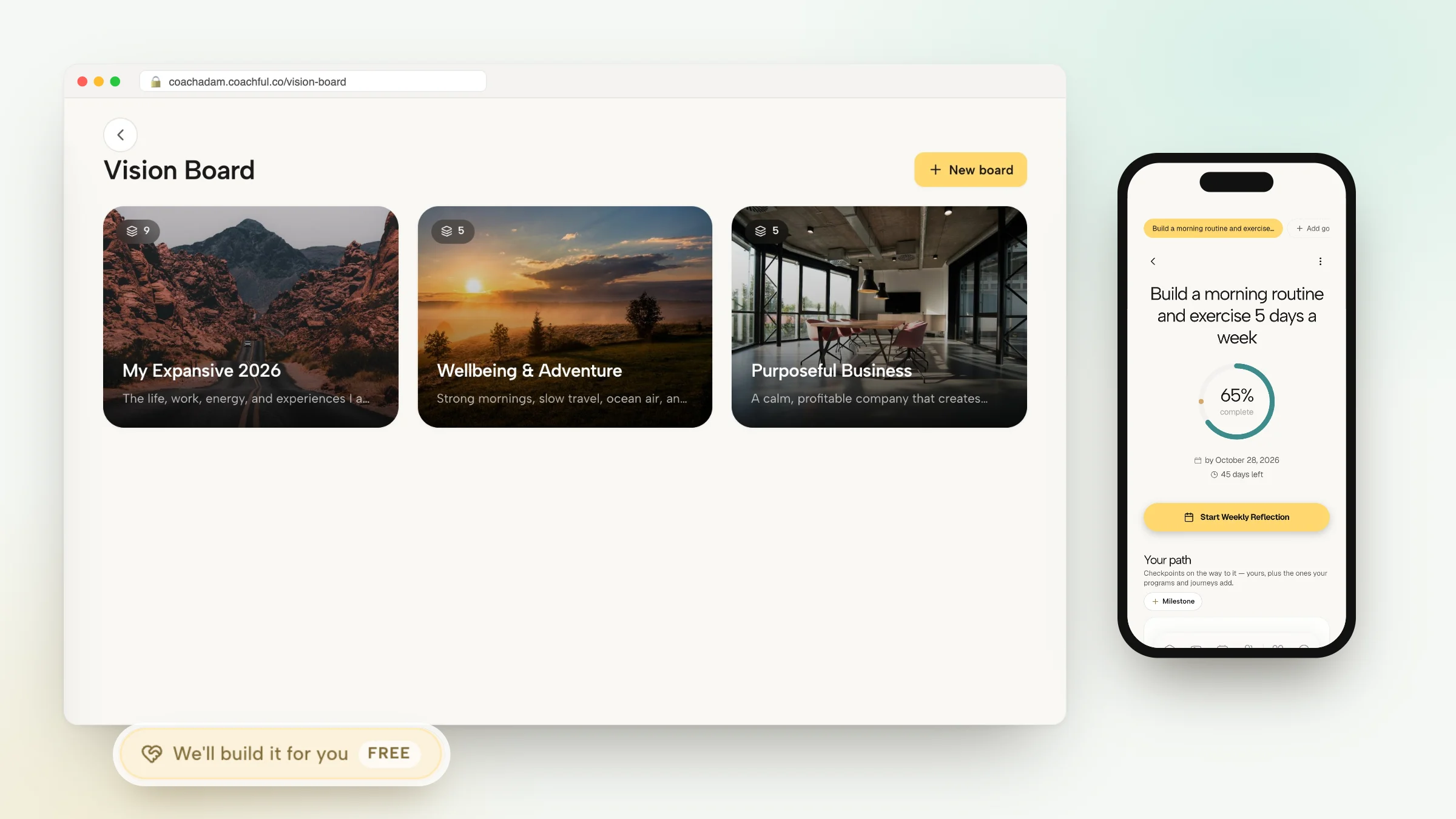
There is no single official transformational coaching model, and no governing body owns the term. The five stages below are Coachful's synthesis of well-established ideas from adult learning and coaching, written so you can use them in a session tomorrow. Once your model is settled, Coachful's team can build it into a program or coaching flow in your account for free, on every plan.
What a transformational coaching model is for
Most coaching models organize a single conversation. GROW, for example, moves from a goal to the current reality, to options, to what the client will do. That works well when the problem is a task. It works less well when the same problem keeps returning in new forms, because the thing producing it is a belief or a commitment the client hasn't looked at.
A transformational model adds depth. It asks the coach to keep track of which level the work is on:
| Level of change | The question at this level | Example |
|---|---|---|
| Behavior | What will you do differently? | "I'll block two hours a day for deep work." |
| Strategy | What approach would work better? | "I'll delegate the weekly report." |
| Assumption | What would you have to believe for the old pattern to make sense? | "If I'm not involved in everything, I'm not adding value." |
| Identity | Who are you becoming as this changes? | "I'm someone who builds a team that doesn't need me in every meeting." |
Change at the top two levels is real but often fades. Change at the bottom two tends to spread into situations the coaching never discussed, which is the mark of transformational work. The model's job is to get you to the deeper levels without skipping the trust and evidence that make them safe.

The five stages at a glance
| Stage | Purpose | The coach's main move | You're done when | Between sessions |
|---|---|---|---|---|
| 1. Contract | Agree the change and the conditions | Turn a vague wish into a shared definition of success | Both of you can say what "better" would look like | An intake form and a baseline rating |
| 2. Surface | Find the pattern behind the presenting problem | Collect examples and listen for repetition | The client names the pattern in their own words | Logging each time the pattern shows up |
| 3. Examine | Find the assumption or commitment holding the pattern in place | Ask what the old behavior protects | A "big assumption" is written down and testable | A reflection prompt on the assumption |
| 4. Experiment | Test the assumption in real life | Design small, safe, time-boxed actions | The client has evidence the assumption is not the whole story | Run the experiment and note what happened |
| 5. Integrate | Make the new way the client's own | Consolidate, plan for setbacks, hand over | The client applies it to a new situation without you | A personal playbook and self-led check-ins |
The stages are a spiral more than a line. A client might reach Stage 4 on one issue and loop back to Stage 2 on another. Each session usually touches two or three stages, and a full engagement passes through all five at least once.
Stage 1: Contract
Contracting agrees what the coaching is for, how you'll work and how you'll both know it's working. In transformational coaching it carries more weight than usual, because the client is about to examine things they would normally defend.
- Define success in observable terms. "Feel less overwhelmed" becomes "leave work by six on four days out of five, without checking email after nine."
- Take a baseline. A Wheel of Life or a few 1 to 10 ratings in the client's own words, repeated at the end. Our guide to the Wheel of Life shows one way.
- Agree the depth. Ask permission to look at beliefs as well as actions, and agree how you'll handle anything that belongs with a therapist.
- Agree confidentiality, especially when a sponsor or employer is paying.
Two questions that open the stage well: "If this coaching worked, what would be different three months from now that someone else could notice?" and "What would make it safe enough to look at the parts of this you'd rather not?"

Stage 2: Surface the pattern
The presenting problem is evidence, not the target. In this stage the coach collects examples and listens for what repeats across them. A client who arrives with "I can't manage my time" may describe three weeks in which the calendar was full of other people's priorities, and each time they said yes in the moment.
- Ask for specific recent examples, not generalizations. "Tell me about Tuesday."
- Listen for the same move in different places: the yes to the boss, the yes to a friend, the yes to the neighbor.
- Reflect it back tentatively. "I notice each story has a moment where you agree before you've decided. Does that fit?"
- Give the client the name. The pattern sticks when it's named in their words ("the reflex yes"), not yours.
Between sessions, ask the client to log each time the pattern shows up and what they told themselves at that moment. Two minutes a day is enough. The levels of listening are the core skill in this stage.
Stage 3: Examine the assumption
Here the work moves from "what keeps happening" to "what is this pattern protecting". The most practical tool for this stage is the immunity to change map from Robert Kegan and Lisa Lahey, which has four columns. Here's one filled in for a fictional client, a manager who wants to give direct feedback:
| 1. Improvement goal | 2. What I do instead | 3. Hidden commitment | 4. Big assumption |
|---|---|---|---|
| Give my team clear, direct feedback within a week of the work | Soften the message until it disappears, wait for "the right moment", fix the work myself | I'm committed to being seen as kind, and to never being the reason someone feels bad | If I'm direct, people will think I'm harsh and stop trusting me |
A composite example, written to show the method rather than a real client.
The big assumption in column four is the thing to test. It's held as a fact ("people will stop trusting me"), and it has probably never been checked. Useful questions in this stage are double-loop questions, in Chris Argyris and Donald Schön's sense: ones that question the reasoning behind an action rather than the action itself. "What were you protecting when you rewrote their slides?" is double-loop. "How could you rewrite them faster?" is not.
Go gently. Examining assumptions can feel exposing, so this stage depends on the trust built in the first two. If what surfaces is grief, trauma or a clinical issue, stop and refer; our guide to trauma-informed coaching covers the signs.

Stage 4: Experiment
Insight alone rarely changes behavior. In Stage 4 the client runs small, real-world tests of the big assumption, and the coach helps design them and make sense of the results.
A good experiment is:
- Small and safe. If the assumption turns out to be true, nothing terrible happens.
- Time-boxed. This week, once.
- Observable. The client can say exactly what happened, not just how it felt.
- Aimed at the assumption, not at the goal. The point is to learn whether "people will stop trusting me" holds.
For the manager above: give one piece of direct, specific feedback to the most secure member of the team, then ask them a day later how it landed. The debrief matters as much as the action: what happened, what the client expected, what they told themselves before and after, and what that suggests about the assumption.
Expect mixed results. Some experiments confirm part of the assumption, which is useful too: it shows where the real limits are.
Stage 5: Integrate
Integration turns a few successful experiments into a way of working the client owns. Without it, change often fades within weeks of the last session.
- Retell the story. Ask the client to describe the original problem as they understand it now. The difference from their intake description is your clearest evidence of change.
- Write the playbook. One page in the client's words: the old pattern, the early warning signs, what they do now, what they do when they slip.
- Plan for setbacks. Name the situation most likely to bring the old pattern back and what they'll do when it does.
- Repeat the baseline from Stage 1.
- Look for transfer. The strongest sign of transformation is the client handling a new situation, one you never discussed, in the new way.
- End well. A closing session with reflection, and a follow-up date a month or two later.

A worked example through the model
A composite client, written to show how the stages connect over ten sessions.
Sessions 1 and 2, Contract. Dev, a newly promoted operations lead, wants to "stop being the bottleneck". Success is defined as two decisions a week made by his team without him, and leaving by six on most days. Baseline ratings: confidence in the team 4 out of 10, own energy 3.
Sessions 2 to 4, Surface. His log shows the same moment eleven times in two weeks: someone brings a problem, and he solves it on the spot. He names it "the rescue".
Sessions 4 and 5, Examine. The immunity map reveals a hidden commitment to being the person who knows the answer, and a big assumption: "If I stop rescuing, things will go wrong and I'll be blamed for it."
Sessions 5 to 8, Experiment. Three experiments, one a week: answer a question with "what would you suggest?"; let one low-stakes decision go ahead without checking it; skip one status meeting. Two go fine. One decision goes wrong, gets fixed by the team, and nobody blames him.
Sessions 9 and 10, Integrate. Dev writes a playbook with the line "my job is to make the call only when it's mine to make". Confidence in the team rises to 7; energy to 6. A month later, at the follow-up, he describes coaching a peer through the same pattern.
How this model compares with other coaching models
| Model | Where it comes from | What it's best at | Where it sits in the five stages |
|---|---|---|---|
| GROW | John Whitmore, Graham Alexander and Alan Fine; popularized in Whitmore's Coaching for Performance (1992) | Structuring a session toward a clear goal and action | Inside Stages 1 and 4: setting goals and designing actions |
| CLEAR | Peter Hawkins | Contracting and review at both ends of a conversation | Bookends every stage; strong on Stage 1 |
| Immunity to Change | Robert Kegan and Lisa Laskow Lahey (2009) | Finding the competing commitment behind a stuck goal | The core tool of Stage 3, and the source of Stage 4's experiments |
| Transformative learning | Jack Mezirow (from 1978) | Explaining how adults revise their frames of reference, often after a "disorienting dilemma" | The theory behind Stages 2 to 5 |
| Double-loop learning | Chris Argyris and Donald Schön (1970s) | Separating questions about actions from questions about the reasoning behind them | The questioning style of Stage 3 |
| The Inner Game | Timothy Gallwey (1974) | Reducing self-interference so performance can rise | A lens for Stage 2: what's getting in the way |
Most experienced coaches use several of these together. Our guide to coaching models every coach should know covers each in more depth, and there are full walkthroughs of the GROW model and the CLEAR model.

Running the model inside a single session
The five stages describe an engagement, but a single 60-minute session often has the same shape in miniature:
- Minutes 0 to 10, contract the session: "What would make today useful?" and a quick look at the last experiment.
- Minutes 10 to 25, surface: one or two specific examples from the past week.
- Minutes 25 to 40, examine: what the examples have in common and what the old move protects.
- Minutes 40 to 52, design the experiment: one small action for the coming week, and what the client will notice.
- Minutes 52 to 60, integrate and close: "What are you taking from today?" in the client's words, written down.
For the questions to use at each stage, see our collection of transformational coaching questions, grouped by the same five stages.
Building the model into your coaching program
A model only works if the between-session work happens. In Coachful, each stage maps onto something the client sees in their app:
| Stage | What to build | Where it lives in Coachful |
|---|---|---|
| Contract | Intake questions and a baseline rating | A form attached to the booking or the first program week, saved to the client record |
| Surface | A short daily log of the pattern | A habit with a reminder, or an evening check-in flow |
| Examine | The immunity map and a reflection prompt | A worksheet before the session, reviewed together |
| Experiment | One experiment a week and a debrief | A weekly task in the program, with a weekly reflection |
| Integrate | The playbook, the repeated baseline and a follow-up | A closing worksheet, a completion flow and a scheduled follow-up session |
Programs are built from weeks and days, with optional modules to group weeks into named phases, so the five stages can become five modules. Check-in steps can be narrowed by program week, so a client in week 2 and a client in week 10 get different questions. You can also keep the model itself as editable pages in Brain, Coachful's private notebook for your methods. More on how programs work in Coachful.
Have the program built for you, free
If your model lives in a notebook and you'd rather not turn it into weeks, tasks and check-ins yourself, Coachful's team will do it for free on every plan. Coachful itself is a paid subscription, and you can start with a free trial.

Open Create and choose We'll build it for you · FREE, then pick "Program", "Journey or coaching flow" or "Form or worksheet". Describe the model, the length of the engagement and what you want clients to do between sessions, and attach up to 10 files, such as your notes, an existing worksheet or a slide from a workshop, plus up to 8 links. The team builds it inside your account and replies by email with next steps, usually within about 24 hours, though that isn't a guaranteed deadline.
A real-estate and money coach recently got a year-long cohort program with an application form and a free nine-day bootcamp course with its own signup funnel. Courses are built as structure, lessons and written material; the team doesn't record your videos, and nothing is invented that you didn't provide. Here's everything the free build covers.
Frequently asked questions
What is the transformational coaching model?
There's no single official one. A transformational coaching model is any structure that helps a client change the beliefs and assumptions behind a recurring problem, then practice acting from new ones. This guide's version has five stages: contract, surface, examine, experiment and integrate.
What are the stages of transformational coaching?
In this model: contract (agree the change and the conditions), surface (find the pattern), examine (find the assumption holding it in place), experiment (test the assumption in real life) and integrate (make the new way the client's own). The stages repeat for each new issue.
What is the difference between the GROW model and transformational coaching?
GROW structures a conversation from a goal to an action and works best for defined tasks. Transformational coaching adds a deeper layer, the assumptions behind the behavior. Many coaches use GROW inside a transformational engagement, for goal setting and for designing experiments.
Is Immunity to Change a transformational coaching model?
It's one of the most useful tools within one. Robert Kegan and Lisa Lahey's four-column map finds the hidden commitment and big assumption behind a stuck goal, which is the core of Stage 3 in this model and the source of the experiments in Stage 4.
How long does transformational coaching take?
Usually three months or longer, because experiments need weeks to run and integration needs time. A ten- to twelve-session engagement, weekly or every other week, is a common shape.
Can I use a transformational coaching model in group coaching?
Yes, with care. Contracting and experiments work well in groups, and peers can hold each other accountable. The examine stage is more personal, so many coaches pair group sessions with short one-to-one calls or private worksheets for that part.
Can Coachful build my coaching model into a program for free?
Yes. Coachful's team builds programs, coaching flows, journeys and worksheets for free on every plan. Send the request from Create with your notes and materials, and the team replies with next steps, usually within about 24 hours. Coachful is a paid subscription; the build costs nothing extra.












