
66 Transformational Coaching Questions, Grouped by Stage
Transformational coaching questions are questions that move a client from describing what keeps happening to examining what they believe about it, and then to testing a different way of acting. They're open, short and aimed at the client's thinking rather than their schedule. Below are 66 transformational coaching questions, grouped by the five stages of a transformational coaching engagement, with situation-specific sets, the questions to avoid and how to turn them into worksheets.
If you want the background first, our guide to what transformational coaching is covers the ideas behind it, and our transformational coaching model explains the five stages these questions follow: contract, surface, examine, experiment and integrate. And if you want these questions turned into a worksheet or a between-session check-in for your clients, Coachful's team will build it for free on every plan.
What makes a coaching question transformational
Most coaching questions help a client do something better. A transformational question asks about the thinking that chose what they did. Chris Argyris and Donald Schön called the difference single-loop and double-loop learning: the first corrects the action, the second questions the reasoning behind it.
| Single-loop question | Transformational version |
|---|---|
| How can you manage your time better? | What do you expect would happen if you had two free hours a day? |
| What will you do differently in the next meeting? | What were you protecting when you stayed quiet? |
| How can you get the promotion? | Who would you have to become for the promotion to feel like yours? |
| What's your plan to stop overeating at night? | What does the evening snack give you that nothing else in your day does? |
| How do you get your team to step up? | What does it cost you if they don't need you as much? |
Good transformational questions share a few traits. They're short. They start with "what" or "how" more often than "why". They contain no hidden advice. And they're asked once the client trusts you, because a question that goes to the root too early feels like an ambush.
How to ask transformational coaching questions
- Ask one question, then stop. Stacking three questions lets the client answer the easiest.
- Let the silence work. The answer after the pause is usually the real one.
- Follow up with "What else?" The first answer is often the rehearsed one.
- Use the client's words. If they said "the reflex yes", ask about the reflex yes, not about "people-pleasing".
- Swap "why" for "what". "Why did you do that?" can sound like blame; "What made that feel like the right move at the time?" invites thinking.
- Ask permission before going deeper. "Can I ask a more personal question about that?" keeps the client in charge.
- Know where coaching ends. If what surfaces is trauma, crisis or a clinical issue, refer. Our guide to trauma-informed coaching covers the signs.
The skill underneath all of this is listening. Our guide to the levels of listening explains how to hear the assumption inside an ordinary sentence.

Stage 1: Contract questions
These questions agree what the coaching is for and how you'll both know it's working. Use them in the first session and at the start of each new topic.
- If this coaching worked, what would be different three months from now?
- What would someone close to you notice first?
- What have you already tried, and what did each attempt teach you?
- What made now the moment to work on it?
- On a scale of 1 to 10, where are you today, and what would make it one point higher?
- What part of this would you rather not look at?
- What would make it safe enough to look at it anyway?
- How will we know if we're working on the wrong thing?
- What do you need from me when you're stuck: a push, a question or patience?
- What would make today's session worth your time?
Stage 2: Surface questions
These questions find the pattern behind the presenting problem. Ask for specific, recent examples rather than generalizations.
- Tell me about the last time this happened. What happened just before?
- Where else does this show up in your life?
- What's the same in all of these examples?
- What do you tell yourself in the moment it happens?
- What happens in your body right before you say yes?
- If this pattern had a name, what would you call it?
- When did you first notice yourself doing this?
- What does this pattern get you that you'd miss if it stopped?
- Who in your life would be least surprised by this pattern?
- What are you not saying about this?
- What would the most honest version of this story sound like?
- If a friend described this to you, what would you notice that they couldn't?
Stage 3: Examine questions
These questions look at the belief or commitment holding the pattern in place. They're the most powerful questions on this list and the ones to use most carefully. Many draw on Robert Kegan and Lisa Lahey's immunity to change approach, which looks for the hidden commitment behind a goal that won't move.
- What are you protecting when you do this?
- What would you have to believe for this to make complete sense?
- What's the worst thing that could happen if you stopped?
- And if that happened, what would it say about you?
- Where did you learn that this is how it works?
- Is that belief true every time, or only sometimes?
- Who would you be without that belief?
- What are you committed to that competes with what you say you want?
- Which of your values is this pattern serving, and which is it costing?
- What's the story you tell about yourself that this pattern keeps confirming?
- If you're right about this, what follows? And if you're wrong?
- What would someone who disagrees with you say, at their most generous?
- What would have to be true for you to change your mind?
Two short follow-ups do a lot of work in this stage: "And then what?" and "What makes you sure?"

Stage 4: Experiment questions
These questions design small, safe tests of the assumption and make sense of what happened. An experiment is aimed at learning, not at hitting the goal.
- What's the smallest version of the opposite of what you usually do?
- Where could you try it this week where the stakes are low?
- What exactly will you do, and when?
- What do you predict will happen?
- How will you know whether your assumption held up?
- What might get in the way, and what will you do then?
- Who could you try it with who would be safe?
- What happened? Describe it as a camera would.
- What did you expect, and what was different?
- What did you tell yourself before, during and after?
- What does that tell you about the belief we wrote down?
- What's the next experiment, a little bigger than this one?
Our walkthrough of scaling questions pairs well with this stage when you want the client to rate progress between experiments.
Stage 5: Integrate questions
These questions make the new way of seeing the client's own, and prepare them to keep it after coaching ends.
- How would you describe the original problem now?
- What's different about how you see yourself?
- Where has the new way shown up somewhere we never discussed?
- What will you do when the old pattern comes back, because it will?
- What are your early warning signs?
- What do you want to remember from this work a year from now?
- If you wrote one page of advice to yourself, what would it say?
- Who could you share this with, so it stays real?
- On the same 1 to 10 scale as our first session, where are you today?
- What's the next thing you want to grow into?

Transformational coaching questions for specific situations
The stage questions work in any niche. These are tuned for four common kinds of client.
Leadership and work
- What do you believe your team would do if you weren't in the room?
- What part of your old job are you still holding on to?
- What kind of leader would your best manager say you are, and is that who you want to be?
Career change
- What would you do next if you knew it couldn't fail, and what does that tell you about what's really stopping you?
- Whose voice do you hear when you talk yourself out of it?
Relationships
- What do you need in this relationship that you haven't asked for?
- What do you assume the other person thinks, and how could you check?
Health and habits
- What is the old habit doing for you that you'd need to replace?
- What would taking care of yourself look like on your worst day, not your best?
For more by niche, see our career coaching questions, confidence coaching prompts and Socratic questions for coaching.
Questions to avoid, and what to ask instead
| Avoid | Why | Ask instead |
|---|---|---|
| "Don't you think you should just say no?" | Advice disguised as a question | "What would saying no cost you?" |
| "Why do you always do that?" | Sounds like blame, and "always" overstates it | "What happens just before you do that?" |
| "Is it fear or is it habit?" | Gives the client your two options | "What do you make of it?" |
| "How do you feel, and what will you do, and when?" | Three questions at once | "How do you feel about it?" Then wait. |
| "Have you tried meditating?" | Closed, and it's your solution | "What's worked for you before, even a little?" |
Turning these questions into worksheets and check-ins
Questions do their best work between sessions, when the client meets the old pattern in real life. A few of them, asked at the right moment, keep the work alive:
- Before each session: a three-question worksheet ("What happened with the experiment?", "What did you tell yourself?", "What do you want from today?").
- Every evening for two weeks: a one-question check-in from Stage 2 ("Where did the pattern show up today?").
- Once a week: a reflection with a 1 to 10 rating and one Stage 4 question.
- At the end: a closing worksheet built from the Stage 5 questions.

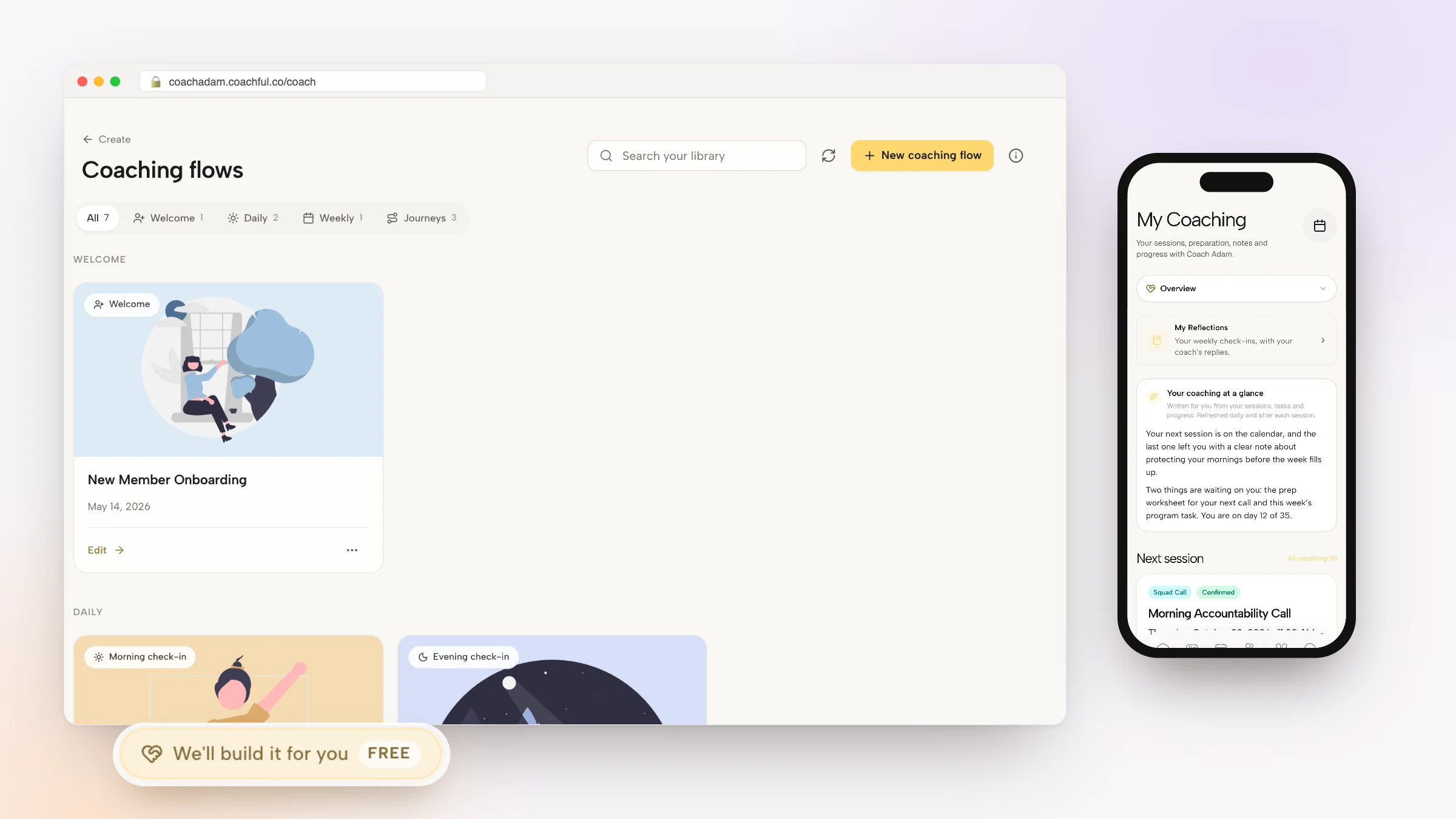
In Coachful, forms and worksheets are a resource type you can attach to a session or a program week, and the answers stay on the client's record. Check-in flows can be set for morning, evening or weekly, and a step can be narrowed by program week, so a client in week 2 and a client in week 10 get different questions. Journaling can be a habit with a reminder. More on forms and questionnaires in Coachful.

Have your question sets built into a worksheet, free
If you'd rather not type 66 questions into forms, Coachful's team will build them for you for free on every plan: a pre-session worksheet, an evening check-in flow, a closing reflection or a whole program that uses them. Coachful itself is a paid subscription, and you can start with a free trial.
Open Create and choose We'll build it for you · FREE, then pick "Form or worksheet" or "Journey or coaching flow". Paste the questions you want, say when clients should see them and attach any existing worksheets (up to 10 files) or links to examples (up to 8). The team builds them inside your account and replies by email with next steps, usually within about 24 hours, though that's not a guaranteed deadline. Nothing is invented: the questions are yours, and anything unclear is left for you to decide. Here's everything the free build covers.

Frequently asked questions
What are transformational coaching questions?
Questions that help a client examine the beliefs and assumptions behind a recurring problem, rather than only the problem itself. "What are you protecting when you do this?" is a typical example. They're open, short, free of hidden advice and usually start with "what" or "how".
What is a powerful transformational coaching question?
One that makes the client pause because they've never asked it of themselves. "What would you have to believe for this to make complete sense?" and "Who would you be without that belief?" often do that. The power comes as much from timing and silence as from the wording.
How many questions should I ask in a coaching session?
Fewer than you think. Five or six well-chosen questions, each followed by silence and a "what else?", usually do more than twenty. Let the client's answers decide the next question rather than working through a list.
What is the difference between transformational and transactional coaching questions?
Transactional questions solve a defined problem ("What needs to be done by Friday?"). Transformational questions look at the pattern producing the problem ("What would happen if it didn't get done?"). Experienced coaches use both, often in the same session.
Can I use these questions in group coaching?
Many of them, yes, especially the contract, experiment and integrate questions. Stage 3 questions are more personal, so in groups offer them as private journaling prompts or save them for one-to-one time.
Are transformational coaching questions the same as therapy questions?
Some look similar, but coaching questions point toward choices and action in the present, and coaches don't diagnose or treat. If a question opens up trauma or a clinical issue, the right next step is a referral to a licensed professional.
Can Coachful turn my coaching questions into a worksheet for free?
Yes. Coachful's team builds forms, worksheets, coaching flows and programs for free on every plan. Send your questions through the request form under Create, and the team replies with next steps, usually within about 24 hours. Coachful is a paid subscription; the build costs nothing extra.












