
Vision Board Workshop: A Two-Hour Plan and Script
A vision board workshop is a guided group session, usually 90 minutes to three hours, in which each person makes a vision board and leaves with written goals and a first step for the coming week. The ones people remember spend as much time on writing and planning as on cutting out pictures, keep any sharing optional, and check in with everyone about a week later. Without that structure, it is a pleasant craft afternoon that nobody thinks about again.
This plan is written for coaches running a public or client workshop, and it works just as well for a team offsite or a group of friends in January. You get a two-hour run sheet, the exact lines to say at each transition, a supply list, an online version, a team version, the follow-up, and how to run the whole thing inside Coachful.
Who runs vision board workshops, and why
| Host | Usual goal | Typical format | What to get right |
|---|---|---|---|
| Coach, public workshop | Meet new people and show how you coach | Two hours in person or 90 minutes online, often in late December or January | A clear next step at the end (a call, a program, a group) |
| Coach, existing clients | Kick off a program or a new year | Group session inside a program | Turn every board into goals and habits the same week |
| HR or a team lead | Wellbeing, team connection, planning | 60 to 90 minutes, work-life focus | Voluntary, private boards; managers do not review them |
| Community group or friends | A fun, reflective evening | Two to three hours with food | Someone keeps time so it does not drift |
If you are new to running workshops in general, our guide on how to run an online coaching workshop covers ticket pages, promotion and the tech check. This page sticks to what is specific to vision boards.
Supplies for an in-person vision board workshop
- A board per person: poster board, foam board or a large sheet of card. Cork boards are lovely but heavy to carry home.
- Images: old magazines and catalogs sorted into piles by theme (travel, home, food, work, nature, fitness) so nobody spends 20 minutes searching for one picture. Invite people to bring printed photos of their own.
- Glue sticks, scissors, washi tape, markers and a few metallic pens.
- Printed prompt cards (the reflection prompts below) and the planning sheet, one per person.
- Sticky notes for first steps, so they can be swapped each week.
- Name tags, a timer, quiet music and snacks.
- A bag or folder so the boards get home flat.
For an online workshop, replace the craft table with a digital board link or template, a prompt card PDF, and a short list of free photo libraries. Send them two days before so people arrive ready.
A two-hour vision board workshop run sheet
| Time | Segment | What happens |
|---|---|---|
| 0:00 to 0:10 | Welcome | Why boards help and what people leave with. One-line intro each: name and one word for the year ahead. |
| 0:10 to 0:25 | Look back | Solo writing: three things that went well this year, one thing you are leaving behind, one lesson you are taking with you. |
| 0:25 to 0:45 | Choose areas and write sentences | Pick three to five life areas. Write one present-tense sentence per area for the end date. |
| 0:45 to 1:15 | Image hunt | Find two or three images per area: at least one of the result and one of the everyday action. |
| 1:15 to 1:35 | Build the board | Arrange by area, theme word in the middle, leave space at the bottom for this week's steps. |
| 1:35 to 1:50 | Obstacles and first steps | For each area: the likely obstacle, an if-then plan, and one step for the next seven days on a sticky note. |
| 1:50 to 2:00 | Pairs and close | Optional: tell one partner your first step. Everyone writes the date they will review the board. Explain the follow-up. |
For a 90-minute online version, shorten the look-back to ten minutes, the image hunt to 20 and the build to 15. For a half-day version, add a longer look-back, a walk or lunch break, and a second round in pairs where each person helps the other make their first steps smaller.
What to say: a facilitator script for each transition
The lines below keep the room moving without lecturing. Adapt the words; keep the order.
- Opening: "Tonight is not about wishing harder. You will leave with a board, three or four clear goals, and one thing to do this week. Sharing is always optional."
- Into the look-back: "Before we picture next year, take stock of this one. Write fast, nobody will read it."
- Into the sentences: "Write each goal as if it is already true on your end date. If it sounds like someone else's goal when you read it back, cross it out."
- Into the image hunt: "For every picture of the result, find one of the ordinary Tuesday that gets you there. Shoes by the door, a laptop open early, a phone in a drawer."
- Into the build: "Group by area. Leave space. A crowded board is hard to read at seven in the morning."
- Into obstacles: "What usually gets in the way? Write 'If that happens, then I will...' for each area."
- Close: "Put your review date in your phone now. In a week, I'll ask how the first step went."
That order follows the research. Picturing only the dream outcome has been linked to lower energy afterwards (Kappes and Oettingen, 2011), picturing the process improved study time and grades in a classic experiment (Pham and Taylor, 1999), and the wish, obstacle, if-then-plan sequence improved goal attainment across 21 studies, with a stronger effect when it was guided by a person rather than read from a document (Wang, Wang and Gai, 2021). That last finding is a good argument for running it as a workshop at all.
Reflection prompts for a vision board workshop
- What went better this year than you expected?
- What are you ready to stop carrying into next year?
- If the next 12 months went well, what would a normal Wednesday look like?
- Which part of your life gets the least of your attention right now?
- What would you do more of if nobody were watching?
- What do you want people close to you to notice about you by next December?
- What is one thing you want to learn?
- Where do you want to spend more of your money, and where less?
- What usually gets in the way when you set goals?
- What is the smallest step you could take in the next seven days?
For more pictures and words people can use, share our list of vision board ideas. The step-by-step method in how to make a vision board works as a handout.
Running a vision board workshop online
- Send everything in advance: the board template or link, the prompt card PDF, the planning sheet and the timing.
- Cameras on, microphones off during solo work, with quiet music shared from your screen.
- Use a digital board or let people work on paper at home and hold the board up at the end. Our guide to the digital vision board compares the options.
- Breakout pairs for the last ten minutes, two or three minutes each.
- Record only your teaching parts, never the sharing, and say so at the start.
A vision board workshop for a team at work
Vision boards can work well at an offsite, with three adjustments. Make it voluntary, because some people do not want to share their personal life with colleagues. Keep boards private by default; nobody, including managers, should review them. And offer a work-only option, such as "the next 12 months in my role", for people who would rather not go personal. A short pairs exercise on first steps is enough sharing for most teams.
Free or paid, and how to price it
We do not have benchmark data for vision board workshop ticket prices, so price from your goal and your costs. If the workshop is how new people meet you, a free or low-cost seat with a clear next step (a discovery call, a group program) often makes more sense than a high ticket. If it is a stand-alone product, add up venue, materials and your preparation time, then decide what a seat needs to cost for the session to be worth running. The free-or-paid section of our online workshop guide walks through the trade-off, and our webinar funnel guide covers sign-ups.
The follow-up that makes the workshop count
| When | What to send | Why |
|---|---|---|
| Same evening | Thank you, a reminder to photograph the board and set the review date | Momentum, while it is fresh |
| Day 2 | The planning sheet and a digital board template | For people who ran out of time |
| Day 7 | "Did your first step happen? Reply with one word." | Reporting progress to someone is linked to better goal attainment |
| Day 30 | A short group review session or a one-to-one offer | The point where most boards are forgotten |
The day-7 check-in is the cheapest part of the whole workshop and probably the most useful. A meta-analysis of 138 randomized studies found that monitoring goal progress improved goal attainment, with larger effects when progress was reported to others or physically recorded (Harkin and colleagues, 2016). If attendees want an ongoing version, pairing them as accountability partners keeps the check-ins going without you.
Vision board workshop mistakes
- Two hours of cutting and gluing and no planning. Protect the obstacles and first-steps segment.
- Forced sharing. Boards can hold money, health and relationship hopes. Always offer a pass.
- Promising outcomes. A board does not make things happen; say plainly that the work after the workshop does.
- No follow-up, which turns a good evening into a forgotten one.
- Too many people for one facilitator. Past about 20 in person, bring a helper to keep time and supplies moving.
Running a vision board workshop in Coachful
If you are a coach, Coachful can hold the whole workshop, from sign-up to the day-30 review.
Sign-ups and the session itself
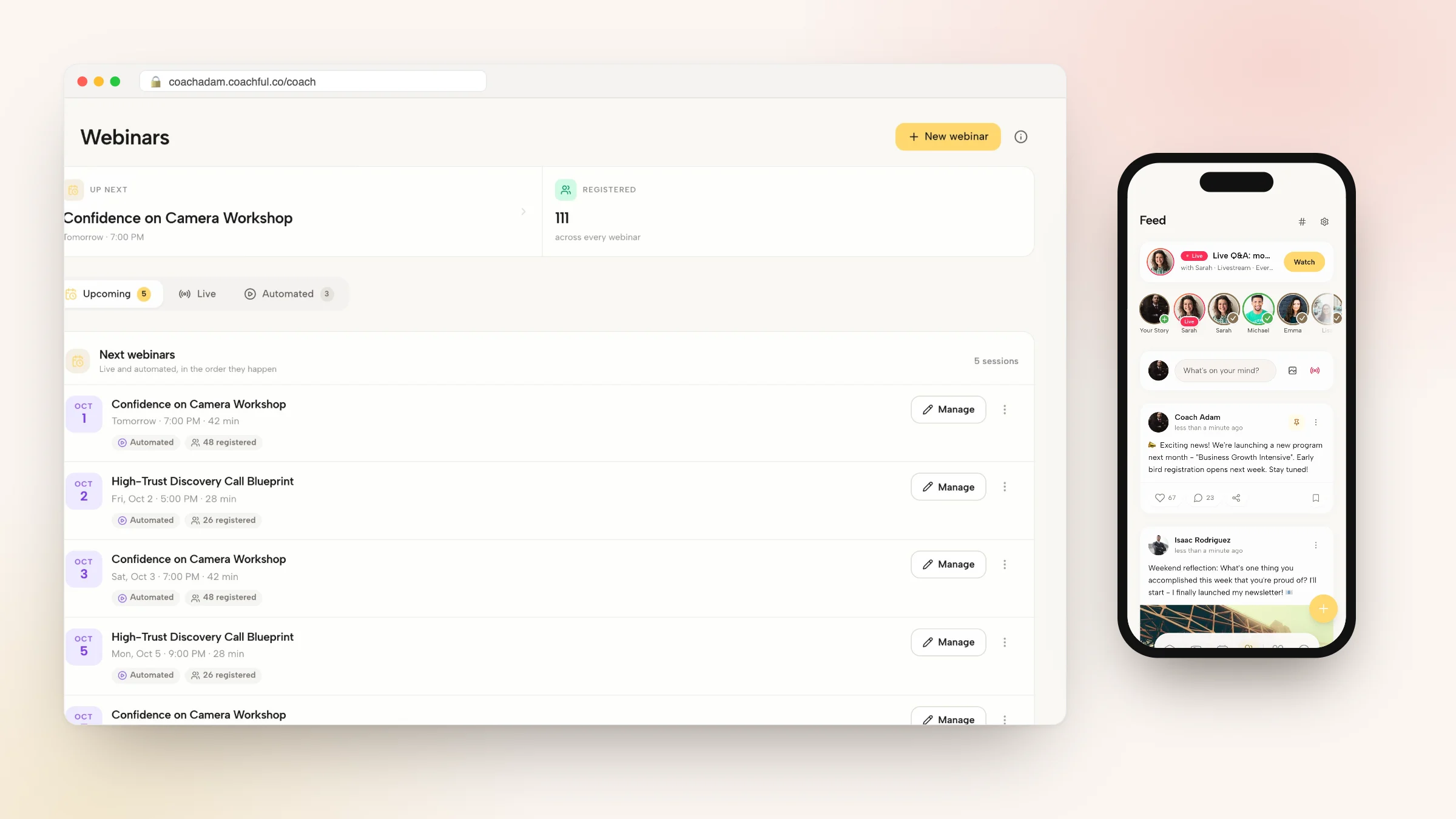
Run the workshop as a live webinar or an event in Coachful, with registration on a page you share, reminders before it starts, and paid tickets if you charge. A funnel can collect sign-ups from your website or social posts and lead into the registration. For an existing group, schedule it as a group session inside the program.

The board each attendee keeps
Build the workshop board as a template in Create > Resources > Vision boards, with the areas, prompts and a "this week" strip already laid out. Send it to attendees you have added as clients, or offer it as a free or paid resource. Each person edits their own private copy, with images, videos, text, cards, drawing and background music, and their copy stays private to them. Put the prompt cards and planning sheet in the same library as a PDF download.


The follow-up, done once
Write the same-evening, day-2, day-7 and day-30 messages as an email sequence, so every workshop runs the same follow-up without you remembering to send it. Invite attendees to post their first step in your community if they like, and for clients, add the board as the first step of a journey or program week so it sits next to their goals and habits.


Or have the team set it up
The Coachful team will build the workshop's registration funnel, the board template, the handout and the follow-up emails inside your account at no extra cost through the free white-glove service. Use the Want us to build it for you? card on the Funnels page or We'll build it for you on the Create page, describe the workshop and attach anything you already have. The team replies by email, usually within about 24 hours. Our pages for group coaching and life coaches show how the rest fits together.

Frequently asked questions
How do you run a vision board workshop?
Welcome people and set expectations, give ten to fifteen minutes to look back on the year, have everyone write one sentence per life area, then hunt for images, build the board, name obstacles with if-then plans and write a first step. Close with optional pairs sharing and a follow-up a week later.
How long should a vision board workshop be?
Two hours suits most in-person groups, and 90 minutes works online. A half day of about three hours gives room for a longer reflection and a break. Under an hour usually means a rushed board and no planning.
What supplies do I need for a vision board party?
A board per person, magazines sorted by theme, printed photos, glue sticks, scissors, tape, markers, sticky notes for first steps, printed prompt cards and a planning sheet, name tags, a timer, music, snacks and a way to carry the boards home flat.
Can you do a vision board workshop online?
Yes. Send a digital board template and the prompts beforehand, keep cameras on and microphones off during solo work, use breakout pairs for sharing, and record only your teaching segments. Shorten each segment so the session fits in about 90 minutes.
Should I charge for a vision board workshop?
It depends on its job. As a way to meet new clients, free or low-cost seats with a clear next step often work best. As a stand-alone product, price from your venue, materials and preparation time. We do not have benchmark ticket-price data, so test and adjust.
Is a vision board workshop a good idea for a work team?
It can be, if it is voluntary, boards stay private, managers do not review them, and there is a work-only option for people who prefer not to share personal goals. Keep any sharing to first steps in pairs.
Can Coachful set up my vision board workshop?
Yes. Coachful's free white-glove service builds the sign-up funnel, the board template, the handout and the follow-up emails in your own account. Ask from the Funnels page card or We'll build it for you on the Create page.












