
Will AI Replace Coaches? What Changes and What Stays Human
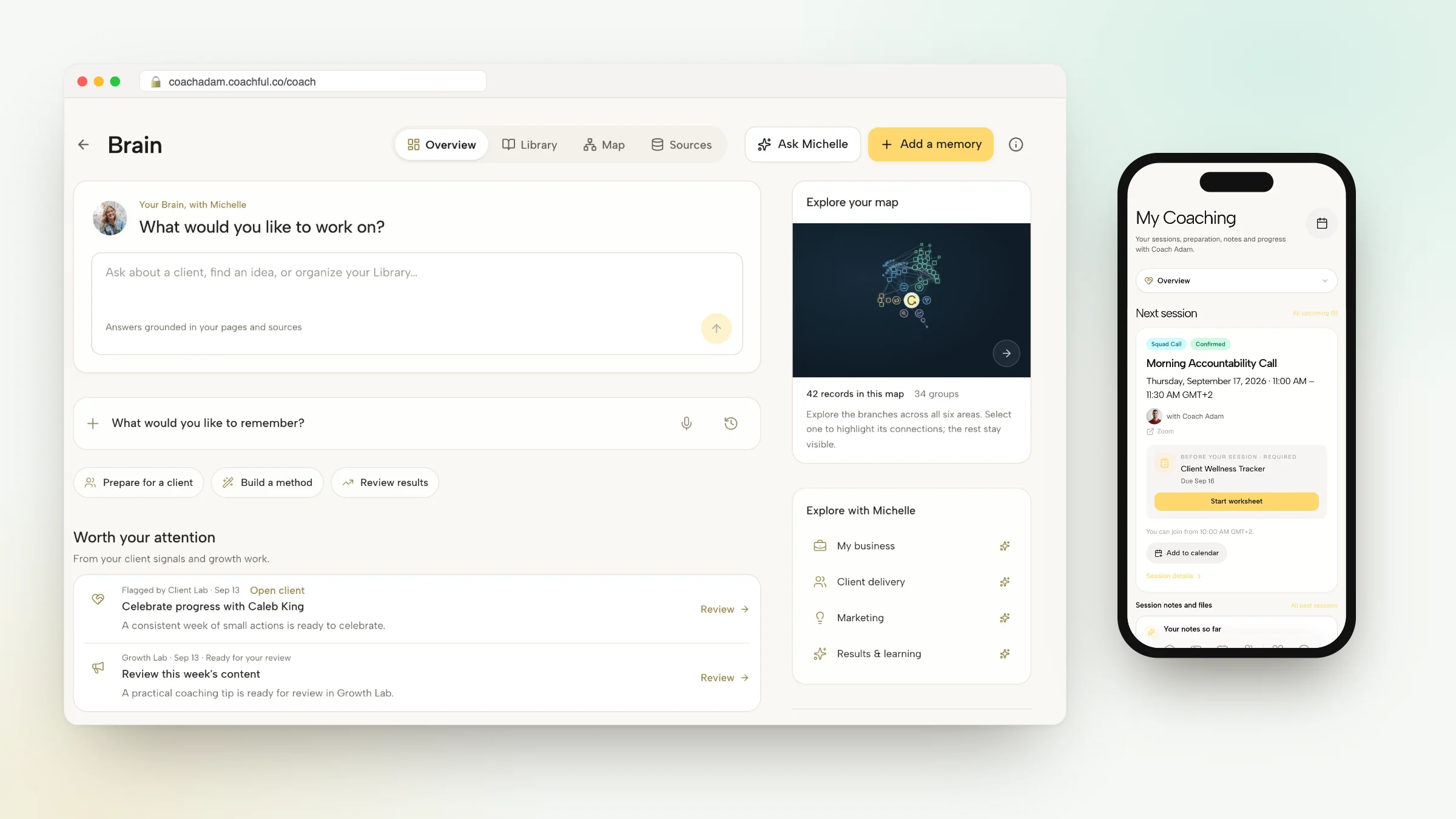
Not wholesale, on current evidence, but it is already taking over parts of the job. Will AI replace coaches? Studies show AI coaching can help people reach clearly defined goals, and in one ten-month randomized trial an AI coach did about as well as human coaches on goal attainment. Where AI still falls short is the relationship: presence, the judgment to notice when coaching isn't enough, and being accountable to a real person. Coaches who sell information and generic reminders are the most exposed; coaches who hand the admin to AI and keep the relationship human are in the strongest position.
This is the coach's-eye view. Below: which coaching tasks AI already does well, what the research says about AI coaching against human coaching, the rules the profession has set, which practices are most exposed, and a practical plan for working with AI rather than against it. If you're a client wondering whether a chatbot can coach you, our guides to AI life coaches and ChatGPT as a life coach cover that side.
Will AI replace coaches? Task by task
| Part of the job | What AI does today | What stays human |
|---|---|---|
| Session notes and summaries | Transcribes, summarizes and drafts the client recap well | Deciding what matters and what the client should see |
| Scheduling, reminders, follow-ups | Largely automated already | Knowing when a missed session means something |
| Programs, worksheets, emails, content | Fast first drafts from a short brief | Your method, your examples and the final edit |
| Questions on a well-defined goal | Competent; trials show goal-attainment gains | Following the unexpected thread |
| Between-session check-ins | Can answer, nudge and log, if a coach sets it up | The coach's read on how someone is really doing |
| Trust, presence and challenge | Weak; users describe AI sessions as transactional | Most of the value clients pay for |
| Spotting risk and referring to therapy | Unreliable; shouldn't be left to AI | A professional's judgment and duty |
| Accountability to a person | Reminders without stakes | Someone you don't want to let down |
What the research says about AI coaching
The evidence is young but no longer thin. The studies coaches should know:
- AI matched human coaches on goal attainment in a ten-month trial. Terblanche and colleagues ran two randomized controlled trials, one with human coaches and one with an AI chatbot coach, each against a control group. Both coached groups improved goal attainment more than controls, and by the end the AI coach was about as effective as the human coaches. The participants were undergraduate students and the measures were self-reported, so the authors caution against generalizing (PLOS ONE, 2022).
- AI speeds up goal-setting but doesn't create presence. In interviews with 15 HR leaders using AI coaching, the AI "effectively accelerates goal clarification and provides structured task suggestions, yet it does not generate a coaching presence." Without it, sessions felt "transactional and emotionally unresponsive," and coaching-trained participants spotted the gaps first (Nam and Choi, PLOS ONE, 2026).
- Clients may want AI to be more directive than human coaches are. In a 158-person comparison of a directive and a non-directive AI coaching chatbot, users rated the directive style higher on working alliance and goal attainment (Terblanche and Brown, 2026). Interesting for design, and a reminder that AI isn't simply a cheaper copy of a human coach.
- AI-written coaching messages can pass as human, with caveats. In a weight-loss trial, revised ChatGPT messages were rated as helpful as human-written ones, and half were mistaken for human. Participants still found them "more formulaic, less authentic, and too data-focused" (Huang and colleagues, 2025).
- AI is unsafe as a stand-in for mental health care. A 2025 study found large language models expressed stigma toward people with mental health conditions and responded inappropriately in high-stakes therapy-like situations, and concluded they should not replace therapists (Moore and colleagues, 2025).
Put together: AI can deliver structured, goal-focused coaching for some people, and it is getting better. It is weakest exactly where the coaching relationship is strongest.

How coaches are already using AI
Adoption is real but mostly behind the scenes. In NBHWC's 2025 survey of board-certified health and wellness coaches, 38 percent reported using AI tools, mainly for documentation, marketing and program development (NBHWC, 2025). That pattern matches what most coaches describe: AI drafts and summarizes, and the coach coaches.
A qualitative study of 12 professional coaches whose coaching firm adopted AI coaching found the same arc many coaches report privately. The top-down rollout first caused real role confusion; coaches defended what they saw as uniquely human, such as empathy, while experimenting, and gradually shifted from seeing AI as a threat to using it as a collaborative tool, with new "blended" human-AI coaching models emerging (Bozer and Kotte, 2026).

The rules the profession has set
Coaching bodies have moved faster than many expected.
- ICF AI Coaching Framework and Standards (November 2024). The ICF published standards for AI coaching systems across six domains, from foundational ethics to assurance, testing, privacy and accessibility, and describes AI as "a valuable complement to human coaching" (ICF).
- ICF Code of Ethics (April 2025). The current code applies a coach's obligations "through any technology systems I may utilize," explicitly including AI, and requires electronic records and communications to be kept confidential and secure (ICF Code of Ethics).
- Laws on AI and therapy. Illinois's Wellness and Oversight for Psychological Resources Act, signed in August 2025, bars the use of AI to provide mental health and therapeutic decision-making, while licensed professionals may still use it for administrative and supplementary support (Illinois IDFPR). Coaching isn't therapy, but the direction is clear: AI that drifts into treatment is a legal risk.
If you're credentialed, the practical upshot is that you are responsible for any AI you use with clients, including what it says and where their data goes. Our guide to AI session notes and client consent covers the consent conversation.
Which coaching practices are most exposed
AI pressure isn't spread evenly. Rough guide:
| More exposed | Less exposed |
|---|---|
| Offers built on information: tips, templates, generic plans | Offers built on a relationship over months |
| "Accountability only" text check-ins with no coaching | Accountability tied to a person the client knows |
| Low-price single sessions on common problems | High-stakes decisions: careers, leadership, transitions |
| Self-paced programs with no live element | Group facilitation and live cohorts |
| Coaches who can't explain their method | Coaches with a clear method and a specific niche |
The pattern: if a client could get 80 percent of your offer from a well-prompted chatbot, price pressure is coming. If what they buy is you, your judgment and their commitment to you, AI mostly makes you more productive. If you're still deciding whether to go into coaching at all, our guide to whether life coaching is a good career weighs the rest of the picture.

A practical plan: working with AI, not against it
- Hand over the admin first. Notes, recaps, scheduling, email drafts and program outlines are where AI saves hours with the least risk. Review everything before a client sees it.
- Get consent and be specific. Tell clients what AI you use, for what, and what happens to their data. Put it in your agreement.
- Put AI between sessions, on your terms. A coach-configured assistant that knows the client's program, habits and check-ins can answer "where was that worksheet?" at 10pm. Set boundaries on topics, and rules for when it sends the client back to you. Our guide to setting up an AI coaching assistant that stays in its lane walks through it.
- Keep risk with humans. Anything that sounds clinical, unsafe or urgent goes to you, and from you to a licensed professional where needed. Don't let AI make that call.
- Redesign the offer around what only you do. More live time on the hard conversations, less on information you can now deliver another way.
- Use AI to get better at coaching. Feedback on your own sessions against the ICF Core Competencies is now possible privately; treat it as a self-development aid, not an assessment. Our guide to the ICF Core Competencies covers what's measured.

How Coachful uses AI, with the coach in charge
Coachful has two kinds of AI, and both are built around the coach rather than instead of them. Details are on the AI coaching assistant page.
Michelle, for the coach. Michelle is the AI assistant inside Coachful. It works from your live practice data across clients, programs, sessions, calendar and payments. It summarizes recorded sessions and writes the client-facing summary, drafts emails and content, builds a program from a description with weeks, tasks and habits, and, if you turn it on, scores your own sessions privately against ICF Core Competencies 3 to 8. It asks you to confirm before it writes any change to your practice, and its competency feedback is not an ICF assessment or a substitute for mentor coaching.
The AI Coach, for your clients, if you want one. It is off until you set it up, and you choose which clients can use it. You give it a name, a personality, instructions, topics to avoid and rules for when to send the client back to you. It answers from the client's own program, tasks, habits, check-ins and next session, in Messages on the web and in the iPhone and Android apps. It doesn't diagnose, treat or do crisis counseling, and it sends personal decisions back to you.
Behind both, the rest of the practice runs as normal: booking, payments, agreements and the client app. See it on the Coachful page for life coaches.


The part AI doesn't do: our team builds it for you
Separately from Michelle, Coachful's team of people will build your website, funnel, offer page or program inside your account for free on every plan. Pick We'll build it for you · FREE under Create, or use the "Want us to build it for you?" card on Website or Funnels, describe what you need and attach up to 10 files and 8 links. The team replies by email, usually within about 24 hours, which isn't a guaranteed deadline. Nothing gets invented, and logo design, video recording and ad management aren't included. See what the free build covers.

Frequently asked questions
Will AI replace life coaches?
Not on current evidence. AI can help with structured, goal-focused coaching, and one trial found an AI coach about as effective as human coaches on goal attainment. Studies also find AI sessions feel transactional and lack coaching presence, which is much of what life coaching clients pay for.
Can AI be a coach?
It can deliver some coaching: asking questions on a defined goal, suggesting tasks and sending check-ins. The ICF has published standards for AI coaching systems and describes AI as a complement to human coaching. It is unreliable at spotting risk and shouldn't be relied on for anything clinical.
Will health coaches be replaced by AI?
Some health coaching tasks will be automated, such as reminders and message drafts. In NBHWC's 2025 survey, 38 percent of board-certified coaches already used AI, mainly for documentation, marketing and program development. Behavior change still leans heavily on a trusted relationship.
Is AI coaching as good as human coaching?
For narrow, well-defined goals it can come close. In a ten-month randomized study with undergraduates, an AI coach and human coaches achieved similar goal attainment. For complex decisions, emotional depth and accountability to a person, the research still favors humans.
Should coaches use ChatGPT with clients?
Only with care. Tell clients what you use and how their data is handled, avoid pasting identifiable details into general tools without consent, review everything AI drafts, and never let it handle anything clinical. The ICF Code of Ethics applies your obligations to any technology you use.
What coaching jobs are most at risk from AI?
Offers built on information or generic accountability: templated plans, tip-based programs, low-price single sessions on common problems. Coaching built on a relationship, a clear method and a specific niche is far less exposed.
Will Coachful build my coaching website for free?
Yes. Coachful's team builds websites, funnels, offer pages and programs for free on every plan, inside your own account. Fill in the form from Create, Website or Funnels, and the team replies by email, usually within about 24 hours. Coachful itself is a paid membership with a free trial.












