
Is Life Coaching a Good Career? An Honest Look at the Numbers
It can be, for the right person, but it is a business before it is a job. Is life coaching a good career? Demand is real and growing: the ICF's estimate of coach practitioners worldwide rose from 53,300 in 2015 to 122,974 in 2025. The catch is income. In the ICF's 2023 study, more than half of coaches reported under $30,000 a year from coaching, and life coaching is the easiest niche to enter and the most crowded. People who do well usually pick a specific audience, sell packages and treat the first two years as building a business.
This page is the decision, not the how-to. It sets out the evidence on demand, income, time and satisfaction, the honest pros and cons, how much the niche matters, and a self-check you can score in five minutes. If you decide yes, our guide to how to become a life coach covers training and setup, and Coachful's team will build your coaching website for free on every plan so setup costs stay low.
Is life coaching a good career? The evidence at a glance
| Question | What the data says | Source |
|---|---|---|
| Is demand growing? | Coach practitioners worldwide: 53,300 (2015), 109,200 (2022), 122,974 (2025) | ICF Global Coaching Studies |
| What do coaches earn? | Global average $52,800 a year from coaching in 2022; 53% earned under $30,000 | ICF 2023 |
| What do life coaches earn? | $47,000 to $72,000 a year in salary data that skews toward employed coaches | PayScale, ZipRecruiter, Glassdoor via Coachful's 2026 report |
| How crowded is life coaching? | Saturation rated "extremely high"; entry "low" | Coachful's 2026 report, practitioner estimate |
| How many hours do coaches coach? | 11.9 hours a week on average in 2022 | ICF 2023 |
| Do coaches do other work too? | 93% offer services besides coaching, most often consulting, training or facilitation | ICF 2023 |
| How long to a stable business? | 4 to 6 years to an established practice | Practitioner estimate |
ICF figures from the 2023 executive summary and the 2025 study page. Report figures from Coachful's 2026 Coaching Business Report on coachingrates.com.
Demand: more coaches, and more paying clients
The profession has more than doubled in a decade. The ICF's 2016 study estimated 53,300 coach practitioners worldwide, 17,500 of them in North America (ICF, 2016). By 2022 the estimate was 109,200, with 34,200 in North America, and 91 percent said they had active clients. The 2025 study put the figure at 122,974 and estimated $5.34 billion in coaching revenue, with 59 percent of coaches expecting to earn more the following year.
That growth cuts both ways. More people buy coaching, and more people sell it. The money tends to follow coaches whose clients have a budget: in the 2023 study, coaches said 57 percent of their clients were sponsored, usually by an employer, and coaches with more sponsored clients reported higher fees and income. Our sibling piece on how many life coaches there are breaks the counts down by region.

Income: the part to be clear-eyed about
Coaching income is spread wide, and the middle is lower than many training programs imply. The ICF's 2023 study put the global average at $52,800 a year from coaching, $67,800 in North America, with more than half of coaches under $30,000. Life coaching sits toward the lower end of coaching overall. Coachful's 2026 report describes it as "the easiest niche to enter and the hardest to monetise, because the outcome is the least measurable."
Two facts make that less gloomy than it sounds. Many coaches work part time by choice; the BLS's career profile of life coaches notes that "few coaches work exclusively as coaches" and many hold another job (BLS). And income rises with experience: the report's bands run from $20,000 to $30,000 in the first year to $65,000 to $100,000 after five to nine years, across all coaching (PayScale, Salary.com and practitioner reports).
For the full breakdown by experience, region and credential, see our life coach salary guide, and for whether the money adds up in practice, do life coaches make money.

Pros and cons of a life coaching career
| Pros | Cons |
|---|---|
| Low barrier to entry: no license, and training can fit around a job | Low barrier to competition: anyone can start, so the field is crowded |
| Meaningful work with people who chose to change | Most of the job at first is finding clients, not coaching them |
| Location-independent; most coaching runs on video | Income is irregular, especially in the first two years |
| Can start part time and grow | No employer benefits, paid leave or retirement match |
| Combines well with an existing career, such as HR, teaching or therapy | Outcomes are hard to measure, so pricing is harder to justify |
| Packages, groups and courses let income grow without more hours | You run the whole business: marketing, sales, admin and tax |
The pattern behind most cons is the same: coaching is a self-employed business. People who enjoy, or at least tolerate, selling and running a small business tend to stay. People who want to coach and nothing else often go back to employment within a couple of years. Our list of things to know before becoming a life coach covers the surprises in more detail.
What the work week actually looks like
In the ICF's 2023 study, coach practitioners averaged 11.9 hours a week working as a coach and 12.2 active clients. The rest of a full-time week goes on everything around the sessions. Coachful's 2026 report estimates 3 to 5 hours a week on preparation and notes, 5 to 8 on marketing and content, 4 to 6 on administration and 2 to 4 on sales calls and follow-up, for a total working week of 26 to 35 hours. Those time splits are practitioner estimates, not a measured study.
If that ratio sounds wrong for you, consider whether you want coaching as a business or coaching skills inside a job, such as a manager, HR partner or an employed coach. Our guide to life coach jobs covers the employed routes.

The niche matters more than the title
"Life coach" is the broadest label in coaching, which is why it is the most crowded. Coachful's 2026 report rates the main niches on income potential, saturation and how hard they are to enter. These are practitioner estimates, drawing on the ICF data.
| Niche | Income potential | Saturation | Barrier to entry |
|---|---|---|---|
| Executive and leadership | Very high | Low to medium | High: needs demonstrable credibility |
| Business | High | High | Medium: crowded, but the buyer has a budget |
| ADHD and neurodivergent | Medium to high | Low | Medium: lived experience counts |
| Career | Medium | Medium | Medium: urgency-driven, short engagements |
| Women's health | Growing | Low | Low to medium |
| Health and wellness | Medium | Very high | Low to medium |
| Life | Medium | Extremely high | Low: easy to enter, hard to monetise |
You can still be a life coach. The coaches who do well usually describe a specific person and problem, such as "life after a divorce" or "first-time managers who are drowning," rather than "helping you live your best life." Our coaching niches list has more than a hundred to test.

A five-minute self-check
Score one point for each statement that is true for you today:
- I can name the specific group of people I'd coach, and where they spend time online or at work.
- I have, or can build, savings or other income to cover 12 to 24 months of uneven earnings.
- I'm willing to spend at least as many hours finding clients as coaching them, at first.
- I'm comfortable asking for money and hearing no.
- I have experience my target clients would value: a career, a life transition, a skill.
- I'll invest in real training and keep learning, through supervision, mentor coaching or a credential.
- I'm comfortable with the boundaries: referring people to therapy when coaching isn't enough.
- I'd still want to do this if it stayed part time for the first two years.
6 to 8: a strong fit; plan your launch. 3 to 5: start part time alongside your current income and test a niche with paying clients. 0 to 2: consider coaching skills inside a job first, or a different helping career.
Whatever you score, the cheapest test is a paid pilot: offer a short package to three to five people in your chosen niche. Our guide to part-time life coaching shows how to fit it around a job.
Credentials, education and the long game
No license is required, but most professional coaches are well educated and credentialed. In the ICF's 2023 study, 30 percent of coach practitioners held a bachelor's degree and 65 percent a more advanced degree, and 85 percent held a credential from a coaching organization. Eighty percent agreed their clients expect one. In consumer life coaching, results and referrals often matter more than the certificate; with employers, a credential is often a requirement. Our guides to life coach qualifications and whether certification is worth it go into which ones count.
The long game is referrals. Coachful's report puts referral flow as the cheapest and highest-converting source of clients, with referrals closing at 40 to 70 percent, a practitioner estimate. That is why the first two years feel slow and years five onward feel different.

What makes the career easier: the right setup
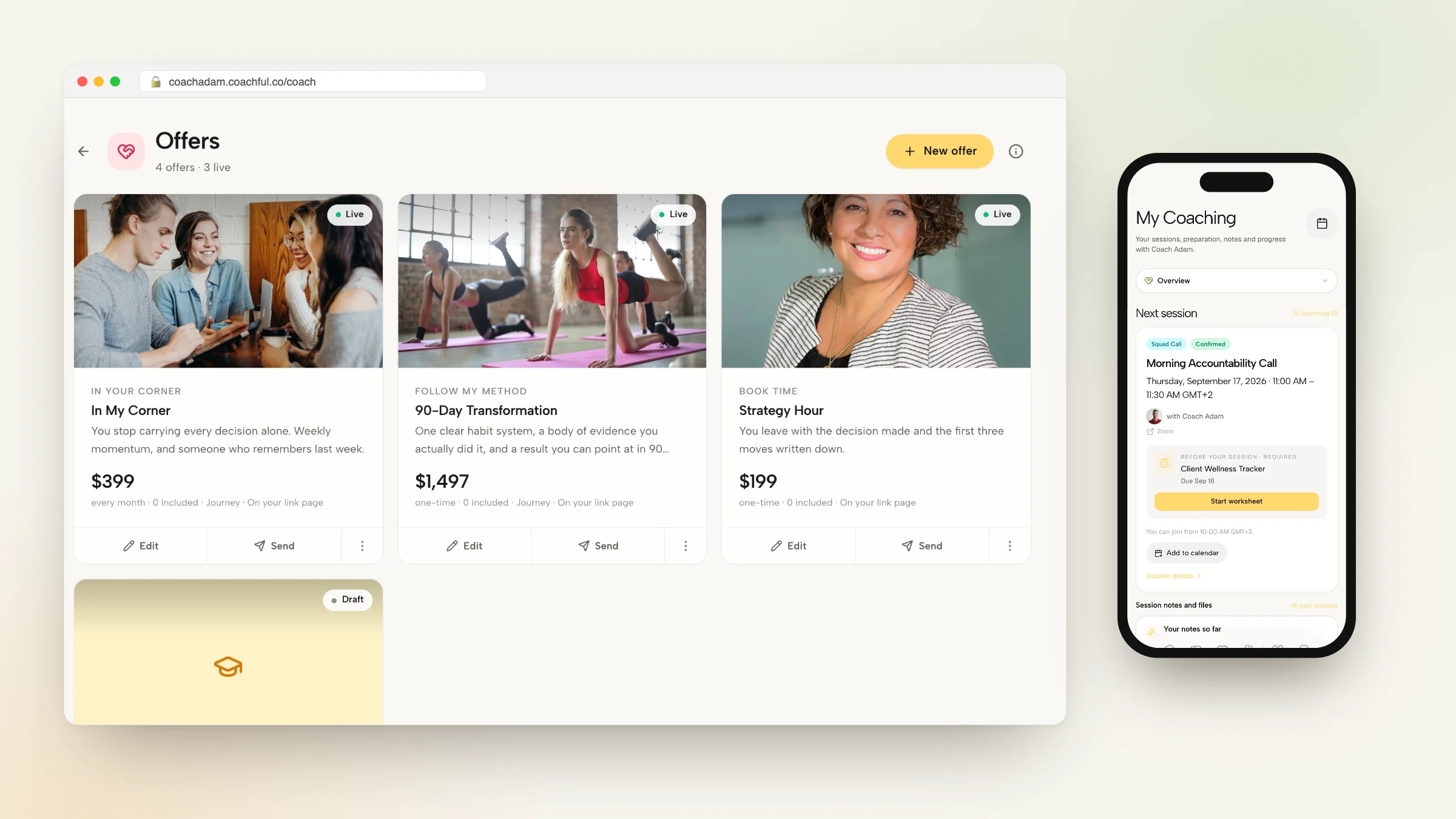
A lot of early coaching careers stall on admin: five tools for booking, payments, contracts, notes and a website, and evenings lost wiring them together. A Coachful membership includes booking with calendar sync, payments to your own Stripe or Razorpay account with a 0% Coachful platform fee, agreements, programs with habits and check-ins, a client app on iPhone and Android, and a website with funnels and email. Coachful also counts your completed sessions against the ICF credential thresholds. See the full setup on the Coachful page for life coaches.
You don't have to build the website yourself. Our team builds websites, funnels, offer pages and programs inside your account for free on every plan. Open Website and click Fill in a form on the "Want us to build it for you?" card, or choose We'll build it for you · FREE under Create, and describe what you want, with up to 10 files and 8 links. The team replies by email, usually within about 24 hours, which isn't a guaranteed deadline. Nothing gets invented: no credentials, testimonials or prices you don't have, and logos, video recording and ads aren't included. See everything the free build covers.


Frequently asked questions
Is life coaching a good career?
It can be, if you treat it as a business. Demand is growing, with the ICF estimating 122,974 coach practitioners in 2025, but over half of coaches reported under $30,000 a year in 2022. A clear niche, packages and a two-year runway make the biggest difference.
Is life coaching in demand?
Yes. ICF estimates of coach practitioners grew from 53,300 in 2015 to 122,974 in 2025, and coaching revenue was estimated at $5.34 billion in 2025. Demand is strongest where an employer or business pays, which is why niches like leadership and career coaching tend to earn more.
Is the life coaching market saturated?
The broad "life coach" label is crowded. Coachful's 2026 report rates life coaching's saturation as extremely high, a practitioner estimate. Narrower niches, such as ADHD or women's health, are rated far less saturated. The fix is specificity rather than leaving coaching.
How long does it take to make a living as a life coach?
Longer than most people plan for. Practitioner estimates in Coachful's 2026 report put the first paying client at one to three months with active outreach, consistent $10,000-plus months at 12 to 36 months, and an established business at four to six years.
Can I be a life coach part time?
Yes, and many coaches are. The BLS notes that few coaches work only as coaches and many hold another job, and the ICF found coaches averaging about 12 hours a week of coaching. Part time is a sensible way to test a niche before relying on the income.
Do you need a degree to be a life coach?
No. There is no legal requirement for a degree or a license. Most professional coaches do have one: in the ICF's 2023 study, 95 percent held a bachelor's degree or higher. Coach-specific training and a credential matter more to many clients and employers.
Will AI make life coaching a bad career?
AI is already taking over parts of the admin, such as notes, summaries and drafts, and some people use chatbots for self-coaching. Accountability and a real relationship are harder to automate. Our sibling guide on whether AI will replace coaches looks at the evidence.
Will Coachful build my coaching website for free?
Yes. Coachful's team builds websites, funnels, offer pages and programs for free on every plan, inside your own account. Fill in the form from Website or Create, and the team replies by email, usually within about 24 hours. Coachful itself is a paid membership with a free trial.












