
Life Coach Jobs: Where the Work Is and What It Pays
Life coach jobs exist, but very few of them look like a normal job with a salary, a manager and paid leave. The paid work falls into four groups: a small number of employed roles (student success coaching, wellness programs, treatment settings), contract work on coaching platforms that sell to employers, part-time coaching alongside another job, and self-employment, which is where most life coaches end up. Coachful's 2026 Coaching Business Report puts life coach pay at $47,000 to $72,000 a year, from PayScale, ZipRecruiter and Glassdoor data, but that figure leans toward employed and posted roles.
So the useful question is less "where are the life coach positions?" and more "which kind of coaching work fits me, and what does each one ask for?" This guide maps the options, shows what three large coaching platforms say they require, sets out the pay data and its limits, and works out how many clients it takes to match a salary. If you go the self-employed route, Coachful's team builds your coaching website for free on every plan, so the first months go on clients instead of web design.
The four kinds of life coach jobs
Job boards mix these together, which is why searching "life coach jobs" turns up everything from university roles to commission-only sales positions. Sorting them by who pays you makes the picture clearer.
| Kind of work | Who pays you | What they usually ask for | How pay works |
|---|---|---|---|
| Employed coaching role | A college, nonprofit, health or wellness program, or treatment facility | A degree, coaching or related training, sometimes a background check | Salary or hourly wage, with benefits |
| Coaching platform contract | A company that sells coaching to employers and matches you with their staff | A recognized credential, logged coaching hours, often workplace or management experience | Paid per session or hour as a contractor; rates are rarely published |
| Part-time or sideline coaching | Your own clients, alongside another job | Whatever your clients trust: training, results, referrals | Session and package fees |
| Self-employed practice | Your own clients, full time | The same, plus a way to be found and booked | Revenue minus costs and tax |
The US Bureau of Labor Statistics described the same pattern in its Career Outlook profile of the job: life coaches are often self-employed, some work as consultants or contractors for businesses that offer coaching as an employee wellness perk, some work for residential care or treatment facilities, and many coach as a sideline to another full-time occupation (BLS Career Outlook, 2017). The profile is from 2017, but the shape of the market it describes still holds.
Employed life coach positions
Salaried coaching jobs tend to sit inside organizations whose main business is something else: education, health, social services. The job title often isn't "life coach" at all, so search for the work, not the label.
- Student success coaching. Colleges and education nonprofits hire coaches to help students stay enrolled and finish. InsideTrack, a nonprofit that coaches learners for colleges and employers, says all its coaches are paid employees rather than contractors or volunteers, that all of them hold a bachelor's degree, and that each gets more than 100 hours of professional development in their first year. Its coaching was the subject of a randomized study that found students assigned a coach were more likely to stay in school (Bettinger and Baker, NBER working paper, 2011).
- Wellness and benefits programs. Employers buy coaching for staff as a perk. Some of it is delivered by in-house coaches, more of it by contractors, as the BLS profile notes.
- Residential and treatment settings. These roles sit next to clinical teams. Expect the job to be defined tightly, and expect licensed clinicians to handle anything that is treatment.
- Coaching companies. Practices with several coaches sometimes hire employed or contract coaches to take on clients the founder can't fit in.
Useful search terms: "success coach", "student success coach", "academic coach", "wellness coach", "coaching associate" and "client coach". Read every posting for the actual duties. Some roles with "coach" in the title are sales jobs with a target.
Remote life coach jobs on coaching platforms
Most remote life coach jobs you'll find are contract places on platforms that sell coaching to companies. The work is real and flexible, but it's mostly workplace and leadership coaching for employees, and the bar is high. Here is what three large platforms say on their own pages, as checked in October 2026:
| Platform | What its coach pages ask for | Flexibility | Pay published? |
|---|---|---|---|
| BetterUp | "Be prepared to have your resume and Coach credential certificate in hand" | "You set your ideal schedule"; members are matched from around the world | No |
| CoachHub | Certification "from one of the leading coaching associations", more than six years of managerial experience, at least 500 coaching hours, usually over 1,000 | "Our coaches work 100% flexibly" | No |
| EZRA | Describes its coaches as certified by the International Coaching Federation and as people who have "been on the front line of business" | Coaches can work from where they choose | No |

Two things follow from that table. First, these platforms are an option once you hold a credential and a few hundred hours, not a way to get your first clients. Second, if your background is in a corporate role, it counts here: CoachHub's six-year management requirement shows the platforms are hiring business experience as much as coaching skill.

There are also directories and marketplaces, such as Noomii and the ICF's Credentialed Coach Finder, where clients find coaches. Those are listings, not jobs: you are still self-employed, and you still sell and deliver the coaching yourself. Our guide to keeping the client you met on a marketplace covers what to watch for.
What employers and platforms ask for
Life coaching itself needs no license (our guide to whether you need a license to be a life coach sets out where the regulated lines are). But the moment someone else is paying you, they set the bar. In practice that means four things:
- A recognized credential. Usually an ICF credential, most often the ACC or PCC.
- Logged hours. Platforms count paid coaching hours, the same way the ICF does.
- Relevant experience. Management for workplace platforms, education for student coaching, health settings for wellness roles.
- Remote readiness. Reliable video, a quiet space, comfort with the platform's tools and session notes.
| ICF credential | Coach training | Coaching experience | Clients |
|---|---|---|---|
| ACC | 60+ hours | 100+ hours, 75 paid | 8+ |
| PCC | 125+ hours | 500+ hours, 450 paid | 25+ |
| MCC | 200+ hours | 2,500+ hours, 2,250 paid | 35+ |
Source: ICF experience requirements. Each credential also needs 10 hours of mentor coaching and an exam.
CoachHub's 500-hour floor lines up with the PCC. If platform work is your goal, plan your first two years around reaching it: our guides to tracking ICF coaching hours and ICF ACC vs PCC vs MCC show how, and our sibling guide to life coach qualifications covers the rest of what buyers look for.

What life coach jobs pay
No large public study measures what life coaches earn, and the BLS doesn't collect data on life coaches as a separate occupation. Its 2017 profile says it counts them inside other groups, including rehabilitation counselors, educational, guidance and vocational counselors, and personal care and service workers. So the honest picture combines Coachful's rates data with the nearest BLS occupations, clearly labeled.
| Figure | Amount | Source | What it is |
|---|---|---|---|
| Life coach annual income | $47,000 to $72,000 | PayScale, ZipRecruiter, Glassdoor, via Coachful's 2026 Coaching Business Report | Self-reported pay and posted roles; skews toward employed coaches |
| Life coach session rate | $75 to $200 | PayScale and practitioner reports | A price per session, not income |
| School and career counselors and advisors | $64,330 median, May 2025 | BLS | Adjacent occupation, not a coach salary; usually needs a master's degree |
| Rehabilitation counselors | $46,850 median, May 2025 | BLS | Adjacent occupation, not a coach salary; usually needs a master's degree |
| Training and development specialists | $69,280 median, May 2025 | BLS | Adjacent occupation, close to corporate coaching roles; usually needs a bachelor's degree |
| All US workers | $50,980 median, May 2025 | BLS | For comparison |
BLS figures from the Occupational Outlook Handbook pages for school and career counselors, rehabilitation counselors and training and development specialists. Life coaching figures in US dollars, Q2 2026, from coachingrates.com.
Coachful's notes on those sources matter here. PayScale data is self-reported and skews toward employed and hybrid coaches, and ZipRecruiter tracks posted roles, so it under-represents self-employed income. That makes the $47,000 to $72,000 band a decent guide to life coach jobs specifically, and a weaker guide to what a private practice earns. For the full breakdown by experience and region, see our guide to life coach salary, and for setting your own rate, how much life coaches charge.
Salary vs self-employed income: how many clients a salary takes
A salary arrives whether or not a client cancels. Self-employed income is what's left after you sell enough sessions, pay costs and set aside tax, including the 15.3 percent self-employment tax in the US. To compare the two fairly, work out the paid sessions a week it takes to match a salary. The table assumes 46 working weeks and counts only paid sessions.
| To earn the equivalent of... | At $100 a session | At $150 a session | At $200 a session |
|---|---|---|---|
| $50,980 (BLS median, all workers) | About 11 a week | About 7.5 a week | About 5.5 a week |
| $64,330 (BLS median, school and career counselors) | About 14 a week | About 9.5 a week | About 7 a week |
Worked examples: annual target ÷ (session rate × 46 weeks), before costs and tax. Session rates sit inside the $75 to $200 life coaching range.
Packages change the arithmetic. A three-month, eight-session package typically sells for $1,200 to $2,500, according to the report. At $1,800, a client slot that stays filled all year brings in $7,200, so nine continuously filled slots pass the counselors' median before costs. Nine clients is fewer than the ICF 2025 study's average of 12.4 clients per coach, as compiled in the report. Keeping those slots full is the real job, and our guides to getting life coaching clients and life coaching package examples cover it.

If you're not ready to leave a job, sideline coaching is the most common start, and our guide to being a part-time life coach shows how to work out the hours you can really offer.
Red flags in life coach job ads
- You pay to start. A "position" that requires you to buy the company's certification or starter kit first is a sale, not a job.
- Commission only, with recruiting. If income depends on signing up other coaches, it's a distribution scheme.
- Guaranteed clients or income. The US Federal Trade Commission warns that no one can guarantee you'll make a lot of money with little risk, and lists pressure to act now among the warning signs (FTC consumer alert).
- Clinical work with a coaching title. A role that asks you to treat anxiety, depression or addiction needs a license you may not have.
- No written terms. Contract coaching should come with a contract: rate, cancellation pay, who owns the client relationship and notice periods.
Building your own life coaching job on Coachful
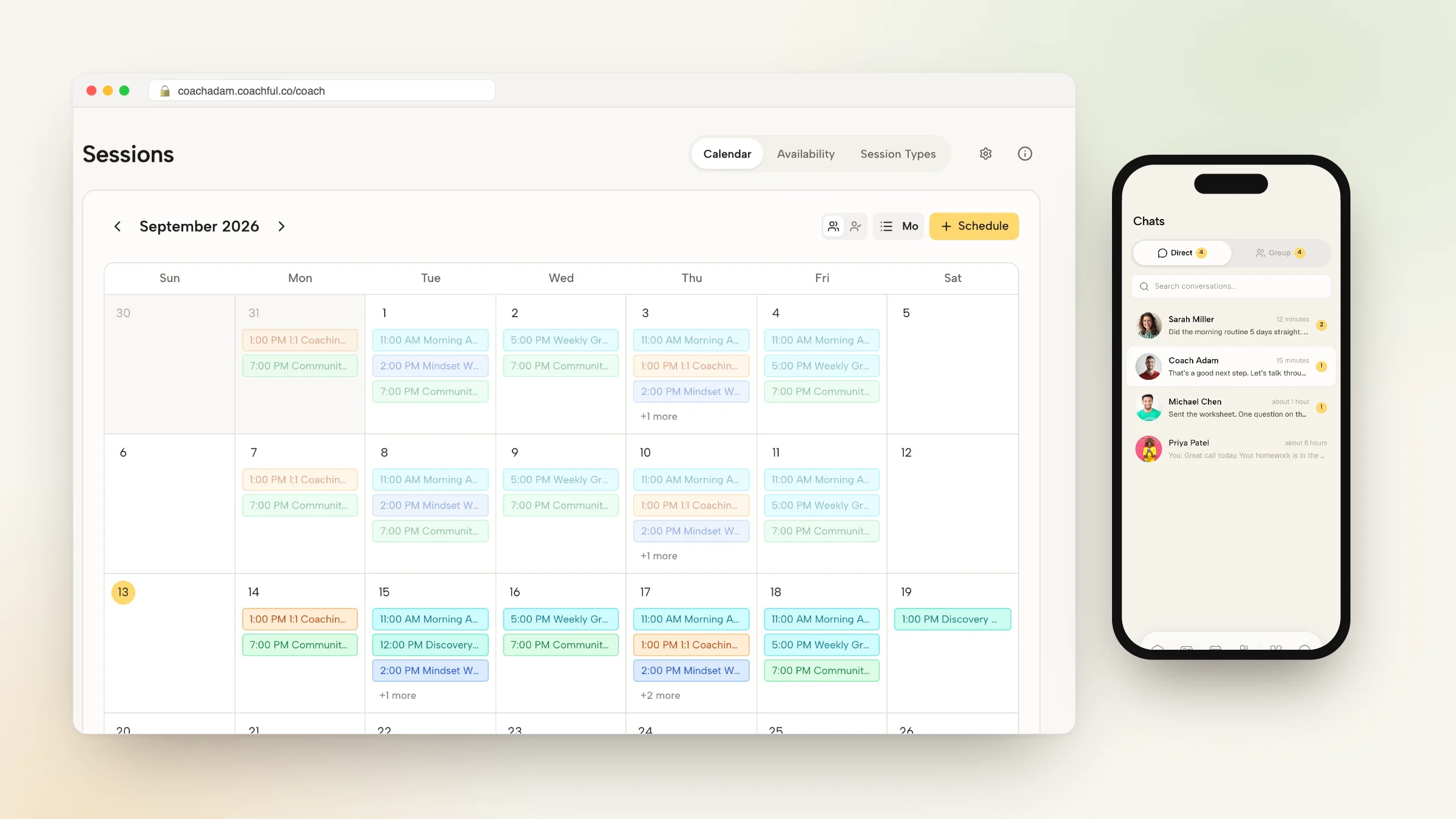
For most coaches, the dependable life coach job is the one they build. That means a way to be found, a calendar people can book, an offer they can pay for and somewhere the coaching lives between sessions. A Coachful membership includes all of it in one place:
- Booking and payment in one step, with two-way Google, Apple and Outlook calendar sync, reminders and intake questions on the booking. See booking software for coaches.
- Packages, subscriptions and payment plans paid into your own Stripe or Razorpay account, with a 0% Coachful platform fee.
- ICF hour tracking. Completed sessions count toward the ACC, PCC and MCC thresholds in hours and distinct clients, and you can export an ICF client coaching log. More on ICF hour tracking, which is the evidence platforms ask for.
- Programs, goals, habits and check-ins in a client app on iPhone and Android.

And if the job market you want is on the hiring side, Coachful also runs multi-coach practices: team members, caseloads per coach and shared session types. The Coachful page for teams explains how, and the page for life coaches covers the solo setup.

The free build. Coachful's team builds your coaching website, first offer page and first program for free on every plan, inside your own account. Coachful itself is a paid membership with a free trial to start. Click Fill in a form on the "Want us to build it for you?" card on the Website page, or choose We'll build it for you · FREE under Create. Say which pages you want and what visitors should do next, and attach up to 10 files and 8 reference links. The team replies by email with next steps, usually within about 24 hours, which is typical rather than guaranteed. Nothing gets invented: no credentials, testimonials or prices you don't have. See everything the free build covers.


Frequently asked questions
Are there real life coach jobs with a salary?
Yes, but they're a small share of the market. Salaried roles are mostly in student success coaching, wellness and benefits programs, and treatment or care settings. InsideTrack, for example, says all its coaches are paid employees. Most life coaches are self-employed or coach part time alongside another job.
How do I find remote life coach jobs?
The main remote option is contract coaching on platforms that sell to employers, such as BetterUp, CoachHub and EZRA. Their coach pages ask for a recognized credential, and CoachHub asks for at least 500 coaching hours and more than six years of management experience, so they suit experienced, credentialed coaches.
How much do life coach jobs pay?
Coachful's 2026 Coaching Business Report puts life coaches at $47,000 to $72,000 a year, from PayScale, ZipRecruiter and Glassdoor data that leans toward employed roles. The BLS doesn't publish a life coach figure; nearby occupations such as school and career counselors had a median of $64,330 in May 2025.
Do I need a certification to get a life coaching job?
To coach your own clients, no. To be hired or contracted by someone else, usually yes. Coaching platforms ask for a credential, most often from the ICF, plus logged hours. Employed roles may also ask for a degree in education, social work or a related field.
Can I get a life coach job with no experience?
Rarely. Most employers and platforms want logged coaching hours. The usual route is training, then practice clients and a few paying ones, logged from day one, while keeping your current job. Pro bono hours count toward the ICF's experience totals within its limits.
How many clients does a full-time life coach need?
At $150 a session over 46 working weeks, about 9 to 10 paid sessions a week matches the $64,330 BLS median for school and career counselors, before costs and tax. With three-month packages at $1,800, about nine continuously filled client slots does the same.
Will Coachful build my coaching website if I go self-employed?
Yes. Coachful's team builds your website, first offer page and first program for free on every plan, usually within about 24 hours of your request. Coachful is a paid membership with a free trial; the build itself costs nothing extra.












