
Life Coach Qualifications: Skills, Credentials and the Law
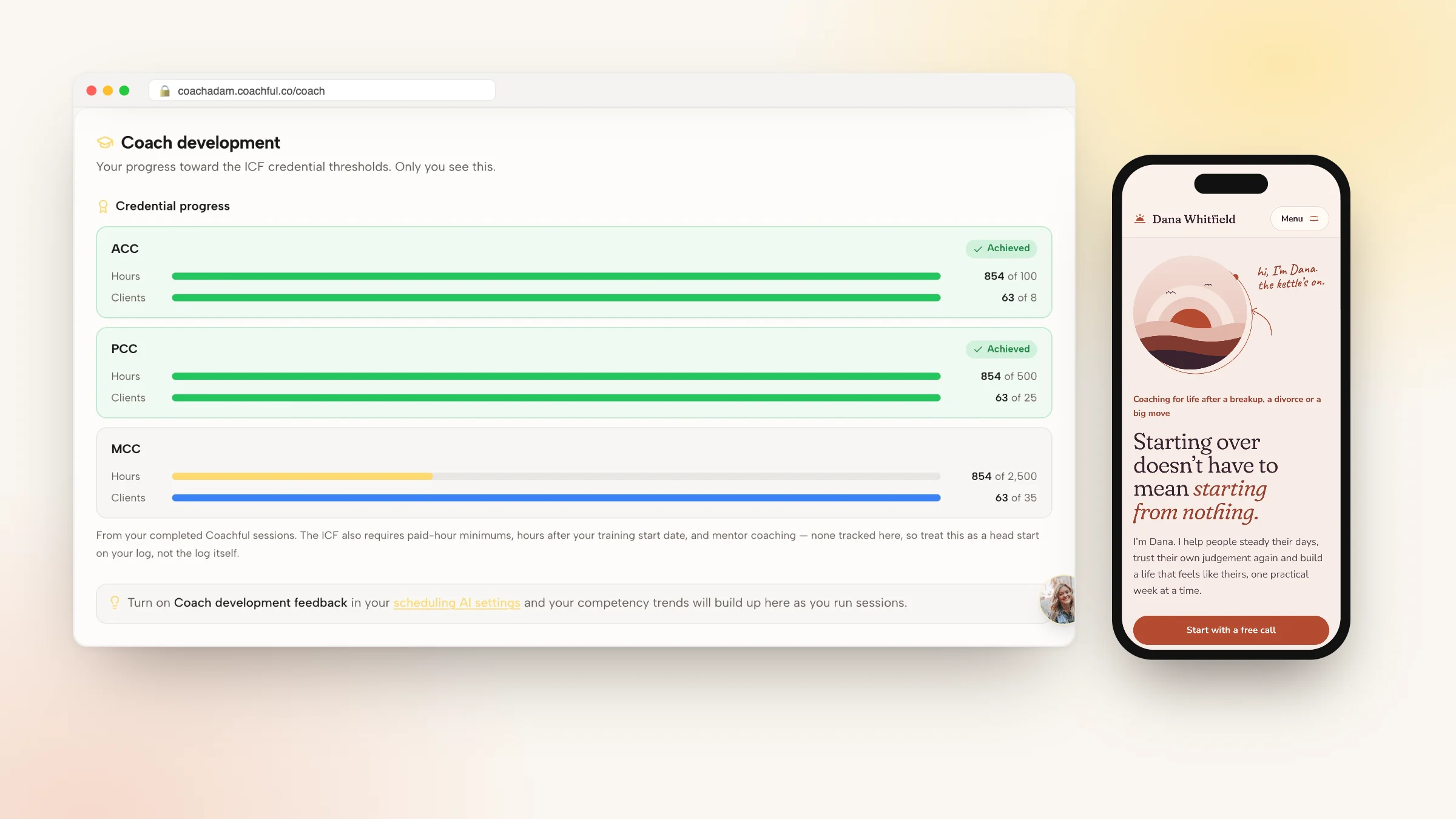
No formal life coach qualifications are legally required in the US, UK, Canada or Australia, because no government licenses life coaching. What makes a life coach qualified in practice comes in four layers: the coaching skills themselves, training from a recognized program, a credential from an independent body (the International Coaching Federation's ACC, PCC and MCC are the most widely recognized), and evidence that clients get results. Clients mostly judge the last one. Employers and coaching platforms check the credential.
So "what qualifications do you need?" has two honest answers: none to start, and more than most people think to get hired by anyone other than yourself. This guide separates the layers, compares the main credentials side by side, shows what clients and buyers actually check, and explains how to present your qualifications without overstating them. When you're ready to show them off, Coachful's team builds your coaching website for free on every plan.
The four layers of life coach qualifications
| Layer | What it is | Required? | Who checks it |
|---|---|---|---|
| Legal basics | Business registration, tax, honest marketing, data protection, a written agreement | Yes, as for any small business | Tax authorities, consumer protection law |
| Coaching skills | Listening, questioning, agreements, ethics, helping clients act | Not legally, but clients notice at once | Clients, on the discovery call |
| Training and credentials | A coach training program, then a credential such as the ICF's ACC | No, but often required by employers and platforms | Credentialing bodies, corporate buyers |
| Evidence of results | Experience with a type of client, outcomes, testimonials | No | Clients, through referrals and reviews |
The US Bureau of Labor Statistics' Career Outlook profile of life coaches put it simply: there are no formal requirements, the field is unregulated, and training and certification help coaches stand out (BLS Career Outlook, 2017).
The legal side: what you can't skip
No license doesn't mean no rules. Our guide to whether you need a license to be a life coach covers the regulated professions next door, and the US business license checklist covers local permits. The short version:
- Register and pay tax like any self-employed person.
- Stay out of licensed work. Diagnosing or treating mental health conditions, medical and clinical nutrition advice, investment advice and legal advice all need their own licenses, and so do titles like "therapist" and "counselor".
- Market honestly. Consumer protection law bars misleading claims about results or credentials.
- Protect client data, with a privacy policy, and follow laws such as the GDPR if you coach people in the EU or UK.
- Put the terms in writing. Scope, confidentiality, cancellations and referrals. Our coaching agreement template is a starting point.
- Check niche rules. Coaching minors, health, money or relationships in crisis brings extra obligations.

The skills that make a coach qualified
The closest thing coaching has to a shared definition of competence is the ICF Core Competencies, updated in 2025. There are eight, in four domains, and they're the basis for every ICF credential and the curriculum of ICF-accredited programs:
| Domain | Competency | What a client notices |
|---|---|---|
| Foundation | 1. Demonstrates Ethical Practice | Clear boundaries, confidentiality, honest referrals |
| Foundation | 2. Embodies a Coaching Mindset | Curiosity instead of advice-giving; the coach keeps learning |
| Co-Creating the Relationship | 3. Establishes and Maintains Agreements | Every session starts with what you want from it |
| Co-Creating the Relationship | 4. Cultivates Trust and Safety | You say the real version, not the polished one |
| Co-Creating the Relationship | 5. Maintains Presence | The coach is with you, not waiting to talk |
| Communicating Effectively | 6. Listens Actively | They pick up what you didn't quite say |
| Communicating Effectively | 7. Evokes Awareness | A question that changes how you see the problem |
| Cultivating Learning and Growth | 8. Facilitates Client Growth | You leave with an action you chose |
Competency names from the ICF's 2025 Core Competencies; the right-hand column is our plain-language summary. See the ICF's Core Competencies page and our guide to the ICF Core Competencies.
Skills can be learned without a program, as our guide to becoming a life coach without certification shows, but they're hard to build without observed practice and feedback. That's what good training and mentor coaching provide. For a quick self-check, Coachful's Good Coach Scorecard asks twelve questions on the traits that separate good coaches from great ones.
Life coaching qualifications and credentials compared
A training certificate proves you finished a program. A credential is awarded by an independent body after checking your training, your coaching hours and a sample of your coaching. These are the main ones a life coach will meet, as published by each body in October 2026:
| Credential | Issued by | Main requirements | Best known in |
|---|---|---|---|
| ACC, PCC, MCC | International Coaching Federation | 60, 125 or 200+ training hours; 100, 500 or 2,500+ coaching hours; 10 hours of mentor coaching; a performance evaluation and exam | Worldwide; the default for corporate buyers |
| EMCC individual accreditation | EMCC Global | Foundation to Master Practitioner: from 1 year, 50 client hours and 5 clients up to 7 years, 500 hours and 40 clients; supervision and CPD at every level | Europe |
| Board Certified Coach (BCC) | Center for Credentialing and Education | 30 to 120 hours of coach training depending on your degree, 30 hours of coaching experience, an endorsement and an exam ($279 application and exam fee) | US, especially for coaches with counseling or social science degrees |
| Coaching and mentoring qualifications, Levels 3, 5 and 7 | ILM (UK) | Certificates and diplomas by level; new versions available from 28 September 2026 | UK workplaces |
| NBC-HWC | National Board for Health and Wellness Coaching | An approved training program and a board exam | US health and wellness coaching |
Sources: ICF experience requirements, and the EMCC, CCE and ILM websites. Health coaching credentials are covered in our health coach certification guide and on nbhwc.org.
For most life coaches the ICF route is the practical default, because it's the one clients can verify and buyers ask for by name. Our guides to becoming a certified life coach and ICF ACC vs PCC vs MCC walk through it, and life coach certification programs compares schools.

What clients and buyers actually look for
Who's buying changes which qualification matters. Coachful's 2026 Coaching Business Report, drawing on the ICF's 2025 Global Coaching Study, finds that 73 percent of coaches report clients and organizations expect certification, and that in consumer coaching, client outcomes and testimonials carry more weight than credentials.
| Individual clients | Employers and organizations | |
|---|---|---|
| Credentials | Preferred | Often mandatory |
| What persuades them | Experience with their situation, testimonials, the discovery call | Credential level, logged hours, references, a proposal |
| Who decides | The individual | HR, learning and development, or the executive team |
| Typical engagement fee | $1,500 to $8,000 | $10,000 to $50,000+ |
From Coachful's 2026 Coaching Business Report, Q2 2026, US dollars. See coachingrates.com.
Credentials also track with income, though experience explains part of the gap. As compiled in the report, ICF ACC holders average $63,000 a year, 21 percent more than coaches without a credential, and PCC holders $78,000, or 50 percent more. Our guide to life coach salary has the rest of the data.

Background and personal qualities
Many coaches' best qualification is the life they had before coaching. The report's framework for matching background to niche:
| If your background is in... | It fits |
|---|---|
| Psychology or personal development | Life, mindset or relationship coaching |
| HR, recruiting or career services | Career coaching |
| Corporate leadership or management | Executive or leadership coaching |
| Sales, marketing or entrepreneurship | Business coaching |
| Health, fitness or nutrition | Health and wellness coaching |
| Finance or accounting | Financial coaching |
| Lived experience with ADHD, chronic illness or similar | Specialist niche coaching |
Beyond background, the qualities that show up in good coaches are learnable: patience with silence, curiosity about people unlike you, comfort saying "I don't know," and the discipline to keep your own advice to yourself. Our list of coaching niches helps if you're still choosing.
How to present your qualifications honestly
- Name the program and the credential precisely. "ICF Associate Certified Coach (ACC), trained at [program]" beats "certified life coach".
- Say what you're working toward. "Currently completing ICF Level 1 training" is honest and reassuring.
- Lead with relevant experience. Former teacher, nurse, recruiter, manager: clients find that as persuasive as a certificate.
- Use real testimonials only, with permission. The US Federal Trade Commission warns that testimonials might not be true or typical (FTC consumer alert).
- Never say "licensed life coach." No such license exists.
Our life coach About page guide and life coach bio examples show how to put this into words.

Building and showing qualifications in Coachful
Coachful isn't a training program or a certification body, and it doesn't certify anyone. It's where you build the evidence most credentials ask for, and show it. A Coachful membership includes:
- ICF hour tracking. Completed sessions count toward the ACC, PCC and MCC thresholds in hours and distinct clients, past sessions can be logged by hand, and you can export an ICF client coaching log with paid and pro bono hours. See ICF hour tracking.
- Private feedback on your coaching. When you turn it on, Michelle, Coachful's AI assistant, scores your own recorded sessions against ICF Core Competencies 3 to 8, privately. It's a self-development aid, not an ICF assessment and not a substitute for mentor coaching.
- Intake and agreements that keep your scope in writing, with e-signature before the first call.
- Client progress across goals, habits and check-ins, the outcomes clients care about.


The free build. Coachful's team builds your coaching website, first offer page and first program for free on every plan, inside your own account. Coachful itself is a paid membership with a free trial to start. Open Website and click Fill in a form, or choose We'll build it for you · FREE under Create; say which pages you want and attach your credentials, bio and photos. The team replies by email with next steps, usually within about 24 hours, which is typical rather than guaranteed. Nothing gets invented: no credentials, testimonials or prices you don't have. See everything the free build covers, or the Coachful page for life coaches.


Frequently asked questions
What qualifications do you need to be a life coach?
Legally, none in the US, UK, Canada or Australia. In practice, clients and employers look for coach training from a recognized program, a credential such as the ICF's ACC or PCC, logged coaching hours and evidence of results with clients like them.
What is the best qualification for a life coach?
For most life coaches, an ICF credential, because it's recognized worldwide and verified independently. Start with the ACC, which needs 60+ training hours, 100+ coaching hours and 10 hours of mentor coaching. In Europe, EMCC accreditation is a strong alternative; in UK workplaces, ILM qualifications are common.
Are life coaching qualifications regulated?
Life coaching itself isn't regulated. Credentials are set by professional bodies such as the ICF and EMCC, which are membership organizations, not regulators. In the UK, some coaching qualifications, such as ILM's, sit within the wider qualifications system.
Do life coaches need a degree?
No. A degree isn't required for any of the main coaching credentials, though the Board Certified Coach credential asks for fewer training hours if you hold a relevant master's or doctorate. Some employed coaching roles, such as student success coaching, do ask for a bachelor's degree.
Can I call myself a qualified life coach without certification?
You can call yourself a life coach; the title isn't protected. Avoid "certified" unless a program certified you, and never say "licensed." Describe your training and experience accurately and let clients judge.
How long does it take to get a life coach qualification?
Training for the ICF ACC takes 60 or more hours, usually over a few months. The credential itself also needs 100 coaching hours, so most coaches take six months to a year or more. Our guide to how long it takes to become a life coach has a full timeline.
Will Coachful build my website and show my qualifications?
Yes. Coachful's team builds your website, first offer page and first program for free on every plan, and puts your real credentials and bio on your About page. It never adds credentials or testimonials you haven't provided.












