Coaching Marketplace Leads: How to Keep the Client You Paid to Meet

A coach on Reddit's r/lifecoaching forum asked for the thing most new coaches quietly want: "Im looking for a platform where any coach can go and list their services and get clients." You can hear what sits under it. The coaching is going fine. The calendar has gaps, the savings have a date on them, and finding people feels like a second job you were never trained for. A marketplace offers to do that part for you.
Some of them do send real people. Where coaches lose money is further in: paying for thirty introductions that never answer, or winning a client who books, pays and messages through someone else's platform, then discovering that the fee follows every renewal and the client list is not yours to take with you.
The short answer: a lead marketplace is worth testing when two things hold. The numbers work, meaning the full cost of winning one client there, dead leads and your time included, sits well below what that client pays you. And the relationship is yours: you get the person's contact details, and the discovery call, agreement, payment and onboarding happen in your own systems under your own name, as far as the platform's terms allow. If either fails, skip it or run a small capped test. Then treat every lead the same way: reply the same day, log where it came from, and move it onto your own booking link.
Coachful details were checked on 3 October 2026.
What goes wrong when a coaching marketplace owns the client
- You pay for silence. Per-lead platforms charge for the introduction whether or not the person ever replies.
- The fee follows the client. On commission models, a share of each payment can keep going to the platform for as long as that client stays.
- You cannot reach your own clients. If messages and bookings live inside the platform, pausing your listing can cut you off from people you are halfway through working with.
- Your reputation stays behind. Reviews earned there usually sit on a profile you do not control.
- Someone else's decision changes your month. A fee change, a ranking change or a shutdown lands on your pipeline and your active clients on the same day. See protecting coaching data from platform shutdowns.
How coaching lead marketplaces charge
A coaching lead marketplace is a platform where coaches list their services and pay to be introduced to people looking for a coach. What it sells is an introduction. Turning that into a client is still your work. The price comes in three shapes:
- Listing fee. A flat amount to appear. Your loss is capped at the fee, and the platform is paid whether or not anyone contacts you.
- Fee per lead. You pay for each enquiry, often one that other coaches received too.
- Commission. The platform takes a share of what the client pays. Nothing is due up front, and the cost grows with every month the client stays.
For fees checked platform by platform, see the best marketplaces for coaches. For which platforms bring demand and which only handle delivery, see coaching platforms to get clients.
Work out the cost per coaching client before you buy a lead
The lead price tells you very little on its own. The number to watch is what one signed client costs:
Cost per client = everything you spent on the channel ÷ clients it produced.
Here is an example with made-up numbers, to show the arithmetic and nothing more. You buy 30 leads at $20 each, so $600. Ten reply, five book a call and two become clients. Each client cost $300 before your time. Against a $1,500 package, that can work. Against a $150 single session, you paid $300 to earn $150.
- Count your hours. Replies, chasing and calls with people who were never a fit are part of the cost.
- On commission, add up the whole engagement. A share of a six-month client is a share of six payments if the terms say so.
- Decide the test before you start. Pick an amount you can lose without resentment and a number of leads to judge it on. Stop when you reach either.
- Compare it with your other channels. Referrals and your own content cost time instead of cash, and those clients tend to arrive with some trust already in place.
The same arithmetic applies to advertising: see working out acquisition cost before scaling paid ads and the wider set of coaching business KPIs.
Seven checks before coaches list on a marketplace
Read the terms and the help pages, then ask support about anything unclear and keep the answers in writing.
| What to check | Good sign | Walk-away sign |
|---|---|---|
| Contact details | You receive the lead's name, email or phone | You can only message inside the platform |
| Exclusivity | The lead is yours alone, or you are told how many coaches receive it | The same enquiry is sold to an unknown number of coaches |
| Off-platform rules | You may book, contract and take payment yourself | Moving the client off the platform breaks the terms |
| Payment | The client pays you directly, or the fee is a clear one-off | A share of every payment with no end date |
| Bad leads | Credits or refunds for wrong numbers, duplicates and spam | Every lead is charged, no questions asked |
| Reviews and profile | You may reuse your reviews elsewhere, with the client's permission | Reviews are locked to the platform |
| Leaving | You can pause or cancel and keep serving current clients | Cancelling ends access to active clients or their history |
If the terms forbid taking clients off the platform, do not work around them. Either accept that those clients live there and count the fee in your price, or choose a platform that sells introductions and leaves the relationship to you.
Coachful, which publishes this guide, runs its own public directory, Find a Coach. People browse it for free and book a discovery call with the coach, and Coachful charges a 0% platform fee on what clients pay. Hold it to the same seven checks.
What coaches need in place before buying a lead
Needed first:
- One clear offer with a price you can say out loud.
- A booking link for a first call.
- A saved first reply you can personalise in two minutes.
- Somewhere to log every lead and its source.
- An agreement and a way to take payment in your own name.
Can wait: a full website, paid profile upgrades and badges, ads, and any automation beyond a welcome message. Buying leads before the first list is ready means paying for introductions you cannot convert.
The handoff: moving a marketplace lead into your own coaching client path
Once a lead arrives, the aim is to get the conversation onto ground you control, quickly and within the platform's rules. Six steps do it.

1. Reply the same day, in your own voice
If the lead was shared, the person may be hearing from several coaches, and a slow reply often means the conversation has already started with someone else. Set a standard you can keep: within the hour when you are at your desk, the same business day at the latest. Keep the message short, like this example:
"Hi Maya, thanks for your note about going back to work after a career break. That is the point where most of my clients start. What would you most like to be different three months from now? If it is easier to talk, here is my calendar for a free 20-minute call: [your booking link]."

2. Log the lead and where it came from
The day it arrives, add the lead to your own pipeline: name, the contact details they gave, which marketplace sent them, what they asked for and the current stage. An introduction lets you reply about what they asked for. Adding them to your newsletter needs its own yes, so ask first.

3. Hold the discovery call on your own booking page
Send one link. Ask two or three questions on the booking form so you both arrive prepared: what they want help with, what they have tried, and whether the timing and budget are realistic. Give each marketplace its own tagged link so you can see later which one produced calls. For the setup, see safe discovery call bookings, and if you are unsure whether the first call should be free, discovery session versus paid first session.

Professional Certified Coach Sharmin Banu, speaking for the coaching school inviteCHANGE, covers five mistakes coaches make in discovery sessions, including explaining your methodology and forgetting to interview the client. Source: YouTube.
4. Send the agreement and take payment in your own name
Where the platform's terms allow it, the agreement is between you and the client, the payment goes to your account, and the receipt carries your name. That is what lets you handle refunds, renewals and payment plans without asking anyone's permission. Follow up within a day while the call is fresh: see following up after a discovery call, the offer page to send afterwards and a coaching agreement template.
If the marketplace requires payment on its side, keep to that for the engagement and count the fee in your price.
5. Onboard them like every other client
A marketplace client should not get a thinner welcome than a referral. Send the same welcome message, intake questionnaire, first session time and one place to reach you. The sooner they are inside your normal client experience, the less they think of themselves as the platform's customer. See which onboarding steps to automate and client portal versus email onboarding.

6. Review the channel every month
For each marketplace, write down leads received, replies, calls held, clients signed, money spent and money earned. Keep the ones where cost per client stays under your limit, and drop the others.
When a coaching marketplace makes sense, and when to skip it
Worth testing if:
- You are new, have no audience yet and need real conversations to practise selling.
- Your niche has urgent, searched-for demand, such as interview preparation.
- You sell a package priced high enough to absorb the leads that go nowhere.
Skip it, or use a flat-fee directory instead, if:
- You mainly sell low-priced single sessions.
- You cannot reply within a day.
- The terms keep booking, payment and messaging on the platform at a commission you could not sustain for a year.
Whatever you choose, keep building channels you own alongside it: a peer referral network, a simple outreach routine, and content that leads to discovery calls. A marketplace works best as one source of clients among several.
Running the marketplace handoff in Coachful
Coachful does not buy leads for you, and it cannot change a marketplace's terms. What it covers is your side of the handoff, in one subscription:
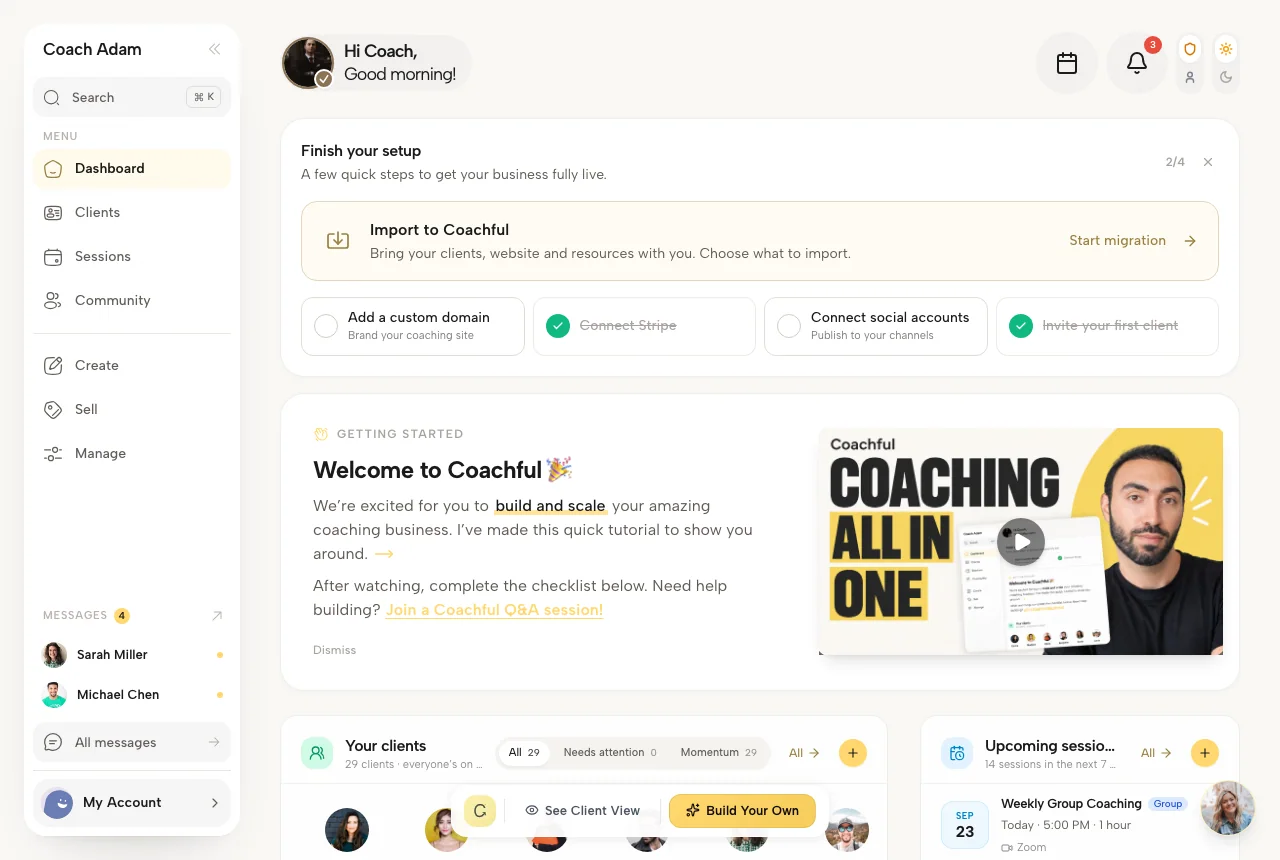
- Your own booking page: availability rules, buffers and time-zone detection, with intake fields on booking that attach to the client record. See scheduling and forms and questionnaires.
- Discovery calls included: calls run on built-in video that is part of the subscription, so there is no separate video tool to pay for.
- Agreement before the first call: agreements with e-signature.
- Payment to your account: Stripe Connect or Razorpay, with one-time payments, subscriptions and payment plans, and an invoice per transaction. Coachful charges a 0% platform fee, so you keep everything after Stripe or Razorpay processing. See coaching payment software.
- Source tracking: funnels carry UTM tracking and the Prospects list shows each lead's source and stage, so you can give each marketplace its own tagged link and see where leads came from. See funnels and the coaching CRM.
- Your brand, and a way out: your logo, colors and custom domain across your website, client home and email, plus a full client data export if you ever leave.
If all you need is a booking link, Coachful is more than you need. If you want the whole path from first call to onboarded client in one place, see what the platform covers. Coachful has a 7-day free trial, card required, no charge during the trial, cancel in one click.
Frequently asked questions
Is there a platform where any coach can list their services and get clients?
Yes, there are directories and lead marketplaces open to independent coaches. Listing is the easy half. What you receive is visibility or introductions, and turning those into clients depends on a clear offer, a same-day reply and your own booking path. The marketplace comparison covers named options and their fees.
Are coaching lead marketplaces worth it?
They are worth it when the full cost of winning one client, including leads that never reply and your own time, stays well below what that client pays you, and when you keep the contact details and the relationship. Run a capped test of 20 to 30 leads, then decide on cost per client.
How much should a coach pay for a lead?
Work backwards from what a client is worth. If a package brings in $1,500 and you would give up 20% of it to win a client, your limit is $300 per client. If one lead in ten becomes a client, a lead is worth at most $30 to you. Replace those example figures with your own after a small test.
Can I take a marketplace client off the platform?
Only if the platform's terms allow it. Some sell introductions and expect you to handle everything afterwards. Others require booking and payment to stay on the platform. Read the terms before your first lead. If off-platform work is not allowed, respect that and count the fee in your price, or choose a different platform.
Who owns the client relationship when a lead comes from a marketplace?
It depends on three things: who holds the contact details, who the agreement is with, and where the payment goes. The relationship is yours when the client has agreed to hear from you directly, the coaching agreement is between the two of you, and payment reaches your own account.
How fast should coaches respond to a marketplace lead?
Within the hour when you are at your desk, and the same business day at the latest. Shared leads may reach several coaches, so a late reply often arrives after the person has booked with someone else. A saved reply you can personalise in two minutes makes this realistic.
Do I need separate tools for booking, video calls and payments after the handoff?
No. You can assemble separate tools, or use an all-in-one coaching platform. Coachful includes booking pages, built-in video calls, e-signature agreements and payments through Stripe or Razorpay in one subscription, so a video tool is not an extra cost.