Best Marketplace for Coaches in 2026
Every list of the best marketplace for coaches has the same problem: it tells you the price of a listing and stops there. That number is almost never what you actually pay. One of the largest directories in this roundup charges $447 a year and then takes 30% of every payment your client makes, on a contract you cannot leave for twelve months. Another sells you a client introduction for $15 and sells the same introduction to four other coaches.
So this is not a list of logos. It is a fee audit. Every price below was read off the vendor's own pricing page, terms of service or help centre on 4 September 2026, and where a vendor's own pages contradict each other, we say so rather than picking the flattering number. Where we could not verify something, we write that we could not verify it.
The reason that matters: while researching this we found five well-ranked articles quoting five different prices for the same directory, and only one was right. Coach directory pricing goes stale faster than almost any category, and most of what is published about it was true in 2023.
The three fee models, and why blending them costs you money
Almost every roundup lists these platforms in one flat column of prices. That is the mistake, because three completely different things are happening to your money.

A listing fee. You pay to appear, and you keep 100% of what you charge. Psychology Today at $29.95/mo and The Coach Space at £10/year work this way. The risk is simple and bounded: if nobody contacts you, you are out the fee and nothing else.
A commission. The platform takes a share of what your client pays you, often for as long as that client stays. Noomii takes 30% on its Pro tier, Fiverr takes 20% of every order forever, Coach.me takes 50% of revenue from a client it sourced. The risk here is unbounded and it grows with your success, which is the opposite of how a marketing cost should behave.
A fee per lead. You buy an introduction, not a client. Bark and Thumbtack both work this way, and neither introduction is exclusive. You pay the same price as the coaches you are bidding against, before anyone has replied to you.
A coach cannot sensibly compare "$447 a year" against "30% of revenue" against "$15 per introduction" without separating those three. Once you do, the ranking below stops being a matter of taste.
The number that actually matters: cost per acquired client
A lead price is not a customer acquisition cost. On the pay-per-lead platforms your real cost is the lead price divided by your close rate, and your close rate is set by how many other coaches were sold the same person.

Work it through with Life Coach Hub's own numbers, which are unusually honest. A lead costs $15. Their support page states that "only the first five coaches who purchase this lead will receive the client's details." So you are one of five, and their own return-on-investment example is built on spending $60 across four leads to win one client, not $15 for one.
That is a genuine 4:1 ratio published by the vendor. At $15 a lead, a coach landing one client per four leads is paying $60 in acquisition cost. That is a good deal if your package is $2,000 and a terrible one if you sell a $150 single session.
Now do it for a commission platform. A $447 Noomii Pro subscription looks cheaper than a year of lead buying, until you add the 30%. A client on a $500-a-month retainer for eight months pays you $4,000, of which $1,200 goes to Noomii. Your true first-year cost for that one client is $1,647, not $447.
The number nobody prints. A $447 listing plus 30% turns a single $4,000 client into $1,647 of first-year acquisition cost.
Three questions settle almost every choice on this page:
- What is my average client worth over the whole relationship? Not per session. If it is over $1,500, a commission model is expensive and a listing fee is cheap. If it is under $300, pay-per-lead will eat you alive.
- Do I keep the client afterwards? On a directory, yes. On an enterprise platform like BetterUp or CoachHub, no: the company is their client, not yours, and you cannot take that relationship with you.
- Can I leave? Read the commitment before the price. This is where the worst surprises on this page live.

Every platform compared on what it actually costs you
All figures checked 4 September 2026 against the vendor's own pages. "Exclusive" means the enquiry goes to you alone.
| Platform | Cost to be listed | Their cut of your revenue | Cost per lead | Exclusive | Who gets in |
|---|---|---|---|---|---|
| Coachful Find a Coach | Included with any plan, from $29/mo | 0% | None | Yes | Any paying Coachful coach |
| The Coach Space | £10 per year | 0% | None | Yes | Open, payment only |
| ICF Coach Finder | $270/yr membership + credential | 0% | None | Yes | ACC, PCC or MCC holders |
| Psychology Today | $29.95 per month | 0% | None | Yes | Licensed clinicians, mostly |
| Noomii | $447/yr Pro, $1,164/yr Elite | 30% Pro, 15% Elite | None | Yes | Application |
| Life Coach Hub | Free, or $17 to $57 per month | 0% | $15, resold to 5 coaches | No | Open, no vetting |
| Coach.me | $9.99 to $97.99 per month | 50% on clients they source | None | Yes | Open, no vetting |
| Bark | Free | 0% | Credits, capped at 5 responses | No | Open, no vetting |
| Thumbtack | Free | 0% | You set it, auction-style | No | Open, no vetting |
| Upwork | Free | 0% to 15% per contract | None | Yes | Open, profile review |
| Fiverr | Free | 20% of every order | None | Yes | Open, no vetting |
| BetterUp, CoachHub | Free to apply | You are paid a rate, not a share | None | n/a | Credential + vetting |
Two columns deserve a second look. The commission column is where the money is: a 30% or 50% share of an ongoing coaching relationship dwarfs every listing fee on this page. And the exclusivity column explains why the free platforms are not free: on Bark and Thumbtack you are buying a race, not a client.
Zero, on a listing you already pay for. Coachful takes no commission and charges no lead fee, against 30% on Noomii Pro, 50% on Coach.me sourced clients and 20% on every Fiverr order.
The twelve, ranked by what they cost you to win a client
1. Coachful Find a Coach: the only one that takes nothing

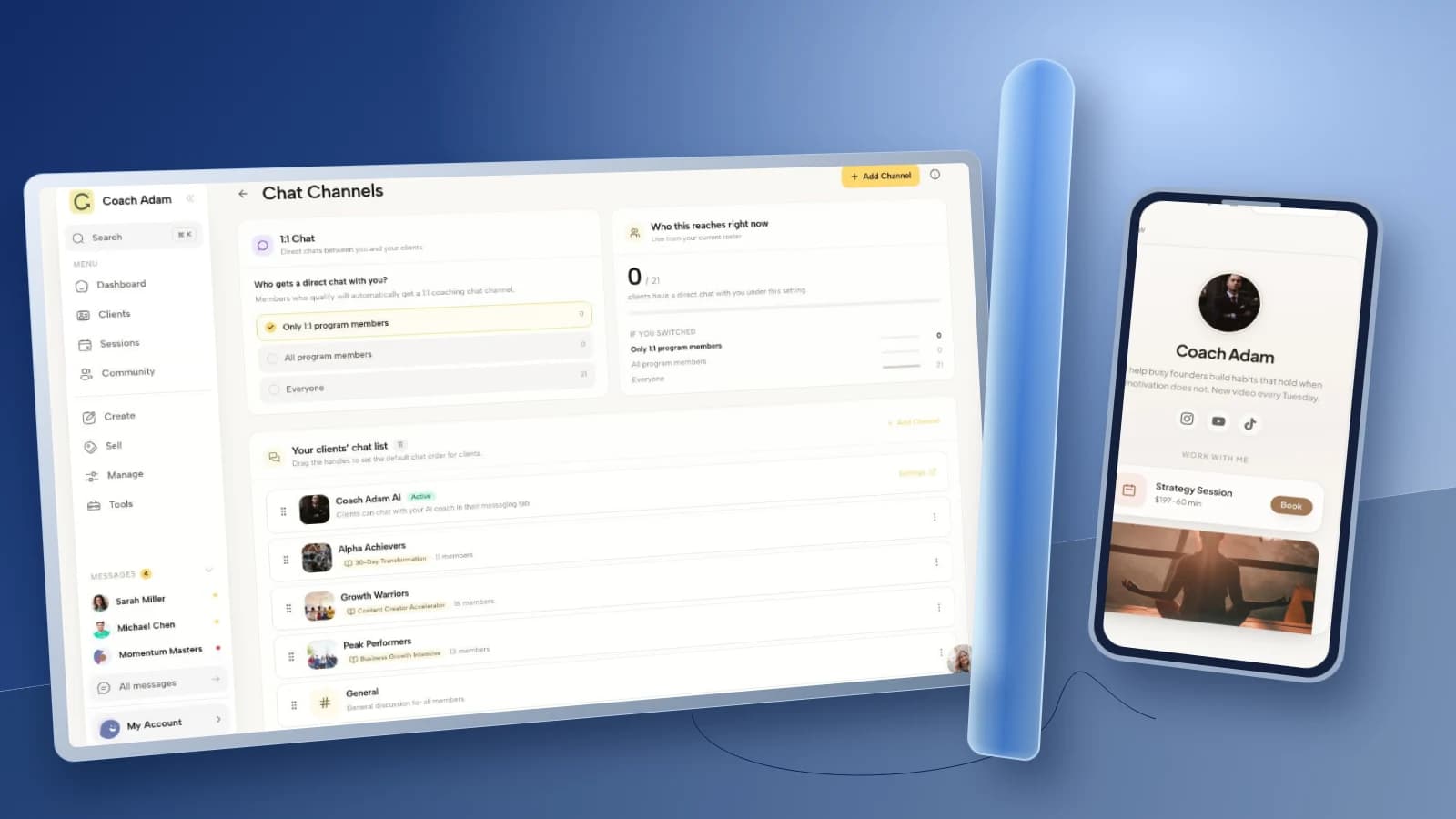
Find a Coach is the directory attached to Coachful. If you already pay for Coachful, your profile is included, with no listing fee, no commission and no charge per introduction. Money goes to your own Stripe account, and enquiries reach you and nobody else.
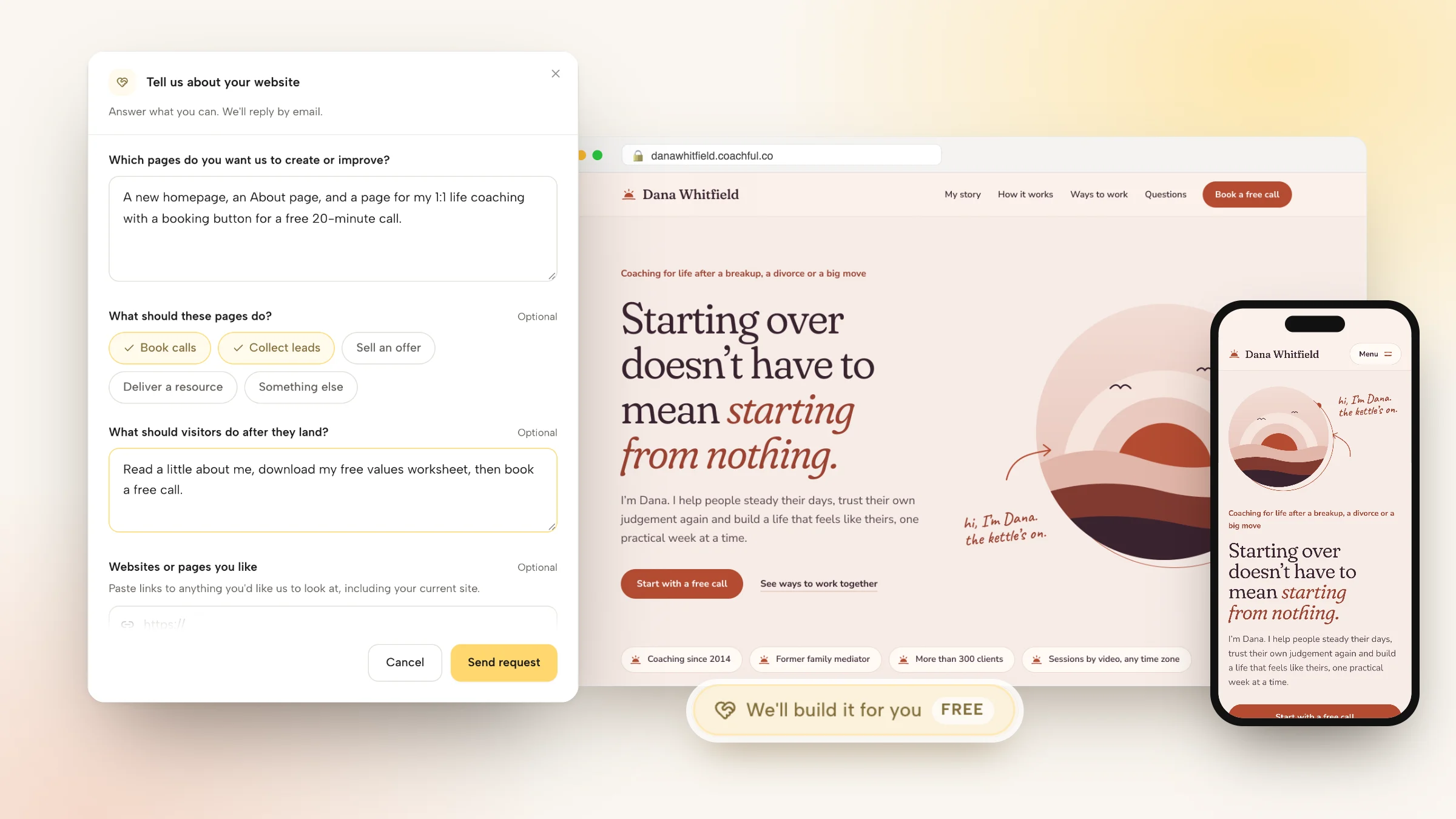
Why Coachful stands out: a free white-glove service. If you run your practice on Coachful, the listing is only the start. Every plan comes with a team that builds things for you: send a short request and they set up your website, booking page and first offer in your account, usually within about 24 hours, at no extra cost. That takes the slowest part of starting a coaching business, the setup, off your plate. See what the team will build for you.
Price, checked 4 September 2026: included on every Coachful plan, from $29/mo for up to 5 clients. Commission: 0%. Lead fee: none. If you are already a Coachful customer, the marginal cost of being listed is zero.
Why it is worth switching on
- Nothing is taken from your revenue. Noomii takes 30% and Coach.me 50% on sourced clients. A $500-a-month client who stays eight months pays you $4,000 and you keep $4,000. On Noomii Pro, $1,200 of that goes to the platform. On Fiverr, 20% of every order does, forever.
- Enquiries are yours alone. No cap of five coaches, no auction, no race to reply first, and no $15 introduction resold to four rivals.
- Visitors land in your checkout. Your profile links to your own booking page, funnel or programme on your own domain. Nothing here can be switched off by somebody else.
- Matching and reporting are built in. A matching quiz routes a client's goals, budget and preferences to the closest three coaches, and each of the nine coaching categories has its own page. Your dashboard shows profile views, clicks and match counts, so you can see whether it is working.
- One account. The listing sits on top of Coachful's coaching software, so the enquiry, booking, programme and payment live in one place.
Potential limitations
- It is new. 97 coaches are published as of 4 September 2026 and it has produced very few client enquiries so far, so treat it as a channel that compounds and list somewhere else too.
- It is built for coaches running the practice on Coachful. The listing comes with the subscription rather than standing alone, so a coach who wants a directory and nothing else is better served by a pure listing site.
2. The Coach Space: £10 a year, and refreshingly honest about what that buys
The cheapest genuine listing in this roundup, and the most straightforward. Ten pounds covers a whole year, there is no commission, and there is no lead fee, because The Coach Space does not broker introductions at all. Its FAQ says plainly that it "is not an intermediary nor an agent" and that a client contracts directly with the coach. Your listing carries a call to action pointing at your own booking page.
Price: £10 for a year, one category. A separate membership tier unlocks multiple categories, and its price is not published anywhere on the site; you have to ask.
Why it is worth ten pounds
- The maths is trivial. One client in a decade pays for it several hundred times over.
- No commission, no brokering, no platform sitting between you and the person who wants to hire you.
- A real backlink to your own site, which has some value beyond the directory itself.
Potential limitations
- It is very small. Their own directory counter reads 32 verified coaches. Ten pounds buys presence in a quiet room.
- One category only unless you upgrade to the membership whose price you cannot see without a sales conversation.
- The "verified for professional standards" badge has no published standard behind it, and the FAQ tells clients to verify credentials themselves, which rather undercuts it.
- No tracking. Enquiries go straight to your own contact page, so you will not know the directory sent them unless you ask.
3. ICF Credentialed Coach Finder: expensive to qualify for, free to be listed
The International Coaching Federation's own directory takes nothing from your revenue and charges nothing to list. What it charges for is the credential, and that is a serious commitment of both money and hours.
Price, checked 4 September 2026: to appear you need an active ICF credential and current ICF membership at $270 a year. Credential application fees for members are $175 for ACC, $375 for PCC and $675 for MCC, with higher fees on the portfolio path and for non-members. Credentials renew every three years at $175 for members, and renewal requires 40 continuing-education credits including 3 in ethics. A realistic first year is around $445, then roughly $270 a year plus amortised renewal.
Why it is worth it for some coaches
- The credential is the closest thing coaching has to a recognised professional standard, and it opens corporate and enterprise doors that nothing else on this page does.
- Zero commission, zero lead fees, direct contact from the client.
- ACC requires 60+ hours of coach-specific education and 100+ coaching hours; PCC requires 125+ and 500+. Those numbers are a real filter, and that is the point.
Potential limitations
- Months and hundreds of dollars before you can be listed at all. This is a credentialing body that happens to run a directory, not a client-acquisition channel.
- The listing itself is bare. No messaging, no booking, no payments, no analytics.
- ICF publicly disclaims the listings. Its own site states the qualifications of listed coaches are "not verified by ICF in any way," which weakens the trust signal the credential is supposed to buy.
- It skews executive and leadership. A poor fit for nutrition, fitness, habit or creator-adjacent niches.
4. Psychology Today: excellent directory, wrong door for most coaches
A flat $29.95 a month, no contract, no commission, no lead fee, and genuinely good mechanics: a protected phone number so your personal line stays private, a contact form, and real reporting on the calls and emails you receive. Very few directories give you attribution that clean.
The catch is who it is for. Psychology Today verifies licences against state and national databases and awards its "Verified" seal only when a licence or primary credential checks out. If you are a coach without a clinical licence, you are likely either excluded or admitted without the seal, paying the same $29.95 while missing the single strongest trust marker on the platform.
Potential limitations
- The audience intent is therapy. Visitors arrive looking for diagnosis-led help and insurance coverage, and a coaching profile competes badly against licensed therapists on the same results page.
- You pay monthly whether or not anything arrives, and the whole proposition rests on Psychology Today's search rankings, which you do not control.
- No booking, no payments, no marketplace mechanics. It is paid visibility plus a phone number.
5. Noomii: read the contract before you read the price

Noomii is the best-known name in coach directories and has been running since 2008. It also has, by a distance, the most demanding terms of anything in this roundup, and almost none of it appears on the pages that rank for its name.
Price, checked 4 September 2026 against Noomii's own terms of service (last revised 16 October 2025): a $1 one-time Hobbyist tier that mainly confirms a valid card, Pro at $447 a year, and Elite at $1,164 a year. Note that Noomii's own pages disagree with each other: the terms and refund policy quote "$37 per month, or $447 annually" while the coach FAQ says annual only.
Then the commission, which is separate and on top: Pro is "subject to a 30% commission on all Client payments generated through SmartMatch leads." Elite is 15%. The terms do not limit that to a first payment or a fixed window.
What the terms say that the listicles do not
- Twelve months, binding. "Enrollment in any paid membership (Pro or Elite) constitutes a 12-month binding contractual commitment," whether you pay monthly or annually, auto-renewing each term.
- No refunds, at all. "All payments are final. Refunds are not offered under any circumstances," explicitly including cancelling early, downgrading, dissatisfaction, and not receiving the number of leads you expected. Any article still repeating Noomii's old "money-back guarantee" is out of date, and several ranking ones do.
- A $500 late payment penalty on commissions overdue beyond 30 days, plus 1% monthly interest.
- A personal guarantee. You are "personally, jointly, and severally liable for all payments, fees, commissions, penalties" regardless of whether you trade through a corporation or an LLC. Your company structure does not protect you.
- They can charge your card for commissions they determine are owed, without further authorisation.
- A non-disparagement clause. Noomii may remove a coach, without refund, for "disparaging or hostile conduct that harms the reputation of Noomii." Worth knowing when you weigh how positive its public reviews look.
What you get for it: a real directory with genuine client traffic, plus SmartMatch, which emails you matched enquiries. Noomii's own referral page puts volume at "on average: 1 to 2 per month."
None of this means Noomii does not work. It means the honest price of a Pro listing is $447 plus 30% of everything a matched client ever pays you, on a twelve-month contract you cannot exit, personally guaranteed. Decide against that number, not against $447.
Read the terms, not the price tag. Twelve months binding, no refunds under any circumstances, and a $500 penalty on commissions overdue past 30 days.
6. Life Coach Hub: free to list, and that is not the price
Listing is genuinely free and the commission is genuinely zero: "You set all your own prices and collect 100% of your revenue," with money going to your own Stripe or PayPal. The cost sits entirely in the leads.
Price: $15 per lead, and their own support page states "only the first five coaches who purchase this lead will receive the client's details." Their published return-on-investment example assumes $60 across four leads to win one client. Separately, if someone contacts you through your own profile's contact button, seeing who they are costs $10 unless you hold a paid plan. Software tiers run $0, $17 and $57 a month, with Silver and Gold marketing packages at $19 and $27.
Potential limitations
- You fund a five-way bidding war up front. $15 buys a one-in-five shot, and there is no refund if you lose.
- Paying $10 to learn who contacted your own profile is a hard thing to defend. The free listing is effectively a paywalled inbox.
- Paying subscribers get advance warning on leads, so free listers are structurally last in line for the good ones.
- No vetting of any kind, so the directory cannot promise clients a quality bar.
- The widely quoted $37 "Professional Coach" tier no longer exists. Another example of stale pricing in this category.
One in five. A $15 lead is sold to the first five coaches who buy it, and the vendor's own example spends $60 across four leads to land one client.
7. Coach.me: the worst of both fee models
Coach.me is a real marketplace rather than a directory: clients discover you, buy through the platform, and Coach.me handles billing. It is also the only platform here that charges you a monthly fee and takes half your revenue on clients it sources.
Price, checked 4 September 2026: Explorer $9.99/mo or $49.99/yr, Professional $37.99/mo or $379.99/yr, Accelerator $97.99/mo or $979.99/yr. On clients you bring yourself, Coach.me takes only payment processing of 5% plus 30c. On clients Coach.me sources, it takes 50%.
Potential limitations
- A listing fee plus a 50% revenue share is the least favourable combination on this page.
- It is small. Coach.me's own January 2026 update reports 95 active coaches in the habit directory and 20,054 new users across all of 2025. That is a modest pool to split.
- The cheap tier is crippled: one package and no coaching calls.
- The niche is narrow. Habit, accountability and consistency coaching, with visible price points around $87 a month, which caps what you can charge into that audience.
- 2025 was explicitly a maintenance year with no new features, per the company's own update.
8. Bark: cheap introductions, and the common failure is not refundable

Free to join, no commission, and Bark markets that hard: "You pay only for the leads you choose, no commission, no hidden fees." You buy credits and spend them to unlock a lead's contact details, seeing the cost before you commit. There is a free "not interested" button.
Price, checked 4 September 2026: $2.20 per credit in the US as a standard pay-as-you-go rate, with packs reducing the per-credit cost. Bark does not publish pack prices publicly. The credits a given lead costs vary with service type, job size, location and how ready the customer is to hire. We could not verify a UK per-credit figure on any Bark page, so ignore the £1.80 that circulates.
Potential limitations
- Capped at five responses per customer, so you are always competing.
- The most common failure is explicitly excluded from refunds. Bark's own help centre states "non-responsive leads aren't covered by our credit return policy," and the ineligible list includes the customer hiring someone else and the customer not replying. For coaching, where enquiry-to-conversation drop-off is normal, that is the entire risk and it sits with you.
- Returns are discretionary, within a 14-day window, on a narrow list of reasons.
- The trust badge is bought, not earned. Bark Verified comes bundled with the Elite Pro subscription.
The risk sits with you. At $2.20 a credit you are one of up to five responses, and a lead who simply never replies is excluded from the credit return policy.
9. Thumbtack: you set the lead price, which means you carry the bidding risk

Free to list, no commission, and a live life-coach category. Thumbtack moved to exact lead prices: you set a price per service with a slider, and that is what you pay when a lead lands. A weekly budget caps total spend.
Price: Thumbtack publishes no price list for any category, so the only way to learn your real cost is to configure a profile. Raising your price is the mechanism for getting more volume, so competitive categories ratchet upward with no ceiling but your own budget.
Potential limitations
- Not exclusive. Five pros can each pay full price for the same customer within four hours, and the cap lifts after that.
- Smart Match charges first and asks later. Leads outside your stated preferences are auto-billed when Thumbtack's AI predicts a fit, and getting the money back requires you to decline and justify. It is on by default, which is expensive for a narrow niche.
- Refunds are discretionary, inside a 45-day window.
- No vetting, so no quality signal to clients.
10. Upwork: the cheapest way to take payment from a client you already found

Free to join, and the fee model changed recently enough that most articles about it are wrong. The old 20/10/5 sliding scale is gone.
Price, checked 4 September 2026: the freelancer service fee "ranges from 0% to 15% per contract," set by Upwork rather than by you, disclosed before you submit a proposal, and fixed once the contract begins. The genuinely useful number is different: Direct Contracts, for a client you bring yourself, cost 5% on Freelancer Basic and 0% on Freelancer Plus.
That makes Upwork worth knowing about even if you never take a marketplace client: it is a cheap escrow and payment rail for a coach who wants contract protection on a client they sourced themselves.
Potential limitations
- Buyers arrive price-anchored to freelance rates, which is the wrong frame for a high-ticket coaching engagement.
- You compete on proposals, which is unpaid time.
- The service fee is Upwork's decision, not yours, and can differ contract to contract.
11. Fiverr: 20% of everything, forever

Free to publish, no lead fees, and buyers come to you through search rather than through bought introductions. That structural difference is real: acquisition risk is zero because you only pay when you sell.
Price: a flat 20%, verified in Fiverr's own payment terms (last updated January 2026): each completed order "credits your account with Earnings equal to 80% of the purchase amount." Every order, every price point, every client, with no volume taper and no loyalty reduction. Withdrawals carry their own charges: no fee via PayPal, $1 via a Payoneer account, $3 for a bank transfer, and earnings clear 14 days after an order completes.
Potential limitations
- 20% forever is the highest ongoing headline take here, and unlike a lead fee it scales with your success.
- Life coaching sits in a lifestyle category that competes on price rather than outcome.
- We could not confirm on a Fiverr page whether Pro applications are currently open to coaching categories, so verify that yourself before counting on the Pro badge.
12. BetterUp, CoachHub and the enterprise lane: a job, not a listing

These are not directories and it is a category error to compare them as such. You apply, you are vetted, and if accepted you are assigned members from companies that bought coaching. You do not set a price, you do not market, and you do not own the client.
BetterUp is actively recruiting and publishes no pay rate anywhere on its own site. Coach-reported figures on Glassdoor conflict badly, spanning roughly $29 to $95 an hour depending on which page you read, and both are model-blended estimates rather than contracts. Coaches there rate compensation 2.6 out of 5, which Glassdoor flags as 24% below the average for coaches elsewhere, and recurring themes include inconsistent client allocation and rates unchanged for years.
2.6 out of 5. That is how BetterUp coaches rate their own compensation, 24% below the average for coaches elsewhere.
CoachHub requires certification from a recognised body, more than six years of managerial experience, and "at least 500 coaching hours, usually more than 1,000." It publishes no rate, no split and no contract terms on any coach-facing page, so you must pass vetting before you learn what the work pays. The widely circulated "$150 to $300 per session, 30 to 40% cut" figure comes from a third-party blog and is not confirmed anywhere by CoachHub. Our guide to life coach jobs covers platform and contract work alongside employed roles.
Torch is closed to new coaches as of 4 September 2026. Its own page says so: "While we're not currently onboarding new coaches, be first in line when opportunities open up." Worth knowing before you spend a week assembling an application.
Sounding Board was acquired by BTS Group in March 2025 and vets through a three-step process plus a live coaching demo, with no published rate. Mento requires graduating its own training programme regardless of your existing credentials, asks for a 24-month commitment at 3 to 5 hours a week, and hires only against immediate member demand.
The common thread: every one of these asks you to clear a demanding bar before disclosing what it pays. That is a reasonable trade for guaranteed volume and zero marketing, and a bad one if you are building your own practice.

How to make a listing convert, whichever one you pick
Coaches blame directories for poor results far more often than the directories deserve. Across the platforms above, the profiles that produce enquiries share five things, and four of them cost nothing.
- Lead with the outcome, not the method. "I help engineering managers stop working weekends" beats "ICF-certified transformational coach" on every directory here, because a person searching is looking for their problem, not your training. Save the credential for the credibility line.
- Name who it is not for. Profiles that exclude somebody convert better than profiles that welcome everybody, because the reader recognises themselves in the contrast. This is also how you stop paying for badly matched leads on pay-per-lead platforms.
- Put a price on the page. Coaches resist this and it costs them. A visible range filters out people who were never going to pay, which matters enormously when you buy leads at $15 each. Life Coach Hub's own quiz asks the client for a budget band precisely because it improves matching.
- Point the button at a booking page, not a contact form. An enquiry form adds a round trip, and every round trip loses people. If the directory lets you choose the destination, send them somewhere they can book time immediately. Our own directory resolves that button to your booking page, funnel or programme; if you need to set that up first, scheduling covers it.
- Reply within the hour on any non-exclusive platform. On Bark and Thumbtack you are one of up to five, and the first credible reply usually wins. If you cannot commit to that, the pay-per-lead platforms are a bad fit for you no matter how good your profile is.
One more thing worth saying: a directory listing is a distribution channel, not a business. Every platform here can be switched off by somebody else, and several have been. Whatever you list on, make sure the client ends up on your own site, in your own client records, paying through your own payment account. That is the difference between renting an audience and owning one.
Own the destination. A 30% commission follows the client for as long as they stay; a listing fee stops the day you cancel it.
Check before you list: this category has a graveyard
Coach directories close, and the articles recommending them do not get updated. Profi wound down with all customer access ending 31 December 2025 and is still listed as a live option by pages ranking today. Torch has paused coach intake entirely. Several smaller directories named by currently ranking articles could not be confirmed as operating at all.
Check the date on the terms. Noomii's were last revised in October 2025, Fiverr's in January 2026, and Thumbtack's exclusivity terms still carry a 2022 date.
Two habits protect you. Before you pay anything, load the vendor's own pricing page and terms rather than trusting a listicle, this one included. And before you commit to a year, check when the terms were last revised: Noomii's are dated October 2025, Fiverr's January 2026, and Thumbtack's exclusivity terms still carry a 2022 date.
Where another platform fits better
We put our own directory first on economics. Here is the honest map of when somebody else's is the better first call.
- You want volume this month. Noomii has run since 2008 and reports one to two matched leads a month. Our directory is newer, so run both rather than choosing between them.
- You want a credential that opens corporate doors. ICF. The application process is the prestige signal, and no open directory, ours included, substitutes for it.
- You are a licensed clinician. Psychology Today's verification and audience beat anything here for you.
- You want the cheapest possible presence without changing software. The Coach Space at £10 a year. Our listing is free only if you are already paying for Coachful.
- You want guaranteed volume and no marketing. BetterUp or CoachHub, accepting that you become a rate-taker who does not own the client.
- You want a payment and escrow rail for clients you already have. Upwork Direct Contracts at 0 to 5%.
Where we win is the part that compounds: you keep 100% of what you charge, the enquiry belongs to you rather than to an auction of five, and the listing sits on the same account you already run the practice in.
Frequently asked questions
What is the best marketplace for coaches in 2026?
It depends on which of three things you are optimising. For keeping the most of what you earn, Coachful Find a Coach at 0% and The Coach Space at £10 a year are the cheapest listings available. For client volume today, Noomii is the largest coach-specific directory, though its 30% commission and twelve-month binding contract make it far more expensive than its sticker price. For credibility with corporate buyers, the ICF Credentialed Coach Finder. There is no single winner, and any page that names one without asking about your average client value is not helping you. If you are a life coach, our guide on how to get life coaching clients covers the channels beyond directories.
Will Coachful set it up for me?
Yes. Every Coachful plan includes a free white-glove service. Send a short request from inside the app describing what you want, such as your website, a booking funnel, your first program and the welcome emails, and the Coachful team builds it in your account, usually within about 24 hours, at no extra cost. You can edit everything they build, and they do not record videos for you.
How much does it cost to list on a coach directory?
Listings range from free to about $1,164 a year. But the listing fee is rarely the real cost. Noomii adds 30% of client payments on its $447 Pro tier, Coach.me takes 50% of revenue from clients it sources on top of a monthly fee, and Fiverr takes 20% of every order. On the pay-per-lead platforms you pay per introduction rather than per listing: about $15 on Life Coach Hub and roughly $2.20 per credit on Bark, with the credits per lead varying. Always calculate your cost per acquired client, not your cost per listing.
Are coaching directories actually worth it?
For a coach with an average client worth more than about $1,500 over the relationship, a cheap flat listing is almost always worth trying, because the downside is capped at the fee. Commission models are a different question: a 30% share of an ongoing retainer can cost more than a year of paid advertising, and it grows as you succeed. Pay-per-lead is the riskiest, because you are buying a one-in-five chance and the most common failure, a client who simply never replies, is explicitly excluded from refunds on both Bark and Thumbtack.
Which coach directories are free to join?
Life Coach Hub, Bark, Thumbtack, Upwork and Fiverr all list for free, but none of them is free to use: the first three charge per lead or per response, and the last two take a percentage of what you earn. Coachful's directory is included at no extra cost if you already pay for Coachful. The genuinely cheapest paid listing is The Coach Space at £10 a year with no commission and no lead fees.
Do I keep my client if they find me through a marketplace?
On a directory, yes: the client is yours, and you set the price and the terms. On Noomii the client is yours but the commission follows the payments. On enterprise platforms like BetterUp and CoachHub the answer is no, and this is the most important structural difference on this page. There the company is the platform's client, you are paid a rate rather than setting one, and you cannot take that relationship with you if you leave.
Can I list on more than one marketplace at once?
Yes, and for most coaches that is the right move. The flat-fee listings do not conflict, and running two or three cheap ones costs less than one commission-based listing. The one thing to watch is Noomii's twelve-month binding commitment: that is the only listing here that locks you in, so give it its own decision rather than adding it to a pile.
What credentials do I need to be listed?
For most of this page, none. Life Coach Hub, Bark, Thumbtack, Fiverr, Coach.me and Coachful all list coaches without any credential check. ICF requires an active ACC, PCC or MCC plus membership. Psychology Today verifies licences against state and national databases. The enterprise platforms are strictest: CoachHub asks for certification plus 500 or more coaching hours and six years of managerial experience, and Torch asks for ACC plus 300 hours for standard coaches and PCC plus 750 hours for executive.
How many leads should I expect?
Very few platforms publish this, which tells you something. Noomii's own referral page says one to two matched leads a month on average, varying by specialisation and profile quality. Bark and Thumbtack volume depends entirely on what you are willing to pay per lead. Treat any promise of guaranteed volume with suspicion, and note that Noomii's terms specifically exclude "failure to receive the number of leads anticipated" as grounds for a refund.
What to do this week
Work out one number first: what an average client is worth to you across the whole relationship. Everything follows from it.
If that number is above $1,500, list on two or three flat-fee directories and skip the commission platforms entirely. The Coach Space at £10, ICF if you hold the credential, and Coachful's directory if you already pay for it. Your total annual outlay is under $300 and nothing scales with your success.
If it is between $300 and $1,500, the flat-fee listings still apply, and pay-per-lead becomes worth a controlled test. Set a strict weekly budget on Bark or Thumbtack, buy ten leads, and track how many became conversations rather than how many became clients. Stop when the budget is spent, not when you feel like it.
If it is under $300, no marketplace on this page will work, and a commission model will quietly consume the margin. Fix the offer before you buy distribution.
And whatever you choose, read the terms before the price. The single most expensive thing in this roundup is not a fee, it is a twelve-month commitment with no refunds and a personal guarantee attached.
Next, see the best all-in-one software for coaches for running the practice once the clients arrive, the 12 best online coaching platforms for the wider platform view, coaching practice management software for the admin side, or browse the Coachful directory itself.
If your work is corporate or sponsored, Coachful for executive coaches covers what procurement teams ask for. If you coach bodies, Coachful for fitness coaches covers that lane. And if you are still choosing the software underneath all of this, the comparison hub puts any two options side by side.
Join Coachful now
You have just read the fee print on twelve marketplaces. Coachful takes 0% commission, charges no lead fee, and sends every enquiry to you alone. What separates it from the other zero-fee listings here is that it comes with the software you already run the practice in, from $29 a month.
Set up your profile, point the button at your own booking page, and keep every dollar a client pays you.