Best All-in-One Software for Coaches in 2026
You are probably paying for four to six logins right now. A scheduler, a video account, something that holds the course, something that holds the community, an email tool, and whatever handles contracts and invoices. Each was a reasonable decision on the day you bought it. Together they are a bill you have stopped reading and a client experience that opens with three different links.
So the real question behind all-in-one software for coaches is narrower than it looks: which single subscription can carry both the selling and the delivering without leaving a hole you patch with a second subscription. That is where most buying decisions go wrong, because the phrase "all-in-one" is used by two categories of product that behave nothing alike.
This guide compares ten platforms that genuinely claim the label for coaches: Coachful, Kajabi, Paperbell, Simply.Coach, Delenta, HoneyBook, GoHighLevel, Systeme.io, Kartra and upcoach. Every price was checked on 2 September 2026 against the vendor's own pricing page, and every rating is quoted with its review count attached. Vendors move prices quietly and often, so treat this as a snapshot and re-check the two or three you shortlist before you put a card in.
What all-in-one actually means when you deliver the coaching
Every platform here can take money and show a client something. That is not a useful test. The useful test is whether it covers all eight jobs a coaching business runs on, because the ones it misses are the ones you go and buy separately.
- Getting found and booked. A page people land on, a calendar with your real availability, time zones handled, reminders sent.
- Getting paid. One-time payments, packages, subscriptions, payment plans, and an invoice when a finance team asks for one.
- Paperwork. An agreement signed before the first call, and an intake form whose answers land on the client record instead of your inbox.
- Delivering the work. Multi-week structure, tasks between sessions, habits, check-ins, notes. This is the job that separates coaching software from marketing software.
- Holding the content. Courses, worksheets, videos, downloads, the pre-work you send everyone.
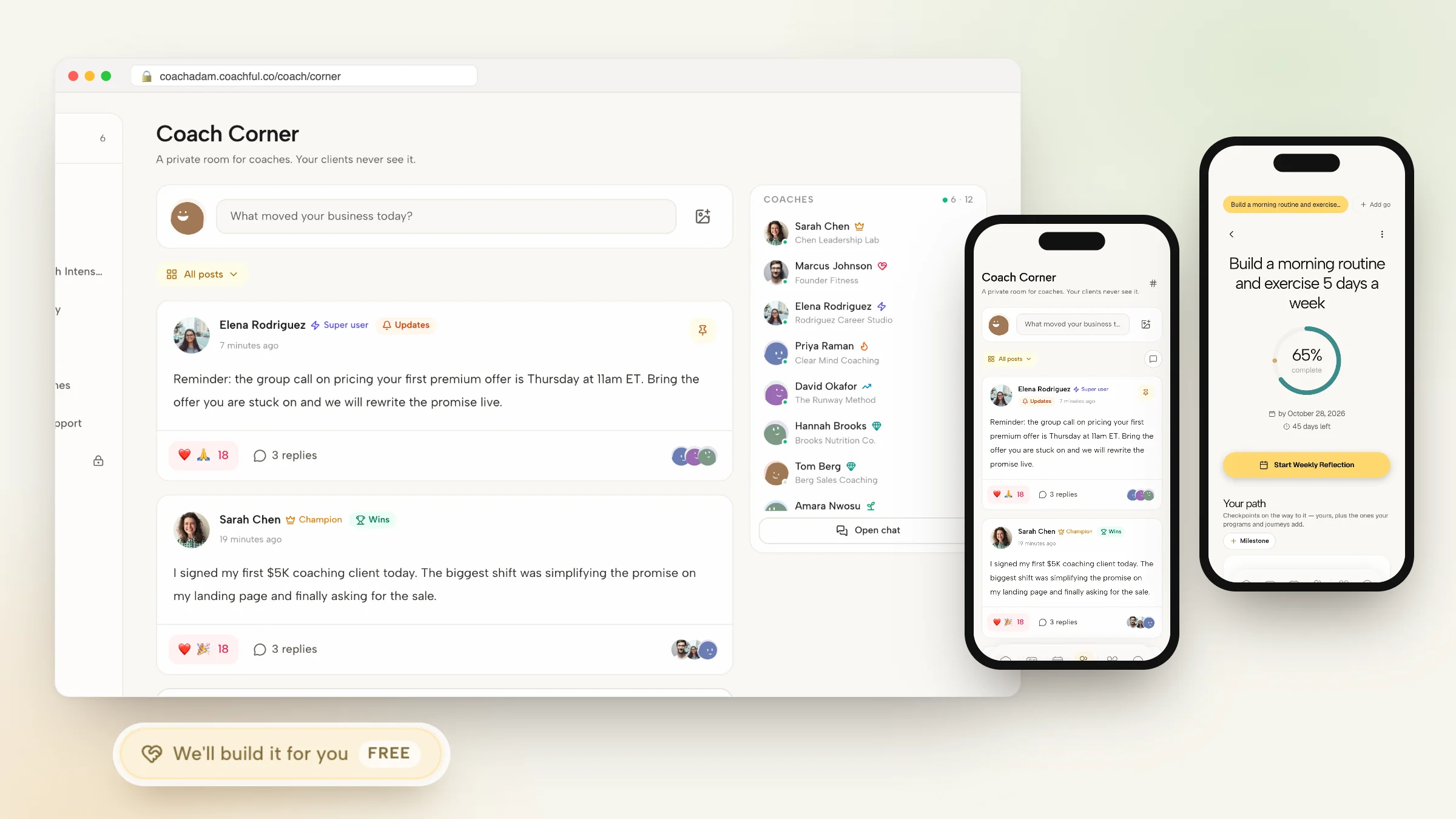
- Keeping a group together. A feed, a chat, a cohort that does not live in a WhatsApp group you cannot search.
- Marketing. A list, sequences, broadcasts, a funnel that captures leads and hands them to the booking calendar.
- Knowing what is happening. Revenue, which clients are drifting, where enquiries came from.
Count how many of those eight your current platform does. Most tools sold as all-in-one score five or six, and coaches quietly buy the other two or three. That is how the one-subscription promise ends as three subscriptions.
The split most roundups miss: selling all-in-one versus coaching all-in-one
Two distinct products wear the same label, and almost nobody tells buyers which one they are shopping for.
All-in-one for selling. Kajabi, Kartra, Systeme.io and, in its own way, GoHighLevel. These are built around the funnel: a landing page, an email list, a checkout, a course to deliver what was bought, analytics on the whole path. They are excellent at turning an audience into revenue. What they lack is a model of a coaching client. Kajabi has no habit tracking and no e-signature contracts. Kartra has no habit tracking, no contracts and no mobile app at any price. Systeme.io has no habit tracking, no contracts and no live rooms. None of them has daily check-ins. If your product is a course and a community, that gap costs you nothing. If your product is twelve weeks of behaviour change, that gap is the product. Wellness coaches in that position can compare seven tools in our software for wellness coaches ranking.
All-in-one for coaching. Coachful, Simply.Coach, Delenta and upcoach. These are built around the client: a program with weeks and tasks, goals, check-ins, notes, progress you can look at before a session. The historic weakness of the category was marketing. Simply.Coach has no funnels, no community and no affiliate tooling. upcoach has no funnels, no invoicing and no contracts. Delenta's website is a branded landing page rather than a full site.
Off to the side sit the client-admin tools. Paperbell and HoneyBook are very good at quote, contract, payment and calendar, and neither has a habit tracker, a real course platform or a community. HoneyBook has no coaching delivery features at all, which is a description rather than a criticism: it was built for photographers and planners and it is excellent at that.
The line that decides it. Of ten products marketed as all-in-one, four track what a client does between sessions and six do not.
The consequence is simple. Buy a selling platform when your delivery is programs and you will bolt on a coaching tool. Buy a coaching platform when your growth depends on funnels and sequences and you will bolt on a marketing tool. The only way to end with one bill is to pick the category that matches the half of your business that is harder to replace, then check the other half is genuinely covered rather than merely listed.
The 60-second decision framework
Answer these four questions honestly and the shortlist writes itself. No "it depends" at the end.
- What do clients do between sessions? If the answer is "watch the next module", you are shopping in the selling category. If it is "complete tasks, log habits, send me a check-in", you are shopping in the coaching category. If it is "nothing, we just talk", a client-admin tool may be all you need.
- Where do new clients come from? Referrals and a booking link means you can skip the funnel builder entirely. Paid ads and a lead magnet means sequences and funnels are not optional, and a coaching tool without them will cost you a second subscription.
- How many clients do you have right now? Client caps are the hidden price of this category. Simply.Coach Starter stops at 3, Delenta Starter at 10 client portals, upcoach Starter at 25 participants. Count your live clients, then read the cap rather than the headline price.
- One coach or several? Paperbell is one service provider per account, so a second coach means a second $97. HoneyBook Starter includes no team members at all. If you are hiring, look at seat pricing before features.
Match your answers to these five routes:
- Programs plus your own marketing, one login for everything: start with Coachful, then Delenta.
- An audience and a course you want to monetise: Kajabi, then Kartra or Systeme.io if the budget is tight.
- 1:1 packages, contracts and a booking link, nothing else: Paperbell, then HoneyBook if you also invoice project work.
- Cohorts, masterminds and accountability above all: upcoach, then Coachful.
- Corporate or sponsored engagements with stakeholder reporting: Simply.Coach, then Delenta.
Everything below is the evidence for those five routes, plus the prices and limitations that decide between them.

What your current stack actually costs
Here is the arithmetic nobody does before they start shopping, using entry-tier monthly prices checked in September 2026. This is the stack a working coach ends up with when the platform covers five of the eight jobs.
| Job | Typical tool | Entry price / month |
|---|---|---|
| Booking and scheduling | Calendly Standard | $10 |
| Video sessions | Zoom Pro | $16 |
| Courses and content | Thinkific Basic | $49 |
| Community | Circle Professional | $129 ($89 billed annually) |
| Email marketing | Kit Creator | $29 |
| Contracts and invoicing | Bonsai Essentials | $25 |
| Six-tool total | $258 / month |
That is $258 a month, or $3,096 a year, before a website or anything that tracks whether clients are doing the work. Move Circle to annual billing and the six-tool total drops to $218. Add a website at $23 (Squarespace Core) and habit tracking at $20 (CoachAccountable Starter) and the eight-tool stack lands at $301 a month, $3,612 a year.
Two numbers matter more than the total. Community is the most expensive line: Circle Professional is $129 billed monthly, more than the entire entry tier of most platforms here, and Circle also takes 2% on payments processed through it on that plan. And the four cheapest lines, scheduling, video, email and contracts, are the four that almost every all-in-one includes, which is where consolidating pays for itself first.
The most expensive line is community. Circle Professional is $129 billed monthly, more than the entire entry tier of most platforms on this page.
Set $258 against the entry prices below and the case gets loud. Coachful Solo is $49 for up to 20 clients, and Pro is $99 with no client cap. Systeme.io Startup is $17. Delenta Starter is $29. Even Kajabi Basic at $179 saves against the six-tool stack, and GoHighLevel Starter at $97 covers more of the eight jobs than the stack does. The question is not whether consolidating saves money. It usually does. The question is what you give up.

What consolidating actually costs you
The honest version, because vendors will not tell you this part.
You lose the best-in-class tool in at least one category. No all-in-one has a community as good as Circle, a course player as good as Thinkific, or a scheduler as detailed as Calendly. GoHighLevel's own reviewers describe its modules as broad but shallow next to Kajabi and Circle. If one of those categories is central to your offer, keep the specialist and consolidate around it.
You concentrate your risk. Three coaching platforms shut down inside eight months: Nudge Coach on 30 April 2025, Practice.do on 3 November 2025, and Profi ended access on 31 December 2025. When a stack of six loses one tool, you replace one tool. When one platform dies, you replace everything at once. That is an argument for checking the export path before you migrate, not against consolidating.
Three shutdowns in eight months. Nudge Coach, Practice.do and Profi all closed between April 2025 and December 2025, so read the export path before you read the feature list.
You inherit their pricing decisions. HoneyBook raised prices roughly 89% in February 2025, moving monthly plans from $19, $39 and $79 to $36, $59 and $129. Kajabi restructured in January 2026: prices up 25% to 61%, Basic contacts cut from 10,000 to 2,500, the $89 Kickstarter tier pulled from the public pricing page, and a 0.5% to 2% surcharge added for anyone using their own Stripe or PayPal. In a six-tool stack a price rise hits one line. In an all-in-one it hits everything, and switching cost is what stops you leaving.
You may lose your own payment processor. HoneyBook is the payment facilitator, so you cannot bring your own Stripe. Kajabi charges 0.5% to 2% if you insist on yours. Kartra takes 5% of sales on the $59 Essentials tier. upcoach takes 2% on Starter, 1% on Pro, 0.5% on Business+. On $5,000 a month of coaching revenue, a 2% fee is $100 a month, more than most of these subscriptions.
Price the fee, not the plan. A 2% cut of $5,000 a month is $100, which is more than the subscription it sits on top of.
You get one export, not six. Check this before you buy. Kartra's funnels, automations and memberships do not transfer anywhere. GoHighLevel funnels and workflows move only as snapshots inside GoHighLevel. Systeme.io contact export links expire after three days. Kajabi course content must be downloaded asset by asset, and Trustpilot reviewers report being asked to pay to retrieve customer data.
How we picked these ten and what we could not verify
Ten platforms, chosen because each markets itself as all-in-one to coaches rather than because it is popular. Every price, cap, transaction fee and review score was checked against vendor pricing pages and public review sites on 2 September 2026, and each score is quoted with its review count so you can weigh a 4.9 from 8 reviews differently from a 4.6 from 1,247.
Where a vendor does not publish something, we say so instead of guessing. Simply.Coach does not state a transaction fee and shows annual prices only behind an on-page toggle, so we could not verify either. Kajabi's trial length is inconsistent across its own site and third-party sources. upcoach publishes annual-billed prices only, with monthly figures appearing on GetApp that we could not confirm on upcoach's own page, so both are given. Systeme.io's calendar sync and Kajabi's two-way calendar sync were not verifiable on their feature pages and are marked unknown rather than absent.
Disclosure: Coachful publishes this article and is one of the ten. It ranks first on coverage across the eight jobs, and the section on who should not pick Coachful is deliberately specific. Read that before the marketing.

1. Coachful, best all-in-one for coaches who deliver programs

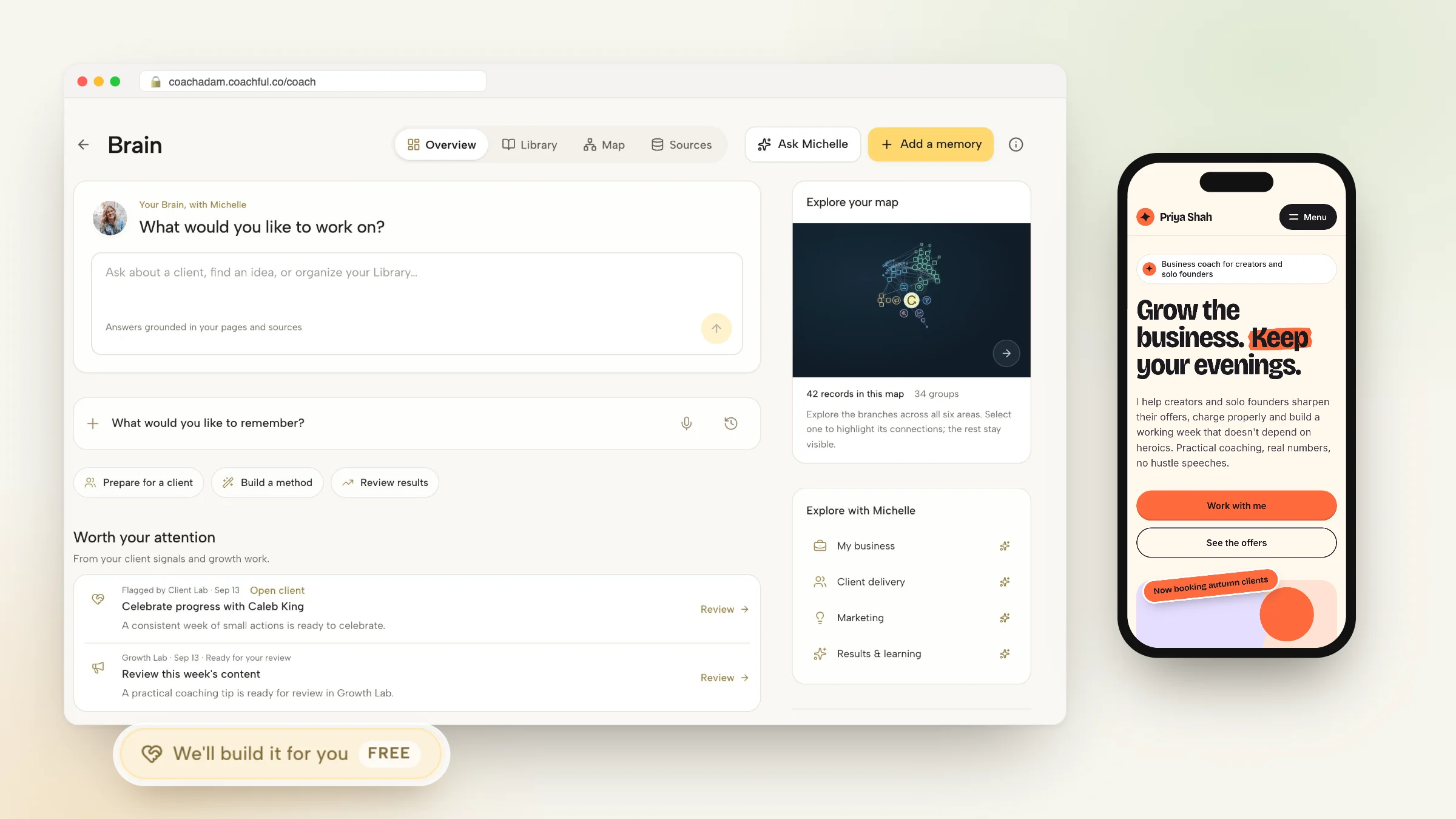
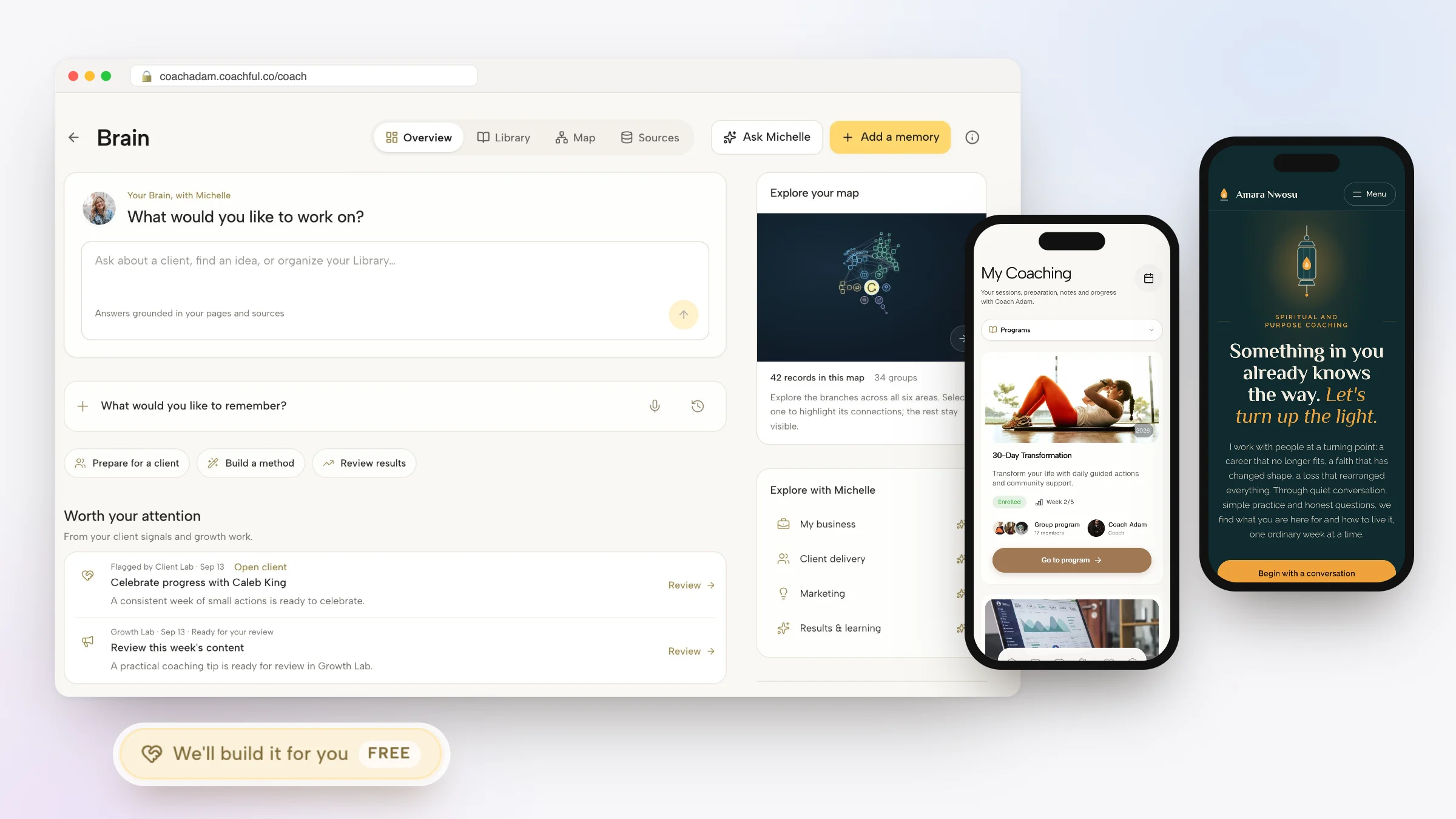
Coachful starts on the coaching side of the split and extends across the selling side, which is the direction that leaves fewer holes. The client record is not a contact in a CRM: it is a person with a program, weekly goals, daily tasks, habits, morning and evening check-ins, streaks and notes. On top sit the pieces a selling platform would normally own: a section-based website builder with blog and custom domain, funnels for booking, applications, lead magnets and checkout, multi-step email sequences with triggers, delays, branching and A/B splits, a community feed with group chat and video events, and courses with modules, drip release and completion tracking. It ranks first on coverage across the eight jobs at the top of this article, which is why it opens the list. See what Coachful includes.
Why Coachful stands out: a free white-glove service. Every plan comes with a team that builds things for you. Send a short request from inside Coachful and they set up your website, a booking funnel, your first program and the welcome emails in your account, usually within about 24 hours, at no extra cost. It takes the slowest part of starting a coaching business, the setup, off your plate. See what the team will build for you.
Pricing, checked 2 September 2026: Lite is $29 a month, $19 billed annually, capped at 5 clients with every feature included. Solo is $49, $39 annually, for up to 20 clients. Pro is $99, $79 annually, with unlimited clients and Coachful Intelligence. Studio is $199 with 3 coach seats and Agency is $299 with 6. The trial is 7 days, card required at signup, no charge during the trial, cancel in one click. Platform fee is 0%: you keep everything after Stripe or Razorpay processing.
Ratings: 4.5 on Trustpilot from 21 reviews.
One bill instead of six. Solo is $49 a month for up to 20 clients, against $258 a month for the six-tool stack it replaces.
Why it works as an all-in-one
- Delivery is native, not a module. Multi-week programs with weekly goals and daily tasks, habits with streaks, check-ins, goals with progress bars, and a per-client AI briefing before a session. Kajabi, Kartra, Systeme.io and HoneyBook have none of this.
- Scheduling is a real scheduler. Booking pages, availability rules, buffers, time-zone detection, paid sessions and session credits, with two-way sync to Google Calendar, Apple Calendar and Outlook or Microsoft 365, built-in video or auto-created Zoom, Meet and Teams links, and reminders by email, SMS at 24 hours and WhatsApp at one hour.
- Money is complete and the fee is zero. Stripe Connect and Razorpay, one-time payments, subscriptions, payment plans, order bumps, Apple Pay and Google Pay, coupons, refunds and Stripe Tax, invoices per transaction plus manual invoices, and agreements with e-signature before the first call. Against upcoach's 2% on Starter or Kartra's 5% on Essentials, 0% is real money.
- The AI is operational, not a copy generator. Michelle works from live practice context across clients, programs, sessions, calendar and payments, builds programs and marketing, takes confirmation-gated actions, summarises calls and briefs you before sessions. Kajabi's AI is credit-metered content generation with 0 credits on Basic.
- It is on the right side of the split. Of ten products marketed as all-in-one, four track what a client does between sessions and six do not. Coachful is one of the four, and it carries the selling side too: Simply.Coach and upcoach have no funnels at all, and Delenta's website is a branded landing page rather than a full site.
- Your branding on their phone from the entry tier, with no build fee. Your logo and colours sit on the client app on iOS and Android on every paid plan. It is your brand inside the Coachful app rather than a separate App Store listing under your own developer account, which is what Delenta unlocks on Premium at $79 and GoHighLevel at $497 a month.
Where it fits, and where it does not
- Built for coaches who run programs. If your revenue is a course and an audience rather than multi-week delivery, a selling platform such as Kajabi or Systeme.io is the better home for that business.
- No HIPAA certification. GDPR-ready with full data export, but if you need a signed BAA today, Simply.Coach and Delenta both claim HIPAA and Coachful does not.
Practical tip: before migrating anything, run one live client through the whole path end to end. Booking link, agreement, payment, program week one, first check-in. Twenty minutes of that tells you more than a fortnight of feature comparison, and every platform here gives you a trial long enough to do it.
Head to head: Coachful vs Kajabi, Coachful vs Paperbell, Coachful vs GoHighLevel.
2. Kajabi, best all-in-one for selling courses to an existing audience

Kajabi has been the default answer for knowledge businesses since 2010 and is still the most complete selling platform on this list. Website, blog, unlimited landing pages, unlimited funnels with checkout and upsells, native email marketing, courses with quizzes and certificates, communities with challenges and leaderboards, and a Coaching product that adds a scheduler, built-in live video for up to 200 participants with 20 breakout rooms, session notes and milestone-based programs. Everything shares one contact record, which is exactly what a fragmented stack cannot do.
Pricing, checked 2 September 2026: Basic is $179 a month, $143 annually, with 5 products, 2,500 contacts, 1 community, 1 website and 2 admin users. Growth is $249, $199 annually, with 50 products, 25,000 contacts, 11 admin users, 500 AI credits, the affiliate program and a branded mobile app. Pro is $499, $399 annually. The old Kickstarter tier at $89, $71 annually, was removed from the public pricing page in January 2026 and reportedly still surfaces in-trial or through support. Kajabi Payments carries a 0% platform fee with processing at 2.9% + $0.30 on Basic, 2.8% on Growth and 2.7% on Pro; bring your own Stripe or PayPal and Kajabi adds 0.5% to 2%.
Ratings: 4.1 on G2 from 93 reviews, 4.4 on Capterra from 226, and 3.5 on Trustpilot from 2,337. That Trustpilot volume is the largest of any course platform here, though only 87 of those reviews landed in the last twelve months.
Why it works as an all-in-one
- The only course platform in this set with a native scheduler, built-in live video, session notes and milestone programs in one product, so a course-plus-group-coaching business genuinely does not need a second tool.
- Branded mobile app included on Growth and Pro rather than sold as a $199-plus add-on.
- Unlimited landing pages and funnels on every tier including Basic, with the largest template, expert and agency ecosystem here if you would rather hire help than learn a tool.
Potential limitations
- The January 2026 restructure was rough on customers. Prices rose 25% to 61%, Basic contacts fell from 10,000 to 2,500, Kickstarter left the public page, and a surcharge appeared for third-party processors.
- No contracts and no e-signature. If you send an agreement before the first call, that is a separate tool.
- No habits, no daily check-ins, no client goal dashboards. The Coaching product is session-centric: programs have timelines, outlines and milestones, but there is no daily task or homework engine.
- The entry price is steep before revenue. $179 a month with 5 products and 2,500 contacts is a lot for a coach with eight clients.
- Value for money is its weakest Capterra sub-score at 3.7 out of 5, and Trustpilot carries recurring complaints about AI-first support that will not escalate, failed cancellations and data-retrieval fees.
- No AI credits and no affiliate program on Basic. Both start at Growth, which is $249 a month.
Practical tip: if you are on Kajabi mainly for the course player and deliver 1:1 or small-group coaching alongside it, price the Kajabi bill against a coaching-first platform plus Kajabi Basic for the course only. Often the second option is cheaper and the delivery is better. Our Kajabi alternative page runs that arithmetic.
3. Paperbell, best all-in-one for solo coaches selling 1:1 packages

Paperbell does one thing with unusual discipline: it takes a coaching package from a landing page through contract, payment, scheduling and intake in a single checkout, and it does not pretend to be more. Founded in 2020 by Laura Roeder, it has one paid tier, no upsells, and a client portal with history, shared notes and messaging. Coaches describe it as an admin assistant rather than a platform, which is the right expectation to set.
Pricing, checked 2 September 2026: the free plan is genuinely free with no time limit, capped at one client, though the public coaching site stays live only for the first 7 days. The single paid tier is $57 a month, or $47.50 a month billed annually at $570 a year, which is two months free against the $684 regular annual. That is per coach: a multi-coach practice buys a separate account per coach. Platform fee is 0%, with Stripe and PayPal processing on top.
Ratings: 4.7 on G2 from 63 reviews, 4.7 on Capterra from 150, and 3.9 on Trustpilot from 13. Capterra rates its customer service 4.8 out of 5 and gave it a Best Value badge in 2025.
Why it works as an all-in-one
- One flat price with unlimited clients, sessions, packages and files, and no tier to be pushed into later.
- The packaged checkout is the cleanest here: contract, payment, booking and intake in one flow the client never falls out of, with group programs, workshops and live classes included rather than gated.
- Calendar sync covers Google, iCal and Apple, and Outlook, with SMS appointment reminders, and the free-until-your-second-client model lets you validate an offer without a card.
Potential limitations
- You outgrow it in one specific direction. No courses or LMS, no community, no goal or habit tracking. Reviewers say plainly they had to add another platform, which is exactly the two-subscription outcome this article is about.
- One service provider per account. A second coach is a second $57 a month, with no shared team view.
- No native mobile app. Mobile browser or add-to-home-screen only.
- Branding is limited. A Trustpilot reviewer calls the options "pretty limited", and there is no white label of the whole experience.
- Explicitly not HIPAA compliant, stated in Paperbell's own FAQ.
- No AI features and no funnels. If your growth plan involves lead magnets and sequences, that is a separate subscription.
Practical tip: Paperbell is the right answer more often than coaches expect. If your delivery genuinely is "we talk every fortnight and I send a worksheet", $97 a month buys everything you need and you should stop shopping. Start at the Paperbell alternatives comparison only if the missing course, community or progress tracking is actually blocking you.
4. Simply.Coach, best all-in-one for executive and corporate coaching

Simply.Coach, founded in 2020 and based in Pune, is built for the part of the market where a third party is paying: HR sponsors, stakeholder reports, 360 assessments, development plans and coach matching. It carries the highest G2 rating in this set and the lowest entry price, and it is one of only two platforms here claiming SOC2, HIPAA and GDPR together.
Pricing, checked 2 September 2026: Starter is $9 a month for 3 clients, 1 contract, 1 program and 1GB. Essentials is $29 for 7 clients, 3 contracts and 3 programs. Growth is $49 for 30 clients with multiple calendars, recurring sessions and your logo. Leap is $69 for unlimited clients with a white-labelled platform, your domain and 100GB. Business tiers are priced per active coach: CoCreate at $79 with 10 clients per coach, 2 admins and 5 sponsors, and Surge at $159 with 25 clients per coach plus white label and custom domain. Annual billing is advertised as saving up to 52%, but the figures sit behind an on-page toggle and we could not verify them. The transaction fee is not stated on the pricing page, so we could not verify that either. The trial is 14 days with no card, capped at 3 clients and 10 sessions.
Ratings: 4.8 on G2 from 146 reviews, 4.6 on Capterra from 41, with customer support rated 4.9 out of 5 on Capterra. There is no Trustpilot presence.
Why it works as an all-in-one
- Programs and pathways with action plans and nudges, goals, development plans, custom reports and scheduled stakeholder reports. Nothing else at $9 a month comes close on the corporate side.
- SOC2, HIPAA and GDPR claimed together, which is rare below enterprise pricing and decisive if you coach inside regulated organisations.
- Native iOS and Android apps in English, Spanish and French, embedded video alongside Zoom, Teams and Google Meet, and business tiers that understand the shape of a coaching firm: admins, sponsors, HR partners, coach matching and stakeholder roles.
Potential limitations
- Client caps on every solo tier below Leap. 3, then 7, then 30. A solo coach with 35 clients is on the $69 tier whether or not they want the white-label features.
- Feature overwhelm is the most common complaint. Reviewers cite a steep initial setup and navigation curve, which is the trade-off for the depth.
- No community, no funnels, no marketing automation. Journey automation and email integration exist, but this is not an autoresponder and there is no lead capture path.
- Website is a showcase page. Landing pages rather than a site builder with a blog.
- The AI story is thin. Marketed as AI-enabled, with specifics we could not verify.
- Integration gaps. Missing accounting connections such as Xero and Wave, and email-marketing connections such as MailerLite. The French localisation is described as unpolished.
Practical tip: the trial cap of 3 clients and 10 sessions is easy to hit before you test the thing you are actually buying, which is the reporting. Load one real engagement with a stand-in sponsor on day one and generate a stakeholder report in week one. See also Simply.Coach vs Delenta.
5. Delenta, best all-in-one for a branded client app on a small budget

Delenta, founded in 2018 in London and an ICF partner, is the quiet completist of this category. Landing page, booking funnel, programs with drip content, quizzes and tasks, courses, community feeds and group chat for cohorts, digital contracts, automatic billing and invoicing, and a white-labelled iOS and Android client app. It announced HIPAA compliance in March 2026 alongside a public trust centre.
Pricing, checked 2 September 2026: Starter is $29 a month, or $19.08 annually at $229 a year, with 1 seat, 10 client portals, 1GB and no group coaching. Pro is $49, or $39.08 annually at $469, with 40 client portals, 5GB and group coaching. Premium is $79, or $58.25 annually at $699, with unlimited client portals, 100GB, the course creator and the mobile app. Teams and Enterprise are custom and priced per seat. There are no platform transaction fees on any plan, with Stripe and PayPal processing on top, and a 14-day trial with no card required.
Ratings: 4.8 on Capterra from 60 reviews with 4.9 for customer service, and 4.1 on Trustpilot from 5. The G2 seller page shows 28 reviews but the score could not be read.
Why it works as an all-in-one
- A white-labelled client app under your own branding at $79 a month is the cheapest route to that outcome in this set.
- Community feeds and group chat for cohorts are included, which Simply.Coach, Paperbell and HoneyBook do not offer at all.
- Delenta-i takes AI session notes and produces summaries scored against ICF markers, which is genuinely useful for credentialed coaches, and there is a 25% annual discount with no platform fee.
Potential limitations
- The mobile app is Premium only. If the branded app is why you are here, your real price is $79 a month, not $29.
- Group coaching starts at Pro. $49 a month before you can run a cohort.
- Client portal caps of 10 and 40 on the two lower tiers, which is the same trap as Simply.Coach.
- The calendar is limited. Reviewers call it restricted next to a dedicated scheduler and describe mobile scheduling as clunky.
- Few email-marketing integrations, and the depth of the product creates a learning curve that is the most common Capterra complaint.
- Video is Zoom only. No built-in video rooms.
Practical tip: ask Delenta for a client-data export sample during the trial. The help centre documents CSV and XLS contact import, but a full client-data export was not something we could verify, and knowing your exit before you enter is the lesson of 2025. See how Delenta compares if the caps are the sticking point.
6. upcoach, best all-in-one for cohorts, masterminds and accountability

upcoach was co-founded in 2020 by performance coach Todd Herman, and it shows in what the product prioritises. Programs are the object everything hangs off: cohorts, masterminds, bootcamps and 1:1 tracks, each with tasks, lessons, events, worksheets and check-ins. The habit tracker and progress dashboards are the best in this set, with one reviewer describing the accountability tooling as something they had never seen in another product. It was also first in the category to ship an MCP server, so you can build programs and pull reports from Claude or ChatGPT.
Pricing, checked 2 September 2026: upcoach publishes annual-billed prices only. Starter is $49 a month for 25 active participants, 1 team seat and a 2% transaction fee. Pro is $99 for 100 participants, 2 seats and 1%. Business+ is $199 for 250 participants, 5 seats, 0.5% and implementation services, with an extra 100 participants at $99 a month. Scale is $399 for 500-plus participants, 10 seats and 0%. Enterprise is custom. GetApp lists monthly-billed prices of $59, $119 and $249 that we could not verify on upcoach's own pricing page. Extra seats on Business+ and Scale are $39 a month. The trial is 14 days with no card, plus a 30-day money-back guarantee.
Ratings: 4.9 on Capterra from 8 reviews with a 4.8 support rating, which is a very small sample. AppSumo, where an early lifetime deal was sold, scores it 4.08 across 78 reviews, and there is no Trustpilot presence.
Why it works as an all-in-one
- Habits, daily check-ins, progress dashboards and who-is-on-track reporting in one place, which is the exact capability the selling platforms are missing.
- Community, courses, live events and program tasks share one participant record, so a cohort does not need a Circle subscription bolted on.
- Multi-role team access with admins, facilitators and sponsors on every plan including the $49 tier, and an MCP integration that is genuinely ahead of the category if you already run your week through an AI assistant.
Potential limitations
- Transaction fees until the $399 tier. 2% on Starter, 1% on Pro, 0.5% on Business+. On $8,000 a month of program revenue, Starter's 2% is $160 on top of the $49.
- No contracts and no invoicing. Neither is marketed, so a coach who signs agreements needs a second tool. upcoach's own typical stack lists Paperbell or Dubsado for exactly that.
- No funnels, no affiliate program, no marketing automation. Program notifications only, and landing pages rather than a website builder.
- Outlook calendar sync is reported missing by reviewers; Google Calendar is the supported path.
- Privacy paperwork has a history. AppSumo reviewers cite a missing DPA for a long stretch and an inability to delete client accounts. GDPR is claimed on product pages, the terms require an Article 9 basis for health data, and HIPAA is not offered.
- Participant bands, not clients. Pricing counts active participants, so a large free cohort costs the same as a paying one.
Practical tip: work out the transaction fee before comparing subscription prices. Multiply monthly program revenue by 2% and add it to $49. If that lands above $99, upcoach Pro is cheaper than upcoach Starter, and a 0% platform such as a flat-fee group coaching platform may be cheaper than both.
7. GoHighLevel, best all-in-one for coaches who sell through a pipeline

GoHighLevel is not built for coaches. It is built for marketing agencies, and coaches use it because the feature footprint is the widest here: CRM pipelines, native calendars with round-robin and class booking, two-way Google, Outlook and iCloud sync, contracts with e-signature, invoicing, two-way SMS and WhatsApp, funnels with upsells and A/B tests, websites and blogs, courses, communities with gamification, a native affiliate manager and unlimited users. If a capability appears in this article, GoHighLevel probably has a version of it.
Pricing, checked 2 September 2026: Starter is $97 a month, or $80.83 annually at $970 a year, with up to 3 sub-accounts and the full feature set. Unlimited is $297, or $247.50 annually at $2,970, adding unlimited sub-accounts and rebilling. Agency Pro is $497, or $414.17 annually at $4,970, adding SaaS mode so you can resell HighLevel under your own brand. Enterprise is custom. The platform fee on your sales is 0%, but usage is metered: email runs at roughly $0.675 per 1,000 sends and SMS at roughly $0.0079 per segment. HIPAA is a $297 a month module with a BAA, the white-label mobile app is $497 a month, and the 14-day trial requires a card with billing starting automatically.
Ratings: 4.6 on G2 from 649 reviews, 4.6 on Capterra from 1,247, and 4.9 on Trustpilot from 14,879. Those figures conflict across sources, with other listings showing 4.2 from 3,647 on G2 and 4.2 from 89 on Capterra, so treat counts as approximate. A large share of coach-facing reviews are affiliate content, because agencies resell it.
Why it works as an all-in-one
- Native scheduling with two-way calendar sync, contracts, invoicing, SMS, pipelines, funnels, courses and communities on every plan including the $97 tier.
- Unlimited contacts and unlimited users inside a sub-account, which no other platform here offers at that price.
- Two-way SMS and WhatsApp are native rather than an integration, and the ecosystem of snapshots, freelancers and templates means most of what you need has already been built by someone.
Potential limitations
- It is genuinely complex. Sub-accounts, snapshots, A2P registration for SMS and workflow building all sit between you and a working system. Reviewers consistently describe a steep learning curve.
- The $97 is not the bill. Metered SMS, email, phone numbers and AI mean published examples land nearer $180 a month in real spend, and HIPAA at $297 or a white-label app at $497 change the picture entirely.
- No habits, no client programs, no progress tracking. You would simulate check-ins with forms and workflows, which works and is miserable.
- Modules are broad but shallow. The course builder, community and website editor lag Kajabi and Circle on polish, and there is no native video.
- Exit is awkward. Contacts and conversations export to CSV, but funnels, sites and workflows move only as snapshots inside HighLevel. Annual plans are non-refundable and data becomes inaccessible after cancellation.
- If you bought through a reseller, the agency owns the account, and your data portability depends on them.
Practical tip: price GoHighLevel by writing down your monthly SMS volume first. A coach sending two reminders to 40 clients sends 80 segments a month, which is trivial. A coach nurturing 3,000 leads is on a different bill entirely. Our GoHighLevel alternative page compares the delivery side directly.
8. Systeme.io, best all-in-one for the smallest possible bill

Systeme.io is the most reviewed product in this roundup and the cheapest serious one, which is a combination that ought to make you suspicious and does not survive contact with the numbers. Funnels, email automation, courses, communities, websites, webinars and an affiliate program run on one contact record, there is a free forever plan, and the paid entry point is $17 a month. It also has a native booking calendar with paid appointments, which only three tools on this page can say.
Pricing, checked 2 September 2026: Free at $0, Startup $17 a month, Webinar $47 a month, Unlimited $97 a month, or $14.17, $39.17 and $80.83 respectively billed annually. Platform fee is 0% on every plan including the free one, with only Stripe or PayPal processing on top. Emails are unlimited across the paid tiers. Custom domains are available on all plans, and sub-accounts arrive on Unlimited.
Ratings: 4.9 on Trustpilot from 8,424 reviews, 4.8 on G2 from 744, and 4.8 on Capterra from 2,126. That is roughly eleven thousand public reviews averaging above 4.8, the strongest review profile of anything on this page by an order of magnitude, and reviewers name the support and migration team repeatedly.
Why it works as an all-in-one
- The price-to-scope ratio has no competition here. At $17 a month you have funnels, unlimited emails, courses, a community, a website and an affiliate program with zero platform fee.
- The free plan is not a demo. It keeps working, which makes it the safest way in this whole category to hold your data live while you migrate somewhere else.
- Funnels, email automation, affiliates and courses genuinely share one contact record, so a tag set by a funnel drives an email sequence without a Zap in the middle.
- A native booking calendar with paid appointments means a coach selling sessions does not need Calendly on top.
- An EU company with GDPR handled, and a migration team that reviewers say does the moving for you.
Potential limitations
- No client app and no coach app. Everything happens in a browser.
- No habits, no check-ins, no client programs. Courses drip by schedule and that is the extent of the delivery model. For accountability coaching this is the wrong tool, at any price.
- No contracts and no e-signature. You are pairing this with something for the paperwork.
- The page builder and the automations are less flexible than premium tools. Capterra reviewers call the editor clunky and mention limited undo, which is the honest cost of $17.
- Communities and courses are basic: no live streaming, no gamification, no app.
- Contact exports expire after three days, and there is no refund for a remaining subscription period. Courses and pages cannot be bulk exported at all, so plan to rebuild content if you leave.
Practical tip: Systeme.io is the best answer on this page to the question "how do I stop paying for five tools this month". It is close to the worst answer to "how do I make my clients do the work". If you are consolidating to cut a bill, start here. If you are consolidating to improve outcomes, do not.
9. Kartra, best all-in-one for behaviour-based automation

Kartra is the most technically ambitious marketing platform here. Pages, funnels, email and SMS, memberships, video hosting, calendars, a helpdesk and an affiliate program all sit in one product, and the automations are genuinely behaviour-based with lead scoring attached, which is a step beyond what the coaching-admin tools do. The native calendar handles recurring, one-off, class and call bookings, and the built-in helpdesk removes a Zendesk subscription. It claims more than 60,000 customers.
Pricing, checked 2 September 2026: Essentials $59 a month, Starter $119, Growth $229, Professional $549, or $52, $99, $189 and $429 billed annually. Read Essentials carefully: it carries a 5% transaction fee and tight caps, so the real entry point for most coaches is Starter at $119, where the fee drops to 0%. Community functionality is reported to require the $229 Growth tier.
Ratings: 4.5 on Capterra from 168 reviews, 3.9 on G2 from 57, and 3.4 on Trustpilot from 128. The pattern across all three is the same: capable product, difficult learning curve, and support that reviewers say is slow.
Why it works as an all-in-one
- It is one of the few products here that is genuinely all-in-one in the marketing sense: pages, funnels, email, SMS, memberships, video, calendars, helpdesk and affiliates, with nothing bolted on.
- Behaviour-based automations with lead scoring are more advanced than any coaching CRM on this page.
- A native calendar and a native helpdesk replace two separate subscriptions, which is real consolidation rather than the appearance of it.
- 0% transaction fee from Starter upward, and an agency console for managing client accounts.
Potential limitations
- 3.4 on Trustpilot from 128 reviews, with buggy behaviour, inconsistent interface and slow support the recurring themes. One reviewer reports waiting four months for a resolution.
- The learning curve is cited on all three review sites, which is unusual and tells you it is not one reviewer's bad week.
- Essentials is a misleading entry price once you add the 5% fee and hit the caps.
- No mobile app for students or admins, and community only appears at $229.
- No habits, no check-ins, no client progress tracking, no contracts. Memberships drip content; they do not track whether a client did anything.
- The lock-in is the worst on this page. Contacts export to CSV, but pages and funnels export only as Kartra elements, membership content has to be rebuilt, and cancelled accounts are retained only briefly before data is gradually deleted. Reviewers say leaving means losing the work you created.
Practical tip: if you are choosing between Kartra and Kajabi, you are choosing between better automation and better support and ecosystem. Compare them against the delivery side in Coachful vs Kajabi, because whichever you pick, the client accountability layer is still missing.
10. HoneyBook, best all-in-one for client admin and contracts

HoneyBook is the most polished client-admin experience in this roundup. Proposals, contracts and invoices combine into one smart file that a client opens once and signs, pays and books from, all inside a single project view with automations behind it. It was built for photographers and event professionals and it shows in the best way: the client-facing side is clean and professional, and Capterra rates it 4.7 across 687 reviews. An AI notetaker and AI email drafts ship on every plan.
Pricing, checked 2 September 2026: Starter $36 a month, Essentials $59, Premium $129, or $29, $49 and $109 billed annually. There is no platform fee on top of processing, but note that HoneyBook is the processor: card payments start at 2.7% plus 10c, and ACH is 1.5%, with no international surcharge. The Scheduler is not on Starter. A 60-day money-back guarantee covers your first paid month.
The February 2025 price increase matters. Tiers moved from $19, $39 and $79 to $36, $59 and $129, an increase of roughly 89%, and Trustpilot reviewers describe jumps from $35 to $129 a month. If you are evaluating HoneyBook on an older recommendation, check the current number.
Ratings: 4.7 on Capterra from 687 reviews, 4.4 on G2 from 194, and 4.0 on Trustpilot from 706. Support is a recurring positive across all three, which is rare on this page.
Why it works as an all-in-one
- The smart file is the best-executed client document in this roundup. Proposal, contract and invoice in one link, signed and paid in one sitting.
- Genuinely one system for the business side: pipeline, contracts, invoices, scheduler and automations in a single project view.
- Processing at 2.7% plus 10c on cards and 1.5% on ACH is competitive, and there is no international surcharge.
- An owner-facing iOS and Android app, so you can send a contract from a phone.
- AI notetaking and email drafting on every plan, not gated to the top tier.
Potential limitations
- No coaching delivery features at all. No programs, no habits, no check-ins, no client progress tracking, no community. This is a client-admin CRM and it does not pretend otherwise.
- No client app. Clients use a web portal, and the owner app is described as glitchy by Trustpilot reviewers.
- The project-per-job structure fights repeat clients. Coaching is inherently a long relationship, and reviewers with recurring clients find the model rigid, with limited flexibility on custom payment schedules.
- Features have moved to legacy status without warning, forcing users to rebuild templates.
- HoneyBook branding is not fully removable, and reporting is limited for a scaling business.
- Smart files and templates are not portable. Clients export to CSV, but the templates and automations you invested in do not come with you.
Practical tip: HoneyBook is the right answer if your admin is the bottleneck and your coaching happens entirely in the session. It is the wrong answer if you sell an outcome that depends on the other six days. Compare directly in Coachful vs HoneyBook or Paperbell vs HoneyBook.
All ten compared on one screen
Entry prices are the cheapest paid tier, checked 2 September 2026. The two columns that decide most of these are the fee on your revenue and whether anything tracks what your client does between sessions.
| Tool | From | Fee on your revenue | Client app | Programs and check-ins | Funnels and email | Contracts | Best for |
|---|---|---|---|---|---|---|---|
| Coachful | $29/mo | 0% | Yes, your branding | Yes | Partial | Yes | Delivering programs |
| Kajabi | $89/mo | 0% on Kajabi Payments | Yes, branded on Growth | No check-ins | Yes | No | Selling courses |
| Paperbell | $97/mo | 0% | No | No | No | Yes | 1:1 packages |
| Simply.Coach | $9/mo (3 clients) | 0% | Partial | Yes | No | Yes | Corporate coaching |
| Delenta | $29/mo | 0% | Yes, white-label on Premium | Partial | Partial | Yes | A branded app, cheaply |
| upcoach | $49/mo | 2% down to 0% | Yes | Yes, excellent | No | No | Cohorts and masterminds |
| GoHighLevel | $97/mo | 0%, SMS metered | Yes, white-label | No check-ins | Yes, deepest | Partial | Selling through a pipeline |
| Systeme.io | Free, then $17/mo | 0% | No | No | Yes | No | The smallest bill |
| Kartra | $59/mo, 5% fee | 5%, then 0% from $119 | No | No | Yes | No | Behaviour-based automation |
| HoneyBook | $36/mo | Processor, from 2.7% + 10c | Owner app only | No | Partial | Yes, best | Client admin and contracts |
Notice what the table makes obvious. Of ten products marketed as all-in-one, four track what a client does between sessions and six do not. If you sell an outcome rather than an hour, that column is the whole decision and every other column is a preference.
How to actually consolidate, in four weeks
The reason most consolidations fail is that coaches migrate everything at once, in the busiest month of the year, and then judge the new tool by the mess of the move. Do it in this order instead.
- Week one: export before you subscribe. Pull a CSV of clients, contacts and any coaching log from every current tool, and save your contracts and program content as documents. Do this first, because it also tells you which vendors make leaving hard, and that is information you want before you sign the next one.
- Week two: rebuild one thing, not everything. Take your single most common offer and build only that: the page, the checkout, the contract, the booking, the first two weeks of the program. One offer end to end reveals every gap. Ten half-built offers reveal none.
- Week three: put one real client through it. Not a test account. A real person, ideally a new signup, so you see the experience they see. Watch where they hesitate. That is your list of things to fix, and it is always shorter than you feared and different from what you expected.
- Week four: cut the overlap, keep one bridge. Cancel only the tools the new one has fully replaced, and keep whatever holds your email list until the last thing has moved. Do not cancel your payment processor connection until you have confirmed a live charge lands in your bank.
Two rules that save people real money. First, do not buy annual until you have run a full billing cycle monthly, because the annual discount is worth less than the cost of being wrong for a year. Second, keep the old tool's data export on your own disk even after you cancel, because a vendor's retention window is not a backup and three products in this category shut down between April 2025 and December 2025.
Export on the day you subscribe. Systeme.io contact export links expire after three days, and GoHighLevel data becomes inaccessible after cancellation.
Where Coachful is the wrong choice
We make Coachful, so this section is the one to read closely. Several of the tools above are better buys for specific coaches, and here is exactly who.
- Your revenue is a course and an audience. Kajabi or Systeme.io. If email marketing, funnels and a real website are where your money is made, that is their core and our secondary.
- You want the lowest possible monthly bill. Systeme.io at $17, or its free plan. Nothing we offer competes with free, and its review record is the strongest here.
- Your bottleneck is proposals, contracts and invoices. HoneyBook's smart file is the best-executed client document in this roundup, and its 4.7 across 687 Capterra reviews is earned.
- You run paid acquisition at volume. GoHighLevel's pipeline, SMS and automation depth is a different category of tool, and if you have a media buyer, buy the media buyer's software.
- You need HIPAA. We are GDPR-aligned and not HIPAA compliant. Delenta announced HIPAA in March 2026, and Simply.Coach is built for corporate and clinical-adjacent work.
- You want deep behaviour-based marketing automation. Kartra does more than we do, if you accept the learning curve and the lock-in.
Where we do think we win is narrow and worth stating plainly: you deliver multi-week programs, the result depends on what your client does between sessions, you want your own branding on their phone, and you would rather pay one flat price with a 0% platform fee than assemble four subscriptions.
Frequently asked questions
What does all-in-one software for coaches actually include?
At minimum: a way to be found, a way to be booked, a way to be paid, a way to deliver the work, and a client record that ties those together. The disagreement in this category is over what delivery means. Marketing platforms read it as publishing content, so they give you funnels, courses and email. Coaching platforms read it as changing behaviour, so they give you programs, tasks, check-ins and progress. Both are honestly all-in-one. They are all-in-one for different jobs, and buying the wrong one is the single most expensive mistake in this category.
Will Coachful set it up for me?
Yes. Every Coachful plan includes a free white-glove service. Send a short request from inside the app describing what you want, such as your website, a booking funnel, your first program and the welcome emails, and the Coachful team builds it in your account, usually within about 24 hours, at no extra cost. You can edit everything they build, and they do not record videos for you.
Is all-in-one software actually cheaper than separate tools?
Usually yes, but not always, and the gap is smaller than the marketing suggests. A typical assembled stack of scheduling, payments, a course host, email and a form tool runs roughly $150 to $250 a month. Most all-in-one options here land between $29 and $129. The exceptions are worth knowing: Kartra's Essentials tier adds a 5% fee, upcoach charges 2% down to 0% by tier, and GoHighLevel meters SMS separately, so at volume any of the three can cost more than the stack it replaced. Price the fee, not the plan.
What is the cheapest all-in-one platform for coaches?
Systeme.io, on price alone, with a free forever plan and a $17 paid entry point at a 0% platform fee. Simply.Coach starts at $9 a month but caps you at three clients. Coachful starts at $29 for up to five clients with every feature included. The honest answer is that the cheapest tool that does your job is cheap and the cheapest tool overall is not, because a $17 plan you have to pair with two other subscriptions costs more than a $49 plan you do not.
Do any of these replace Zoom?
Some include video and most coaches keep Zoom anyway. That pattern shows up in reviews of CoachVantage, Simply.Coach and others: the built-in video works, and clients already have Zoom installed and know how it behaves. Treat built-in video as a convenience worth having and not as a subscription you can confidently cancel, and note that Satori has no native Zoom integration at all, which surprises people.
Which all-in-one tools have a white-label client app?
Three go as far as a separate listing under your own name: Delenta on Premium at $79 a month, GoHighLevel on its higher tiers, and Kajabi's branded app on Growth and Pro. Coachful is the cheapest way to get your logo and colours in front of clients, on every paid plan with no build fee, though that is your brand inside the Coachful app rather than a listing of your own. Systeme.io, Kartra, Paperbell and HoneyBook have no client app at all, and HoneyBook's app is for you rather than your client.
Your name on the app, without the build fee. Coachful carries your branding on every paid plan, where Delenta gates it at $79 and GoHighLevel at $497 a month.
Can I move my data out if I change my mind?
Partly, and this varies more than any other factor here. Contacts and clients export to CSV almost everywhere. What does not travel is the work you built: Kartra's funnels and memberships have to be rebuilt, Systeme.io cannot bulk export courses or pages and its contact export link expires in three days, HoneyBook's smart files and templates are not portable, and GoHighLevel data becomes inaccessible after cancellation with non-refundable annual plans. Export on the day you subscribe, not the day you leave.
Should a brand new coach buy all-in-one software?
Buy the cheapest thing that gets you paid, and buy it this week. A new coach's problem is clients, not software, and every hour spent configuring funnels is an hour not spent talking to someone who might hire you. Satori's free Scholar tier or Systeme.io's free plan will carry your first few clients, and Paperbell's free trial lets you test it first. Revisit this page when admin or client results start costing you real time, because that is the point where consolidation pays for itself.
What is the best all-in-one software for coaches in 2026?
There is no single answer, and any page that gives you one is selling something. For delivering programs where results depend on what clients do between sessions, Coachful. For selling courses to an existing audience, Kajabi. For 1:1 packages with the least possible software, Paperbell. For corporate and executive work, Simply.Coach. For the smallest bill, Systeme.io. For paid acquisition at volume, GoHighLevel. For client admin and contracts, HoneyBook. Match the tool to the job, then test it with one real client before you commit a year.
The decision, in one paragraph
Write down where your money comes from and where your clients get stuck. If the money comes from content and an audience, buy a marketing platform and accept that accountability will be manual. If the money comes from an outcome your clients need help sticking to, buy a coaching platform and accept that your funnels will be simpler. Then pick the cheapest tool in the right half, run one real client through one real week, and only pay annually once that week went well.
Compare any two of these directly in the comparison hub, see the wider platform view in the 12 best online coaching platforms, or read what Coachful includes.
Join Coachful now
If the result you sell depends on what your clients do between sessions, stop assembling that half of the stack from four subscriptions. Start the 7-day trial, build one program, and put one real client through booking, agreement, payment and week one before you decide anything else.