
Health Coach Salary in 2026: Pay, Rates and Real Income
The typical health coach salary in 2026 is $52,000 to $77,000 a year, based on PayScale, ZipRecruiter and Glassdoor data compiled in Coachful's 2026 Coaching Business Report. Most health and wellness coaches charge $75 to $200 a session. The US Bureau of Labor Statistics doesn't track health coaches as a separate job, so the closest government figures come from neighboring occupations, such as health education specialists, who earned a median of $64,070 in May 2025.
That gives you three different numbers, and they measure three different things. A salary is what an employer pays you. Income is what a self-employed coach keeps after selling sessions, programs and monthly coaching. A BLS median is pay for a related job that isn't coaching. This guide sorts them out, then does the arithmetic: how many clients, at what price, it takes to earn each one.
If you go independent, one cost you can skip in the lean first months: Coachful's team builds your health coaching website and first program page for free on every plan.
Health coach salary figures and where they come from
Every figure below names its source. The aggregator numbers come from self-reported pay and job postings, so read the last column before you plan around any of them.
| Figure | Amount | Source | What it really measures |
|---|---|---|---|
| Health and wellness coach, yearly | $52,000 to $77,000 | PayScale, ZipRecruiter, Glassdoor | Self-reported pay and posted roles; leans toward employed coaches |
| Health and wellness coach, per session | $75 to $200 | PayScale and practitioner reports | The price of an hour, not hourly pay |
| US median, all coaching | $71,719 a year | ICF Global Coaching Study 2025, PayScale | Every niche, including executive coaching billed to employers |
| Health education specialists (adjacent occupation) | $64,070 median, May 2025 | BLS Occupational Outlook Handbook | Employed health educators, not coaches |
| Community health workers (adjacent occupation) | $51,850 median, 2025 | BLS Occupational Outlook Handbook | Employed outreach and support roles, not coaches |
Coaching figures compiled in Coachful's 2026 Coaching Business Report for Q2 2026, US dollars, before tax and business costs. BLS figures are for adjacent occupations and are labelled as such.
Coachful's notes on the report's sources flag the bias in the first row: PayScale is self-reported and skews toward employed and hybrid coaches, and ZipRecruiter tracks posted roles, so both under-represent self-employed practice income. The full breakdown for the niche lives on the health and wellness rates page.
The report's own one-line verdict on the niche is worth keeping in mind: health and wellness is "the most crowded end of the profession, and the one competing hardest against apps and subscriptions." It rates income as medium and saturation as very high.

Salary or income: which number applies to you
Health coaches get paid in two very different ways, and the search term "health coach salary" mixes them up.
- Employed. A clinic, an employer wellness program or a digital health company hires you. You get a salary or an hourly wage, the employer finds the clients, and benefits, if any, come on top. Your number is set by the job, which is what the aggregator figures above mostly capture.
- Self-employed. You find the clients, set the price and collect the money. There is no salary, only revenue minus costs minus tax. The ceiling is higher and the floor is zero, and the first year usually sits near the floor.
- Both. Plenty of coaches keep a salaried role and build a private practice on evenings and weekends. That's a sensible way to test pricing before you depend on it.
When you compare the two, compare like with like. A $60,000 salary with paid leave and an employer paying part of your payroll taxes is worth more than $60,000 of self-employed revenue. The second has to cover your software, insurance, unpaid holidays and the full self-employment tax.
What the BLS says about jobs next to health coaching
The BLS's Occupational Outlook Handbook has no health coach entry. The health education specialists and community health workers page, the closest match, doesn't mention coaching at all. These neighboring occupations are useful as benchmarks for what employers pay health-adjacent roles, and nothing more.
| Adjacent occupation (not a coach salary) | Median pay | Jobs | Outlook, 2025 to 2035 | Typical entry education |
|---|---|---|---|---|
| Health education specialists | $64,070 (May 2025) | 70,400 | 6% growth | Bachelor's degree |
| Community health workers | $51,850 (2025) | Not shown on that page | Not shown on that page | High school diploma or equivalent |
| Dietitians and nutritionists | $76,400 (May 2025) | 86,300 | 8% growth | Bachelor's degree, and a license in many states |
| Fitness trainers and instructors | $47,160 (May 2025) | 388,400 | 7% growth | High school diploma, plus certification |
Source: BLS Occupational Outlook Handbook pages for dietitians and nutritionists and fitness trainers and instructors, fetched October 2026. None of these is a health coach occupation.
Two things in that table matter for a health coach. The highest-paid neighbor, dietitians and nutritionists, is licensed in many states, which is exactly why a health coach can't sell meal plans or medical nutrition therapy where the law reserves them. And the health education median sits inside the coaching band, which is at least consistent with the aggregator range as a picture of what health-adjacent employers pay.

How many clients a health coach needs to earn a salary
For a self-employed coach, the salary question becomes a capacity question: how many paying clients, at what price, for how many months. Monthly coaching is the cleanest way to do the sum. The report puts ongoing health coaching with two to four sessions and messaging at $300 to $700 a month.
| Yearly revenue you want | Clients at $300 a month | Clients at $450 a month | Clients at $700 a month |
|---|---|---|---|
| $52,000 (bottom of the salary band) | 15 | 10 | 7 |
| $64,070 (BLS health educator median) | 18 | 12 | 8 |
| $77,000 (top of the salary band) | 22 | 15 | 10 |
Our arithmetic: target divided by twelve months of fees, rounded up, with every place filled all year. Revenue before costs and tax. Price points from the $300 to $700 monthly range in Coachful's 2026 Coaching Business Report.
For a capacity check, the ICF Global Coaching Study 2025, as compiled in the report, puts the average coach practitioner at 12.4 clients. Fifteen clients at $450 is above average but reachable for a full-time coach. Twenty-two clients at $300 is a lot of people to coach well, which is the case for pricing toward the middle of the range rather than the bottom.
Most health coaches mix formats, so here are three illustrative practices built inside the report's ranges. They are worked examples, not measured incomes.
| Practice | What it sells | Clients times rate | Yearly revenue |
|---|---|---|---|
| Side practice | Single sessions at $100, four a week | 4 × $100 × 46 weeks | $18,400 |
| Program-led | Three new clients a month on a $1,500 three-month program | 3 × 12 months × $1,500 | $54,000 |
| Mixed practice | Ten monthly clients at $450, plus a group program of 10 people at $500 each, run twice a year | (10 × $450 × 12) + (10 × $500 × 2) | $64,000 |
The mixed practice reaches the BLS health educator median with ten one-to-one clients. The group program does real work here: the report puts cohort programs at $500 to $3,000 per person across coaching, for 8 to 20 participants, so two cohorts add $10,000 for perhaps a dozen group calls. If you want the sum the other way round, from take-home pay to sessions, how to set a coaching revenue target walks through it, and how many clients make a full roster covers the hours.

Health coach pay by experience and specialty
Experience moves price more than anything else in the data. For health and wellness specifically, the report's practitioner estimates put newer coaches at $50 to $100 an hour, experienced coaches at $100 to $200 and the top of the niche at $200 to $400. These are estimates, not study findings.
Across all of coaching, the report's career-stage bands show how slowly income usually builds: $20,000 to $30,000 in the first year, $40,000 to $65,000 from years one to four, and $65,000 to $100,000 from years five to nine (PayScale, ZipRecruiter, Salary.com and practitioner reports). Health coaches tend to sit toward the lower end of each band, because the niche is crowded and the cheapest alternative is an app.
That alternative has a price. The report lists app-based programs with daily lessons and a weekly coach check-in at $17 to $149 a month. A general "healthy habits" offer gets compared with that. A specific offer, such as blood sugar coaching after a prediabetes diagnosis or support through perimenopause, gets compared with the cost of the problem. The report flags women's health as underserved and growing, with low saturation, which is one of the few places in the data where a health coach faces less competition. Our breakdown of what health coaches charge covers the rates and program prices in more detail, and the sibling guides on nutrition coach salary and nurse coach salary cover two specialties with their own benchmarks.

Does board certification raise a health coach's pay?
The honest answer is that nobody has published a clean measure. The 2026 report doesn't break out pay for the NBC-HWC, the National Board for Health & Wellness Coaching credential. What it does show is a credential premium across coaching generally: the ICF Global Coaching Study 2025, as compiled in the report, puts ICF ACC holders at $63,000 on average and PCC holders at $78,000, compared with coaches holding no credential. Those are ICF credentials, a different body, so treat them as a sign that credentials and income travel together, partly because credentialed coaches have logged more hours.
For a health coach, board certification matters most where an employer or clinic is the buyer. The NBHWC's board certification page lists the requirements: an approved training program, 50 logged coaching sessions, an associate degree or 4,000 hours of work experience, and the board exam, with a $100 application fee and a $400 exam fee as listed in October 2026. Our guide to health coach certification compares the approved programs and their prices, and how to become a health coach covers the full path.

What comes off the top: costs and tax
Revenue isn't pay. Before you compare your practice with a salaried job, take out:
- Self-employment tax. In the US, the IRS sets the self-employment tax rate at 15.3%, made up of 12.4% for Social Security and 2.9% for Medicare, once net earnings reach $400. Income tax comes on top. Employees split Social Security and Medicare with their employer; a self-employed coach pays both halves.
- Training and recertification. Board certification renews with continuing education and a yearly fee, and most coaches buy more training as they specialize.
- Insurance and software. Liability insurance, booking, payments, a website and somewhere for clients to track habits between sessions.
- Payment processing. Card processors take a fee on each payment.
- The unpaid hours. Discovery calls, marketing, check-in reviews and notes. A full practice of 12 clients is more than 12 hours of work a week.
A cash reserve stops a slow month from becoming a crisis; our guide to a cash reserve for slow months shows how much to hold, and the financial setup after your first payment covers accounts and tax.

Running a health coaching practice that pays
The coaches in the top half of the data sell programs and monthly coaching, keep clients past the first package and spend as little of their week as possible on admin. A Coachful membership includes the pieces that make that practical:
- Programs with weekly goals, daily tasks, habits with reminders and morning, evening or weekly check-ins, in a client app on iPhone and Android.
- Forms and worksheets, such as a recurring wellness tracker, with answers saved to the client record.
- The Fitness & Nutrition power-up for coaches whose training and scope include nutrition targets, meal plans and recipes.
- Payments to your own Stripe or Razorpay account with a 0% Coachful platform fee, as one-time payments, payment plans or monthly subscriptions.
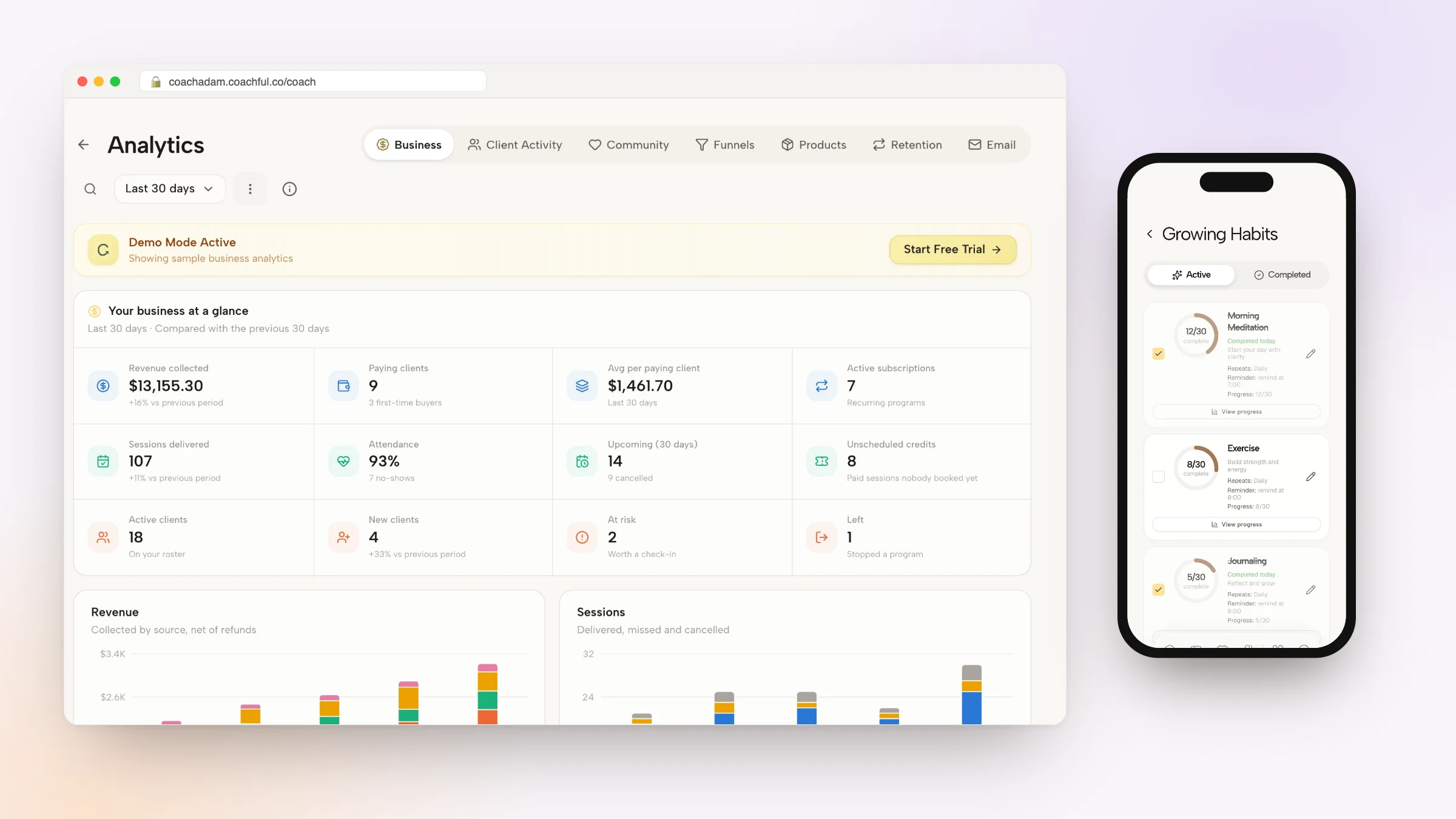
- Analytics showing revenue collected, paying clients and average revenue per paying client, the number your real income comes from.
Two limits to know: Coachful isn't HIPAA-certified (it is GDPR-ready with full data export), and it doesn't sync with wearables or Apple Health. The Coachful page for health coaches shows the full setup.
You also don't have to build the storefront yourself. Coachful's team builds your website, program page and first offer for free on every plan, inside your own account. Coachful itself is a paid membership, and you can start with a free trial. Open Website and click Fill in a form on the "Want us to build it for you?" card, or choose We'll build it for you · FREE under Create. Say which pages you need, what they should do and what visitors should do next, and attach up to 10 files and 8 links.

The team replies by email with next steps, usually within about 24 hours, which is typical rather than guaranteed. A recent build for a menopause and midlife health coach who started with no site, logo or prices produced five pages in sage and cream, with every button leading to a free 20-minute consultation. Nothing gets invented: no credentials you don't hold, no testimonials or prices you haven't given. The team doesn't design logos, record videos or run ads. See everything the free build covers.
Frequently asked questions
How much do health coaches make a year?
Coachful's 2026 Coaching Business Report puts health and wellness coaches at $52,000 to $77,000 a year, from PayScale, ZipRecruiter and Glassdoor data. Those sources lean toward employed roles, so a self-employed coach can earn well below or above the band depending on price, specialty and how many paying clients they keep.
How much do health coaches make per hour?
Most charge $75 to $200 a session, based on PayScale data and practitioner reports. Practitioner estimates put newer coaches at $50 to $100 and specialists at $200 to $400. A session price isn't hourly pay, because unpaid marketing and admin time sits behind every paid hour.
What is the BLS salary for a health coach?
There isn't one. The BLS doesn't have a health coach occupation. The closest are adjacent jobs: health education specialists earned a median of $64,070 in May 2025 and community health workers $51,850. Those are employed roles that aren't coaching, so use them as benchmarks only.
Can a health coach make six figures?
Some do, usually with a narrow specialty, monthly coaching or programs rather than single sessions, and some group work. At $700 a month, $100,000 of revenue takes 12 clients all year, before costs and tax. At $300 a month it takes 28, which is more than most coaches can serve well.
How many clients does a health coach need to make $60,000?
At $450 a month, about 12 clients kept all year. On a $1,500 three-month program, 40 programs a year, or just over three new clients a month. Both are revenue before costs and tax, so add your expenses and the 15.3% self-employment tax before you treat either as pay.
Do board-certified health coaches earn more?
The 2026 report doesn't measure the NBC-HWC's effect on pay. Across coaching, ICF credential holders report higher average incomes, and board certification tends to matter most to clinics, employers and digital health companies, which often ask for it when hiring.
Will Coachful build my health coaching website for free?
Yes. Coachful's team builds health coaching websites, program pages and first offers for free on every plan, inside your account. Fill in the form from Website or Create, and the team replies with next steps, usually within about 24 hours. Coachful is a paid membership; the build costs nothing extra.












