
How to Become a Spiritual Life Coach: A Grounded Guide
How to become a spiritual life coach comes down to two things done well: real coaching skill, learned through training and supervised practice, and a grounded spiritual practice of your own that you can help other people build. There's no license for spiritual coaching and no single required certification. What separates a trustworthy spiritual life coach from the noise is how clearly they describe the work, how carefully they hold its boundaries and whether clients' lives actually change.
This guide covers what a spiritual life coach does and doesn't do, the training worth paying for, the ethical lines, a niche, offers like circles and retreats, and the practical setup. It builds on our main guide to how to become a life coach, which covers the general steps in more depth.
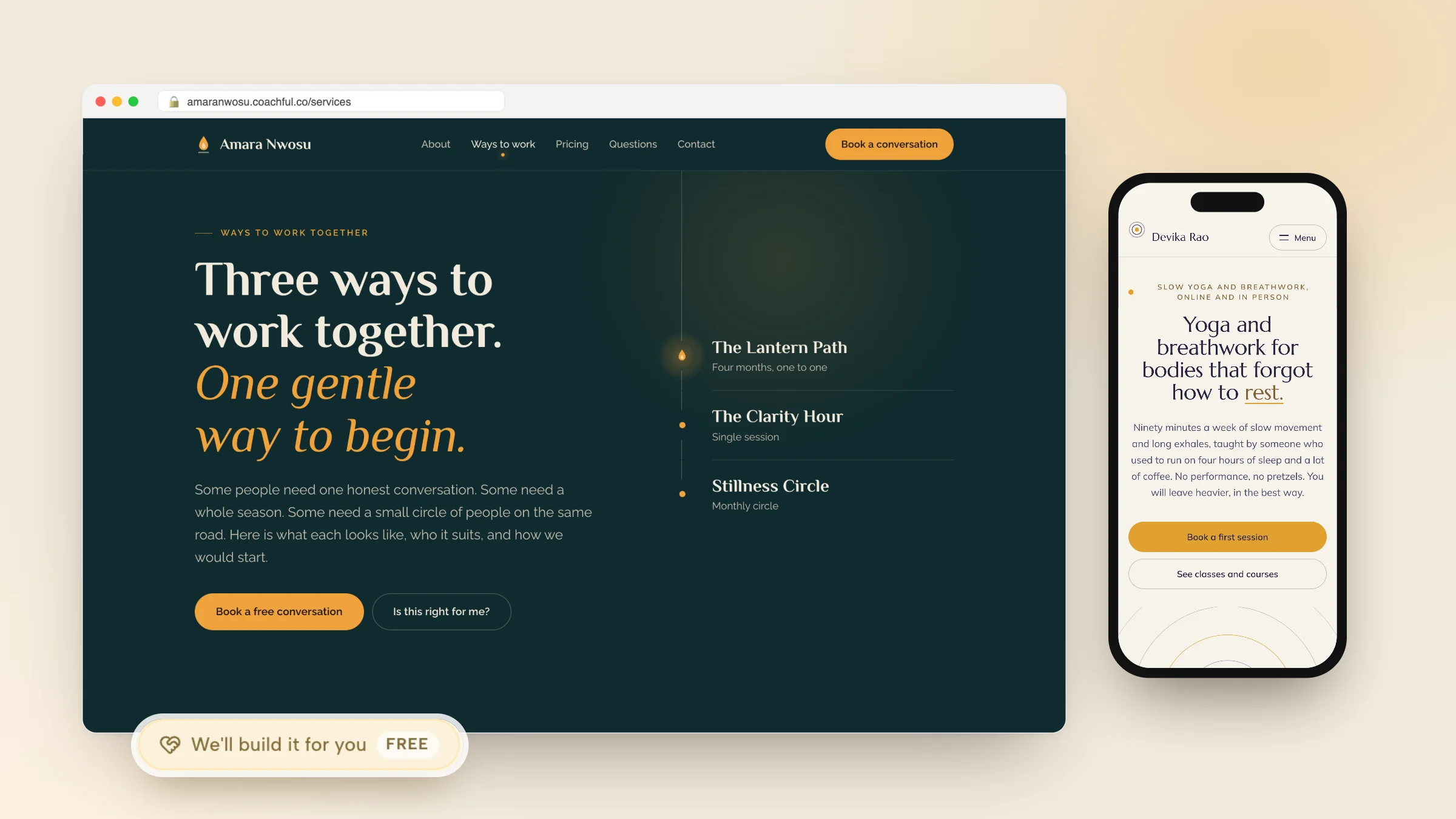
When you get to the website, you won't need to wrestle with it alone: Coachful's team builds your coaching website, first offer and first program for free on every plan.
What a spiritual life coach does
A spiritual life coach helps clients connect how they live with what they find meaningful: values, purpose, a sense of something larger, a daily practice, a relationship with their faith or with its absence. The coaching itself works the same way as any good coaching. The client sets the agenda, the coach asks rather than tells, and the client chooses what to do next. What's different is the territory.
Spiritual coaching can be religious or not. Some coaches work within one tradition. Many work with clients from any background, or none, on questions like "what is this season of my life asking of me?" or "how do I make a daily practice I keep?"
It helps to know the neighbors, because clients often confuse them:
| Role | What they do | How it differs from spiritual life coaching |
|---|---|---|
| Spiritual life coach | Forward-looking work on meaning, values, practice and the choices that follow | The baseline for this guide |
| Spiritual director | Contemplative companionship, often within a tradition, attending to the client's inner life | Less goal-focused; its own training tradition |
| Therapist or counselor | Assesses and treats mental health conditions, including trauma | A licensed, clinical profession |
| Clergy or religious leader | Teaching, pastoral care and ritual within a faith community | Holds religious authority a coach doesn't |
| Meditation, yoga or breathwork teacher | Teaches a specific practice | Teaches a method; a coach helps the client decide how it fits their life |
Many spiritual coaches combine roles, such as a coach who is also a trained meditation teacher. That's fine, as long as you tell clients which hat you're wearing.

Step 1: Get honest about your own practice and background
Clients come to a spiritual coach partly because of who the coach is. Before you market anything, write down plainly:
- Which practices you've actually trained in, with whom, and for how long.
- Which traditions those practices come from, and whether you have standing to teach them.
- What your own spiritual life looks like now, including the uncertain parts.
- What you won't do: readings, healing claims, anything outside your training.
That list becomes the honest core of your About page and protects you from a common trap: borrowing practices from traditions you weren't trained in and presenting them as your own. When you teach something from a tradition, name the source and your training in it.
Step 2: Learn to coach, not only to guide
A deep personal practice doesn't make someone a good coach. Coaching is a separate skill: listening for what the client means, asking open questions, and resisting the urge to hand over your own answers. That last one is harder for spiritual coaches than most, because the temptation to share "what worked for me" is strong.
You have three routes:
- An ICF-accredited coach training program. It teaches the ICF Core Competencies and ethics, and leads to the ACC credential if you log the hours. Some programs have a faith-based or spiritual focus; check any program's accreditation in the ICF's own education directory, not just its website badge. Our guide to becoming a certified life coach covers the path.
- A non-accredited spiritual coaching course. These vary hugely. Ask how much of the course is coaching skill with observed practice, and how much is content about spirituality.
- Self-study and supervised practice. The ICF's Code of Ethics and its ethics course are free, and you can practice with peers. Our guide to becoming a life coach without certification has a 12-week plan.
Coachful's 2026 Coaching Business Report notes that in consumer coaching, outcomes and testimonials carry more weight than credentials. Spiritual coaching is almost entirely consumer coaching, so certification is a choice, not a gate. Our seven checks before you enroll help you decide.
Step 3: Draw your ethical lines before your first client
Spiritual coaching sits close to some sensitive ground: grief, trauma, religious upbringing, illness, a client's sense of what's real. The ethical lines need to be clear before a hard session, not during it.
- No health claims. Don't promise that a practice will cure illness, anxiety or depression. A spiritual practice can support someone; it doesn't replace treatment.
- No spiritual bypassing. Avoid steering a client away from real pain toward "everything happens for a reason." Our guide to trauma-informed coaching covers how to stay with difficulty safely.
- Consent for practices. Ask before leading a meditation, visualization or breathwork exercise, explain what it involves, and make opting out easy. Some practices, such as intense breathwork, aren't suitable for everyone; tell clients to check with their doctor if they have a health condition.
- Don't impose beliefs. The ICF Code of Ethics centers the client's own values and choices. Your worldview is not the curriculum.
- Refer when it's clinical. Keep a short list of therapists, including ones experienced with religious trauma, plus a crisis line. Our guide to keeping therapy and coaching separate covers the practical side.
Put the boundaries in your coaching agreement in plain language. Our guide to whether you need a license to be a life coach explains which work is regulated.

Step 4: Choose a niche within spiritual coaching
"Spiritual life coach" is a category. A niche names the person and the season they're in. Some examples:
- Professionals running on empty who want a daily practice that survives a busy week.
- People in midlife asking what the second half is for.
- Adults rebuilding a spiritual life after leaving a religious community, worked on with care and a referral plan.
- People grieving a loss who want to find meaning without being rushed through it.
- Creatives and founders who want their work to line up with their values.
The Lantern template shown earlier puts this well: "I work with people at a turning point: a career that no longer fits, a faith that has changed shape, a loss that rearranged everything." Three turning points, one audience. Our list of coaching niches has more ideas.
Step 5: Design your offers and price them
Spiritual coaching often works best as more than one-to-one sessions. A practice can mix:
| Offer | What it looks like | Pricing reference |
|---|---|---|
| One-to-one package | Three months of sessions with a daily practice between them | Life coaching packages of 8 sessions over 3 months: $1,200 to $2,500 |
| Circle or group program | A small group meeting weekly or monthly | Group life coaching: $100 to $300 a month per person |
| Membership | Recorded practices, a community and a monthly live call | Memberships: $47 to $197 a month, as listed in the report |
| Workshop or day intensive | A half or full day on one theme | Life coaching VIP days: $750 to $2,000 |
| Retreat | Several days away with a small group | No published benchmark; cost it from the venue, food and your time |
Package, group and VIP-day ranges are for life coaching, from Coachful's 2026 Coaching Business Report (practitioner reports and a verified sample of published rates). The membership range is listed in the report without a named study behind it. The report has no spiritual-coaching-specific figures.
Spiritual coaches are often uneasy charging for this work. A clear price with a sliding-scale option is kinder than vagueness, because people can decide without an awkward conversation. Our guides to sliding-scale rates, coaching retreat ideas and selling retreats with a deposit cover the details. For what income looks like across life coaching generally, see life coach salary data.

Step 6: Build the practice between sessions
Most of a spiritual practice happens on ordinary days, not on calls. The coaching that sticks gives clients something small to do every day and somewhere to notice what changed:
- A morning intention and an evening reflection, in your own words.
- A short meditation, prayer or journaling habit they track.
- A weekly review: what did I notice, what will I try next week?
- A circle or community where people share what's shifting.

Keep the daily ask tiny. Five minutes kept for thirty days does more than an hour-long practice abandoned in week two.

Set up your spiritual coaching practice
A Coachful membership includes the website, booking, payments, programs and client app, so a client can find you, book a first conversation, pay and keep their practice going in one place. For spiritual coaches specifically:
- Programs with daily habits and morning and evening check-ins written in your own voice, plus coaching flows for daily check-ins and weekly reviews.
- Circles and community: enrolling clients in a group program creates a cohort with a community feed, group chat and group calls. See the community platform.
- Sessions and memberships sold from one checkout, with payments to your own Stripe or Razorpay account and a 0% Coachful platform fee.
- Recorded practices such as meditations sold or included as courses and downloads.
- A calm website from designed templates for spiritual, mindfulness and retreat coaches.
The Coachful page for spiritual coaches shows the setup, and our guide to a spiritual coach website covers tone, pages and copy.

Coachful's team will also build your website, first offer and first program for you, free on every plan, inside your own account. Coachful itself is a paid membership with a free trial to start. Click Fill in a form on the Website page, or choose We'll build it for you · FREE under Create. Describe your practice, your niche and the pages you want, and attach up to 10 files, such as photos, a description of your circle or an existing PDF. The team replies by email with next steps, usually within about 24 hours, which is typical rather than guaranteed.
One recent request came from a life-purpose coach moving from another coaching tool: a dark forest-green site with home, about and coaching pages, the three programs drawn as one pine at three heights taken from the coach's emblem, and the program descriptions adapted from the old pages. Nothing gets invented: no credentials, testimonials or prices you haven't given the team. See what the free build includes.

Frequently asked questions
Do you need a certification to be a spiritual life coach?
No. Spiritual coaching isn't licensed or regulated in most countries, and no certification is required. Training in coaching skills is still worth it, whether through an ICF-accredited program or structured self-study, because a deep practice doesn't automatically make someone a good coach.
What is the difference between a spiritual life coach and a spiritual director?
A spiritual life coach works forward from the client's goals: meaning, values, a daily practice and the choices that follow. A spiritual director offers contemplative companionship, often within a tradition, with less focus on goals. Both differ from therapy, which is a licensed clinical profession.
How much do spiritual life coaches charge?
Coachful's 2026 report has no spiritual-specific figures. The nearest benchmark is life coaching: $75 to $200 a session for most coaches, three-month packages of $1,200 to $2,500 and group coaching at $100 to $300 a month per person, from practitioner reports and a verified sample.
Can a spiritual life coach be religious?
Yes. Some spiritual coaches work within one faith tradition, others with clients of any background or none. Say clearly on your website which you are, so clients can choose. Our guide to becoming a Christian life coach covers faith-specific practice.
How do I become a spiritual life coach with no experience?
Start with coach training or a structured self-study plan, coach a few people pro bono for feedback, and choose a niche from your own spiritual journey. Be honest about what you've trained in, and build clear ethical boundaries and a referral list before you take paying clients.
What should a spiritual coach not do?
Don't make health or healing claims, diagnose or treat mental health conditions, impose your beliefs or lead practices without consent. Refer clients to a licensed therapist when their struggles are clinical, including religious trauma.
Can I run circles and retreats as a spiritual coach?
Yes, and many spiritual coaches do. Circles work as group programs or memberships with a community between calls. Retreats are usually sold with a deposit and a balance payment, with prices worked out from venue, food and your own time.
Will Coachful build my spiritual coaching website for free?
Yes. Coachful's team builds coaching websites, offer pages and programs for free on every plan, inside your account. Fill in the form on the Website page or under Create and the team replies with next steps, usually within about 24 hours. Coachful is a paid membership; the build costs nothing extra.












