
Is Group Coaching Worth It? Evidence, Costs and Red Flags
Is group coaching worth it? For most people working on a common goal, such as a career change, a health habit, burnout or growing a small business, yes, and often at a fraction of the price of one-to-one coaching. In the largest trial so far, more than 1,000 women physicians in an online group coaching program saw lower burnout and impostor feelings than a control group. Group coaching programs typically cost $500 to $3,000 per person, or $100 to $300 a month for ongoing group life coaching. It is a poor fit if your situation is highly personal, if you need privacy, or if the "group" turns out to be a course with a chat room.
The trade-off is simple to name: you get less individual airtime and more perspective, peer accountability and a lower price. Whether that trade suits you depends on your goal, your temperament and how the program is run. This guide covers the evidence, the costs, a way to compare value per hour, and what separates real group coaching from a crowded webinar.
Group or one-to-one? The quick answer
| If this is you | Group coaching | One-to-one coaching |
|---|---|---|
| Your goal is common: a habit, a job search, burnout, a launch | Good fit | Also works, at a higher price |
| You learn from hearing how others handle the same problem | Good fit | You miss that |
| You need a deadline and other people noticing | Good fit | Works if the coach follows up |
| Your situation is complex, unusual or confidential | Limited | Better |
| You find it hard to speak up in groups | Possible in a small group | Often better |
| Budget is tight | Usually better value | Consider one session plus a group |
| You are in crisis or need mental health care | No | No. See a licensed clinician first. |
If you want the definition first, our guide to what group coaching is explains how it differs from team coaching and masterminds.
What the research says about group coaching
- A large trial in physicians. In a randomized trial with 1,017 women physician trainees at 26 institutions in 19 states, a four-month web-based group coaching program reduced emotional exhaustion, depersonalization, impostor syndrome and moral injury, and raised self-compassion and flourishing, compared with a control group (Mann and colleagues, 2023). It followed a smaller pilot trial of a six-month online program with 101 female residents that also reduced emotional exhaustion (Fainstad and colleagues, 2022).
- Groups can beat individual sessions. A systematic review of randomized trials that compared group-based and individual treatment for adult obesity found significantly greater weight change at 12 months in the group programs, across five trials with 336 participants (Paul-Ebhohimhen and Avenell, 2009). The sample is small, but the direction is notable.
- Group job search programs pay off. In a randomized experiment with 1,801 job seekers, a group job search workshop led to higher reemployment and monthly income two years later (Vinokur and colleagues, 2000).
- Public health uses groups on purpose. The CDC's National Diabetes Prevention Program puts participants in a group with a trained lifestyle coach and says the yearlong program cuts type 2 diabetes risk in half (CDC).
The limits: most of this research is in specific settings, such as medical training, weight management and unemployment, and much of it measures self-reported outcomes. It shows that well-run groups work. It does not show that every group program you see advertised is well run.

What group coaching costs in 2026
These ranges come from Coachful's 2026 Coaching Business Report for the second quarter of 2026, in US dollars, with one-to-one prices alongside for comparison.
| Format | Typical price | Source behind the range |
|---|---|---|
| Group coaching program, any niche | $500 to $3,000 per person, cohorts of 8 to 20 | Practitioner reports |
| Ongoing group life coaching with a community | $100 to $300 a month | Practitioner reports and a verified sample of 18 life coaches' published rates |
| Membership or community | $47 to $197 a month | Practitioner reports |
| For comparison: 3-month one-to-one life coaching, 8 sessions | $1,200 to $2,500 | Practitioner reports and the same verified sample |
| For comparison: an hour of one-to-one life coaching | $75 to $200 | PayScale and practitioner reports |
Compiled in Coachful's 2026 Coaching Business Report. Practitioner reports are estimates, not measured study results. More on coachingrates.com.
For examples of how coaches structure these programs, see group coaching programs.
How to judge the value of a group program
Group prices look cheap until you work out what you are buying. Before you pay, ask four numbers: the price, the number of live sessions, how long each one runs, and the maximum group size. Then do two quick sums.
| Example program | Price per live hour | Your share of each session, if split evenly |
|---|---|---|
| 8 weekly calls of 75 minutes, 8 people, $600 | $60 | About 9 minutes of focus, plus everyone else's examples |
| 12 weekly calls of 60 minutes, 15 people, $900 | $75 | About 4 minutes |
| 2 monthly calls of 60 minutes, 200 members, $99 a month | About $50 | Effectively none. This is a community with a live Q and A. |
| For comparison: one-to-one at $150 an hour | $150 | The whole hour |
Our arithmetic, for illustration. Prices are examples inside the ranges above.
"Your share" undersells groups, because hearing someone else work through your exact problem is often as useful as your own turn, and the peer accountability continues between calls. It does tell you whether you are buying coaching or content. A small group with a cap is coaching. A large membership is a community, which can still be worth $99 a month if the people are good and you show up.
Then judge the outcome the same way you would for one-to-one coaching: one goal, a baseline, and a checkpoint halfway through. If you have not spoken in three sessions, say so to the coach. Good group coaches manage airtime on purpose.

Signs of a well-run group program
- A size cap and a start date. A cohort that starts together and stays small builds trust. Most of the trial programs above were structured cohorts with a defined length.
- Screening. The coach asks a few questions before you join, so the group shares a goal and nobody needs a level of support the format cannot give.
- Ground rules on confidentiality. What is said in the group stays there, agreed at the first session. Our guide to confidentiality in group coaching covers what good norms look like.
- Live coaching, not only teaching. Each session should include time where members bring real situations and get coached, not just a slide deck.
- Something between sessions. A group chat, small accountability pods or weekly check-ins, so the group exists outside the call.
- A clear route to individual help. The option of a one-to-one session if something comes up that does not belong in a group.

Red flags
- "Group coaching" with no cap. Hundreds of members and one monthly call is a course or a community. Price it accordingly.
- The program is mainly a sales funnel. Every call ends with a pitch for the expensive one-to-one or "inner circle" tier.
- No confidentiality agreement. Especially for health, relationship or work topics.
- No screening at all. Anyone can join, including people in crisis the coach is not equipped to support.
- Income or weight-loss guarantees. Treat these the same way in a group as in one-to-one coaching.
For a wider checklist, see red flags when hiring a coach.
What a good group program looks like from the inside
You should know when the next group call is, what to prepare and where the group talks between calls. Many programs now run inside a client app, so the sessions, the group chat and your own goals sit together.

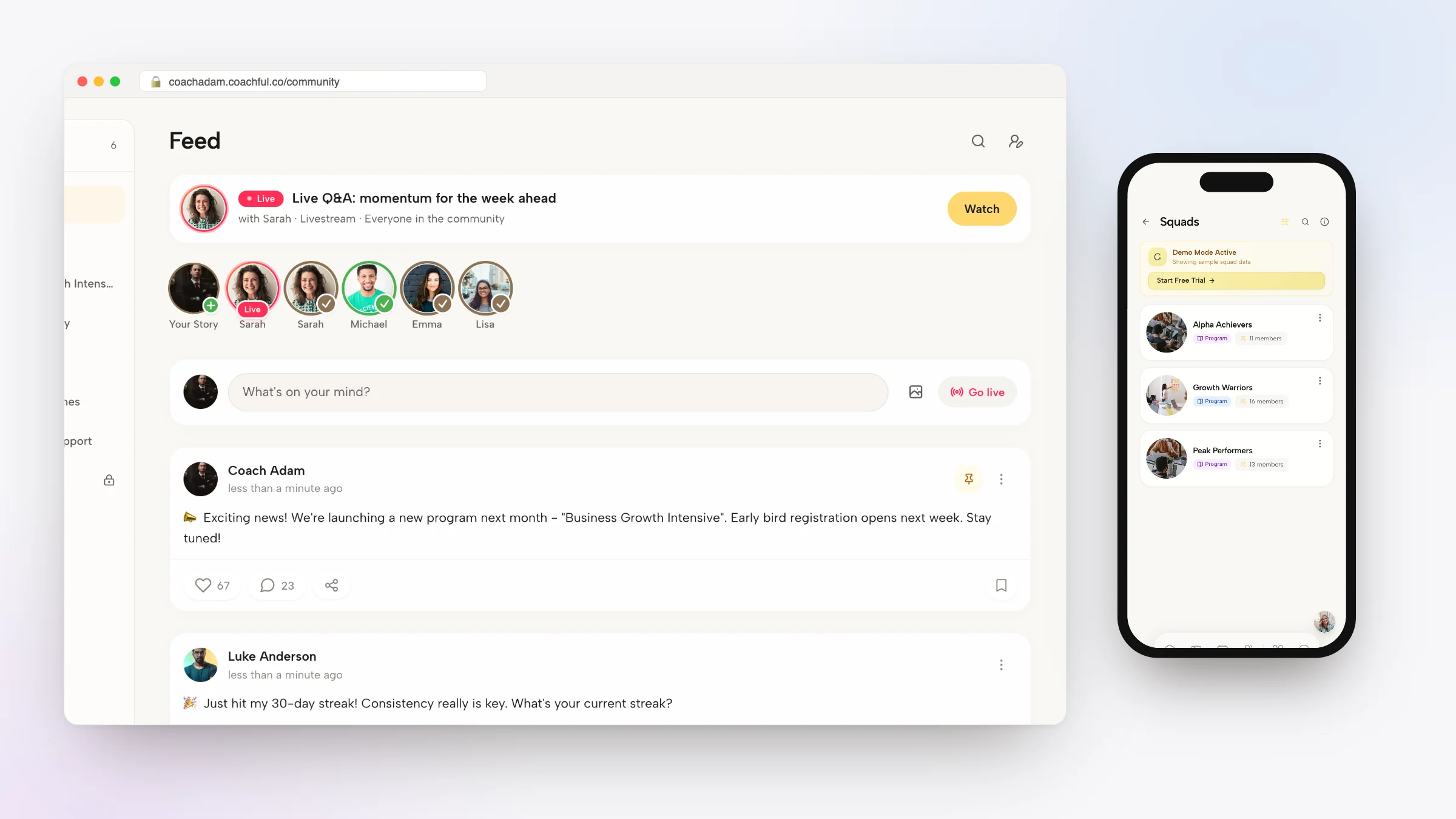
In Coachful, a group program shows which week you are on and who else is in it, group calls appear in your sessions with any prep that is due, and the community feed and group chats carry the conversation between calls. On the coach's side, the program's group calls sit on the calendar alongside one-to-one sessions.


Find a group coaching program on Coachful
Coachful's Find a Coach directory is open to anyone, and you can switch from browsing coaches to browsing programs, which is the quickest way to find group programs. Filter by category, such as Health and Fitness, Business or Mindset, or search for your goal. The Find My Coach quiz asks what you want to improve, where you are now, your preferred style and your monthly budget before suggesting coaches. Profiles show each coach's programs, with a calendar to book a discovery call or a form to send a message. Ask the group size and the start date on that call.

Do you run group coaching?
Buyers will run the arithmetic above, so state your group size, session count and length on your sales page. Coachful's team will build that sales page or website for you for free on every plan, usually within about 24 hours: see how the free build works. See also Coachful for group coaching, our guide to creating a group coaching program and these group coaching activities.

Frequently asked questions
Is group coaching as effective as one-to-one coaching?
For common goals it can be. A review of trials comparing group and individual obesity treatment found greater weight loss in the groups at 12 months, and a trial of online group coaching for over 1,000 physicians found lower burnout. For complex, private or unusual situations, one-to-one coaching usually serves you better.
How much does group coaching cost?
Group coaching programs typically cost $500 to $3,000 per person for cohorts of 8 to 20, ongoing group life coaching $100 to $300 a month, and memberships $47 to $197 a month, according to practitioner reports compiled in Coachful's 2026 Coaching Business Report.
What is a good group size for group coaching?
Smaller groups give each person more time. In the examples above, a group of 8 on a 75-minute call leaves about 9 minutes of focus each, while 15 people leaves about 4. Ask for the maximum size before you join, and be wary of programs with no cap at all.
Is group coaching worth it for introverts?
Often, if the group is small and the coach structures turns so quieter members get space. Many introverts find they learn a lot from listening and speak up once trust builds. If the thought of sharing in a group stops you joining at all, start with one-to-one coaching.
Is a mastermind the same as group coaching?
Not quite. In a mastermind, members supply most of the expertise and the facilitator keeps the structure. In group coaching, a coach leads and coaches members on their goals, with peers adding perspective. Many programs blend the two, so ask who does the coaching.
How long should a group coaching program last?
Long enough to practice the change and short enough to stay committed. The physician trials ran four and six months, and the CDC's diabetes prevention program runs a year. Many coaching cohorts run 6 to 12 weeks. Pick a length that fits how long your goal really takes.












