Co-Active Coaching: Cornerstones, Evidence and a Session
Co-Active coaching is a coaching approach built on the belief that clients are "naturally creative, resourceful, and whole", so the coach's job is to partner with them rather than fix them. Coach and client design their working relationship together (the "designed alliance"), and the coaching attends to the whole person, not only the problem they brought. It was developed by the founders of what is now the Co-Active Training Institute, which says it has taught the model since 1992.
Below: where Co-Active coaching came from, its four cornerstones, the skills it teaches, what the research does and does not show, a full session with sample dialogue and 11 questions, who it suits, the cautions, and the training pathway with prices as listed in October 2026. If you coach on Coachful, our team will set up the agreement, check-ins and program described here in your account for free.
Where Co-Active coaching came from
The Co-Active Training Institute, originally called The Coaches Training Institute, was established in 1992 by Laura Whitworth, Karen Kimsey-House and Henry Kimsey-House. Its own history page says they collaborated with Thomas Leonard, another early figure in professional coaching. The model was set out in the book Co-Active Coaching, first published in 1998 by Laura Whitworth, Henry Kimsey-House and Phil Sandahl, with later editions adding Karen Kimsey-House; the fourth edition came out in 2018.
The name joins two ideas: "co", the partnership between coach and client, and "active", the client's movement toward action. The institute now trains coaches and leaders in many countries and states on its site that more than 150,000 people have been through its programs.
The four cornerstones, and what they mean in a session
| Cornerstone (CTI's wording) | What it means | What it looks like in practice |
|---|---|---|
| People are naturally creative, resourceful, and whole | The client is not broken and does not need fixing | You ask before you advise, and you trust the client's answer |
| Dance in this moment | Follow what is present instead of a fixed agenda | You drop your planned question when something more alive shows up |
| Focus on the whole person | Heart, mind, body and spirit all matter | A "time management" topic becomes a conversation about what saying yes costs |
| Evoke transformation | Aim for a deeper shift, not only a solved problem | You ask who the client is becoming, not just what they will do |
Two more ideas hold the cornerstones together. The designed alliance, which CTI describes as "an intentional agreement between two or more parties" that "builds an active, living container that changes over time", is the explicit agreement about how you will work: how direct to be, what to do when the client is stuck, how they want to be challenged. And listening at different levels, from your own thoughts (Level 1) to full attention on the client (Level 2) to the whole field around you both (Level 3), which we cover in our guide to the levels of listening.
The book also teaches a set of skills that show up in every Co-Active session: powerful questions, acknowledging (naming who the client was being, not just what they did), championing, making requests and challenges, and leaving the client with an "inquiry", a reflective question to carry between sessions.

What the research shows about Co-Active coaching
There is very little research on Co-Active coaching as a named method, so treat strong claims with care. Here is what we found.
- A small trial in weight management. In a 12-week telephone study at a Canadian university, 45 students with obesity were randomized to motivational interviewing delivered through Co-Active Life Coaching or to a structured lifestyle program. The structured group lost more weight by week 12 (about 7.8 lb versus 2.5 lb), while the coaching group cut calorie intake more, and the authors judged both approaches similarly effective. A companion paper found both groups improved self-esteem and quality of life over six months. Small sample, one site, and the coaching was blended with motivational interviewing.
- Strong support for the relationship itself. A meta-analysis of 27 samples and 3,563 coaching processes found a moderate link between the quality of the working alliance and client outcomes (r = .41), and a negative link with unintended harms (r = -.29). That doesn't prove the Co-Active model, but it supports its central bet that how coach and client work together matters.
- Coaching in general. A meta-analysis of organizational coaching found positive effects on performance, well-being, coping, work attitudes and goal-directed self-regulation (g = 0.43 to 0.74). Studies like this rarely separate one school of coaching from another.
So the fair claim is modest: Co-Active coaching is a well-established training lineage whose emphasis on the relationship is consistent with good evidence, and whose specific outcomes have barely been tested.
How to run a Co-Active coaching session
- Revisit the alliance. In the first session, design it in detail. In later sessions, check it in one question: "Is the way we're working still right for you?"
- Ask for the agenda. "What do you want to focus on today, and what would make this time worth it?"
- Listen at Level 2 and 3. Notice energy, word choice and what the client avoids, not only the content.
- Coach the person, not just the issue. Ask what the topic means to them and who they are being in it.
- Follow what's alive. When the energy shifts, name it and ask whether to go there.
- Acknowledge. Name the quality the client showed ("That took courage to say") rather than praising the result.
- Forward the action. Make a request or a challenge, and let the client accept, decline or counter-offer.
- Leave an inquiry. One open question to live with until next time.
A short sample dialogue
Daniel, a consultant, came in for time management. Illustrative, not a transcript.
Daniel: I need a better system. My calendar is a mess.
Coach: We can look at the system. Before we do, what's the mess costing you?
Daniel: Evenings. My kids are asleep when I get home three nights a week.
Coach: Your voice dropped when you said that. What's here right now?
Daniel: Guilt, I suppose. And I say yes to every client request.
Coach: What do you want to be true about your evenings?
Daniel: Home by six, three nights a week.
Coach: I'm going to challenge you. What if it were four nights?
Daniel: That's too much. I'll commit to three, starting Monday.
Coach: Three it is. Here's an inquiry for the week: what does "enough" look like at work?
The challenge was meant to be bigger than Daniel would accept. His counter-offer of three nights is the commitment, and it is his.
11 Co-Active coaching questions
- How do you want me to work with you when you're stuck?
- What do you want to focus on today?
- What would make this time worth it?
- What's here right now?
- What matters most to you about this?
- Who are you being when you say yes to everything?
- What does your intuition tell you?
- If you weren't afraid, what would you do?
- What's the request you're not making?
- What will you do, by when, and how will I know?
- What question do you want to live with this week?

Who Co-Active coaching suits, and who it doesn't
It suits life coaching, career and life transitions, leadership development where presence matters as much as skills, and clients who are capable and want a partner rather than an expert. It is also a good default stance underneath more structured models such as GROW.
It suits less well clients who want expert advice or training (a mentor or consultant may serve them better), situations with a fixed external target such as a compliance deadline, and anyone in a mental health crisis. "Creative, resourceful and whole" is a coaching stance, and it is not a reason to keep coaching someone who needs clinical care.
Cautions coaches learn the hard way
- Not fixing is not the same as withholding. Sometimes a client needs information. Ask permission, offer it briefly, then go back to coaching.
- Challenges need a strong alliance. A deliberately big request lands as support only when the client knows they can say no.
- "Whole person" has limits. Exploring meaning and values is coaching; diagnosing childhood patterns is not. Our trauma informed coaching guide covers where to stop.
- Write the alliance down. A verbal alliance drifts. Put scope, confidentiality and how you will work in your agreement, then revisit it.
Co-Active coaching training and certification
We checked the Co-Active Training Institute's site in October 2026. Its current pathway has three stages.
| Stage | Format | Listed price (October 2026) | What it leads to |
|---|---|---|---|
| Co-Active Foundations | Prerequisite course; included when you enroll in Ignite the Practice | Listed as a $490 value | Entry to the pathway |
| Ignite the Practice | 5 live online days in two parts, with self-paced work between | $3,490, or $5,280 with ACC supervision (11 hours of mentor coaching) | Co-Active Practitioner Certificate, 52 ICF training hours |
| Deepen the Work | Longer certification program | $8,490 | CPCC certification and ICF Level 2 training hours |
CPCC is a CTI certification, not an ICF credential. The ICF credentials are the ACC, PCC and MCC, described on the ICF credentialing pages and in our comparison of ACC vs PCC vs MCC.
Running Co-Active coaching in Coachful
A Co-Active engagement has a few moving parts that are easy to lose: the alliance, the requests, the inquiries and the client's own words. This is how coaches keep them together in Coachful, all included in your membership.
The designed alliance as a signed agreement
Write your alliance into a coaching agreement template under Agreements, with sections for scope, confidentiality, how you'll challenge and what happens when the client wants to change the way you work. Clients sign it before the first call and it stays on their record. Signed copies made elsewhere can be dropped in as PDFs.
Inquiries that arrive between sessions
Create a weekly coaching flow with one open question, the week's inquiry, and a short text answer. You can change the question each week, and the answers land on the client's record so you can open the next session with them.

Requests as goals and milestones
When a client accepts a request ("home by six, three nights a week"), save it as a goal with milestones. The client sees it in their app and can start a weekly reflection from it.

Notes in the client's words
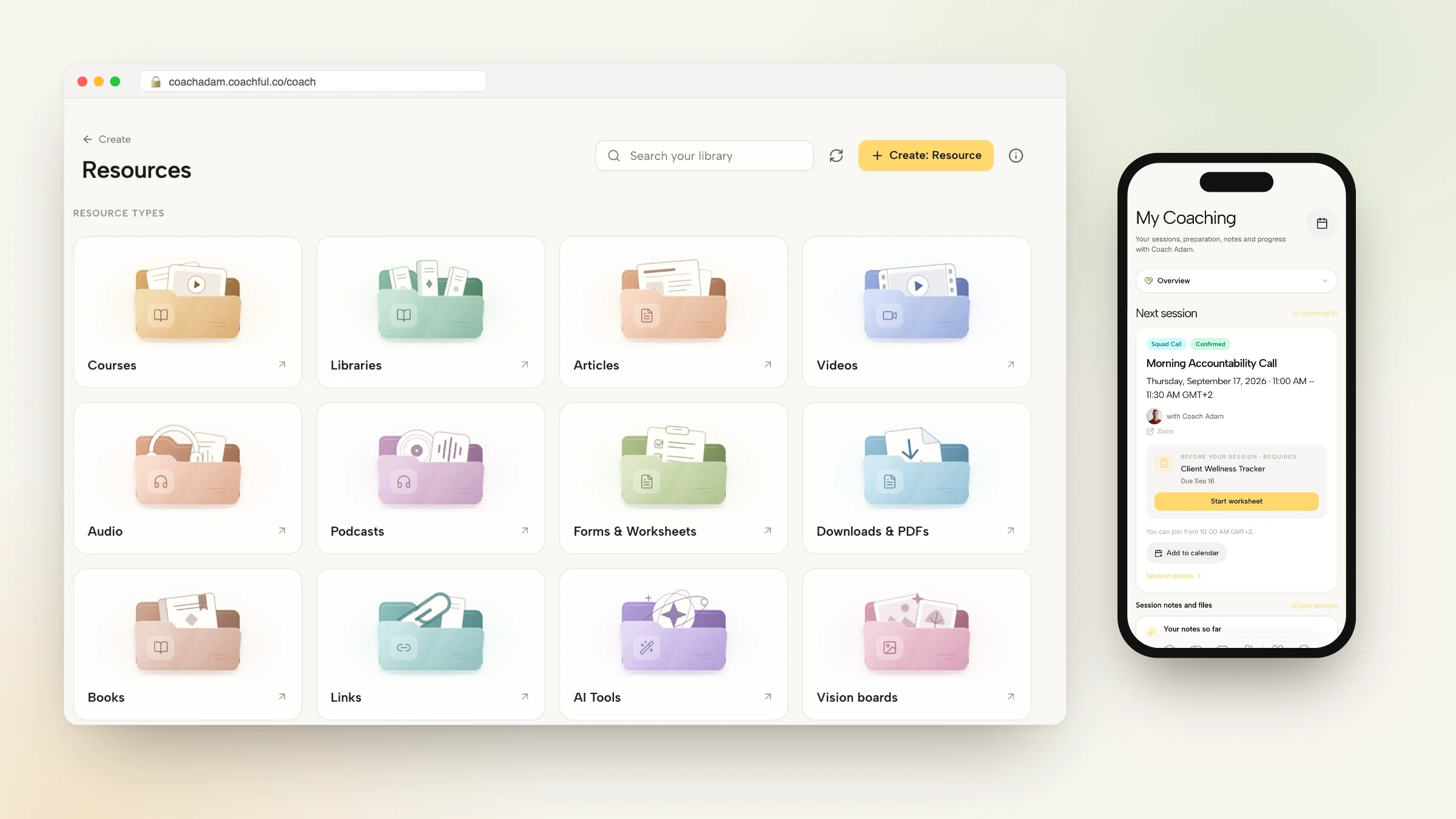
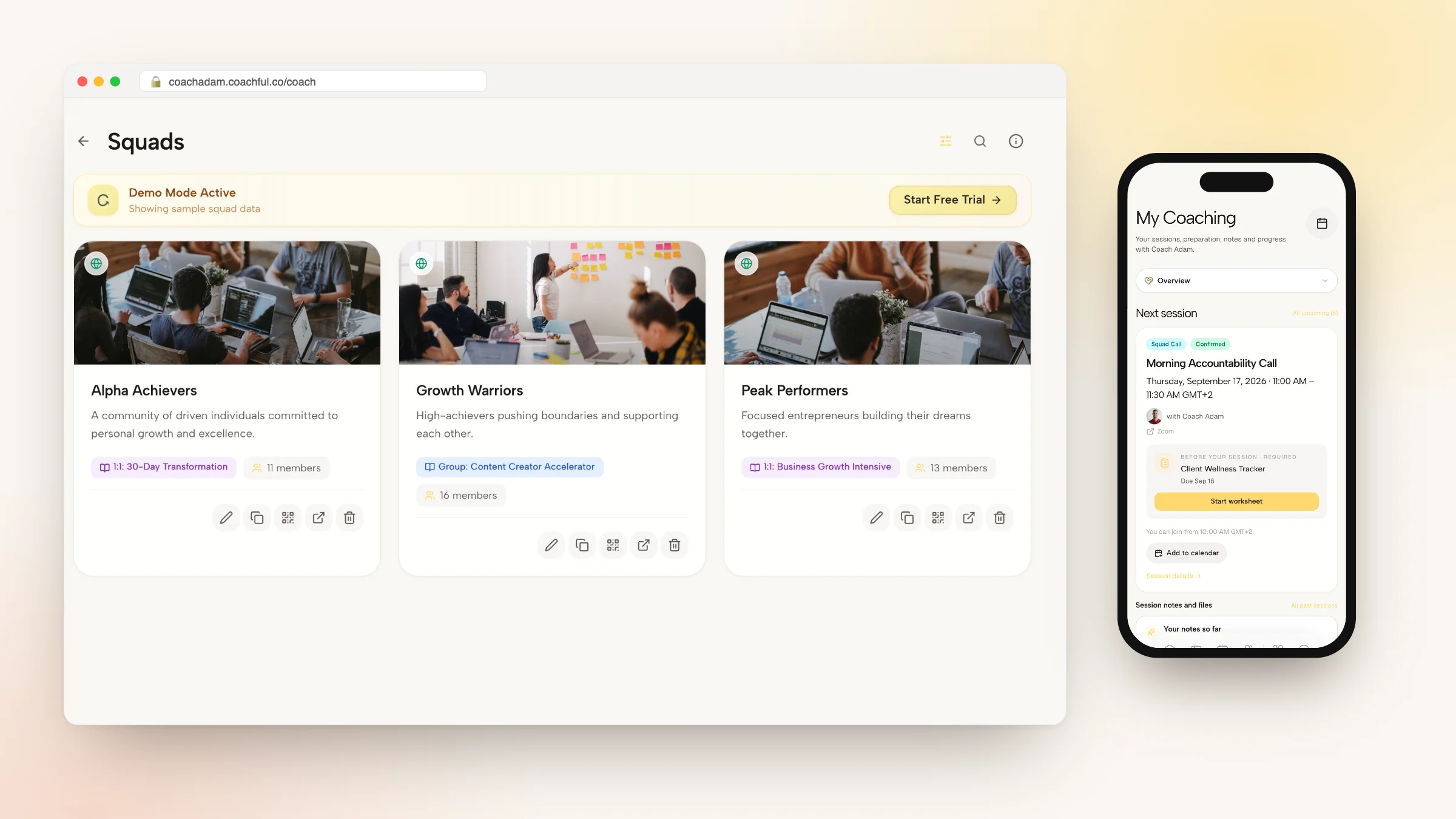
Shared session notes build into Your notes so far on the client's My Coaching page, next to the next session and any prep. Private notes stay yours.
A longer program for transitions
If you run a defined engagement (for example 12 sessions over six months), build it as a program with weekly tasks and check-ins, so each client follows the same arc at their own pace.

Your ICF hours
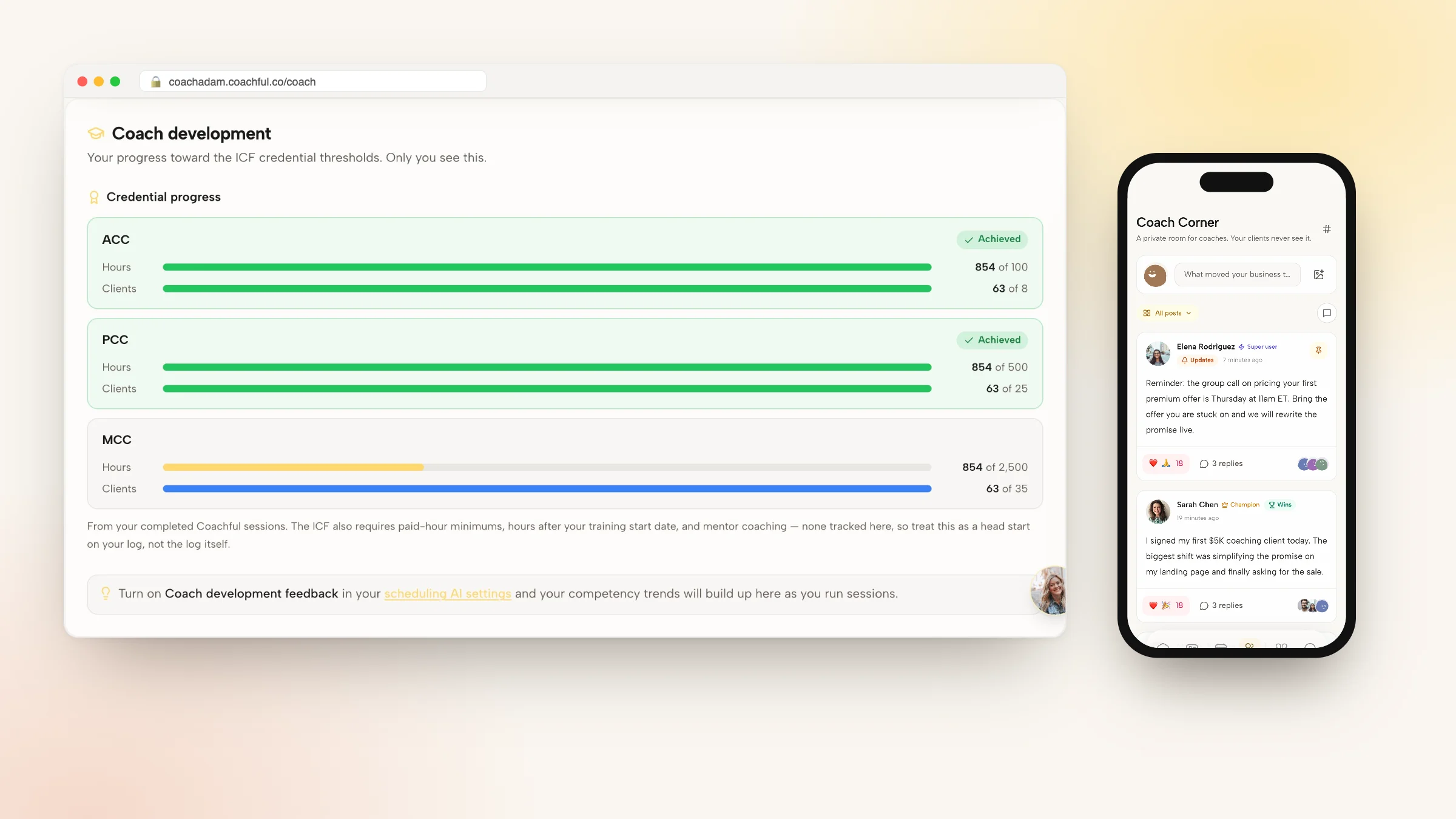
If you're working toward an ICF credential after Co-Active training, the Coach development panel totals hours and clients from your completed Coachful sessions against the ACC, PCC and MCC thresholds. It is a head start on your log, not the official log. See ICF hour tracking and our guide to ICF coaching hours.

Have our team set it up for you
Coachful's white-glove service is free on every plan. From Create > We'll build it for you, ask the team to build your alliance agreement, a weekly inquiry flow, a six-month program, or a website for your coaching. Attach the documents you already use. The team replies by email, usually within about 24 hours, and builds it inside your account so everything stays editable. Read what the free white-glove service includes, and see our page for life coaches.

If you're comparing approaches, our overview of 15 coaching models puts Co-Active next to GROW, CLEAR and OSKAR, and the guides to ontological coaching and positive psychology coaching cover two neighboring schools.
Frequently asked questions
What is the Co-Active coaching model?
It is a coaching model built on four cornerstones: people are naturally creative, resourceful and whole; dance in this moment; focus on the whole person; and evoke transformation. Coach and client design their working relationship together and use skills such as powerful questions, acknowledgment, requests and inquiries.
Who created Co-Active coaching?
Laura Whitworth, Karen Kimsey-House and Henry Kimsey-House established The Coaches Training Institute, now the Co-Active Training Institute, in 1992. The book Co-Active Coaching was first published in 1998 by Whitworth, Henry Kimsey-House and Phil Sandahl.
What is a designed alliance in coaching?
It is the explicit agreement coach and client make about how they will work together: how direct to be, how to handle being stuck, how challenges will land, and confidentiality. CTI describes it as an intentional agreement that changes over time as the relationship's needs change.
Is Co-Active coaching evidence-based?
Partly. Direct research is thin; one small trial of 45 students found Co-Active coaching combined with motivational interviewing performed similarly to a structured weight program. Its focus on the relationship is supported by a meta-analysis linking working alliance quality to coaching outcomes (r = .41).
Is CPCC the same as an ICF credential?
No. CPCC is the Co-Active Training Institute's own certification. Its Deepen the Work program provides ICF Level 2 training hours, which count toward an ICF credential such as the PCC, but you still apply to the ICF separately.
How much does Co-Active training cost?
As listed in October 2026, Ignite the Practice costs $3,490 (or $5,280 with ACC supervision), and Deepen the Work, which leads to CPCC, costs $8,490. Foundations is included when you enroll in Ignite.
Can Coachful build my Co-Active coaching setup for free?
Yes. The white-glove service is free on every Coachful plan. Ask from Create > We'll build it for you and the team will build your agreement, weekly inquiry flow or program in your account, usually within about 24 hours.