Ontological Coaching: Language, Moods, Body and Evidence
Ontological coaching is a coaching approach that works with a person's "way of being", the combination of how they use language, the moods and emotions they live in, and how they hold their body. The idea is that results come from actions, actions come from how we observe a situation, and a coach can help a client become a different observer by working in those three domains. It grew out of Chilean philosophy and linguistics in the 1980s and 1990s and is widely taught in Latin America, Spain and Australia.
This guide covers where ontological coaching came from, its core distinctions (including the speech acts coaches listen for), what research now shows, a session with sample dialogue and 11 questions, who it fits, the cautions, and training routes. If you coach on Coachful, our team will build the worksheets, check-ins and program in this guide in your account for free.
Where ontological coaching came from
"Ontology" is the branch of philosophy that studies being. The coaching approach draws on three sources: the speech act theory of J. L. Austin, whose How to Do Things with Words (1962) argued that saying something can be doing something (a promise, a declaration), as summarized in the Stanford Encyclopedia of Philosophy; the phenomenology of Martin Heidegger; and the biology of cognition of Chilean scientist Humberto Maturana.
The bridge into coaching was Fernando Flores, a Chilean engineer and former minister in Salvador Allende's government. After about three years as a political prisoner, he went into exile in California, completed a PhD at UC Berkeley, wrote Understanding Computers and Cognition (1986) with Terry Winograd, and built workshops that turned speech acts into practical skills for managing commitments.
Two other Chileans shaped the coaching method. Sociologist and philosopher Rafael Echeverría wrote Ontología del lenguaje (1994), and with lawyer Julio Olalla he founded The Newfield Group in California in 1990. Olalla's own book, From Knowledge to Wisdom (2004), was published by Newfield Network. In Australia, Alan Sieler's Coaching to the Human Soul volumes (from 2003) became the main English-language texts. A 2020 academic chapter describes ontological coaching as "the Chilean School", developed by exiles from the dictatorship.
The core distinctions of ontological coaching
Observer, action, results
Sieler's model is simple: the results we get come from the actions we take, and our actions come from the kind of observer we are. Coaching aimed only at action ("try a new email script") changes results a little. Coaching that shifts the observer ("you've decided she doesn't respect you, so you stopped asking") changes what actions even seem possible.
Three domains of being
| Domain | What the coach listens for | Example question |
|---|---|---|
| Language | The stories, judgments, requests and promises the client makes, and the ones they avoid | "Is that a fact, or your assessment?" |
| Moods and emotions | Background moods such as resignation, resentment, ambition or acceptance that make some actions feel impossible | "What mood are you usually in when you walk into those meetings?" |
| Body | Posture, breath and movement that match the mood and story | "How are you sitting as you say that?" |
The speech acts coaches listen for
Ontological coaches borrow a short list of basic speech acts and listen for them in everything a client says. Most coaching breakthroughs in this approach come from noticing one of these is missing or confused.
| Speech act | What it is | Common coaching issue |
|---|---|---|
| Assertion | A statement that can be checked: true or false | Treated as if it were an opinion, or used to win arguments |
| Assessment | A judgment or opinion ("she's unreliable") | Held as if it were a fact, without grounding it in evidence |
| Declaration | A statement that creates a new reality, such as "no", "I'm starting", "I was wrong" | The declaration the client needs is never made |
| Request | Asking someone to do something by a time | Vague, implied or never made, followed by resentment |
| Offer | Proposing to do something for someone | Made without checking whether it's wanted |
| Promise | A commitment, often in reply to a request | Made too easily, then broken, which erodes trust |

What the research says about ontological coaching
For years there was almost no outcome research. That has started to change, mostly through one research group at the National University of Singapore.
- A multicenter randomized trial with nurses (2026). 400 nurses in Singapore were randomized to an ontological coaching program (one group session, then four individual sessions) or to standard workplace support. After the program the coached group reported higher psychological well-being, better goal-setting proficiency and job satisfaction, and lower intention to leave nursing. The authors call it "feasible and promising" and recommend cluster randomization, objective retention measures and long-term follow-up.
- A pilot trial with nursing students (2024). The same team tested four to six ontological coaching sessions over six months with nursing undergraduates, as a pilot for larger work.
- Interviews with participants. A 2025 qualitative study of 34 nurses and three coaches found participants valued the coaching as a place to confide and a source of fulfillment, and that readiness and openness mattered.
Read these with their limits in mind. The control groups received usual support rather than another active program, outcomes were self-reported, and the work comes largely from one team in one health system. We found no trials comparing ontological coaching with other coaching approaches. Coaching in general has stronger support: a meta-analysis of workplace coaching found positive effects across five outcome types.
How to run an ontological coaching session
- Agree the concern. What breakdown, or what possibility, brought the client here today?
- Listen for the story. Let the client tell it once without interruption. Note assessments presented as facts.
- Separate assertions from assessments. Ask which parts can be checked and which are judgments. Then ask what evidence grounds each judgment.
- Name the mood. Ask about the mood the client is in when this situation happens. Resignation ("nothing will change") and resentment ("they owe me") are common.
- Notice the body. Ask how they hold themselves in that mood, and what changes if they shift.
- Find the missing speech act. Usually a clear request, a declaration of "no", or a promise renegotiated.
- Design it. Help the client word the request or declaration: who, what, by when, and what "done" looks like.
- Practice. Have them say it out loud, then agree when they will make it.
A short sample dialogue
Elena is an operations manager. Illustrative, not a transcript.
Elena: My director never listens to me. There's no point raising the staffing issue again.
Coach: "She never listens." Is that something we could check, or is it your assessment?
Elena: I suppose it's my assessment. She did approve the rota change in June.
Coach: And "there's no point". What mood are you in when you say that?
Elena: Resigned. Tired of it.
Coach: When you last raised staffing, what exactly did you ask her for?
Elena: I said we're stretched thin.
Coach: That's an assessment too. Was there a request in it?
Elena: No. I never actually asked for anything.
Coach: If you made one clear request, what would it be, and by when?
Elena: Approve one agency nurse for night shifts, starting next month. Decision by Friday.
11 ontological coaching questions
- Is that a fact we could check, or your assessment?
- What evidence grounds that assessment?
- What mood are you in when this happens?
- What becomes impossible for you in that mood?
- How are you holding your body as you tell me this?
- What request have you not made?
- What exactly would you ask for, from whom, by when?
- What promise have you made that you no longer want to keep?
- What do you need to declare: a no, a beginning, an ending?
- What kind of observer would see more options here?
- What will you say, and when will you say it?

Who ontological coaching suits, and who it doesn't
It suits leaders and teams stuck in broken commitments and unclear requests; people in healthcare, operations or project work, where coordination runs on requests and promises; clients who keep telling the same story about a situation; and coaches who like working with language precisely, as in clean language or Socratic questioning.
It suits less well clients who want quick tactical help, those who find philosophical vocabulary off-putting, and anyone whose situation is shaped by real power imbalances or harm that a "different observer" stance could seem to dismiss.
Cautions for ontological coaches
- "You create your reality" can become blame. Shifting the observer is useful. Telling someone facing discrimination or unsafe staffing that it's all interpretation is not. Separate what is the client's to change from what is not.
- Drop the jargon. Clients don't need the words "assessment" and "declaration" to benefit. Use plain questions.
- Moods are not diagnoses. Resignation in a meeting is coaching material. Persistent hopelessness, sleep changes or thoughts of self-harm need a referral; our guide to trauma informed coaching covers the referral conversation.
- Watch the workplace triangle. When an employer pays, agree in advance what you share. The ICF's Code of Ethics and our coaching code of ethics guide cover confidentiality with sponsors.
Ontological coaching training routes
Ontological coaching is taught mainly by private schools, many in Spanish. One we checked on its own site in October 2026: Newfield Network, which dates itself to 1991, runs Coaching for Personal and Professional Mastery, a nine-month program in three phases (Foundation, Practice and Integration) that it lists as ICF Level 2 accredited. In Australia, Alan Sieler's books were published through his Newfield Australia organization; we could not verify a current program there.
When comparing schools, ask how many hours of observed coaching with feedback are included, whether the program is ICF-accredited, and whether teaching is in your working language. Our checklist on whether coaching certification is worth it applies here too.
Running ontological coaching inside Coachful
Ontological work turns on what the client says and does between sessions: the request they promised to make, the declaration they practiced. This is how coaches track that in Coachful, all included in your membership.
An "assertion or assessment" worksheet
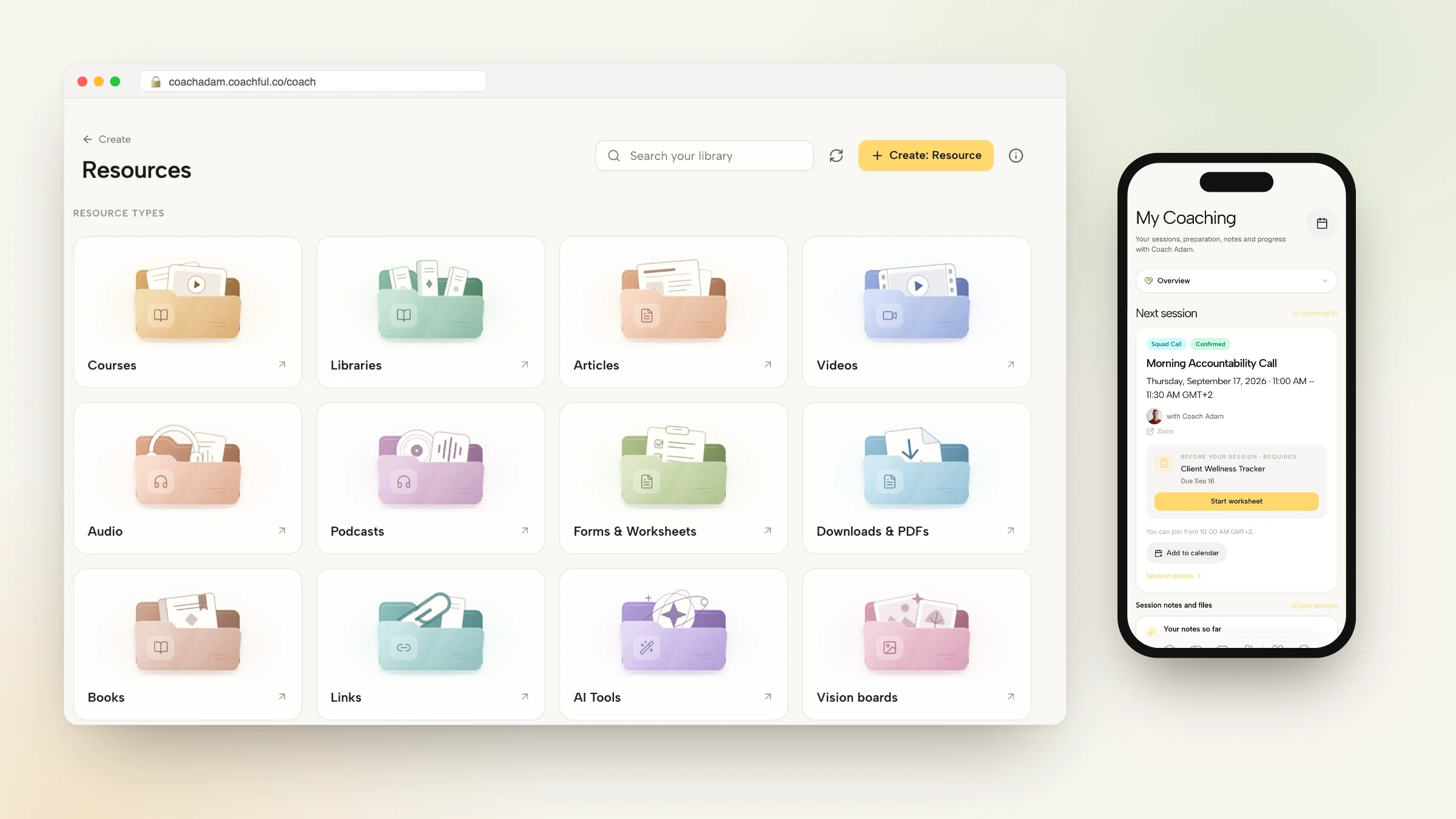
Tools > Explore includes an editable Fact versus story template (observation, interpretation, evidence, alternative), which maps closely onto the assertion and assessment distinction. Rename the fields, add a final prompt ("What request will you make, of whom, by when?") and assign it before the next session.
A mood and body check-in
Build a short form with a slider for mood (for example Resigned to Ambitious) and a text question about posture or breath. A daily coaching flow can carry the same questions with a Mood Scale step and a Journal Page only the client reads.

Requests and promises as tracked actions
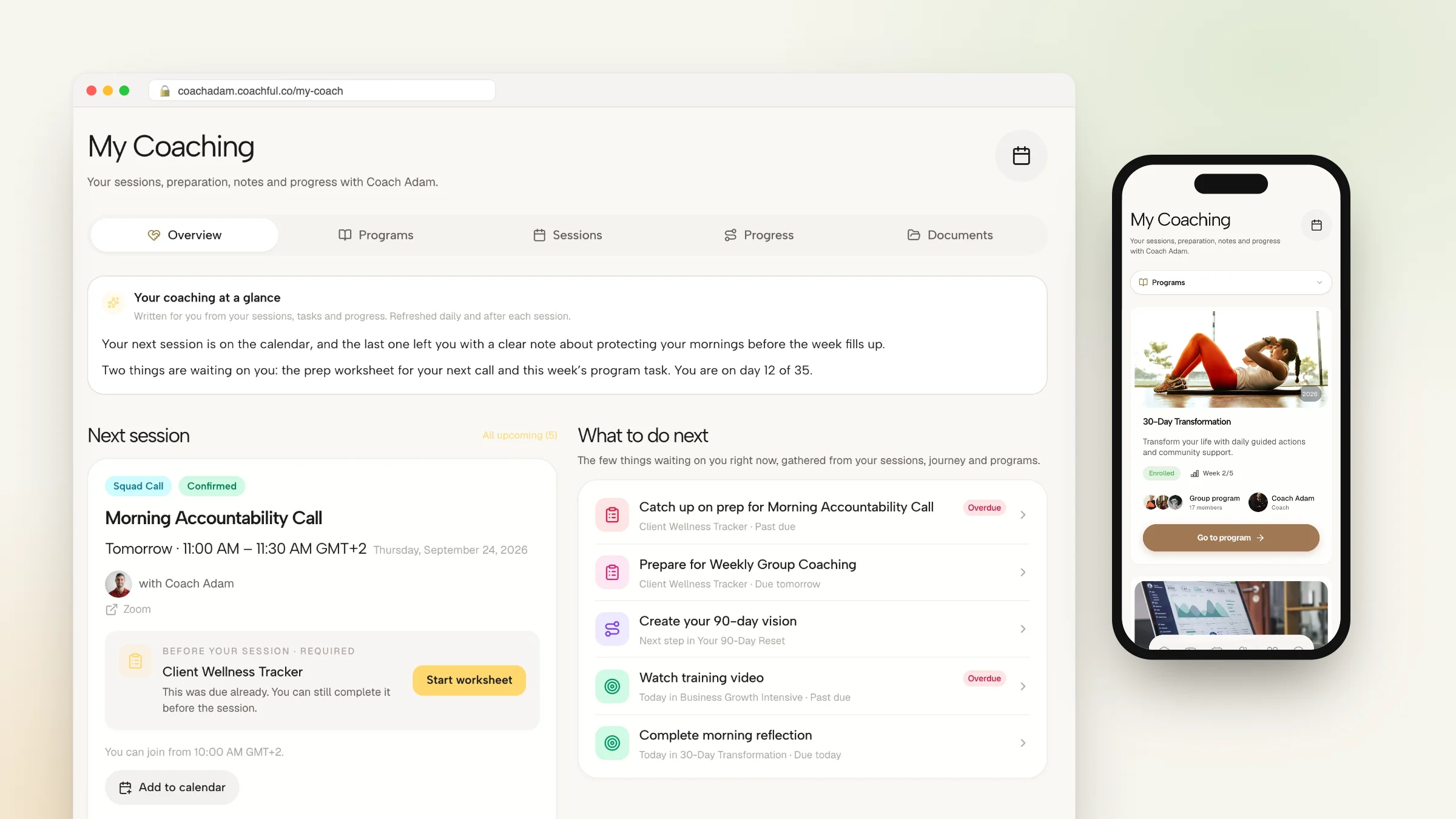
When the client commits to a request ("decision on the agency nurse by Friday"), add it as a task or goal. It shows up in their app under what to do next, and you can see whether it happened before the next session.
Patterns across your clients
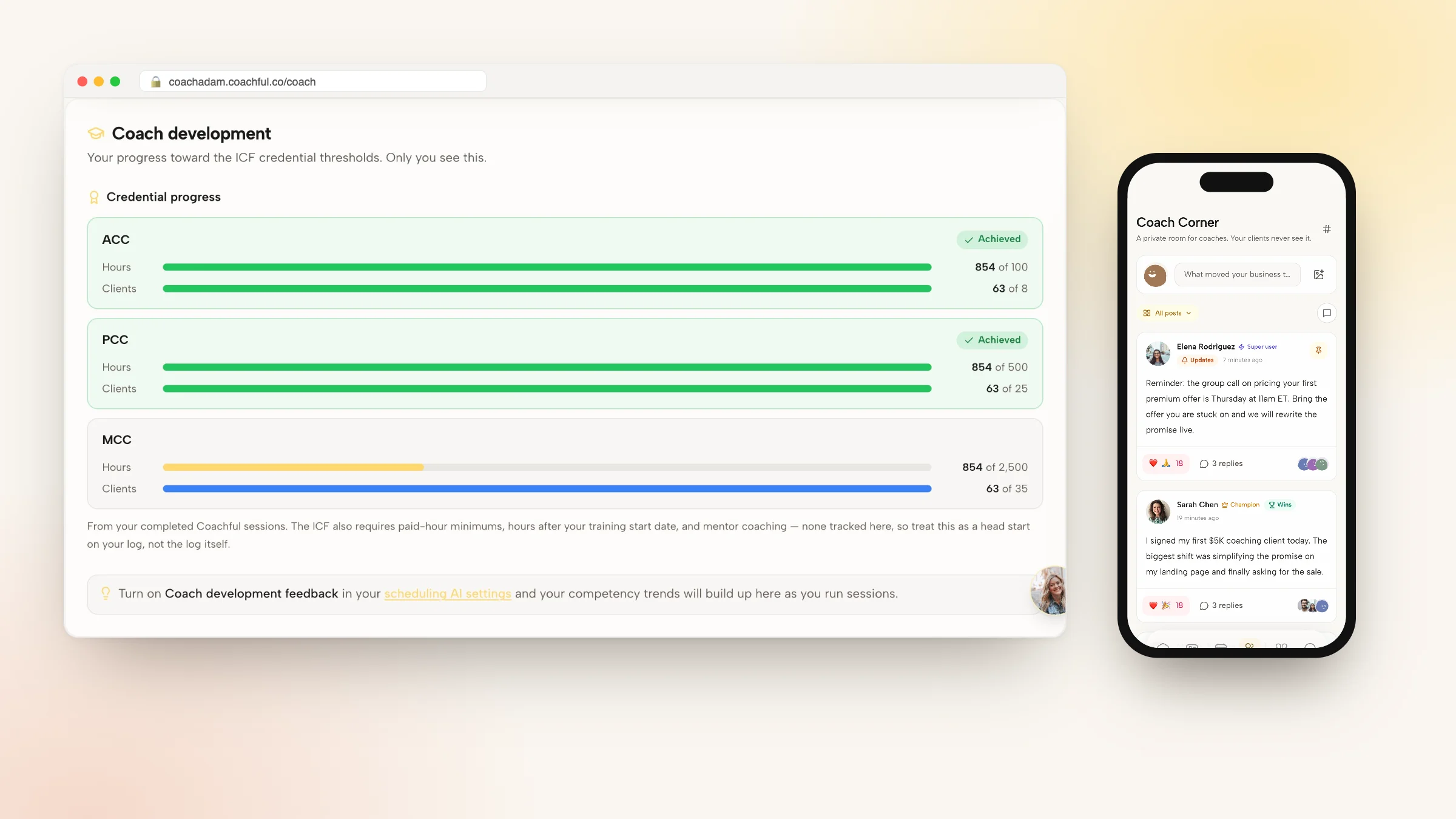
The Clients overview shows check-in rates, average mood and reflections across your practice. If several clients from the same team report the same mood, that's worth a conversation with the sponsor, within what you agreed to share.

A group-plus-individual program
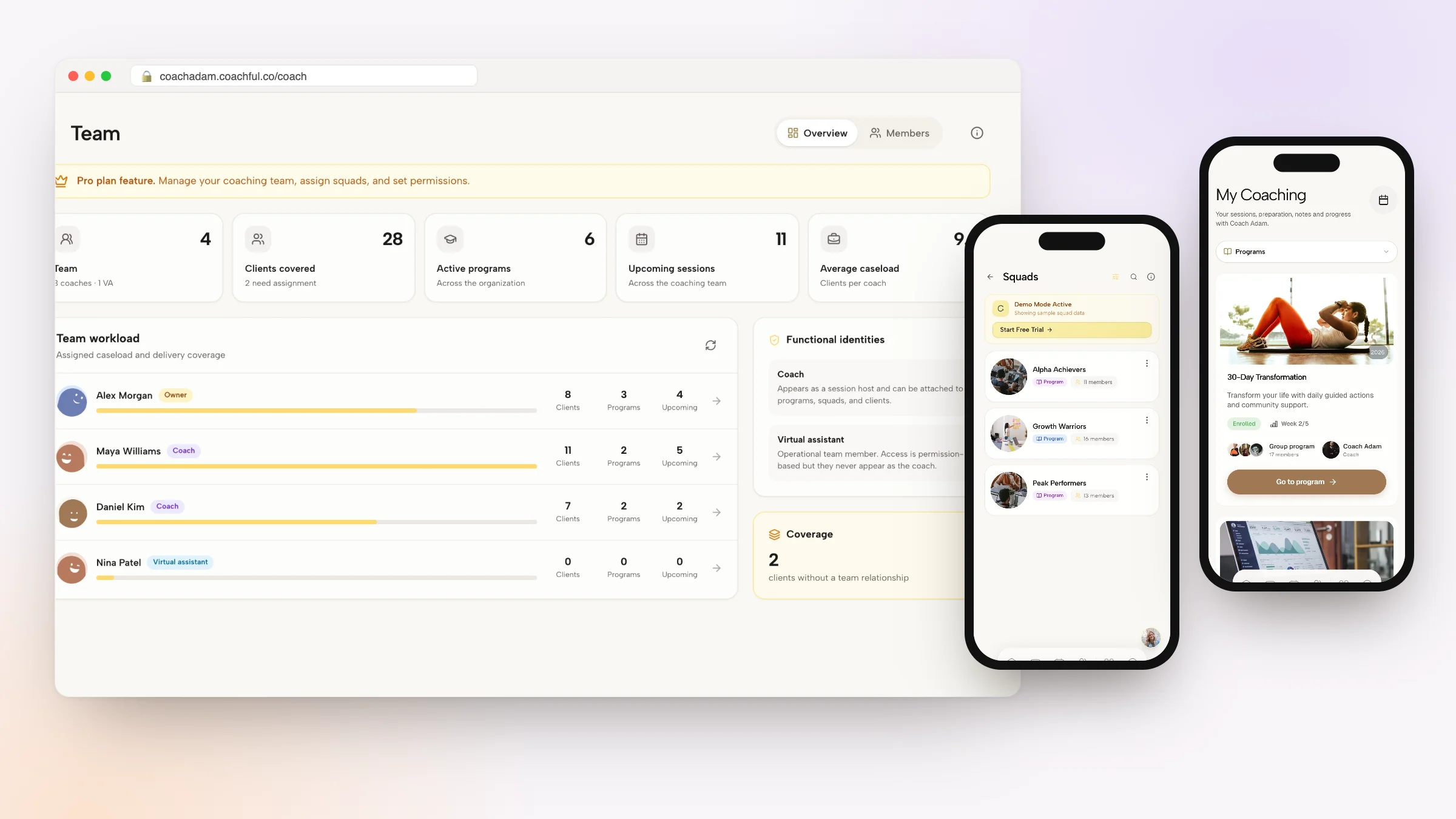
The Singapore trial used one group session followed by four individual sessions. You can build the same shape as a program with a cohort call and 1:1 sessions, so each participant sees their week, their group and their coach in one place.

Journeys for the longer arc
For a six-month engagement, a journey sets out the steps (first distinctions, moods, the body, commitments) and shows the client their progress.

Let the Coachful team build it
Coachful's white-glove service is free on every plan. From Create > We'll build it for you, ask the team to build your speech-acts worksheet, a mood check-in, a group-plus-individual program or a website. Attach your existing materials, in any language you coach in. The team replies by email, usually within about 24 hours, and builds it inside your account so you can edit everything. Read what the free white-glove service builds, and see our pages for executive coaches and career coaches.

Related approaches: Co-Active coaching, somatic coaching (the body domain in more depth) and narrative coaching.
Frequently asked questions
What is ontological coaching?
Ontological coaching works with a person's way of being, meaning their language, moods and body, on the idea that how we observe a situation shapes the actions we take and the results we get. Coaches listen for speech acts such as assessments, requests and promises and help clients make the ones that are missing.
Who founded ontological coaching?
It grew from the work of Chilean thinkers Fernando Flores, Rafael Echeverría and Julio Olalla. Echeverría's Ontología del lenguaje (1994) set out the theory, and Echeverría and Olalla founded The Newfield Group in California in 1990. Alan Sieler wrote the main English-language texts.
Is ontological coaching evidence-based?
The evidence is early but growing. A 2026 randomized trial with 400 nurses in Singapore found ontological coaching improved self-reported well-being, goal-setting and job satisfaction and reduced intention to leave, compared with usual support. Independent replication and comparisons with other coaching methods are still missing.
What are the six speech acts in ontological coaching?
Assertions (checkable statements), assessments (judgments), declarations (statements that create something new, such as "no"), requests, offers and promises. Coaching often focuses on assessments held as facts and on requests that were never clearly made.
How is ontological coaching different from NLP?
Both pay attention to language, but they come from different places. Ontological coaching draws on philosophy, speech act theory and biology, and focuses on commitments and moods. NLP came from modeling therapists' language patterns and uses techniques such as anchoring and reframing. Neither is a therapy.
How long does ontological coach training take?
It varies by school. Newfield Network's flagship program runs nine months and is listed as ICF Level 2 accredited. Many Spanish-language schools run programs of similar length; check accreditation and observed practice hours before enrolling.
Will Coachful build my ontological coaching program for free?
Yes. The white-glove service is free on every Coachful plan. Ask from Create > We'll build it for you and the team will build your worksheet, mood check-in or full program inside your account, usually within about 24 hours.