
How Long Does Coaching Take to Work? A Realistic Timeline
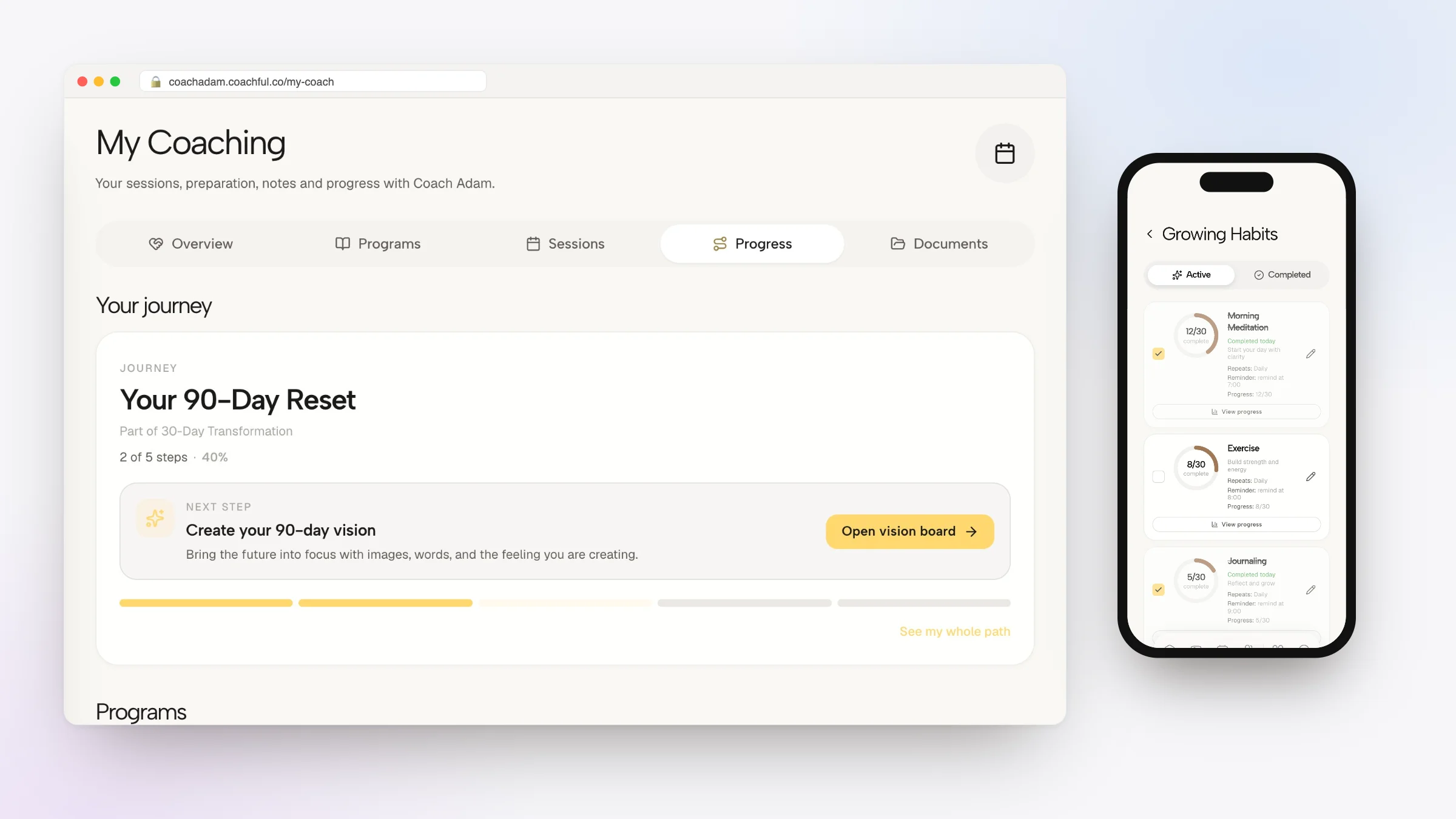
How long does coaching take to work? Most people notice clearer thinking within one to three sessions, see their own behaviour start to change within about two to three months, and get changes other people notice within three to six months. That is why most coaching engagements run three to six months; the International Coaching Federation says most last four to six. The number of sessions matters less than people assume: studies have not found that more sessions alone produce better results.
This page sets out a realistic timeline by phase and by type of goal, the research behind it, what speeds coaching up or slows it down, and how to tell at session four whether yours is on track.
A realistic coaching timeline
| When | What usually changes | What it looks like |
|---|---|---|
| Sessions 1 to 3 (first few weeks) | Clarity | You can name the goal, the obstacle and a first step. Many people feel relief at this stage. |
| Weeks 3 to 8 | Experiments | You try new behaviours, some stick, some do not. Progress is uneven. |
| Months 2 to 3 | Habits start to hold | Some changes need less effort. You catch yourself before the old pattern. |
| Months 3 to 6 | Others notice | Colleagues, family or clients comment, or results show up: the job, the routine, the conversation finally had. |
| 6 to 12 months | It becomes how you work | Mostly for big shifts: a new role, a leadership style, a long health change. |
These are typical ranges drawn from the research below and from how coaching engagements are structured, not guarantees. Individual variation is large.

How long coaching takes, by type of goal
| Goal | Typical time to a result | Why |
|---|---|---|
| One decision (take the job, end the project) | One to three sessions | Clarity is the result |
| A new daily habit | About two to three months | Habit formation takes around two months, with wide variation |
| A job search in your current field | Weeks to months | You control the search, not employers' timelines |
| A career change | Three to twelve months | Testing a direction comes before applying |
| A leadership behaviour others notice | Three to six months, often longer | Colleagues update their view of you slowly |
| A health behaviour, such as eating or activity | Months, often a year | Lifestyle programmes are designed to run for twelve months |
What the research says about how long coaching takes
The number of sessions is not a reliable predictor. Three meta-analyses of workplace coaching have tested whether the number of sessions predicts results, and none found that it does. The 2023 update also tested total hours of coaching, with the same result, and noted that the field still has not answered how many sessions or hours are needed (Cannon-Bowers and colleagues, 2023). A meta-analysis of 20 controlled executive coaching studies found no effect of session count either, though programme length did matter for attitude outcomes (Nicolau and colleagues, 2023).
Short engagements can show results. In a study of 31 healthcare leaders, six one-hour coaching sessions were associated with improved goal attainment, self-efficacy and resilience and lower stress, although with no control group (Grant and colleagues, 2017).
Habits take about two months, and sometimes far longer. A 2024 systematic review of 20 studies with 2,601 participants found median times to habit formation of 59 to 66 days and mean times of 106 to 154 days, with individuals ranging from 4 to 335 days (Singh and colleagues, 2024). Morning practices and habits people chose themselves tended to be stronger.
Behaviour changes before downstream results. A meta-analysis of 60 teacher coaching studies found larger effects on teachers' instruction (0.49 standard deviations) than on student achievement (0.18) (Kraft, Blazar and Hogan, 2018). The same logic applies to you: what you do changes first, and outcomes such as a promotion or a weight loss follow later.
Lifestyle coaching is designed for a year. The Medicare Diabetes Prevention Program is a 12-month coach-led programme, and its worksheet for participants says: "Twelve months might sound like a long commitment, but learning new habits, gaining new skills, and building confidence take time" (CMS). The CDC reports that in the original research, completing the programme cut participants' chances of developing type 2 diabetes by 58% compared with placebo, and that participants were still one-third less likely to develop it a decade later (CDC).

Why coaching engagements usually run three to six months
The research above lines up with how coaching is sold. The ICF's guide for clients says most engagements last four to six months (ICF guide for individuals). Coachful's 2026 Coaching Business Report lists typical life coaching packages of four weeks, three months and six months, and puts corporate executive coaching contracts at 6 to 12 months. Three months gives a new habit time to start holding; six gives others time to notice.
How often you meet inside that window is a separate question, covered in how often you should see a life coach. For what a typical engagement looks like week by week, see what to expect from a life coach, what to expect from a career coach or what to expect from executive coaching.
What makes coaching work faster
- A specific goal. "Leave work by 6pm three days a week" moves faster than "better balance", because you can tell whether it happened. Our guide to coaching goal setting shows how coaches sharpen goals.
- Practice between sessions. The session is where you plan; the week is where change happens, which is why accountability is built into most coaching.
- A coach who fits. If you do not trust them, you will not bring the real problem.
- Some stability. Coaching during a crisis can help, but progress on long-term goals often pauses until the crisis passes.
- Self-chosen actions. The habit review above found that self-selected habits tended to be stronger. Coaching is built on you choosing the action.
What slows it down
- Goals set to please someone else, such as a manager or partner.
- Sessions that are frequently moved or cancelled, so experiments never get reviewed.
- Trying to change five things at once.
- An underlying issue that needs a different professional. If anxiety, low mood or trauma keeps blocking progress, a licensed therapist may need to come first or alongside; see life coach vs therapist.

How to tell whether coaching is working
Agree how you will measure progress in the first session, then check it at set points.
- Baseline. Rate where you are today on your goal from 1 to 10, or use a tool like the free Wheel of Life or the progress tracker.
- Session four check. Can you name one thing you now do differently? Is the goal clearer? If neither, raise it.
- Mid-point review. Re-rate the goal and compare. Adjust the goal, the approach or the frequency.
- End review. Re-rate again, and for work goals ask two or three people what they have noticed.
If nothing has shifted by the mid-point, that is a signal, not a failure. Good coaches will suggest a change of approach or an end to the engagement. Our list of red flags when hiring a coach covers coaches who keep you on with no progress.

What results to expect, honestly
Coaching has a solid evidence base in the workplace, where reviews consistently find moderate positive effects. The evidence for life coaching outside work is thinner: a systematic review of life coaching and health outcomes found only five studies, two of them randomised trials, with mixed but promising results (Ammentorp and colleagues, 2013). Be wary of anyone promising a specific outcome by a specific date. A reasonable promise sounds like "most clients feel clearer within a few sessions, and we review progress at session six".
Find a coach on Coachful
Use Coachful's Find a Coach directory to search coaches and programmes by topic, or take the Find My Coach quiz, which asks what area you want to improve, where you are now, your preferred style and your budget. Browse categories like Mindset, Health & Fitness or Business, then book a discovery call and ask each coach how long their clients usually take to see change, and how they measure it.

Are you a coach?
Prospects want an honest timeline. Put one on your website, with how you measure progress. Coachful's team will build the site for you for free on every plan, usually within about 24 hours: see how the free build works. Inside Coachful, goals, check-ins and habit streaks sit on each client's record, so progress reviews have real data. See client management for coaches and our guide to tracking client progress.

Frequently asked questions
How long does it take to see results from coaching?
Most people feel clearer within one to three sessions, see their own behaviour change within two to three months and get results others notice within three to six months. Big changes, such as a career switch or a leadership style, can take six to twelve months.
How many coaching sessions does it take to work?
There is no proven number. Three meta-analyses of workplace coaching found that the number of sessions did not predict results. In practice, many engagements run 6 to 12 sessions, and a single decision can take one to three.
How long does life coaching last?
Typically three to six months. The ICF says most coaching engagements last four to six months, and common life coaching packages run four weeks, three months or six months.
Why do I feel worse after a few coaching sessions?
Sometimes coaching brings an avoided issue into view, and that can feel uncomfortable for a while. Tell your coach. If the feeling is persistent low mood or anxiety, speak to a doctor or licensed therapist.
Can coaching work in one session?
For a single, clear decision, yes. Habits and behaviour that others notice need repetition over weeks or months, which one session cannot provide.
When should I stop coaching?
When you have reached the goal and can keep it going on your own, or when nothing has shifted by the mid-point review despite changing the approach. Many people move to a monthly or quarterly check-in instead of stopping outright.












