
What to Expect From a Life Coach: Sessions, Timeline, Cost
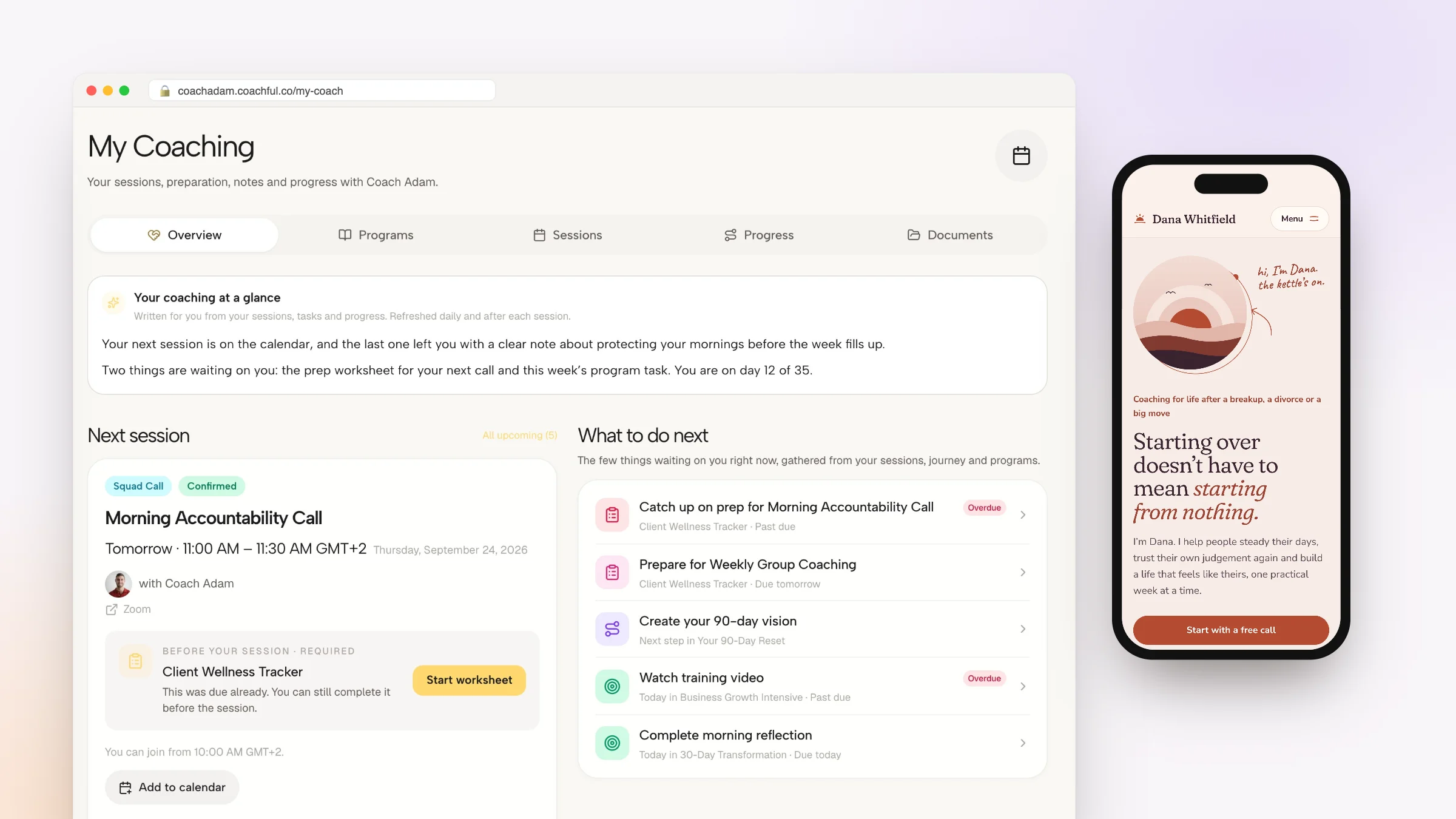
What to expect from a life coach, in short: a structured conversation every week or two, usually 45 to 60 minutes, in which the coach asks far more than they tell, helps you pick one goal and a next step, and checks what happened since last time. Most engagements run three to six months, and most of the change happens between sessions, in the things you try. Do not expect diagnosis, therapy or someone who makes your decisions for you.
That is the gist. The rest of this guide walks through a typical engagement week by week, shows an example session minute by minute, and covers how often you will meet, what it costs, what a coach will not do, and the signs by week six that it is working or not.
What to expect from a life coach at a glance
| Question | What is typical | Where this comes from |
|---|---|---|
| How long does it last? | Three to six months for most engagements | The ICF says most engagements last four to six months; common life coaching packages run 4 weeks, 3 months or 6 months |
| How often do you meet? | Weekly or every two weeks | A 3-month package of 8 sessions works out to roughly every 10 to 12 days |
| How long is a session? | 45 to 60 minutes; some coaches run longer sessions | Packages in Coachful's rates data use 60-minute sessions; the ICF guide mentions sessions of one to two hours |
| Who sets the agenda? | You do, each session | Agreeing the session focus with the client is part of the ICF Core Competencies |
| Will they give advice? | Sometimes, with your permission; mostly questions | Coaching assumes you can generate your own solutions |
| What happens between sessions? | One or two actions you chose, plus short check-ins | Common practice; agreed in the coaching agreement |
| What does it cost? | Typically $75 to $200 a session in the US | Coachful's 2026 Coaching Business Report |
Before the first session: the free call and the agreement
Most life coaches start with a short discovery call, often 20 to 30 minutes and free. It is a fit check, not a sample session. You describe what you want to change, the coach explains how they work, and you both decide whether to go ahead. The International Coaching Federation's guide for clients suggests meeting at least three coaches and asking each for two references (ICF guide to experiencing coaching). Our list of questions to ask a coach before hiring gives you the script.
If you go ahead, expect three pieces of paperwork:
- A coaching agreement. The ICF guide says it should cover "roles and responsibilities" through to "meeting schedules and communication preferences". Look for confidentiality, cancellation rules, between-session contact and how either of you can end it.
- An intake form. Questions about your goals, what you have tried, what is going on in the main areas of your life and anything the coach should know. Many coaches use a wheel of life here; you can try the free Wheel of Life tool before your first call.
- Booking and payment. Usually a package paid upfront or monthly, with the sessions booked from the coach's calendar.

A life coaching engagement, week by week
Every coach runs things a little differently. This is a typical three-month, eight-session engagement, which is the most common package shape in Coachful's rates data.
| When | What happens | What you will be doing |
|---|---|---|
| Week 0 | Discovery call, agreement, intake form | Deciding if this coach fits; writing down what you want to be different |
| Week 1, session 1 | Longer conversation about where you are and where you want to be; one or two goals named | Choosing a first, small experiment to try that week |
| Weeks 2 to 4, sessions 2 and 3 | Reviewing the experiments, finding what got in the way, sharpening the goal | Noticing patterns: when you stall, what you avoid, what works |
| Weeks 5 to 6, session 4 | A mid-point review against the goals you set | Saying honestly what has changed and what has not; adjusting the plan or the goal |
| Weeks 7 to 10, sessions 5 to 7 | Bigger moves: the conversation you have been avoiding, the application, the new routine | Doing harder things with more confidence; needing the coach a little less |
| Weeks 11 to 12, session 8 | Final review and a plan for keeping it going | Deciding whether to stop, renew or switch to a lighter monthly rhythm |
Two things surprise people. First, the opening sessions can feel slower than expected, because the coach is asking questions instead of handing you a plan. Second, the goal often changes. Someone who arrives wanting a new job sometimes discovers the job is fine and the problem is that they never say no to anything. A good coach notices that, says so, and lets you decide what to do with it.

An example life coaching session, minute by minute
This is an illustrative example, not a transcript of a real client. It shows a fourth session for a client who wants to stop working evenings.
| Minutes | What happens |
|---|---|
| 0 to 5 | Arriving: how the week went, energy, anything urgent |
| 5 to 15 | Reviewing last session's experiment: leaving the laptop at work two nights a week |
| 15 to 20 | Agreeing today's focus and what would make this hour useful |
| 20 to 45 | The coaching: questions, reflection, sometimes a short exercise |
| 45 to 55 | Choosing the next experiment, with a day and a time |
| 55 to 60 | What you are taking away, in your words |
And a short sample of the middle section:
Coach: You managed one laptop-free night out of two. What was different about the night that worked?
Client: My partner had booked dinner, so I had to leave on time.
Coach: And the night that didn't?
Client: Nothing was booked. A message came in at 5:40 and I just answered it.
Coach: So a fixed plan held, and an open evening didn't. What would you like to do with that?
Client: Book something both nights. Even a walk.
Coach: What's the first one, and when?
Notice what the coach does not do: lecture about work-life balance, or tell the client to turn off notifications. The client found the pattern, so the client owns the fix. That is the core of the ICF's view of coaching, which assumes people "are capable of generating their own solutions," with the coach supplying "discovery-based approaches and frameworks" (ICF distinctions, reproduced by the University of North Texas). For more worked examples, see our coaching session examples, and for how sessions run in general, what happens in a coaching session.

What happens between sessions
Expect to leave each session with one or two actions you chose, not a long to-do list. Between sessions, a coach might:
- send a short recap of what you agreed, so it is in writing;
- ask you to fill in a quick check-in or reflection before the next call;
- give you a worksheet, a habit to track or something to read;
- answer short messages, within limits agreed in the contract.
Ask about message limits early. "Message me any time" sounds generous and often means slow replies. A clear rule, such as replies within one working day, is easier to live with.
The between-session work matters because change is slow. A 2024 systematic review of health habit formation found median times of 59 to 66 days for a habit to form, with individual cases ranging from 4 to 335 days (Singh and colleagues, 2024). That is one reason most coaching packages run for months rather than weeks.

How often you will meet and for how long
There is no single standard. The ICF's client guide says most engagements last four to six months, and describes sessions of one to two hours, though many life coaches now run 45- or 60-minute sessions. The packages in Coachful's 2026 Coaching Business Report give a practical picture of what life coaches sell:
- a 4-week starter of four 60-minute sessions (weekly);
- a 3-month programme of eight 60-minute sessions (roughly every 10 to 12 days);
- a 6-month deep dive of 12 to 16 sessions (every one to two weeks);
- a VIP intensive day, or monthly group coaching.
Weekly suits the start, when you are building momentum. Every two weeks gives experiments time to play out. Monthly works for maintenance. We cover the trade-offs in how often you should see a life coach and the timeline question in how long coaching takes to work.
What a life coach will not do
Expect a coach to be clear about the edges of the job. A life coach does not diagnose or treat mental health conditions, prescribe, or give legal or financial advice that needs a licence. Life coaching is not licensed in the US (see do you need a license to be a life coach), so the boundaries depend on the coach's own ethics. The ICF Code of Ethics asks coaches to explain the nature of coaching before it begins and to agree roles, responsibilities, confidentiality and financial arrangements (ICF Code of Ethics).
See a licensed professional instead, or as well, when:
- low mood, anxiety or panic is stopping you from functioning day to day;
- you are dealing with trauma, an eating disorder, addiction or thoughts of self-harm (in the US, call or text 988 for the Suicide and Crisis Lifeline);
- the question is medical, legal or financial in a way that needs a licensed answer.
Coaching and therapy can run side by side when both professionals know about each other. Our guide to life coach vs therapist covers when each fits, and do life coaches give advice explains where suggestions end and coaching begins.

What a life coach costs
In US dollars, Coachful's 2026 Coaching Business Report puts a typical life coaching session at $75 to $200 (PayScale and practitioner reports), with three-month, eight-session packages at $1,200 to $2,500 and four-week starters at $400 to $600 (practitioner reports). Ranges and sources by career stage are on coachingrates.com, and our guide to how much life coaches charge goes deeper.
Life coaching is rarely covered by health insurance; see is life coaching covered by insurance before you assume otherwise.
Signs it is working by week six, and signs it is not
| Good signs | Warning signs |
|---|---|
| You can name one thing you now do differently | Sessions feel like pleasant chats with nothing to show for them |
| You set the agenda and the coach follows it | The coach pushes their own method or product regardless of your goal |
| You are being asked hard questions, kindly | You leave every session feeling judged, or flattered |
| The goal is clearer than when you started | Nobody has checked progress against the goals you set |
| You need the coach a little less each month | You are being upsold before the first package is finished |
If the warning signs win, say so at the mid-point review. A good coach will adjust or suggest ending. Our list of red flags when hiring a coach covers the bigger problems, and signs you need a life coach helps if you are still deciding whether to start.
How to get the most out of life coaching
- Arrive with one situation, not a speech. "My manager emailed at 9pm and I replied" is easier to work with than "work-life balance".
- Do the experiment, even badly. A half-done experiment gives the next session something real to look at.
- Write down what you notice. Two lines a day is enough.
- Tell the coach when something is not working. Including their approach.
- Agree a review date at the start. Then you both know when to judge it.

Find a life coach on Coachful
Coachful's Find a Coach directory is open to anyone. You can search by topic, filter by category, such as Lifestyle, Mindset or Relationships, and switch between browsing coaches and their programmes. The Find My Coach quiz asks what area you want to improve, where you are now, the coaching style you prefer and your budget, then suggests coaches. Each profile lets you book a discovery call or send a message, so you can run three short calls and compare.

Are you a life coach?
Clients arrive with exactly the questions on this page, so answer them on your website: how many sessions, how often, what happens between calls, what you will not do. Coachful's team will build that website for you for free on every plan, usually within about 24 hours; here is how the free build works. See also Coachful for life coaches and our guide to running a first coaching session.

Frequently asked questions
What should I expect from my first session with a life coach?
Expect a longer conversation about where you are, what you want to change and how you will work together. The coach will confirm the agreement, ask a lot of questions and help you name one or two goals. Most first sessions end with a small experiment for the coming week.
How many sessions with a life coach do I need?
Many clients work in blocks of four to eight sessions. A single decision may take two or three; a bigger change usually takes three to six months. The ICF says most engagements last four to six months. Agree a review point after four sessions.
Does a life coach tell you what to do?
Mostly no. A coach asks questions so you find your own answers, and may offer a suggestion or a tool if you ask. If a coach mainly instructs you, that is closer to mentoring or consulting.
Is what I tell a life coach confidential?
It should be, within limits written into your agreement. Coaches are not covered by the same legal privilege as therapists, so ask what they record, who can see it and when they would break confidentiality, for example if someone is at risk.
What do life coaches do between sessions?
Typically they send a short recap, may ask you to complete a check-in or worksheet before the next call, and answer brief messages within agreed limits. The main between-session work is yours: the experiments you chose.
What is the difference between a life coach and a therapist?
A therapist is a licensed professional who can assess and treat mental health conditions. A life coach works with people who are functioning and want to move forward on goals. Some people see both, with each knowing about the other.
How do I know if life coaching is working?
By the mid-point you should be able to name something you do differently and see progress against the goal you set at the start. If you cannot, raise it with the coach and adjust, or end the engagement.












