
What to Expect From a Career Coach, Week by Week
What to expect from a career coach: a short, practical engagement, often four sessions over four to six weeks for a job search or around eight over three months for a career change, with homework after every call. Expect help getting clear on the target, fixing your CV and LinkedIn, practising interviews and negotiating, plus someone who asks on Friday whether you sent the applications. Do not expect a coach to find you a job; that is a recruiter's role, and a coach who guarantees placement is a red flag.
Below is how a typical engagement runs week by week, an example session, the timeline you can realistically expect, what it costs and how to tell early whether it is working. If you are still working out what career coaching is, start with what is career coaching, which covers the basics this page builds on.
What to expect from a career coach: the quick answer
| Question | Typical answer |
|---|---|
| How long is the engagement? | One session for a single question; 4 sessions over 4 to 6 weeks for a job search sprint; about 8 over 3 months for a career transition |
| How long is each session? | About 50 minutes in the packages in Coachful's rates data |
| How often? | Weekly during an active search; every two weeks for a bigger change |
| How much homework? | A lot: CV drafts, outreach messages, applications, recorded practice answers |
| Will they write my CV? | Some do, some review and coach you to rewrite it; ask before you buy |
| Will they find me a job? | No. They help you search better; employers and recruiters do the hiring |
| What does it cost? | Typically $100 to $250 an hour, or $500 to $1,000 for a 4-session sprint (US) |
Before you start: what the first call is for
Most career coaches offer a short discovery call. Use it to check three things: whether they work with people at your level and in your field, whether they handle the part you are stuck on (direction, applications, interviews or negotiation), and how they run sessions. The International Coaching Federation recommends talking to at least three coaches and asking each for two references (ICF guide for individuals).
After you sign up, expect an intake form asking for your current CV, your LinkedIn link, the roles you are aiming for, your constraints (salary floor, location, visa, start date) and what a good outcome looks like in three months. Fill it in honestly, including the part where you have applied to 60 jobs and heard back from two. That number is useful.

A career coaching engagement, week by week
Career coaching usually follows one of two tracks. A job search sprint assumes you know the kind of role you want. A career transition starts further back, with what you want to do next.
| When | Job search sprint (4 sessions) | Career transition (about 8 sessions) |
|---|---|---|
| Week 1 | Target roles agreed; CV and LinkedIn reviewed line by line | Values, strengths and what drained you in past roles; a long list of possible directions |
| Weeks 2 to 3 | Rewritten CV; an outreach plan for 10 to 20 people; an applications tracker started | Narrowing to two or three directions; informational conversations booked with people doing those jobs |
| Weeks 4 to 6 | Mock interviews on the questions you dread; a story bank of examples | Testing a direction: a short course, a side project, a conversation with a hiring manager |
| Weeks 7 to 10 | Offer and negotiation support, if you are there | Repositioned CV and LinkedIn for the new field; targeted applications |
| Weeks 11 to 12 | Review, or a top-up session for the final round | Interview practice, negotiation, and a plan for the first 90 days in the new role |
The job search sprint maps to the four-session, four-to-six-week package in Coachful's 2026 Coaching Business Report, and the transition track to its eight-session, three-month package. Your coach may compress or stretch either. Career coaching is bought at a moment of urgency, which is why the report notes that engagements in this niche tend to be short.

An example career coaching session
This is an illustrative example, not a real client. It is a second session in a career transition, for a client who is a project manager wondering about product management. Our coaching session examples walk through seven more, with annotated dialogue.
| Minutes | What happens |
|---|---|
| 0 to 8 | What happened with last week's homework: two informational chats booked, one done |
| 8 to 15 | Agreeing today's focus: what the first conversation revealed |
| 15 to 40 | Unpacking it: what sounded energising, what sounded like the job they want to leave |
| 40 to 50 | Next experiments: two more conversations and a look at one entry route |
Coach: You said the product manager you spoke to "spends half her week in meetings defending priorities." How did that land?
Client: Honestly, it sounded like my current job with a different title.
Coach: What part of her week did you want?
Client: The research with customers. That bit I would do for free.
Coach: So the question might be less "product manager or not" and more "how close to customers". Who could you talk to who does mostly that?
Client: A user researcher, maybe. I don't know any.
Coach: Who would know one?
Two features are typical. The coach turns a vague option into a sharper question, and the session ends with specific outreach rather than more reading. A session later in a job search looks different: more practice, out loud, with feedback. Our career coaching activities list shows the exercises coaches use.

How much homework to expect
More than people think. A useful rule of thumb is that the hour with the coach is the smallest part of the week. Expect to:
- rewrite your CV more than once, and adapt it for each strong application;
- send outreach messages and follow-ups, logged in a tracker;
- book and hold informational conversations;
- record practice answers on your phone and listen back;
- research salary ranges before any offer conversation.
The research supports this mix. A meta-analysis of 47 job search interventions found that participants had 2.67 times the odds of finding employment compared with control groups, and that programmes worked only when they combined skill-building with motivation (Liu, Huang and Wang, 2014). Skills without follow-through, or encouragement without skills, did not do the job.

A realistic timeline for results
Expect clarity and better materials within the first two or three sessions. Expect interviews to take longer, and offers longer still, because hiring runs on employers' timelines. For context, the US Bureau of Labor Statistics reported a median unemployment duration of 11.5 weeks in September 2026, with an average of 24.8 weeks (BLS Table A-12). Those figures cover all unemployed people, not coaching clients, but they are a fair reminder that a four-week sprint rarely ends with a signed offer.
A career change usually takes longer than a search for a similar role, because you are testing a direction before you apply. Ask your coach to set milestones you control, such as conversations held and applications sent, rather than only the outcome you do not. More on timelines in how long coaching takes to work.
What a career coach will and will not do
| Usually does | Usually does not |
|---|---|
| Help you choose a target and test it | Choose your career for you |
| Review your CV, LinkedIn and cover letters | Apply to jobs on your behalf |
| Run mock interviews and give feedback | Guarantee interviews or a job |
| Coach you through negotiation | Negotiate with the employer for you |
| Hold you to the weekly plan | Treat depression or anxiety that stops you functioning |
If job loss has left you struggling to get through the day, a licensed therapist or your doctor is the right first stop, and coaching can follow. If you are a student, check your college career center first; the Bureau of Labor Statistics says career counselors are employed primarily in colleges and universities (BLS). In the US, the public employment service also offers job search assistance through approximately 2,300 American Job Centers, though services vary by state and some have eligibility requirements (US Department of Labor).
What a career coach costs
Coachful's 2026 Coaching Business Report gives these US figures. A typical hour runs $100 to $250 (PayScale and practitioner reports). Single 50-minute sessions published by 35 coaches on one marketplace ranged from $99 to $280. A four-session job search sprint runs about $500 to $1,000, and an eight-session career transition over three months about $1,200 to $2,500 (practitioner reports). Details on coachingrates.com and in how much career coaches charge. Check first whether your employer or a severance package will pay; the question of value is covered in is a career coach worth it.

Signs it is working, and when to speak up
- After session one: you have a clearer target and a short list of actions with dates.
- After two or three: your CV and LinkedIn read like the role you want, and your outreach is getting replies.
- By the mid-point: you are having more conversations and, in a search, landing more first-round interviews.
Speak up if sessions are generic (the same template advice for everyone), if the coach pushes an add-on before the first package is done, or if nobody has checked progress against your goal. Our guides to signs you need a career coach and how to find a career coach help with the choice.
Find a career coach on Coachful
Search Coachful's Find a Coach directory for "career", "interview" or the field you are moving into, or browse the Tech & Skills and Business categories. The Find My Coach quiz matches you by area, stage, preferred style and budget. From each profile you can book a discovery call or send a message, so you can talk to two or three coaches before choosing.

Are you a career coach?
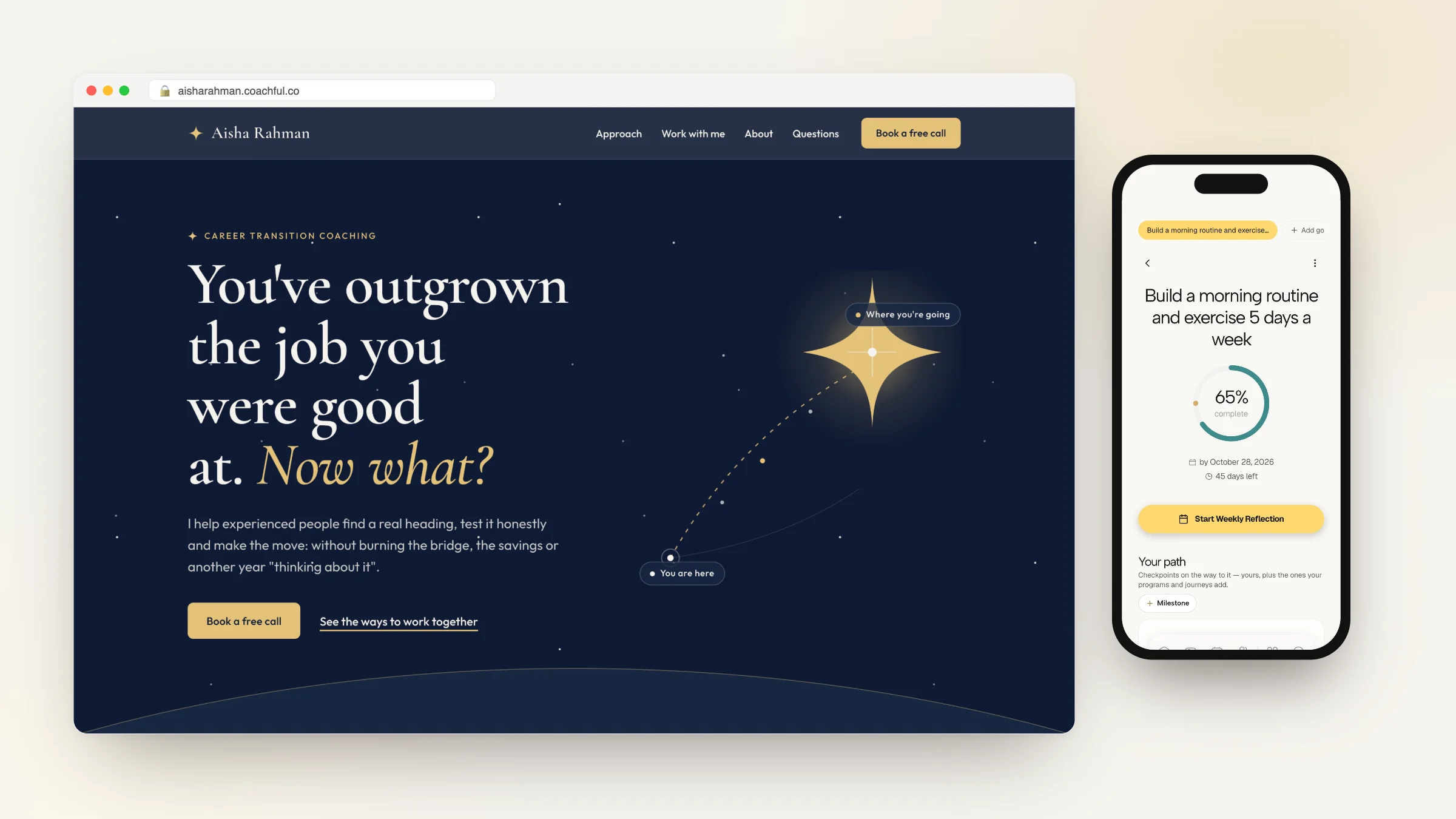
People searching this page want to know your timeline, your homework expectations and your packages before they book. Put those on your website. Coachful's team will build it for you for free on every plan, usually within about 24 hours, including pages for CV review and interview prep that clients pay for and book in one flow: see how the free build works. More on Coachful for career coaches and becoming a career coach.

Frequently asked questions
What should I expect in my first career coaching session?
Expect the coach to review your intake answers, your CV and LinkedIn, ask what you want and what has not worked, and agree a target for the engagement. You should leave with a short action list for the week, such as CV changes and a first set of outreach messages.
How many sessions with a career coach do I need?
One session can sort a single question, such as a salary negotiation. A focused job search often takes about four sessions over four to six weeks; a career change about eight over three months, according to the packages in Coachful's 2026 Coaching Business Report.
Can a career coach get me a job?
No. A career coach improves how you search, present yourself and interview. Recruiters and employers do the hiring. Be wary of anyone who guarantees a job or placement in exchange for a fee.
Does a career coach write your resume?
Some include CV writing, many review and coach you to rewrite it yourself, and some refer you to a separate resume writer. Ask exactly what is included before you pay.
How often do you meet with a career coach?
Weekly during an active search, when momentum matters, and every two weeks during a slower career change so you have time to test ideas between sessions.
What is the difference between a career coach and a career counselor?
Career counselors use aptitude and achievement assessments, work mainly in colleges and universities, and some states require them to be licensed, according to the Bureau of Labor Statistics. Career coaches focus on goals, strategy and action, and coaching itself is not licensed. Some professionals do both.
Is it worth paying a career coach if I am unemployed?
It can be, if you are stuck on a specific part of the search. Check what your local American Job Center or college career center offers first, then consider a short, defined sprint with a coach rather than an open-ended package.












