
How to Become a Motivational Coach: Skills, Training, Pay
To become a motivational coach, train in coaching (an ICF-accredited program is the most recognized route), learn what motivation research actually supports, practice on real clients until you can get someone from "I should" to a plan they keep, and pick a specific group of people to help. No license is required. What clients pay a motivational coach for is structure rather than a pep talk: a reason they own, a goal precise enough to measure, a plan for the bad Tuesday and someone who checks in.
That's how to become a motivational coach in short. This guide covers what the job is and how it differs from motivational speaking and therapy, the four research ideas worth building your practice on, a sample session with questions you can use, training and cost, pricing, and how to find your first clients.
When you're ready to launch, Coachful's team will build your coaching website and first offer page for free on every plan.
What a motivational coach does
A motivational coach helps people start and keep doing something they've said they want: exercise, a business, a degree, a career change, a creative project. The client usually knows what to do. The gap is between knowing and doing, and the coach's work lives in that gap.
Three jobs get called "motivational," and they're different:
| Role | What they do | Who pays | How it's sold |
|---|---|---|---|
| Motivational coach | Works one-to-one or in small groups on a person's own goal, over weeks or months | Individuals, sometimes employers | Programs, packages, monthly coaching |
| Motivational speaker | Delivers talks and workshops to audiences | Event organizers, companies, schools | Speaking fees per event |
| Therapist or counselor | Assesses and treats mental health conditions, including depression that saps motivation | Clients, insurers | Licensed clinical sessions |
Some motivational coaches also speak, because a talk is a good way to meet clients. But the coaching itself is closer to accountability and mindset work than to keynotes. If the mindset side interests you most, our sibling guide on how to become a mindset coach goes deeper on beliefs, and how to become a life coach covers the broader path.

Four ideas from motivation research to build on
A lot of motivational content is slogans. These four ideas have real research behind them, and each turns into something you do in a session.
1. People keep going when they feel competent, autonomous and connected
Self-determination theory, from psychologists Richard Ryan and Edward Deci, proposes three innate psychological needs, competence, autonomy and relatedness, which "when satisfied yield enhanced self-motivation" and when thwarted reduce it, as their 2000 paper in American Psychologist puts it. For a coach: let the client choose the goal and the method, design early wins they can feel, and give them people to do it alongside.
2. Specific, hard goals beat "do your best"
Edwin Locke and Gary Latham summarized 35 years of goal-setting research in a 2002 American Psychologist paper. They report that specific, difficult goals consistently led to higher performance than urging people to do their best, with effect sizes in meta-analyses of .42 to .80, and that goals combined with feedback on progress work better than goals alone. For a coach: "get fit" becomes "run 5K without stopping by June 1," and progress gets measured weekly.
3. Ambivalence is normal, and the client's own reasons work best
Motivational interviewing, developed by William Miller and Stephen Rollnick, treats "I want to and I don't want to" as the starting point rather than a failure. The Motivational Interviewing Network of Trainers (MINT) runs a resource hub on the approach. For a coach: ask questions that draw out the client's reasons for change, and reflect them back, instead of supplying yours. Our guide to motivational interviewing for coaches covers the core skills, and the sibling motivational interviewing questions is a question bank.
4. If-then plans close the gap between intending and doing
Peter Gollwitzer's research on implementation intentions, reviewed in a 2006 meta-analysis with Paschal Sheeran, studies plans of the form "if situation X happens, I'll do Y." For a coach: every commitment gets a when, a where and a plan for the most likely obstacle. "If I get home after 7, I'll do the 20-minute version, not skip it."
What a motivational coaching session looks like
A simple shape for a 50-minute session, built on those four ideas:
- Check in on last week's commitment (5 minutes). What happened, without judgment.
- Agree what this session is for (5 minutes). One focus, chosen by the client.
- Explore (20 minutes). What's getting in the way, what has worked before, what matters about this goal.
- Design the next step (15 minutes). Specific, measurable, with an if-then plan for the obstacle.
- Close (5 minutes). The client says the commitment in their own words, and how you'll check in.
A short sample exchange
Client: I was going to write every morning and I managed twice. I just don't have the discipline.
Coach: Twice is more than zero. What was different on those two mornings?
Client: I'd put the laptop on the kitchen table the night before. The other days I checked my phone first.
Coach: So the setup the night before mattered more than discipline. What would make that setup happen four nights this week?
Client: If I'm brushing my teeth, the laptop goes on the table. And the phone stays charging in the hall.
Coach: How sure are you, from one to ten, that you'll do that?
Client: Seven.
Coach: What would make it an eight?
Questions to keep on hand
- What would be different in your life if this were done?
- Why does this matter to you now, rather than last year?
- On a scale of one to ten, how important is this? Why not a lower number?
- What's the smallest version of this you could do on a bad day?
- When did you last keep a commitment like this? What helped?
- What usually gets in the way, and what will you do when it shows up?
- How will you know, at the end of this week, that it worked?
- Who could you do this with, or tell about it?
- What would you need to stop doing to make room for this?
- What's one thing you'll do in the next 24 hours?
Our free coaching questions tool has more, sorted by situation.

Where motivational coaching stops
Lack of motivation is sometimes a symptom. Persistent low mood, loss of interest in everything, exhaustion that rest doesn't fix, or trouble starting tasks that has followed someone all their life can point to depression, burnout or ADHD, which need assessment and treatment from a licensed professional. A coach who keeps pushing harder in those cases does harm.
The ICF's Core Competencies ask coaches to maintain "the distinctions between coaching, consulting, psychotherapy and other support professions" and to refer clients to other support professionals "as appropriate." In practice: ask about sleep, mood and history in your intake, agree in writing that coaching isn't therapy, and know who you'll refer to. Our sibling guide to the ICF Core Competencies covers the full model, and keeping therapy and coaching separate covers the practical side.
Training and credentials for a motivational coach
There's no motivational coaching credential you need, and no license. What helps, in order:
- General coach training, ideally ICF-accredited. An ICF Level 1 program runs 60 to 124 hours and leads to the Associate Certified Coach (ACC) credential, which needs 100 coaching hours and an exam. Three Level 1 examples with prices as listed in October 2026: Coach Training Alliance's Certified Coach Program ($3,949, 75 hours with 60 ICF hours), Coaching Out of the Box's FastTrack ($4,895, 76 live hours) and Coach Training EDU's Essentials ($4,950, 62.5 hours, also accredited at Level 2). Our list of ICF accredited coaching programs has more.
- Motivational interviewing training. MINT lists trainers, and many offer short workshops. It's the most transferable skill for this niche.
- Your own track record. Clients trust a motivational coach who has changed something hard in their own life and can talk about it honestly.
| Step | Realistic time | Cost |
|---|---|---|
| ICF Level 1 program | About 6 months part time | About $3,949 to $4,950 for the three examples above |
| Practice and first paid hours toward the ACC | About a year at two coaching hours a week | Your time |
| ICF ACC application | About 4 weeks of review on an accredited path | $175 for members, $325 for non-members, as listed in October 2026 |
| MI workshop | A few days | Set by each trainer |
Times are our arithmetic from program and ICF requirements, not published averages.

How to package and price motivational coaching
Coachful's rates data has no figure for motivational coaching, so the closest is life coaching. The 2026 Coaching Business Report puts life coaches at $75 to $200 a session (PayScale and practitioner reports), with these package shapes observed in the market:
- Starter: four 60-minute sessions over four weeks with email support, $400 to $600.
- Three-month program: eight sessions with email and worksheets, $1,200 to $2,500.
- Group coaching: group calls and a community, $100 to $300 a month per person.
Motivation is an accountability product, so the format that fits best is usually a fixed-length program with weekly check-ins between sessions, followed by a lighter monthly option for clients who want to keep someone in their corner. A group works especially well here, because relatedness is one of the three needs and peers keep each other going. For the income side, see the life coaching rates page, our breakdown of what life coaches charge and life coach salary.

Get your first motivational coaching clients
- Pick a goal, not a personality. "Motivation coaching" is vague. "Coaching for adults finishing a degree while working" or "getting founders to ship the thing" is a person someone can recognize.
- Run a free short challenge. Five or seven days, one small action a day, a daily check-in. It shows your method and gives people an early win, then points to a paid program. Our guide to a five-day challenge for first clients walks through one.
- Speak, then coach. A 20-minute talk at a workplace, a meetup or a podcast reaches people who want what you do. End with a single next step.
- Coach a few people at a pilot price, with clear before-and-after measures, and ask for honest testimonials you can use with permission.
- Make check-ins visible. A Wednesday prompt asking how the week's commitment is going keeps the work alive between sessions, and it's the part of your method clients describe to friends.

The tools a motivational coaching practice runs on
Most of a motivational coach's value happens between sessions, so the tools matter more than in most niches. A Coachful membership includes:
- Goals with milestones and weekly reflections, and habits with reminders, in a client app on iPhone and Android.
- Coaching flows: morning, evening and weekly check-ins you design, so commitments get checked without you sending every message.
- Accountability calls and group cohorts with a community feed, where clients share wins with their peers.
- Booking, payments and agreements in one flow, paid to your own Stripe or Razorpay account with a 0% Coachful platform fee.
More on client accountability in Coachful and the Coachful page for mindset coaches.
Have your website built for free
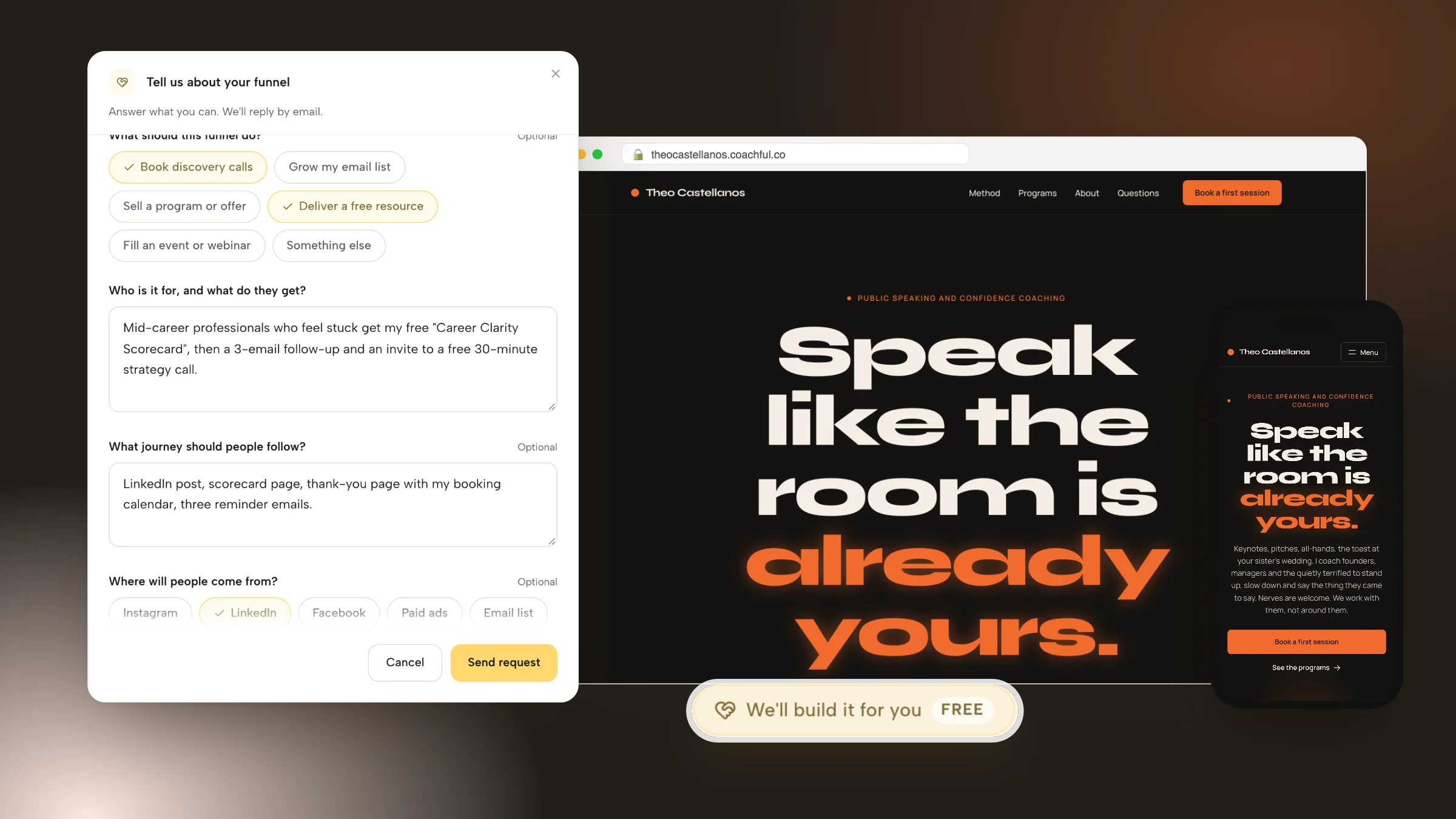
Coachful's team builds your website and first offer page for free on every plan, inside your own account; Coachful itself is a paid membership with a free trial to start. Choose We'll build it for you · FREE under Create, or Fill in a form on the Website page, and say which pages you need and what visitors should do next.

The team replies by email with next steps, usually within about 24 hours, which is typical rather than guaranteed. Nothing gets invented: no credentials you don't hold, no testimonials or results you haven't given. See everything the free build covers.
Frequently asked questions
Do you need a certification to be a motivational coach?
No. There's no license or required credential for motivational coaching. Coach training, ideally an ICF-accredited program leading to the ACC, teaches the skills and gives clients something to check, and motivational interviewing training is especially useful in this niche.
What's the difference between a motivational coach and a motivational speaker?
A speaker delivers talks to audiences and is paid per event. A coach works with individuals or small groups on their own goals over weeks or months, paid through programs or monthly coaching. Many coaches speak to find clients, but the work itself is different.
How much do motivational coaches charge?
There's no published figure for motivational coaching specifically. The closest data, life coaching, runs $75 to $200 a session, with three-month programs at $1,200 to $2,500 and group coaching at $100 to $300 a month per person, according to Coachful's 2026 Coaching Business Report.
Can a motivational coach help with depression?
Not as treatment. Persistent low mood, loss of interest or exhaustion can point to depression, burnout or ADHD, which need a licensed professional. A coach can work alongside treatment on goals and habits, but should refer rather than push harder.
How long does it take to become a motivational coach?
You can start coaching after a short training, but a solid path takes about 18 months part time: around six months for an ICF Level 1 program, then about a year of coaching to reach the 100 hours the ACC asks for.
What does the research say about motivation?
Self-determination theory points to three needs, competence, autonomy and relatedness. Goal-setting research finds specific, difficult goals with feedback beat "do your best." Motivational interviewing works with ambivalence, and if-then plans help people follow through.
Will Coachful build my motivational coaching website for free?
Yes. Coachful's team builds coaching websites and first offer pages for free on every plan, inside your account, usually within about 24 hours. Coachful is a paid membership; the build costs nothing extra.












