
8 Things to Know Before Becoming a Women's Leadership Coach
Before becoming a women's leadership coach, know that the strongest research in this field points at organizations as well as individuals, that the biggest drop in women's careers happens at the first promotion to manager rather than at the top, and that the old advice on negotiation and "leading like a woman" doesn't hold up well. Clients come from two very different markets, women paying for themselves and companies buying programs, and the work regularly runs into caregiving, health and burnout.
This is the coach-side companion to our guide on leadership coaching for women, which is written for the women looking for a coach and covers formats, costs and how to choose. If you're still deciding how to train, start with how to become a leadership coach. And when you need a website that works for both of your buyers, Coachful's team will build it for free on every plan (item 6).
The 8 things at a glance
| # | What to know | What it means for your coaching |
|---|---|---|
| 1 | Your clients don't need fixing | Coach the person and name the context |
| 2 | The drop-off starts at the first promotion | New managers are a market, not just senior women |
| 3 | Sponsorship is a skill you coach | Map sponsors and rehearse the ask |
| 4 | "Women don't ask" is outdated | Coach evidence, timing and handling "no" |
| 5 | Skip the "lead like a woman" clichés | Work with each client's own style |
| 6 | Two markets buy very differently | Plan for individuals and for company programs |
| 7 | Life outside work walks into the session | Know your scope and your referrals |
| 8 | Groups work unusually well here | Design confidentiality before the first cohort |
1. Your clients don't need fixing
A lot of women's leadership content still sells a deficit: be more confident, speak up more, stop apologizing. Experienced clients have heard it all and many find it insulting, because they've watched the same behavior get rewarded in a male colleague and penalized in them.
The research gives you better footing. In a widely cited paper, Robin Ely, Herminia Ibarra and Deborah Kolb argued that "second-generation" gender bias, subtle beliefs and workplace practices that inadvertently favor men, gets in the way of women seeing themselves and being seen as leaders, and that women's leadership development should be treated as identity work in that context (Academy of Management Learning & Education, 2011). The practical takeaway for a coach: help your client build skills and strategy, and be honest that some of what she's facing is the system, not her.
What to do: in early sessions, separate what's in her control (how she frames her work, who knows about it, what she asks for) from what isn't (a biased review process). Coach the first; name the second without making it the whole story. Clients and corporate buyers both respond better to that balance than to either "it's all bias" or "just be bolder."

2. The drop-off starts at the first promotion
The popular image of women's leadership coaching is a senior executive preparing for the board. The data suggests a large share of the need is much earlier. The 2025 Women in the Workplace report from LeanIn.Org and McKinsey found that for every 100 men promoted to manager, only 93 women were promoted, and the figures were lower for women of color: 82 Asian women and Latinas and 60 Black women per 100 men. The authors call this the "broken rung."
That matters for your niche. Women stepping into their first management role, or trying to, face a gap that compounds over a career. Coachful's 2026 Coaching Business Report separates leadership from executive coaching for a similar reason: leadership coaching "sits just below executive work because the buyer is often a rising manager rather than the C-suite."
What to do: decide which rung you serve. "New managers in their first year" and "directors going for VP" need different offers, language and prices. Our list of leadership coaching topics helps map the work by level.
3. Sponsorship is a skill you coach
Mentors give advice. Sponsors use their influence: they put a name forward, argue for a stretch role, defend a promotion case in the room. Sylvia Ann Hewlett's book Forget a Mentor, Find a Sponsor (Harvard Business Review Press, 2013) popularized the distinction, and the gap is still visible in the data. The 2025 Women in the Workplace report found that among entry-level employees, 31 percent of women have a sponsor, compared with 45 percent of men.
Telling a client "you need a sponsor" is advice. Coaching her through getting one is the job: who has influence over her next move, who has seen her work, what she can offer in return, and what exactly she'll ask for. Most clients find the ask itself the hardest part, because it feels like self-promotion.
What to do: build a simple stakeholder map in the first month, rehearse the sponsor conversation in a session, and agree a specific ask ("Would you put my name forward for the regional role?"). In Coachful, the Executive Coaching power-up has a Women in leadership edition with visibility, sponsorship and negotiation templates, leadership brand, sponsor agreement and confidence evidence worksheets, and an eight-week visibility and sponsorship program you can adapt.
4. "Women don't ask" is outdated
Linda Babcock and Sara Laschever's book Women Don't Ask (Princeton University Press, 2003) shaped a generation of negotiation advice: women lose out because they don't ask for raises. Later research complicates that. Using matched employer-employee data, Benjamin Artz, Amanda Goodall and Andrew Oswald found that women asked for promotions and raises at similar rates to men but were less likely to get them (Industrial Relations, 2018).
If your coaching still rests on "you just need to ask," you may be solving a problem your client doesn't have and missing the one she does. The more useful questions are about timing, evidence and what happens after a "no": what's the case, who decides, what's the fallback, and how does she respond when told "not this cycle"?
What to do: prepare negotiations like a project. Build the evidence file over months, test the ask with an ally first, role-play the "no," and agree a follow-up date in the same conversation. Our coaching questions for imposter syndrome help with the doubt that often comes up during preparation.

5. Skip the "lead like a woman" clichés
Marketing in this niche often sells a distinct "feminine" leadership style: more collaborative, more empathetic, more intuitive. The evidence is thinner than the marketing. Alice Eagly and Blair Johnson's meta-analysis of 162 studies (Psychological Bulletin, 1990) found mostly small differences between men's and women's leadership styles, with the clearest being that women tended to lead in a somewhat more democratic, participative way.
Your clients are individuals. Some are blunt, data-driven operators who resent being told to soften; some are quiet consensus builders who are tired of being told to be louder. Selling one gendered style alienates half your market and boxes your clients in.
What to do: coach each client's own leadership style and how it lands in her particular organization. Use 360 feedback or stakeholder conversations to see how she's perceived, and work on the gap between intent and impact. Our guide to executive presence coaching covers that work without the clichés.
6. Two markets buy very differently
Women's leadership coaching has two buyers. Individual women pay from their own pocket, decide in days or weeks and care about fit and results. Companies buy programs: cohorts for high-potential women, coaching attached to an employee resource group or a promotion pipeline. Coachful's report compares the two: consumer sales cycles run one to three weeks while corporate ones run one to six months, the corporate decision-maker is HR, L&D or the executive team, and credentialing is "often mandatory" there. The report puts leadership coaching at $150 to $400 an hour and $80,000 to $100,000 a year (ICF Global Coaching Study 2025 and PayScale).
Most women's leadership coaches start with individuals and add corporate work, because a few company programs can stabilize the year. That means your website, credentials and offers need to speak to both: a woman deciding alone at night and an HR lead scanning for structure and an ICF credential.
What to do: offer a 1:1 package for individuals and a defined cohort or workshop format for companies, and put both on your site. Our guides to pricing a corporate workshop and executive coaching certification cover the corporate side, and the Coachful page for executive and leadership coaches shows the practice setup.

Have the website built for free
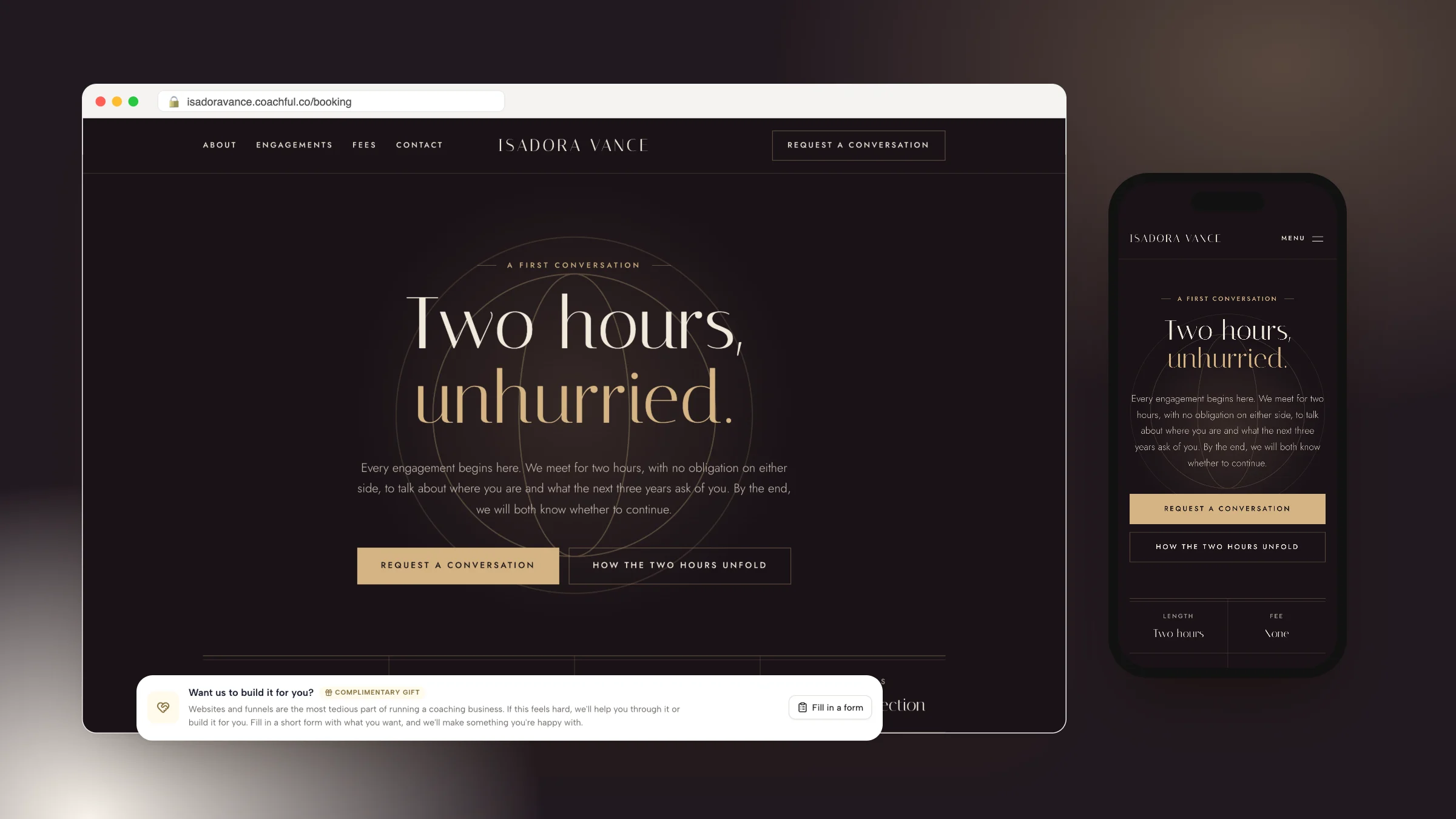
Coachful's team builds coaching websites, program pages and funnels for free on every plan, inside your own account. Coachful itself is a paid subscription with a free trial. Open Website, click Fill in a form on the "Want us to build it for you?" card, and describe your pages, including separate paths for individuals and organizations. The team replies by email with next steps, usually within about 24 hours, which is typical rather than guaranteed. Nothing is invented: no client logos, testimonials or credentials you don't have. See what the free build covers.

7. Life outside work walks into the session
A session that was meant to be about a promotion case becomes about a mother's diagnosis, a child's school crisis, perimenopause symptoms that make afternoon meetings hard, or a level of exhaustion that looks a lot like burnout. Many clients carry heavy caregiving loads and arrive with very little slack left.
Coaching can help a client redesign her week, set boundaries at work and make decisions about what to drop. It can't treat depression or anxiety, and it isn't legal advice. If a client describes harassment or discrimination, an employment lawyer or the relevant regulator is the right next step; in the US the Equal Employment Opportunity Commission enforces federal laws against job discrimination.
What to do: keep a referral list that covers therapists, doctors and employment lawyers, and say early in the engagement that life outside work is welcome in the room. Our consumer guides to menopause coaching and burnout coaching show how clients experience those overlaps.
8. Groups work unusually well here
Many senior women are the only woman at their level, or one of very few. A cohort of peers from other companies gives them something one-to-one coaching can't: people who recognize the situation immediately and can share what worked. Group formats also suit corporate buyers, who can develop a whole pipeline at once.
The risk is confidentiality. Women in a cohort may work in the same industry, or even the same company, and stories travel. A group that doesn't feel safe turns into polite networking.
What to do: set confidentiality rules in writing before the first session, have each member agree them, decide what happens if two members work together, and keep the group small enough that everyone speaks. Our guides to group coaching confidentiality and creating a group coaching program have the details. In Coachful, enrolling clients in a program creates a cohort group with its own feed, chat and calls, while each woman keeps an individual record of goals and progress.


The bottom line
Women's leadership coaching is meaningful work with a strong evidence base for why it's needed, and a weaker one for some of the advice that's traditionally sold with it. The coaches who do well treat their clients as capable leaders in a system that isn't neutral, serve a specific rung, coach sponsorship and negotiation as skills, avoid gendered clichés, and build both a 1:1 practice and a company offer. For the craft itself, see leadership coaching skills, and for the market, what leadership coaching is.
Frequently asked questions
What does a women's leadership coach do?
A women's leadership coach helps women build the skills, visibility and relationships that lead to bigger roles, and handle obstacles such as getting credit for work, finding sponsors, negotiating pay and scope, and leading while carrying a heavy load outside work. Good coaches work on what the client controls and are honest about the system around her.
Do I need a certification to be a women's leadership coach?
No law requires one, but corporate buyers often do. Coachful's report notes that credentialing is "often mandatory" in corporate coaching, and many buyers treat the ICF PCC as the working standard. Individual clients care more about your understanding of their situation and your results.
How much do women's leadership coaches charge?
Coachful's 2026 report has no women-specific figure. Leadership coaching overall runs $150 to $400 an hour (ICF Global Coaching Study 2025 and PayScale), with company-funded engagements usually priced higher than self-funded ones.
Who hires a women's leadership coach?
Individual women, often at a promotion point or in a new role, and companies running programs for high-potential women, employee resource groups or leadership pipelines. The two buy differently: individuals decide quickly, companies take months and involve HR or L&D.
Is there research that leadership coaching for women works?
There's evidence that structured group coaching for women can help with outcomes like burnout and impostor feelings, especially in medicine, and strong evidence that women face barriers such as fewer sponsors and slower early promotion. Our client-side guide to leadership coaching for women summarizes the trials.
Should women's leadership coaches only work with women?
That's your choice. Many coaches focus on women in their marketing and still coach other leaders. A specific focus makes you easier to find and refer; what matters is that your offer is clear about who it's for.
Will Coachful build my women's leadership coaching website for free?
Yes. Coachful's team builds coaching websites and program pages for free on every plan, inside your own account. Coachful is a paid subscription; the build costs nothing extra. Fill in the form from the Website page, and the team replies with next steps, usually within about 24 hours.












