
9 Things to Know Before Becoming an ADHD Coach
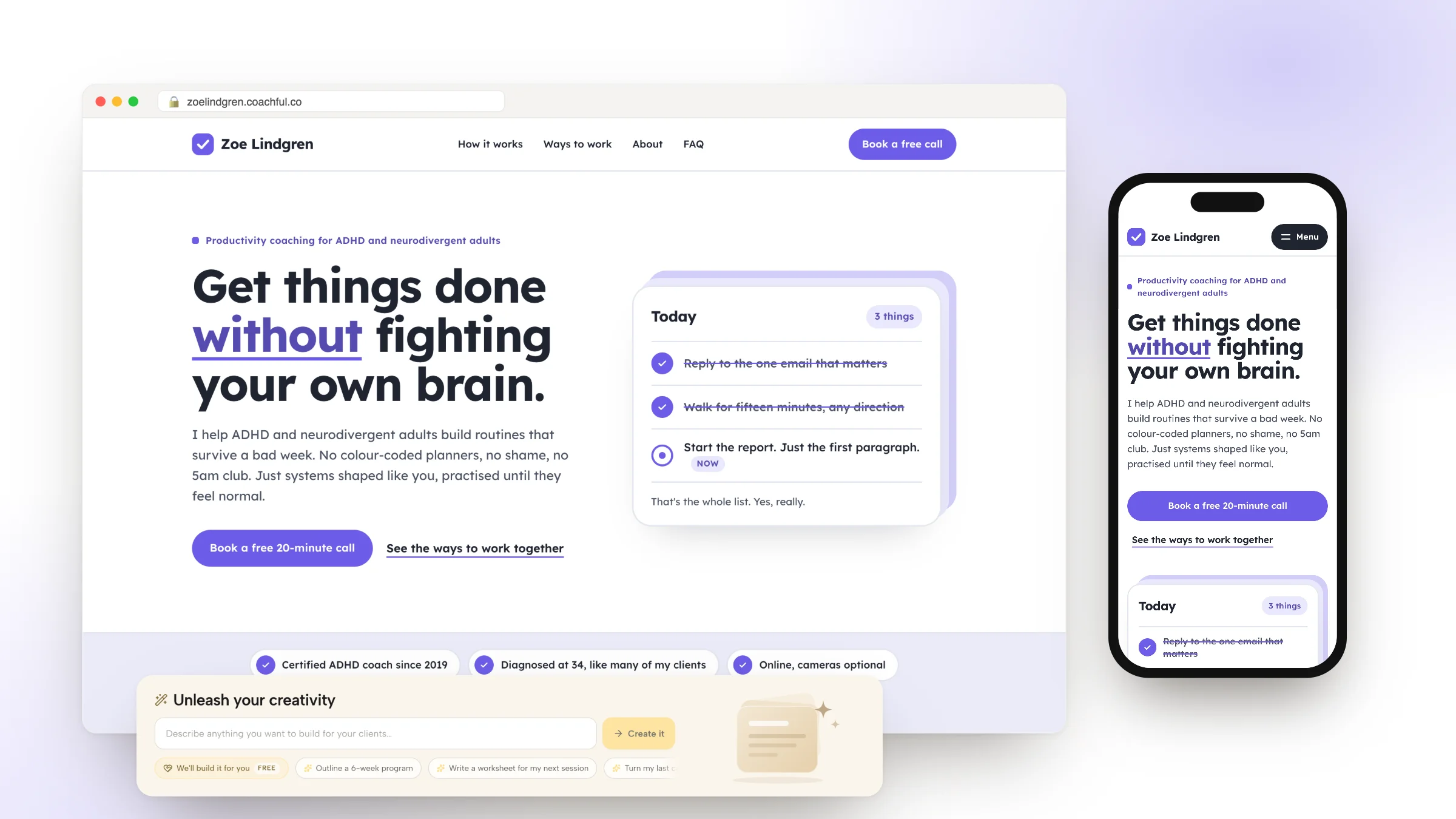
The most important things to know before becoming an ADHD coach: many of your clients will be adults diagnosed recently, often carrying years of shame; some will miss sessions, so your policies need to be firm and kind at once; medication and co-occurring conditions will come up, and they belong to clinicians; and the person paying, a parent for example, isn't always the person you coach. The demand is real and the competition is still light, but the business only works if you design it around how your clients' brains actually work, and often how yours does too.
These are the lived-experience notes that sit beside our guides on how to become an ADHD coach (training, a typical client week, scope) and ADHD coach certification (PAAC, ICF and the programs). If admin is your weak spot, Coachful's team will build your ADHD coaching website for free on every plan, as item 9 explains.
The 9 things at a glance
- Many clients are newly diagnosed adults, and the market is bigger than it looks.
- Lived experience is an asset with a trap built in.
- Clients will miss sessions, so write policies that are kind and firm.
- Shame shows up before strategy.
- Medication and co-occurring conditions will come up, and they aren't yours to manage.
- Price the between-session contact, because that's where the value is.
- Body doubling is popular, and the evidence is still early.
- The payer and the client are often different people.
- Your own admin has to be ADHD-proof.
1. Many clients are newly diagnosed adults
A CDC survey published in 2024 estimated that 15.5 million US adults, about 6 percent, had a current ADHD diagnosis, and that 55.9 percent of them were diagnosed at 18 or older. It also found that 36.5 percent were receiving no ADHD treatment at all, and that almost half had used telehealth for ADHD care (CDC MMWR, 2024, self-reported data from late 2023).
That shapes who walks through your door. A 38-year-old who was diagnosed last spring often arrives with two things at once: relief that there's an explanation, and grief or anger about the years spent thinking they were lazy. Their first need may be understanding their own patterns rather than a productivity system.
Coachful's 2026 Coaching Business Report rates ADHD and neurodivergent coaching as medium to high on income, low on saturation and medium on difficulty to enter, which makes it one of the few niches with real demand and light competition. What to do: make your first sessions about how this client's attention, energy and motivation actually work, before you install anything. Our consumer guide to ADHD coaching shows how clients see the service.

2. Lived experience is an asset with a trap built in
The same report notes that in this niche "lived experience counts as qualification." Many ADHD coaches have ADHD themselves or raised a child who does, and clients trust them faster because of it. You know what it's like to lose a morning to one email.
The trap is that your workarounds feel like the answer. The timer method that saved your career may be useless to a client whose problem is starting rather than stopping, or whose bad days are about sleep. ADHD varies a lot from person to person, so a coach who hands every client the same system will help some and quietly fail the rest.
There's also the question of how much to share. A sentence of "I've been there" builds trust. Ten minutes on your own story turns the session into yours.
What to do: treat each strategy as an experiment the client runs for a week, then review it together, and keep a library of options rather than one method. Share your own experience briefly and only when it helps the client see a possibility.
3. Clients will miss sessions
Time blindness, a forgotten reminder or a day that went sideways means some clients will miss sessions or arrive late, and some will feel so embarrassed about it that they disappear for weeks. If your policy is "missed sessions are forfeited, no exceptions," you'll lose good clients. If your policy is "no problem, rebook whenever," your calendar and income fall apart.
Most ADHD coaches end up somewhere in between: reminders by more than one channel, a grace allowance (say, one free reschedule a month), and prepaid packages so a missed session doesn't mean a missed payment. The important part is saying it warmly and in writing at the start, so the policy never feels like a punishment.
What to do: send reminders on the channels the client actually checks. Coachful sends email reminders, plus SMS at 24 hours and WhatsApp at 1 hour once messaging is enabled. Take payment for packages up front, and write the grace rule into your agreement. Our guide to preventing no-shows has more options.

4. Shame shows up before strategy
Many adults with ADHD have heard some version of "you're so smart, if only you tried harder" for decades. By the time they hire a coach, a missed task doesn't feel like a missed task. It feels like proof. That's why a client may hide that they didn't do the week's action, cancel rather than admit it, or over-promise in the session to make up for it.
Coaching that ignores this tends to stall. A session that opens with "did you do it?" becomes a test. A session that opens with "what got in the way, and what did you notice?" becomes data.
What to do: set the tone in the first session: slips are information, not failure. Celebrate small wins on purpose, because clients often discount them. Keep actions tiny enough to succeed on a bad day. If shame looks more like depression, with low mood that lasts, hopelessness or withdrawal, that's a reason to suggest a therapist alongside coaching. In Coachful, the Focus & ADHD power-up's Today board includes a wins jar for exactly this kind of evidence.
5. Medication and co-occurring conditions will come up
Your clients' treatment will affect your sessions. The same CDC report found that 71.5 percent of adults taking stimulants had trouble filling a prescription in the past year because the medication was unavailable. A client whose prescription ran out mid-month may have a very different week from the one you planned, and they may ask what you think about their dose or a switch.
That question isn't yours to answer. Diagnosis and medication belong to the prescriber, and you should never suggest starting, stopping or changing it. ADHD also often co-occurs with other conditions, such as anxiety, depression, sleep problems and learning disorders (NIMH), which need their own care.
What to do: help the client prepare for appointments (what they noticed, what they want to ask), adjust the plan for a rough medication week without judgment, and keep a referral list for psychiatrists, psychologists and therapists. The scope table in our guide on becoming an ADHD coach sets out who does what.
6. Price the between-session contact
The value of ADHD coaching is often in the small touches between sessions: the morning check-in, the "I'm stuck" message answered within the hour, the weekly two-minute review. New ADHD coaches tend to price the session and give the rest away, then find themselves answering messages all evening.
Coachful's report has no ADHD-specific rate. The closest benchmark is life coaching, at $75 to $200 an hour (PayScale and practitioner reports), but an hourly comparison undersells a service with daily contact. Most ADHD coaches price a monthly package that includes a set number of sessions and defined between-session support. Insurance rarely covers coaching, so assume clients pay directly; our sibling article on whether ADHD coaching is covered by insurance covers HSAs and the exceptions.
What to do: write down what the package includes between sessions and when you reply (for example, weekdays within four hours). Use structured check-ins so the contact is predictable for both of you. Our piece on the ADHD accountability check-in has a format that keeps it short.

7. Body doubling is popular, and the evidence is still early
Body doubling, working alongside another person, live or on video, so it's easier to start and keep going, is one of the most requested things in ADHD coaching. Many clients swear by it, and group focus sessions are an easy offer to run.
Be careful how you sell it, though. Research on body doubling as a technique is early: the published work so far is mostly surveys of how people use it and small pilot studies, rather than controlled trials. That doesn't mean it doesn't help. It means you should present it as something to try and evaluate, not as a proven treatment, and you shouldn't build your whole offer on a claim you can't back.
What to do: offer body doubling as one tool, ask clients to rate how it worked after a few sessions, and drop it for anyone it doesn't help. In Coachful, the Focus & ADHD power-up's ADHD edition starts with 15-minute timers, body doubling, a two-minute first step and an energy log, alongside a Break it down tool with an "I'm stuck" button and routine checklists built from habits.
8. The payer and the client are often different people
If you coach students and young adults, a parent will very often find you, book the call and pay. That creates questions that adult life coaching rarely raises. What will you tell the parent? What happens when the student doesn't want coaching at all? Who decides the goals?
With minors, consent and safeguarding come first: the parent or guardian agrees to the coaching, and the young person should agree too. With adult students, the client is the student even if the parent pays, which means session content stays with the student unless they choose to share it.
What to do: hold a three-way first meeting, agree in writing what the parent will hear (attendance and general progress, for example) and what stays private, and check the student actually wants to be there. Our guides to becoming an executive function coach and executive function coaching go deeper on student work and the parent conversation.

9. Your own admin has to be ADHD-proof
Plenty of ADHD coaches have ADHD, and the business side can be brutal: invoices not sent, follow-ups forgotten, a notes system that lives in four places, a website half-built for a year. Clients notice when the person coaching their systems doesn't have one, and you'll feel it in your income.
The fix is the same one you'd give a client: fewer places, fewer decisions, more automation. One tool for booking, payment, notes and client messages. Packages paid up front so nothing needs chasing. An email sequence that welcomes new leads without you remembering to.

Hand over the website
Coachful's team builds coaching websites, funnels and program pages for free on every plan, inside your account, so the half-built site can stop being a project. Coachful itself is a paid subscription with a free trial. Choose We'll build it for you · FREE under Create, or Fill in a form on the Website page, and describe what you want. Add up to 8 links and 10 files. The team replies by email with next steps, usually within about 24 hours, which is typical rather than guaranteed, and invents nothing: no credentials, testimonials or prices you haven't given. See what the free build covers. The Coachful page for ADHD coaches shows the rest of the setup, and our roundup of software for ADHD coaches compares the options.

The bottom line
ADHD coaching combines strong demand with light competition, which is rare. The coaches who last design for reality: newly diagnosed adults who need understanding before systems, missed sessions handled with warmth and rules, shame treated as part of the work, medication left to prescribers, between-session support priced properly, body doubling offered honestly, and a business run on as few moving parts as possible. If you're weighing the niche, our guide to signs someone needs an ADHD coach shows what clients are looking for when they search.
Frequently asked questions
What should I know before becoming an ADHD coach?
Know that many clients are adults diagnosed recently, that missed sessions are common so policies need to be both kind and firm, that medication and co-occurring conditions belong to clinicians, and that a lot of the value sits in short contact between sessions, which you should price into your packages.
Do you need ADHD to be an ADHD coach?
No. Many ADHD coaches have ADHD or parent a child who does, and Coachful's report notes that in this niche lived experience counts as qualification. Training still matters, because ADHD varies so much that one person's strategies won't fit every client.
Are ADHD coaches in demand?
Yes. A 2024 CDC report estimated 15.5 million US adults have a current ADHD diagnosis, more than half diagnosed as adults, and about a third receive no treatment. Coachful's report rates the niche low on saturation and medium to high on income.
Can an ADHD coach talk about medication?
An ADHD coach can help a client prepare questions for their prescriber and plan around a difficult week, but should never advise starting, stopping or changing medication. That decision belongs to the client and their doctor or nurse practitioner.
How much do ADHD coaches charge?
Coachful's 2026 report has no ADHD-specific figure. The closest benchmark is life coaching at $75 to $200 an hour. Many ADHD coaches sell monthly packages that include sessions plus defined between-session support, paid directly by the client or a parent.
Does body doubling work for ADHD?
Many people with ADHD find it helpful, but research is early, mostly surveys of how people use it and small pilot studies. Coaches should offer it as one tool to try and evaluate rather than a proven treatment.
Will Coachful build my ADHD coaching website for free?
Yes. Coachful's team builds coaching websites and funnels for free on every plan, inside your own account. Coachful is a paid subscription; the build costs nothing extra. Request it from Create or the Website page, and the team replies with next steps, usually within about 24 hours.












