
Can a Therapist Be a Life Coach? Licenses, Ethics and Setup
Yes. Can a therapist be a life coach? Licensed therapists, counselors, psychologists and social workers can add coaching to their work, and many do. The catch is that licensing boards judge the service, not the label: if what you call coaching is really therapy, it can be treated as practice under your license, with everything that comes with it. Done well, it takes a clear scope, separate agreements and records, precise marketing and insurance that covers the coaching.
This guide is for clinicians weighing that move. It covers where the line sits, what your license means when you coach, the ethics of holding two roles, a setup checklist, and how to use clinical skills without slipping back into treatment. It isn't legal advice; the rules are state by state, so confirm the details with your board and, where money or risk is significant, a lawyer.
Can a therapist be a life coach? The quick answer
| Question | Short answer |
|---|---|
| Can a licensed therapist offer life coaching? | Yes. No license is needed to coach, and having one doesn't stop you. |
| Does my license apply when I coach? | It can. Boards look at what you actually do. Ask yours how it treats coaching by a licensee. |
| Can I coach clients in states where I'm not licensed? | Genuine coaching isn't licensed, but anything clinical would be. Keep that work strictly non-clinical, and check if unsure. |
| Can I coach my current therapy clients? | Approach with caution. Two roles with one person is a multiple relationship under most codes. |
| Can I bill insurance for coaching? | No. Coaching isn't a billable health service. Therapy billing stays with therapy. |
| Does my malpractice policy cover coaching? | Not necessarily. Ask your insurer in writing. |
| Do I need a coaching credential? | Not legally. Coach training helps with the different stance, and some buyers ask for it. |
Where coaching ends and therapy begins
For a licensee, the distinction has to be sharper than the one most coaches use, because you have more to lose if it blurs. A practical way to draw it:
| Your therapy practice | Your coaching practice | |
|---|---|---|
| Purpose | Assess, diagnose and treat a mental health condition | Help a functioning client reach goals they set |
| Who it's for | People with symptoms that affect daily life | People who are broadly well and want change |
| Starting point | Intake, assessment, diagnosis, treatment plan | Screening for fit, a coaching agreement, goals |
| Records | Clinical records under your profession's rules | Coaching notes, kept separately |
| Payment | Insurance or self-pay, with clinical billing rules | Self-pay or employer-paid only |
| Marketing | Your license, specialties, conditions treated | Outcomes and goals, never symptoms or treatment |
| When things get clinical | That's the work | Pause and refer, including back to therapy elsewhere |
The line is genuinely contested. A Stanford psychiatrist writing in Perspectives on Psychological Science argued that the distinctions often drawn between life coaching and psychotherapy "are increasingly blurry" and risk confusing vulnerable patients (Aboujaoude, 2020). Clinicians who coach are often the people best placed to keep it clear. Our guide to life coach vs therapist sets out the client-facing version.

What your license means when you coach
Two official sources show why the label "coaching" doesn't settle anything on its own.
California's Board of Behavioral Sciences, which licenses marriage and family therapists, clinical social workers and professional clinical counselors, says its practice acts "do not discuss life coaching," that life coaches "are not regulated by any governmental entity," and that they "are prohibited from practicing in the scopes of practice" of the board's licensed professions (California BBS). In other words, the test is what the service is.
Some statutory definitions of clinical practice are broad enough to overlap with coaching language. Minnesota defines the practice of psychology to include "enhancing interpersonal relationships, work, life and developmental adjustment" and "personal and organizational effectiveness" (Minnesota Statutes 148.89). Those are phrases many coaches would happily put on a homepage.
What that means for you:
- Ask your board. California's board discussed life coaching at committee meetings in 2022 and 2023 and considered a consumer guide; many boards have said nothing at all. A written question is cheap insurance.
- Assume your professional duties don't switch off. If a coaching client discloses something that would trigger a duty as a clinician, get advice on your obligations before you need it.
- Keep clinical work out of coaching completely, especially with clients in states where you aren't licensed. If a coaching client needs treatment, refer them to a clinician licensed where they live.
- Don't use coaching to work around licensure, such as "coaching" someone through depression in a state you can't practice in. That is the scenario boards worry about.
Our guide to whether you need a license to be a life coach covers the general rules for coaches without a clinical license.
The ethics of holding two roles
Your profession's code (the APA, ACA, NASW or AAMFT code, depending on your license) has rules on multiple relationships and on representing your services accurately. Coaching's main ethics code points the same way. The ICF Code of Ethics, current since April 2025, asks coaches to consider "the implications of having multiple agreements and relationships," and to disclose to clients when they act in a role other than coach, giving "therapist" as an example. It also requires coaches to "accurately identify my coaching qualifications" (ICF Code of Ethics). The ICF's 2025 Core Competencies add that a coach "maintains the distinctions between coaching, consulting, psychotherapy and other support professions" and "refers clients to other support professionals, as appropriate."
In practice, the hardest cases are the crossovers:
- A current therapy client asks for coaching. Switching the label midstream, for example because coaching is cheaper or not insured, is the riskiest move. If the clinical work isn't finished, keep it therapy.
- A former therapy client wants coaching. Check what your code says about post-therapy relationships, document the change of role and the reasons, and consider whether a different coach would serve them better.
- A coaching client starts to sound clinical. Pause, name it, and refer. Don't quietly start treating them under a coaching agreement.
Our operations guide, how to keep therapy and coaching separate in one practice, covers intake, records, packages and communication channels for dual practitioners in detail, so this page won't repeat it.

A setup checklist for therapists adding coaching
- Write your scope down. One paragraph on what your coaching covers and doesn't, used everywhere: website, agreement, discovery call.
- Screen at intake. A few questions that flag current treatment, recent crises or symptoms that point to therapy rather than coaching.
- Use a coaching agreement, not your therapy consent form. State that coaching isn't therapy or health care, how confidentiality works, fees, cancellations, and what happens if clinical concerns come up. Our coaching agreement template is a starting point.
- Separate the records. Keep clinical records in a system that meets your clinical obligations. If you bill insurance electronically for therapy, you are a HIPAA covered entity: CMS says "providers who submit HIPAA transactions, like claims, electronically are covered" (CMS).
- Separate the offers and the billing. Coaching is self-pay or employer-paid. Never put a diagnosis on a coaching invoice. Our guide to whether coaching is covered by insurance explains why.
- Check your insurance. Ask your professional liability insurer whether coaching is covered, and get the answer in writing. Our life coach insurance checklist lists the questions.
- Market precisely. You can mention your license as background ("licensed therapist for 12 years"), but don't imply your coaching is therapy, and don't list conditions you "treat" on a coaching page.
- Have a crisis plan. Know what you'll do, and where you'll refer, if a coaching client is at risk. In the US, 988 is the Suicide and Crisis Lifeline.

Using clinical skills well as a coach
Therapists bring real advantages to coaching: listening, pattern-spotting, comfort with emotion, and knowing when someone needs more than coaching. The adjustment is mostly one of stance. Coaching starts from the client as the expert on their life, works forward from goals rather than back from symptoms, and leaves the plan in the client's hands; the ICF's competencies describe a coach who "acknowledges and supports client autonomy in the design of goals, actions and methods of accountability."
Habits that help clinicians make the switch:
- Ask about the next step before the history. If you notice yourself formulating, that's your cue.
- Agree goals in the client's words and review them every few sessions.
- Offer observations, not interpretations, and check what the client makes of them.
- Get coach training or mentor coaching if you want feedback on coaching itself. Clinical training is excellent preparation, but it isn't the same skill set.
- Keep a trauma-informed lens without doing trauma work. Our guide to trauma-informed coaching covers the boundary.
On costs: if you are already a licensed therapist, coach training may count as improving skills in your present work rather than qualifying you for a new trade. IRS Publication 970 uses a psychiatrist training in psychoanalysis as an example of education that doesn't qualify someone for a new profession (IRS Publication 970). Whether your coach training is deductible depends on your situation; our guide to whether coaching is tax deductible explains the test, and a tax professional can apply it.

Where Coachful fits, and where it doesn't
Coachful is built for the coaching side of a dual practice. It is not HIPAA-certified, so keep therapy records and insurance billing in a clinical system that meets your obligations. For the coaching practice, a Coachful membership includes intake and screening forms, coaching agreements sent for e-signature before the first session, booking, self-pay packages and payment plans through your own Stripe or Razorpay account with a 0% Coachful platform fee, programs with habits and check-ins, and a coaching website with legal pages that is separate from your therapy site. The contracts and forms pages show the detail, and the Coachful page for life coaches shows the full setup.
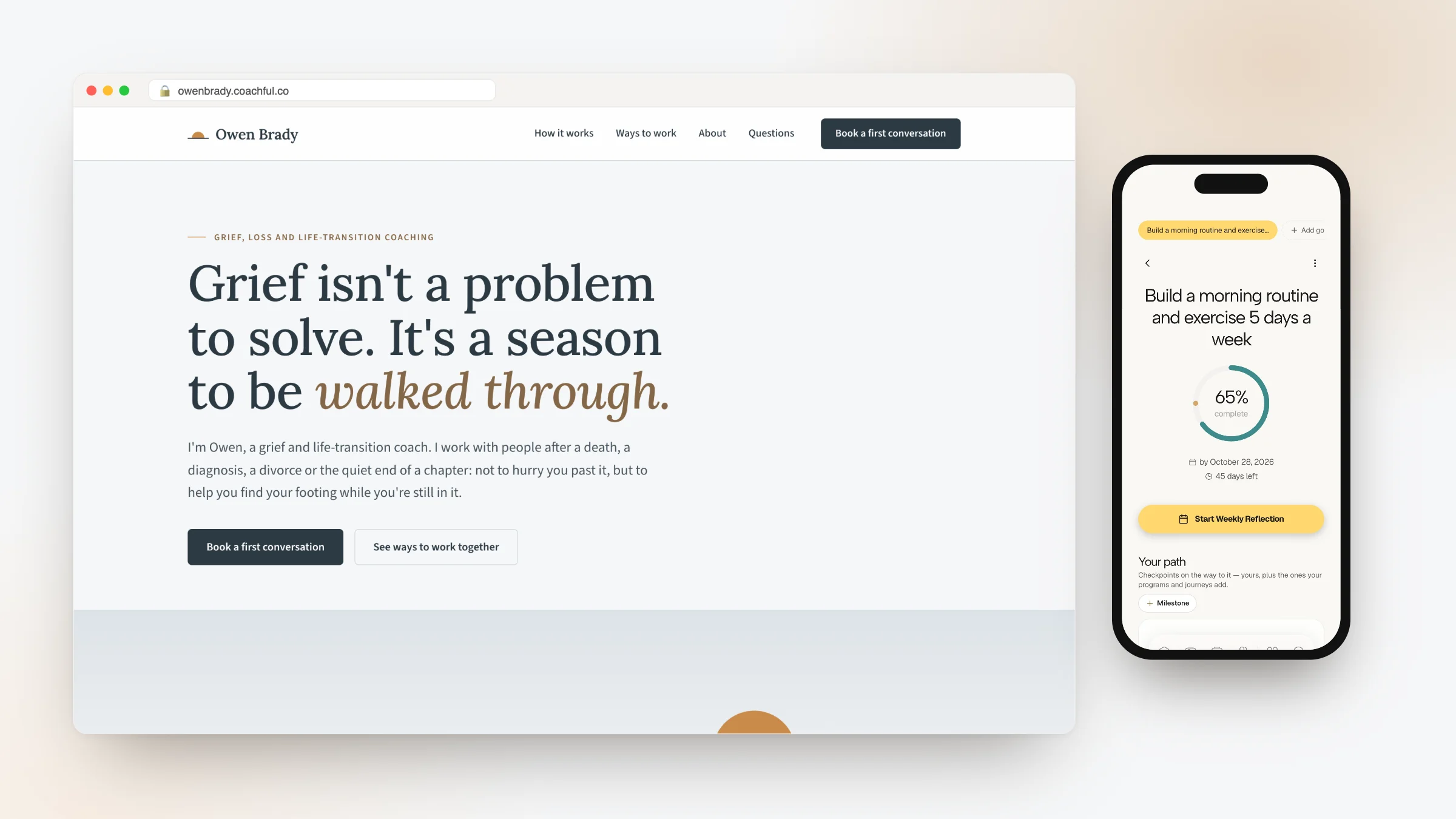
A coaching site, built for you. Coachful's team builds websites, funnels, offer pages and programs inside your account for free on every plan. One recent request came from a psychologist-turned-coach working on emotional eating: the team built a new homepage with three clear paths (book a call, join the free community, enroll in the program) and a free-community funnel that delivers a guide. To ask, click Fill in a form on the "Want us to build it for you?" card on Website, or choose We'll build it for you · FREE under Create, and attach up to 10 files and 8 links. The team replies by email, usually within about 24 hours, which isn't guaranteed. It doesn't invent credentials, testimonials or prices, and it doesn't design logos, film videos or run ads. See what the free build covers.


Frequently asked questions
Can a licensed therapist do life coaching?
Yes. Coaching doesn't require a license, and holding one doesn't prevent you from coaching. Because boards judge the service rather than the label, keep coaching clearly non-clinical, with its own agreement, records and marketing, and check how your board treats coaching by licensees.
Can a therapist coach clients in other states?
Genuine coaching isn't a licensed activity, so it can cross state lines. Clinical work can't follow it there. Keep coaching with out-of-state clients strictly non-clinical, and refer anyone who needs treatment to a clinician licensed where they live.
Can a psychologist be a life coach?
Yes, and many are. Some state definitions of practicing psychology are broad, such as Minnesota's, which includes enhancing life adjustment and personal effectiveness. Ask your board how it views coaching by a licensed psychologist before you market it.
Can I be both a client's therapist and their coach?
It's risky and usually best avoided at the same time. Two roles with one client is a multiple relationship under most professional codes, and the ICF Code of Ethics asks coaches to disclose when they act in another role, such as therapist. Finish or transfer the therapy first.
Do therapists need a coaching certification?
Not legally. Clinical training covers a lot, but coaching uses a different stance, client-led and goal-focused. Coach training or mentor coaching helps with that shift, and corporate buyers sometimes ask for an ICF credential.
Does my therapist malpractice insurance cover coaching?
Not automatically. A policy defines which professional services it covers, and coaching may not be among them. Ask your insurer in writing whether coaching is included, or whether you need an endorsement or a separate policy.
Can therapists bill insurance for coaching?
No. Coaching isn't a billable health service, and putting a diagnosis on a coaching invoice can create serious problems. Bill therapy as therapy, and keep coaching self-pay or employer-paid.
Will Coachful build my coaching website for free?
Yes. Coachful's team builds websites, funnels, offer pages and programs for free on every plan, inside your own account. Fill in the form from Website or Create, and the team replies by email, usually within about 24 hours. Coachful itself is a paid membership with a free trial.












