
How to Become an Online Fitness Coach: Certification and Pay
Online fitness coaching is personal training with the gym taken away, so the path has two halves. To work out how to become an online fitness coach, start with the training half: earn a personal trainer certification with an accredited exam and get good at coaching the people in front of you. Then the online half: choose a model (app-delivered programs, live video sessions or a hybrid) and set up a way to deliver workouts, track progress and take payment. Personal training isn't a licensed profession in most places, but employers and serious clients expect certification, and the Bureau of Labor Statistics notes that trainers usually must be certified before they work with clients.
Online changes more than the location: you can't spot a lift, you see form on a phone screen, and your clients train when you're not there. This guide covers your niche, the certification choice, scope, business models and what they pay, a first 12-week program, the tools and the first clients. When you're ready to launch, Coachful's team will build your fitness coaching website for free on every plan.
What changes when you coach fitness online
| In person | Online | What you need instead |
|---|---|---|
| You watch every rep | You watch a few filmed sets a week | Clear video instructions and a habit of asking for form checks |
| You adjust on the spot | You adjust between sessions | Workout logs with sets, reps and how hard it felt |
| The gym has the equipment | Every client has different equipment | An intake on equipment, space and schedule, and substitutions in the plan |
| The appointment creates the habit | The client has to show up alone | Reminders, check-ins and someone who notices a missed week |
| Clients are local | Clients can be anywhere | Time zones, currencies and a clear emergency plan for each client |
If you already train people in person, the move is mostly about systems. Our guide to moving in-person training clients online covers the transition step by step.

Choose who you'll train before you choose a platform
Online, you compete with every free workout video ever posted, so "fitness coaching" alone won't sell. A specific person with a specific constraint will:
- Parents with 30 minutes and a pair of dumbbells at home.
- Adults over 50 who want to stay strong enough to lift grandchildren and suitcases.
- Runners training for a first half marathon on four days a week.
- Women returning to training after pregnancy, with their clinician's go-ahead.
- Desk workers whose backs ache by Thursday.
The niche decides the specialty course you take, the equipment you program for and the content you post. It also makes referrals easier, because people can describe you in one sentence. If you're unsure, our list of coaching niches and the guide to testing a niche with a paid pilot will help you choose.
Step 1: Get a certification with an accredited exam
The BLS says personal trainers usually must be certified before they begin working with clients, and that most also need CPR, first aid and AED training. The detail that matters when you compare courses is whether the exam is accredited by the National Commission for Certifying Agencies (NCCA). Two examples, as each provider published them in October 2026:
| NASM Certified Personal Trainer | ACE Personal Trainer | |
|---|---|---|
| Exam accreditation | NCCA-accredited | The included certificate exam is non-accredited; the NCCA-accredited proctored exam is an add-on, listed at $99 |
| Exam format | 120 questions, closed book, proctored online or in person, two hours | Accredited exam: 150 questions, three hours, proctored in person or remotely |
| Prerequisites | High school diploma or GED; current CPR and AED before the exam | Accredited exam: age 18+, high school diploma or equivalent, adult CPR/AED with a hands-on skills check |
| Study time | NASM says many finish in four to six weeks at 10 to 15 hours a week | ACE says most people study for three to six months |
The ACE detail is a good example of why you read the small print: a certificate from a non-accredited exam may not satisfy a gym or an insurer that asks for an NCCA-accredited credential. Whatever you choose, pick the accredited exam. Then add a specialty that matches your clients, such as strength for older adults, pre- and postnatal training or endurance.
Step 2: Know your scope as a fitness coach
- Screen before you program. Use a readiness questionnaire such as the PAR-Q+ and ask about injuries, surgeries, medications and pregnancy. When the answers say so, ask for medical clearance first.
- Don't diagnose or rehab injuries. Pain that changes how someone moves goes to a physical therapist or physician. You can train around it with their guidance.
- Nutrition has limits. General healthy-eating guidance is usually fine; individualized plans for medical conditions often belong to licensed dietitians. Our sibling guide on becoming a nutrition coach explains the line.
- Have an emergency plan per client. You're not in the room. Know their location and who to call.
Step 3: Pick your online coaching model
The model decides your income ceiling and how your week feels. Coachful's 2026 Coaching Business Report gives two useful price anchors from practitioner reports: app-based programs with a weekly coach check-in at $17 to $149 a month, and ongoing monthly coaching with sessions and messaging at $300 to $700 a month.
| Model | What the client gets | Trade-off |
|---|---|---|
| Program only | A written program in an app, updated monthly | Low price, needs many clients, high churn |
| Program plus check-ins | Program, weekly written check-in, form reviews | The most common online model; scales to dozens of clients |
| Live 1:1 video | Two or three live sessions a week | Highest price per client, fewest clients, fixed hours |
| Small group | Live group classes plus a shared program | Good income per hour, needs an audience to fill |
We compared the first two in detail in app-only vs live-call pricing for online fitness coaching.

What online fitness coaches earn
Coachful's rates data has no coach figure specific to fitness. The closest public number is for an adjacent, mostly employed occupation: the BLS reports a median of $47,160 a year for fitness trainers and instructors in May 2025, across 388,400 jobs, with 7 percent growth projected from 2025 to 2035. That is a salary for gym and studio employees, not the income of a self-employed online coach, which depends on your model and client count. The arithmetic for a check-in model:
| Clients | At $149 a month | At $300 a month | At $500 a month |
|---|---|---|---|
| 10 | $1,490 | $3,000 | $5,000 |
| 25 | $3,725 | $7,500 | $12,500 |
| 40 | $5,960 | $12,000 | $20,000 |
Monthly revenue before costs and payment processing; price points drawn from the ranges in Coachful's 2026 Coaching Business Report.
Forty check-in clients is a full week of work for one coach, so plan the hours as well as the income. Our sibling piece on online fitness coach salary goes further into the numbers, and how many clients make a full roster helps with capacity.
Step 4: Build your first 12-week program
Start with one program for one kind of client, and run it before you sell it widely. A shape that works for busy adults:
- Week 1: intake, a baseline test (for example a set of push-ups, a timed walk or run, a simple squat test), and three sessions a week of 45 minutes.
- Weeks 2 to 4: the first block, with progression written into the plan.
- Week 5: retest and adjust.
- Weeks 6 to 8 and 9 to 11: two more blocks, each retested at the end.
- Week 12: final test, a comparison with week 1, and the offer for the next block.
Pair the workouts with two or three daily habits (steps, protein at breakfast, a bedtime) and a weekly check-in with a few questions. Our step-by-step guide to creating an online fitness coaching program has the full template.

Step 5: Set up the tools
An online fitness business needs a place for programs and logs, a way to talk, check-ins, progress tracking, booking and payments. In Coachful, all of it is included in your membership, and the Fitness & Nutrition power-up adds the training-specific parts:
- A workout builder with an exercise library and supersets, circuits, AMRAP, EMOM and intervals.
- Workout logging by the client, with set history you can review.
- Nutrition targets up to calories and macros, meal plans, recipes and food lookup.
- Private progress photos and measurements.
Around it: a client app on iPhone and Android, habits with reminders, check-ins, group programs with a community feed, booking with reminders, and payments through your own Stripe or Razorpay account with a 0% Coachful platform fee, including monthly subscriptions. One honest limit: Coachful doesn't sync with wearables, Apple Health or Health Connect, so clients log workouts in the app. More on the Fitness & Nutrition page and the Coachful page for fitness coaches, or compare options in our roundup of fitness coaching software.


Get your fitness coaching website built for free
Many online fitness coaches sell from Instagram or TikTok, so the website's job is to turn a profile visit into a consult or a purchase. Coachful's team builds it for free on every plan, inside your account: a homepage, a programs page, a coach page, a booking or checkout page and your link-in-bio page. Coachful itself is a paid subscription, and you can start with a free trial.

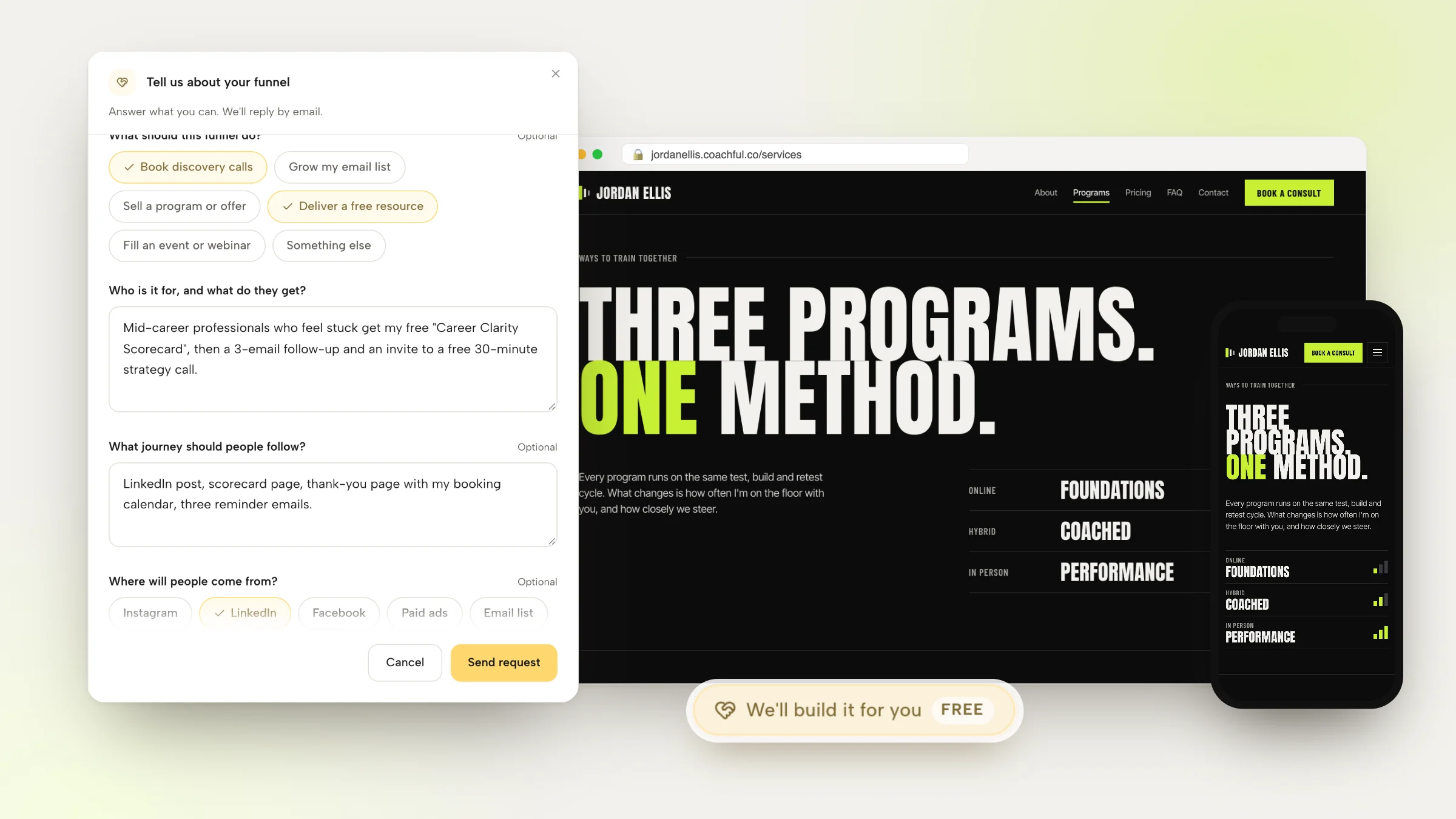
Click Fill in a form on the "Want us to build it for you?" card on the Website page, or choose We'll build it for you · FREE under Create. Tell the team the pages, what they should do and where your traffic comes from; add up to 8 links and up to 10 files such as photos and your logo. Video files aren't accepted, and the team doesn't film your exercise demos. They reply by email with next steps, usually within about 24 hours, typical rather than guaranteed.
A recent build for a business mentor who sells on Instagram shows the pattern: a sales page and checkout for a 12-week mentorship, a lead-magnet funnel that now leads into the sales page, and rewritten follow-up emails, with the design taken from the coach's own guide PDF. Nothing is invented, including transformations you haven't documented. Here's everything the free build covers.
Step 6: Get your first online clients
- Move one or two in-person clients online at a lower rate in exchange for honest feedback on the experience.
- Pick one platform and post for one person. "Strength for desk workers over 40" earns follows that turn into clients; generic workout clips mostly don't.
- Show the process, not only results. A week of a client's program, their logged sessions and what you changed after the check-in.
- Run a short challenge with a clear start date, then invite finishers into the full program. Our five-day challenge funnel guide shows the setup.
- Put everything behind one link. A link-in-bio page that books consults and sells the program in one tap.

Frequently asked questions
Do you need a certification to be an online fitness coach?
Most places have no license for it, but certification is the norm. The BLS says personal trainers usually must be certified before working with clients. Choose a certification with an NCCA-accredited exam and keep CPR and AED current.
Which personal trainer certification is best for online coaching?
Any certification with an NCCA-accredited exam covers the fundamentals. NASM's CPT exam is NCCA-accredited; ACE's accredited exam is a separate proctored add-on to its course. Add a specialty that fits your online clients.
How much do online fitness coaches make?
The BLS median for fitness trainers and instructors was $47,160 in May 2025, mostly employed roles. Online income depends on your model: 25 check-in clients at $300 a month is $7,500 a month before costs.
How long does it take to become an online fitness coach?
Certification takes four weeks to six months depending on the course and your pace. Most coaches then spend a few months coaching in person or with practice clients before launching an online program.
Can I be an online fitness coach part time?
Yes. A program-plus-check-in model fits around another job, because check-ins can be done at set times rather than live. Start with five to ten clients and one program.
Can online fitness coaches give nutrition advice?
General healthy-eating guidance usually, yes. Individualized nutrition plans for medical conditions are often limited to licensed dietitians, depending on the state. Screen at intake and refer when needed.
Will Coachful build my fitness coaching website for free?
Yes. Coachful's team builds coaching websites, sales pages and funnels for free on every plan. Fill in the form from the Website page or Create, and the team replies with next steps, usually within about 24 hours. Coachful is a paid subscription; the build costs nothing extra.












