
Life Coach for Young Adults: What It Helps With and Costs
A life coach for young adults helps people roughly 18 to 25 get through the launch years: staying in college or leaving it, choosing a direction, landing a first real job, moving out, handling money and building a routine that holds. At 18 or older you are the client, even if a parent pays. Coaching suits decisions and follow-through. It isn't the right first step for anxiety or depression, which are common at this age and need a licensed professional.
The psychologist Jeffrey Arnett gave this stretch of life a name in a 2000 paper: emerging adulthood, a period he placed between 18 and 29, marked by identity exploration, instability, self-focus, feeling in-between and a sense of possibility (emerging adulthood). Developmental psychologists still argue about whether it's a distinct stage. Anyone who has been 22 and unsure what comes next won't need convincing that it's a real experience. This guide covers what young adult coaching helps with, how it works when a parent pays, when to see a therapist or use campus services instead, what the evidence says, what it costs and how to find a coach.
What young adults bring to a life coach
The goals tend to cluster around a few decisions and a lot of follow-through:
- Direction. "I don't know what I want" is the most common opener. A coach turns it into experiments: three conversations with people in jobs you're curious about, one short course, one volunteer shift.
- College. Whether to switch majors, take a gap, transfer or leave, and how to finish once you've decided to stay.
- The first job. CVs, interviews, the first 90 days, and what to do when the job isn't what you hoped. Our guides to interview coaching and career coaching cover the specialist versions.
- Living independently. Rent, budgets, cooking, sleep, the admin nobody taught you.
- Getting things done. Procrastination and planning, often the hidden reason behind the other goals. See time management coaching.
- Confidence and people. Speaking up at work, making friends after college, dating, setting limits with family. Social skills coaching goes deeper on this.
A good coach at this stage asks more and tells less. You'll get further with "what did you learn from that interview?" than with a list of interview tips.

When a parent is paying
Many young adult clients are booked by a parent. That's fine, as long as everyone understands that the client is the young adult. At 18 the confidentiality belongs to them.
The International Coaching Federation's Code of Ethics calls the person paying a "sponsor" and asks coaches to agree with clients and sponsors, before coaching begins, on "what information is exchanged and how it is exchanged among all parties" (ICF Code of Ethics). In practice, a good arrangement looks like this:
| The parent who pays gets | The young adult decides |
|---|---|
| Invoices and the schedule | The goals |
| Confirmation that sessions are happening, if the young adult agrees | Whether anything from sessions is shared, and what |
| An optional review call with the young adult present | Whether to continue after the first package |
Parents: offer coaching as a resource, not a fix. A 20-year-old who was signed up without being asked tends to show up, nod and change nothing. A 20-year-old who picked their own coach from three discovery calls usually does the work.
Coach, therapist, campus services or mentor?
Young adulthood is the peak age for mental health struggles. In 2022, 36.2 percent of US adults aged 18 to 25 had a mental illness in the past year, the highest of any adult age group, and fewer than half of them, 49.1 percent, received treatment (NIMH). That isn't a reason to avoid coaching. It is a reason to pick the right kind of help first.
| Kind of help | Best for | Cost to you |
|---|---|---|
| Life coach | Decisions, plans and follow-through when you're basically steady | Paid, usually by the session or package |
| Therapist or counselor | Anxiety, depression, trauma, grief, substance use | Often partly covered by health insurance |
| Campus counseling and career center | Students: short-term counseling, career advice, CV reviews | Often included for enrolled students |
| Mentor | Advice from someone a few steps ahead in your field | Usually unpaid |
See a licensed professional when...
- Worry, low mood or panic is affecting your sleep, work or study most days.
- Drinking, drugs, gambling or gaming has started to cost you things you care about.
- You're dealing with trauma or a loss that isn't easing.
- You have thoughts of harming yourself. In the US, call or text 988 to reach the 988 Suicide and Crisis Lifeline; elsewhere, call your local emergency number.
Coaching can come later, or alongside therapy if your clinician agrees. Our guide to life coach vs therapist explains the difference.
What the evidence says about coaching at this age
The strongest study comes from college. Economists Eric Bettinger and Rachel Baker evaluated InsideTrack, a student coaching service, in a randomized experiment across public, private and for-profit universities. Students randomly assigned a coach, who contacted them regularly to clarify goals, connect daily activities to long-term goals and build skills like time management and self-advocacy, were more likely to persist during the coaching and more likely to still be enrolled a year after it ended. The authors also found coaching a more cost-effective way to raise retention than previously studied options such as extra financial aid (Bettinger and Baker, NBER working paper 16881, 2011).
Two caveats. Most participants were what the authors call non-traditional college students, not the typical 18-year-old freshman. And this was structured, proactive coaching aimed at one outcome, staying in school. Still, the mechanism, regular contact, clear goals and practical skills, is exactly what a good young adult coach provides. For life coaching more broadly, a randomized trial of a ten-week group program found gains in goal striving, well-being and hope (Green, Oades and Grant, 2006).

What a first three months might look like
Every coach works differently, but a sensible three-month arc for a 22-year-old who feels stuck might run like this:
| Weeks | Focus | What you'd actually do |
|---|---|---|
| 1 to 2 | The picture | Rate the main areas of your life, name what matters to you, pick one area to start |
| 3 to 6 | Experiments | Small, cheap tests: informational chats, a short course, a weekend project, an application or two |
| 7 to 10 | Routines | The habits the plan depends on: a sleep window, a weekly money check, protected job-search hours |
| 11 to 12 | Review | What worked, what you've learned about yourself, what you'll keep doing without a coach |
Coachful's Wheel of Life assessment covers the first step, and the SMART goal worksheet turns a vague wish into a goal you can test.

What a life coach for young adults costs
Coachful's 2026 Coaching Business Report has no figures for young adult coaching, so here are the life and career coaching benchmarks it does publish:
| What you buy | Typical price | Source |
|---|---|---|
| One life coaching session | $75 to $200 | PayScale and practitioner reports |
| Newer life coach, per hour | $50 to $100 | Practitioner estimate |
| Life coaching, three months, eight sessions | $1,200 to $2,500 | Practitioner reports and verified published rates |
| Group life coaching | $100 to $300 a month | Practitioner reports |
| Career coaching, single session | $99 to $280 | A marketplace's published rates |
| Job search sprint, four sessions | $500 to $1,000 | Practitioner reports |
US dollars, Q2 2026, from coachingrates.com and its career coaching page.
On a tight budget, a group program or a short sprint on one goal gets you most of the structure for less. Newer coaches often charge less while they build experience, and many are excellent with people close to their own age. Our guide on whether a life coach is worth it helps you decide.

How to choose a coach in your twenties
- Look for experience with your stage, not just your goal. Ask how many clients they've coached in the same situation.
- Ask how they'd structure the first month. You want a plan with check-ins, not open-ended chats.
- Ask about between-session support. Messages, reminders, a place to track goals. This is where most of the change happens.
- Check who you'd actually be talking to. Some programs sold by a well-known name are delivered by a team of junior coaches.
- Book two or three discovery calls. Choose the coach who asked the best questions, not the one with the best stories.
Watch for three red flags common in coaching aimed at young people: promises to "find your purpose" in a set number of days, income claims from hustle-style programs, and a pitch, partway through, to pay for a coaching certification so you can become a coach yourself. The US Federal Trade Commission notes that no one can guarantee you'll make a lot of money with little risk (FTC consumer alert). Our guide on how to find a life coach has the full set of questions to ask.
Find a life coach for young adults on Coachful
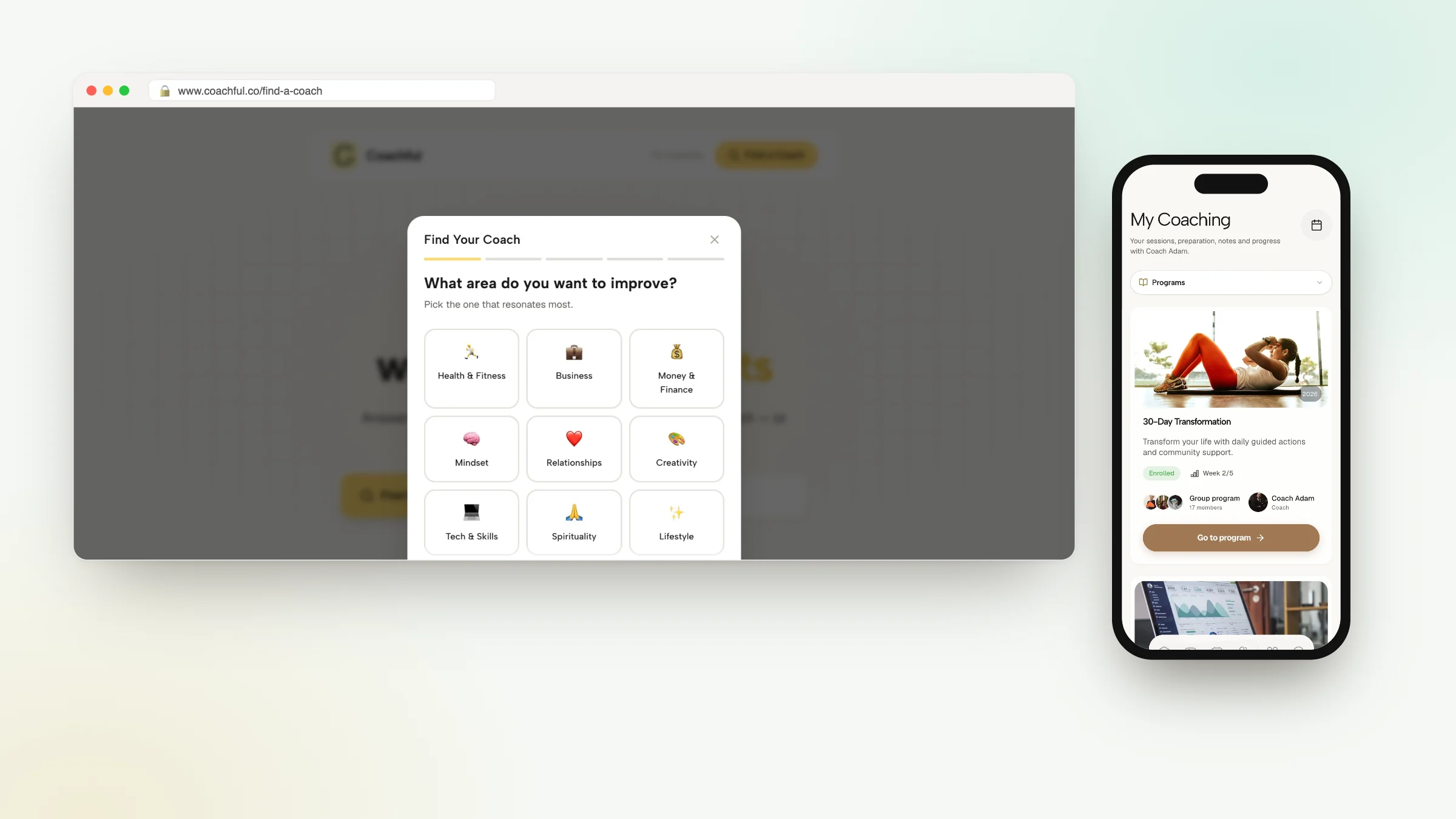
Coachful's Find a Coach directory is public, so you can browse without an account. Search "young adults", "college", "career" or "confidence" and it matches coaches whose headline or bio mentions them, or browse Mindset and Lifestyle. You can switch between browsing coaches and browsing their programs, which is the quickest way to find group options.

The Find My Coach quiz asks five short questions: the area you want to improve, where you are right now, your email, the coaching style you prefer and your monthly budget, from under $100 a month upward. It then suggests coaches. Profiles show each coach's background, credentials and method in their own words, their programs and prices, and a calendar for a discovery call or a form to send a message.

Are you a coach who works with young adults?
This age group finds coaches on their phones and decides fast, so your site needs one clear offer and an easy way to book. Our guide to becoming a life coach covers the setup, the Coachful page for career coaches covers first-job work, and Coachful's team will build your website for you at no extra cost through the free white-glove service.

Frequently asked questions
Is a life coach worth it for a young adult?
It can be, when you have a decision to make or a plan you keep not starting, and you're steady enough to act. A randomized study of student coaching found coached students were more likely to stay in college. If you're struggling with your mental health, see a licensed professional first.
What does a life coach for college students do?
They help with choosing or changing a major, planning study time, deciding whether to stay, transfer or take a break, and building the habits that get you through the year. Check what your college offers first: many have free counseling and career centers.
Can I hire a life coach for my adult son or daughter?
You can pay, but they need to choose it. At 18 or older they're the client, and what they discuss is confidential unless they agree to share it. The best approach is to offer to pay and let them pick the coach after a few discovery calls.
How much does a life coach for young adults cost?
Most life coaches charge $75 to $200 a session, and group life coaching usually runs $100 to $300 a month, according to Coachful's 2026 Coaching Business Report. Newer coaches typically charge $50 to $100 an hour.
Should I see a life coach or a therapist in my twenties?
See a therapist if worry, low mood, trauma or substance use is affecting your daily life; in 2022 more than a third of US adults aged 18 to 25 had a mental illness, according to NIMH. See a coach if you're basically steady and want help with decisions, plans and follow-through.
What age group is a young adult life coach for?
Most coaches who use the term mean roughly 18 to 25 or 18 to 30: the years of college, first jobs and first homes. Psychologist Jeffrey Arnett's idea of emerging adulthood covers 18 to 29.
Is group coaching good for young adults?
Often, yes. It costs less than one-to-one coaching, it puts you with people facing the same decisions, and the group adds its own accountability. Look for a program with a clear start, end and weekly structure.












