
9 Things to Know Before Becoming an Online Fitness Coach
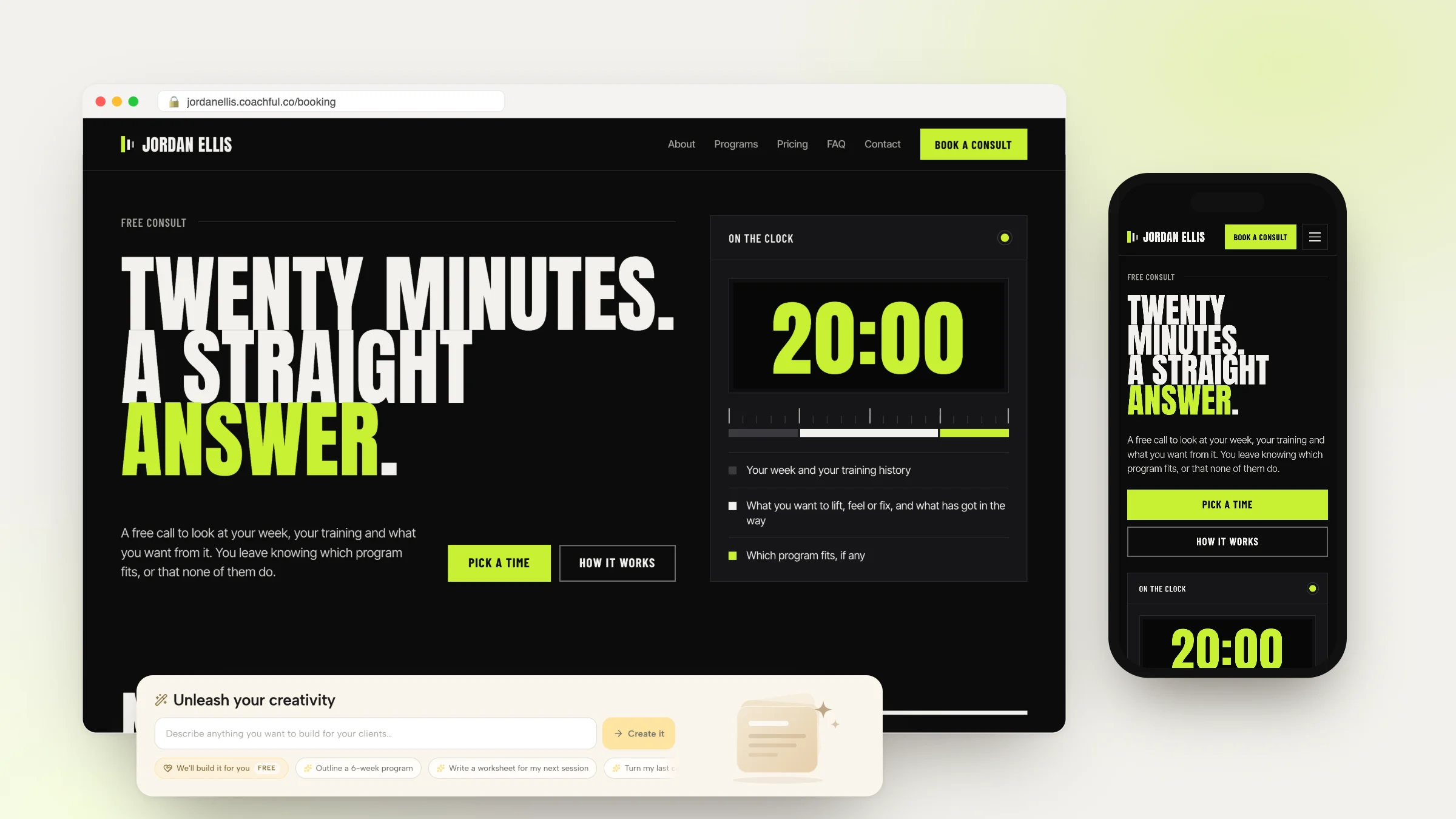
The big things to know before becoming an online fitness coach: the workouts are the easiest part of what you sell to copy, most of the coaching happens by message rather than on video, and your income is a monthly subscription, so keeping clients matters more than signing them. You'll also be marketing yourself on social media as part of the job, answering pain and nutrition questions you can't fully assess from a phone, and handling clients' progress photos with real care.
This is the honest companion to our step-by-step guide on how to become an online fitness coach, which covers niche, NCCA-accredited certification, scope, business models and a first program, and to online fitness coach salary for the numbers. If you'd rather spend setup week training people, Coachful's team will build your fitness coaching website for free on every plan (item 9).
The 9 things at a glance
| # | What to know | The takeaway |
|---|---|---|
| 1 | The workouts are the easiest part to copy | Sell adjustment and accountability, not a plan |
| 2 | You'll coach more by text than by video | Budget time per client for messages and reviews |
| 3 | Your audience is your pipeline | Content and DMs are part of the job |
| 4 | Your body becomes part of the marketing | Relatable beats shredded; honesty beats hype |
| 5 | Pain questions arrive by message at 10pm | Have a referral rule and check your insurance |
| 6 | Churn is your real number | Track who stays, not just who signs |
| 7 | App-only and coached tiers are different businesses | Decide which one you're building |
| 8 | Nutrition questions start on day one | Know your scope before the first client asks |
| 9 | Progress photos are sensitive data | Keep them private and ask before sharing |
1. The workouts are the easiest part to copy
A good twelve-week program feels like your product. To a prospect scrolling at night, it looks like one of thousands of free workouts. Apps generate plans, YouTube is full of follow-along sessions, and a reasonable template costs nothing to find.
What clients actually pay an online coach for is everything around the plan: someone who changes Thursday's session when their knee is grumpy, notices that their squat has stalled for three weeks, swaps the program when they travel, and messages when they've gone quiet. That's judgment and attention, and it's much harder to copy.
What to do: describe your offer in terms of the adjustments and support, not the number of workouts. "Your plan rewritten every week around how training actually went" sells the part only you can do. Our guide to creating an online fitness coaching program covers how to build in those adjustment points.

2. You'll coach more by text than by video
New online coaches often picture weekly video calls. In practice, much of the work is asynchronous: reading weekly check-ins, watching short form videos, replying to messages, adjusting the next week's sessions. A client might never be on a live call with you after onboarding and still get excellent coaching.
That has a cost you need to price. If each client sends a check-in and a few messages every week and you spend, say, 20 to 30 minutes reviewing and replying, a roster of 30 clients is 10 to 15 hours a week before any content, sales or admin. Those are illustrative numbers, but the arithmetic is why rosters that look easy on paper feel overwhelming in month three.
What to do: time yourself for a month, then set your roster size and price from real minutes per client. Use a structured weekly check-in so reviews are fast, and batch replies into set blocks rather than answering all day. Our guide on app-only versus live-call pricing shows how the format changes the hours.

3. Your audience is your pipeline
An in-person trainer gets clients from the gym floor. An online coach gets them from attention: social posts, short videos, a newsletter, a podcast guest spot, DMs with people who commented. If nobody sees you, nobody signs, however good your programming is.
That means content creation is a recurring part of the job, not a launch task. The coaches who build steady online businesses usually pick one or two channels where their niche already spends time, post consistently about the specific problem they solve, and have a simple path from a post to a conversation: a free guide, a short application or a booking link.
What to do: block content time on your calendar like client time, and build one clear next step for people who are interested. Our sibling guide to getting online fitness coaching clients covers channels in detail, and a link in bio page can take people straight to booking or checkout.
4. Your body becomes part of the marketing
Online, people judge a fitness coach partly on how they look and move on camera. That pressure is real, and it pushes many coaches toward constant shirtless photos, extreme cuts for content and before-and-after pictures that set expectations no client can meet.
You don't need to look like a magazine cover. Many clients, particularly busy adults, older lifters and beginners, are put off by it and look for a coach who seems like someone they could talk to. What sells is competence, relatable proof and clear communication about the training.
Honesty matters for another reason: the FTC's guidance on endorsements says that if testimonials show results beyond what people can generally expect, the ad needs to make clear what typical results are (FTC Endorsement Guides). What to do: show your training, your coaching and real clients' stories with permission, and describe what a typical client achieves in a typical timeframe.
5. Pain questions arrive by message at 10pm
"My lower back is tight after deadlifts, should I keep going?" "My shoulder clicks when I press, is that bad?" These arrive by message, often late, and you can't watch the person move or feel what they describe. The pull is to diagnose from a text. Don't.
Fitness coaches don't diagnose or treat injuries. Pain that changes how someone moves, sharp pain, numbness or anything after a fall belongs to a physical therapist or physician; you can then train around it with their guidance. Screening at intake, with a readiness questionnaire such as the PAR-Q+ and questions about injuries and medications, catches a lot of this earlier.
What to do: write a simple rule into your onboarding ("If something hurts in a way that changes how you move, stop that exercise and we'll get it checked"), keep a short list of physical therapists clients can see, and ask your insurer whether your liability policy covers online coaching and clients in other states or countries. The scope section of our guide on becoming an online fitness coach has more detail.

6. Churn is your real number
Most online fitness coaching is billed monthly. That's great for predictable income and dangerous for complacency, because every client decides again every month whether to stay. A coach who signs eight new clients a month but loses eight is running hard to stand still.
Clients tend to leave at predictable points: the end of a program block with no clear next phase, a holiday or illness that breaks the routine, a plateau, or a failed payment nobody followed up. Each of these can be planned for.
What to do: track how many clients stay each month and why people leave, not just how many sign. Offer a pause instead of a cancellation for travel and illness, end every block with a retest and the next phase, and take payment automatically with retries for failed cards. Our guides to membership pauses and automated prepayment show the setup.

7. App-only and coached tiers are different businesses
There's a big gap between selling a program in an app for a low monthly price and selling weekly coached adjustments for a much higher one. A low-price tier needs many subscribers and a constant flow of marketing. A high-touch tier needs fewer clients and your time. Mixing the two without thinking usually means high-touch effort at low-touch prices.
For context, the nearest public pay figure is for fitness trainers and instructors, whose median pay the US Bureau of Labor Statistics put at $47,160 a year in May 2025, mostly for people employed by gyms and studios (BLS). That's an adjacent occupation, not an online coaching income, and it shows why the model you choose matters: online, your income is your price times your clients times how long they stay.
What to do: decide which business you're building first, then add the other tier deliberately, for example an app-only program as a cheaper next step for coached clients who graduate. Our online fitness coach salary guide models income by model.
8. Nutrition questions start on day one
Nearly every fitness client wants to talk about food, often before they've done a workout. "How much protein should I eat?" "Can you give me a meal plan?" "Is this supplement worth it?" It's tempting to answer everything, and some of it is fine to answer. Some isn't.
General healthy-eating guidance and helping a client follow their own clinician's advice are usually fine for a fitness coach. In some US states, individualized nutrition advice or meal plans, especially for a medical condition, are restricted to licensed dietitians or nutritionists. Supplement questions about a condition belong to a doctor or pharmacist.
What to do: decide your nutrition scope before your first client and write it into your agreement. If nutrition is a big part of your offer, consider a nutrition coaching course and read our sibling list of things to know before becoming a nutrition coach. In Coachful, the Fitness & Nutrition power-up adds a workout builder with an exercise library (supersets, circuits, AMRAP, EMOM and intervals), client workout logging with set history, and nutrition targets, meal plans and recipes for the parts that are in scope.

9. Progress photos are sensitive data
Progress photos and body measurements are useful: clients often see changes in photos that the scale hides. They're also some of the most personal data a client will ever give you. A photo meant for your eyes ending up in a group chat, an ad or a public "client results" post without clear permission can end a coaching relationship and your reputation with it.
What to do: store photos somewhere private to you and the client, ask for written permission before sharing any image, and let clients opt out of photos entirely. Some clients, particularly those with a history of body image struggles, do better with strength numbers and energy ratings than photos. In Coachful, progress photos and measurements in the Fitness & Nutrition power-up are private to the client and their coaching team.
Have your fitness coaching website built for free
Coachful's team builds coaching websites, program pages and funnels for free on every plan, inside your account. Coachful itself is a paid subscription with a free trial. Open Website and click Fill in a form, or choose We'll build it for you · FREE under Create, then describe your offer and what visitors should do. The team replies by email with next steps, usually within about 24 hours (typical, not guaranteed). It invents nothing, including transformation claims or testimonials you don't have, and it doesn't record your videos. See what the free build covers, and the Coachful page for fitness coaches shows the rest of the setup.


The bottom line
Online fitness coaching gives you reach no gym can, and asks for skills most trainers didn't train for: writing, marketing, asynchronous coaching and retention. Know that your plan is easy to copy and your attention isn't, that messages eat hours you need to price, that content is part of the job, that pain and nutrition questions need firm scope, and that churn decides your income. Then read the companion list of online fitness coaching mistakes before your first launch.
Frequently asked questions
What should I know before becoming an online fitness coach?
Know that clients pay for adjustments and accountability more than workouts, that most coaching happens by message, that you'll need to market yourself consistently, and that monthly billing makes keeping clients your most important number. Have a clear scope for pain and nutrition questions before you start.
Do you need a certification to be an online fitness coach?
No law requires one for online coaching in most places, but the BLS notes personal trainers usually must be certified before working with clients, and insurers and clients often expect it. Choose a certification with an NCCA-accredited exam.
How many clients does an online fitness coach need?
It depends on your price and how much time each client takes. Time yourself per client for a month, then work back from your income goal. A high-touch coached tier needs far fewer clients than a low-price app-only tier.
How much do online fitness coaches make?
There's no official figure. The closest is the BLS median for fitness trainers and instructors, $47,160 a year in May 2025, mostly for employed trainers. Online income is your price times your clients times how long they stay.
Can an online fitness coach give nutrition advice?
General healthy-eating guidance is usually fine. In some US states, individualized meal plans or nutrition advice for a medical condition are limited to licensed professionals, so check your state's rules and write your scope into your agreement.
Is online fitness coaching saturated?
Generic online fitness coaching is crowded and competes with free content and apps. A specific niche, such as parents training at home or adults over 50 lifting for the first time, faces far less competition and is easier to market.
Will Coachful build my fitness coaching website for free?
Yes. Coachful's team builds fitness coaching websites, program pages and funnels for free on every plan, inside your account. Coachful is a paid subscription; the build costs nothing extra. The team replies with next steps, usually within about 24 hours.












