
How to Get Clients as an Online Fitness Coach: A Playbook
How to get clients as an online fitness coach, in short: pick one specific audience, show your coaching process on one platform rather than workouts anyone could post, and give people a small, dated way to start, such as a two-week challenge, that leads to your full program. Add one or two partners who already see your audience, move in-person clients online where you can, and put everything behind one link that books a consult or sells the program.
The online fitness market is crowded with free workouts, so a follower count rarely turns into income on its own. What people pay a coach for is the part content cannot give them: a plan built around their week, someone checking their sessions, and adjustments when life gets in the way. This guide shows how to get that across, channel by channel, with the messages to send, a 30-day plan and the setup that keeps clients once they arrive. If you are still getting certified, start with how to become an online fitness coach; every Coachful plan also includes a free build of your website or funnel by our team, covered at the end.
Where online fitness coaching clients come from
| Channel | Why it works | Speed | Watch out for |
|---|---|---|---|
| Your in-person clients | They already trust you, and travel or schedules make online useful | Days | Pricing online the same as in-person without changing the service |
| Referrals from current clients | Friends and colleagues see the change | Weeks | Asking too early, before there is progress to point at |
| Content on one platform | Shows how you coach to the exact person you want | Months | Posting generic workouts that compete with free content |
| Challenges | A low-risk, dated start that ends with an invitation | Weeks | No clear next step on the last day |
| Partners | Physical therapists, run clubs, studios and climbing gyms see your audience every day | Weeks | One-way arrangements with nothing in it for them |
| Paid ads | Scale once the rest converts | Fast, at a cost | Running ads before you know your cost per client |
Choose one audience you can describe in five words
"Online fitness coaching for everyone" asks you to out-post every influencer on the platform. "Strength for desk workers over 40", "First marathon, full-time job" or "Lifting again after a baby" gives you a reader who recognizes themselves, a problem with a shape, and a reason to pick you over free videos. You can widen later; almost nobody regrets starting narrow.
Check one thing before you commit: can you coach this person safely online? Clients with a recent injury, a heart condition or a complicated history may need in-person assessment or a clinician first. Our list of online fitness coaching mistakes covers the cases to screen out.

Channel 1: move in-person clients online
If you train people in person, your fastest online clients are already in your diary. Offer a hybrid option to clients who travel, have moved, or can only make it in some weeks: a program in an app, logged sessions you review, a weekly check-in and occasional live calls. Price the online version on its own terms rather than as a discount, because the service is different. Our guide to moving in-person training clients online covers the transition, and app-only vs live-call pricing covers the price.
Channel 2: content that shows the process
Workout clips teach exercises. Process content shows coaching, which is what you sell. Four kinds of post do most of the work:
- The week of a client's plan (with permission, names removed): what was planned, what got done, what you changed after the check-in.
- The adjustment. "She missed two sessions this week. Here's how I rewrote the plan instead of starting over."
- The mistake your audience makes. "Why desk workers over 40 stall on squats, and the two-minute fix."
- Your own training, if it matches your audience. A running coach logging a marathon block is useful content.
Be careful with transformations. The FTC's Endorsement Guides say that if you cannot show a client's result is what people generally achieve, the ad must make clear what the generally expected results are, and any connection such as a discount for posting must be disclosed (FTC). Showing progress over weeks, with honest context, is both safer and more persuasive than a single before-and-after.
Pick one platform and stay for 90 days. If you want to test demand first, our guide to testing client demand on TikTok is a quick way in.

Channel 3: run a short challenge
A challenge gives a follower a dated, low-risk way to try your coaching. The format that converts best is short, specific and ends with an invitation:
- Name a result and a length: "14 days to a morning routine that includes movement" or "Five days of 20-minute strength sessions you can do at home".
- Set a start date and open sign-ups for a week before.
- Deliver it in a group space, with a short daily task, a place to post and one live call.
- On the last day, invite finishers into your full program with a deadline that is real, such as the next cohort's start date.
Our five-day challenge funnel guide walks through the pages and emails.

Channel 4: partners who see your audience
Partners turn one relationship into a stream of introductions. Good ones for online fitness coaches:
- Physical therapists discharging patients who need a structured return to training. Offer to send progress updates back, with the client's permission.
- Run clubs, climbing gyms and studios whose members want structure between sessions.
- Dietitians whose clients need a training plan to go with the food plan, and who can take your clients who need a medical diet.
- Employers running wellbeing challenges for staff.
Make it worth their while: a talk for their members, a shared challenge, or a clear handoff in both directions.
The offer and the consult
Lead with one program, not a menu. A 12-week program with a clear outcome, monthly check-ins or a monthly subscription after it is easier to say yes to than a list of session prices. Online fitness coaching prices vary widely by model, and there is no reliable survey of coach rates. The closest public figure is for an adjacent, mostly employed occupation: the BLS reports a median of $47,160 a year for fitness trainers and instructors in May 2025 (BLS). See how much a fitness coach costs and online fitness coach salary for how coaches price.
Keep the consult to 20 minutes: their goal, their week, their training history, any injuries or conditions, and what they have tried. Use a pre-exercise screening questionnaire, such as the PAR-Q+, on the booking form, and refer anyone who needs medical clearance before you start. Then make one recommendation and say the price plainly. The coaching sales script has the full conversation.

Messages you can copy
Reply to someone who comments on a post:
"Thanks, Sam. Sounds like the 3pm slump is your squat session's biggest enemy. I'm starting a 14-day home strength challenge on the 3rd for people with desk jobs. Want me to send the details?"
To an in-person client who is moving:
"I'd love to keep training you after the move. I run an online version: your plan in an app, I review every logged session, we check in weekly and do a live call each month. Want to try it for the first month and see how it feels?"
Asking for a referral after a personal best:
"Three pull-ups. In January you couldn't hang for ten seconds. Do you have a friend or colleague who's been saying they want to get stronger? I'll send you a short note to forward."
A 30-day plan to get online fitness clients
| Days | Focus | Done when |
|---|---|---|
| 1 to 3 | Write your five-word audience and your 12-week program outcome. Set up one link that books a consult and sells the program. | A stranger could tell who it's for in five seconds |
| 4 to 7 | Offer the online option to every in-person client it suits. Message 20 people who know your work. | Ten conversations started |
| 8 to 14 | Plan a 14-day challenge with a start date. Post three process pieces a week pointing to sign-ups. | Sign-up page live, first sign-ups in |
| 15 to 20 | Contact three partners: a physical therapist, a club or studio, a dietitian. | One partner conversation held |
| 21 to 28 | Run the challenge. Show up daily, run one live call, invite finishers into the program on the last day. | Invitations sent, consults booked |
| 29 to 30 | Count leads, consults and clients by source. Decide which channel gets next month. | You know your conversion rate |

Keep the clients you get
For online fitness coaches, retention is acquisition. A client who stays six months refers friends and becomes the proof in your content; a client who quits in week three becomes a quiet churn number. The basics: reply to logged sessions within a day, make the weekly check-in specific ("you hit 3 of 4 sessions, which one moved and why?"), have a plan for travel weeks, and celebrate small wins in a group. Our guide to increasing client retention has the detail.

Running it on Coachful
Coachful's Fitness and Nutrition power-up adds a workout builder with an exercise library that handles supersets, circuits, AMRAP, EMOM and intervals, client workout logging with set history, nutrition targets up to calories and macros, meal plans, recipes, food lookup, and private progress photos and measurements. Around it:
- Programs and challenges with daily tasks, habits and check-ins, and a group space with a feed and chat created when clients enroll. See group coaching software.
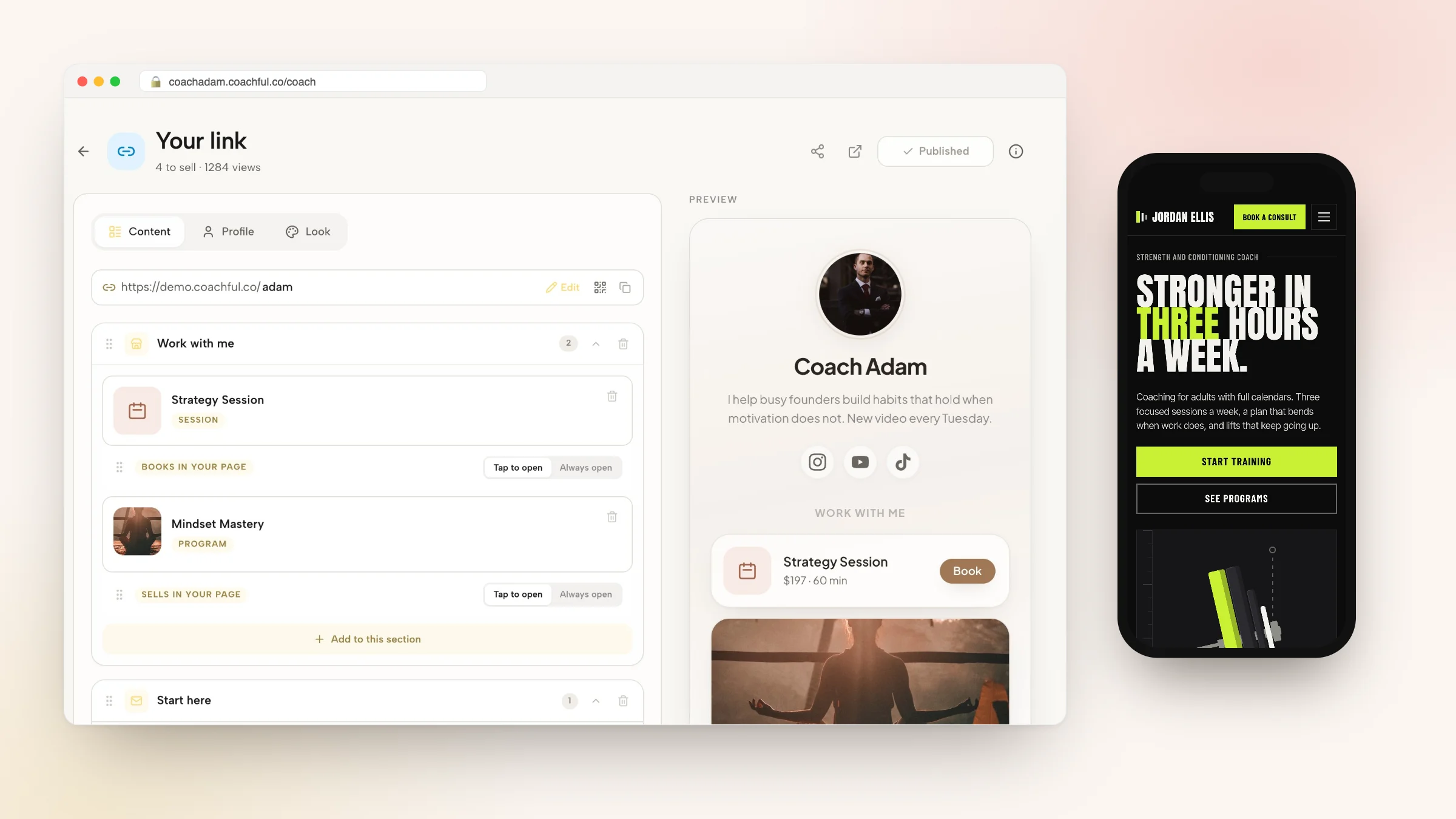
- A link-in-bio page that books a consult, sells a program and collects emails from one link, plus funnels for challenges and lead magnets.
- Payments through your own Stripe account, with one-time prices, monthly subscriptions and payment plans, and a 0% Coachful platform fee.
- A client app on iPhone and Android with your branding, where workouts, habits and messages live.
- Find a Coach, Coachful's public directory, with a Health and Fitness category for your profile.
It does not sync with wearables or Apple Health; clients log sessions in the app. Our page for fitness coaches has the full picture, and best fitness coaching software compares the options.

Get your website or challenge funnel built for you
Every Coachful plan includes a free white-glove build. On the Website or Funnels page, the "Want us to build it for you?" card opens a short form: what the funnel should do (fill a challenge, book consults, sell a program), who it is for, the journey you want people to follow, and where traffic comes from, such as Instagram, YouTube or your email list. Attach up to ten files, such as your logo and photos. The Coachful team replies by email, usually within about 24 hours, and builds it in your account so you can edit it afterwards. The team does not film your workout videos; you record those. For the website itself, see personal trainer website.

Frequently asked questions
How do online fitness coaches get clients?
Most start with in-person clients who move online and referrals from them, then build one channel: content that shows their coaching process to a specific audience, short challenges that lead into a program, or partners such as physical therapists and run clubs. Everything points to one link that books a consult.
How do I get my first online fitness coaching client?
Offer an online option to someone you already train, or message 20 people who know your work with a one-sentence description of who you help. A short challenge with a start date is the fastest way to turn followers into a first paying client.
Do I need a big following to get online fitness clients?
No. A few hundred followers who match your audience can fill a small practice if your posts show your process and point to one clear next step. Direct conversations, challenges and partners matter more than reach at the start.
Should I run ads for online fitness coaching?
Only once people who find you organically already sign up and buy. Ads multiply whatever happens underneath them. Know your cost per client first; our guide to paid ads for coaches covers the numbers.
Are transformation photos allowed in fitness marketing?
They are, with care. The FTC expects ads to make clear what results people generally achieve if a testimonial is not typical, and to disclose any payment or perk for the endorsement. Get written permission from every client you feature.
Can Coachful build my challenge funnel for free?
Yes. Every Coachful plan includes a free white-glove build. Fill in the funnel form with what it should do, who it is for and where your traffic comes from, and the team builds it in your account, usually within about 24 hours. You record any workout videos yourself.
What should an online fitness coaching program include?
A plan built around the client's week, logged sessions you review, a weekly check-in, a way to message you, and a plan for travel or sick weeks. Our guide to creating an online fitness coaching program covers the structure.












