
9 Things to Know Before Becoming a Health Coach
The most useful things to know before becoming a health coach are that your clients usually know what to do already, that lasting habits take longer than most programs run, and that your scope, your claims and your clients' health data all come with rules you have to keep. The work is rewarding and in demand, but you compete with apps on one side and clinicians on the other, so the coaches who do well are specific about who they help and careful about what they promise.
This is the reality check that sits beside our step-by-step guide on how to become a health coach, which covers training, board certification and setup in order. Here we cover what surprises people in the first year. And if you go independent, Coachful's team will build your health coaching website for free on every plan, which item 9 explains.
The 9 things at a glance
| # | What to know | Why it matters |
|---|---|---|
| 1 | Clients already know what to do | You sell follow-through, not information |
| 2 | Habits take longer than your program | Design for the slump, not the first fortnight |
| 3 | Out-of-scope requests start in week one | Diagnosis, medication and some nutrition advice belong to clinicians |
| 4 | You're competing with apps | Generic habit advice is now cheap software |
| 5 | Board certification opens institutional doors | Consumers rarely ask; clinics and employers often do |
| 6 | Insurance billing is still mostly out of reach | Plan on clients paying you directly |
| 7 | Health data needs care, and HIPAA may or may not apply | Your tools and agreements should match your setup |
| 8 | Your marketing claims are regulated | Testimonials and "results" fall under FTC rules |
| 9 | Two different careers share one title | Employed and self-employed paths need different choices |
1. Clients already know what to do
Almost nobody hires a health coach because they don't know vegetables are good for them. They know. What they can't do is eat differently at 9pm after a long day, walk when it's raining, or go to bed while there's still email. The gap is between knowing and doing, and that gap is the job.
This surprises people who came to health coaching through a love of nutrition science or fitness. You'll spend far less time explaining things than you expect, and far more time asking questions like "What happened on the evenings it went well?" and "What's the smallest version of this you'd actually do on a bad day?" The training that pays off here is in behavior change methods, especially motivational interviewing, which is built for helping someone talk themselves into change rather than being lectured into it.
What to do: when a client asks a "what should I eat" question, notice whether they need information or a plan they'll follow. Usually it's the second. Our list of motivational interviewing questions is a good set to practice with, and what health and wellness coaching is explains the approach in plain terms.

2. Habits take longer than your program
The best-known study on this, by Phillippa Lally and colleagues at University College London, followed people who picked one new daily health behavior and repeated it. On average it took 66 days for the behavior to feel automatic, with individuals ranging from 18 days to a projected 254 days. Missing a single day didn't seem to matter much; missing many did (Lally and colleagues, European Journal of Social Psychology, 2010, as summarized by the British Psychological Society).
Two practical lessons follow. A four-week "reset" can start a habit but is shorter than the average time it took participants for a habit to stick, so plan what comes next. And the dangerous stretch isn't the start, when motivation is high. It's the middle, when the novelty has gone and the first busy week arrives.
What to do: build programs of at least three months for any habit-change goal, with a planned "what if I slip" conversation in the first month, not after the slip. Keep the daily ask tiny. Our guide to creating a health coaching program has a week-by-week structure.

3. Out-of-scope requests start in week one
Health coaches are not licensed to diagnose, prescribe or treat, and in some US states individualized nutrition advice for a medical condition is restricted to licensed dietitians or nutritionists. Your clients won't know that. Expect versions of these within your first month:
| What the client asks | Why it's out of scope | What you can say |
|---|---|---|
| "Can you look at my blood work?" | Interpreting labs is clinical | "Let's write down the questions to ask your doctor about it." |
| "Should I stop my medication?" | Medication decisions belong to the prescriber | "That's one for your doctor. I can help you prepare for that appointment." |
| "What should I eat for my thyroid?" | Diet for a condition may be restricted to licensed professionals in your state | "Your doctor or a dietitian can set that. I'll help you stick to what they recommend." |
| "Which supplements should I take?" | Recommending supplements to treat a condition is clinical advice | "Ask your pharmacist or doctor; they can check it against what you already take." |
| "Help me lose 20 pounds before the wedding." | Fine as a goal, risky as a crash plan | "Let's plan the habits that get you there safely, and check with your doctor if anything feels extreme." |
What to do: put your scope in writing on your website and in your agreement, check the rules where you and your clients live, and keep a short list of doctors and dietitians to refer to. Coaches who hold the line build trust with clinicians, who then send them clients. Our health coaching templates include intake forms that ask the right questions up front.

4. You're competing with apps
Coachful's 2026 Coaching Business Report calls health and wellness "the most crowded end of the profession, and the one competing hardest against apps and subscriptions," rating saturation very high. It also lists app-based programs with a weekly coach check-in at $17 to $149 a month. So "eat better, move more, sleep well" is now something a phone sells cheaply.
That doesn't make human coaching obsolete; it changes what you're selling. Software sends the same reminder to everyone. A coach notices that the client's evenings fall apart every Thursday because that's the late meeting, and redesigns Thursday. The report's rates reflect the gap: health and wellness coaches typically charge $75 to $200 an hour (PayScale and practitioner reports), with newer coaches at $50 to $100 (practitioner estimates).
The same report flags women's health as underserved and growing, with low saturation. That's the pattern across the niche: specific beats general. "Perimenopausal women who want their energy back" or "professionals recovering from burnout who need sleep first" gives a person a reason to choose you over an app. See what health coaches charge for program pricing, and our consumer guides to menopause coaching and burnout coaching to see how those clients think.

5. Board certification opens institutional doors
In the US, the credential clinics, employers and digital health companies tend to recognize is the National Board Certified Health & Wellness Coach (NBC-HWC) from the National Board for Health & Wellness Coaching. NBHWC lists four requirements: an NBHWC-approved training program, 50 qualifying coaching sessions logged after your program's skills assessment, an associate degree or higher in any field (or 4,000 hours of work experience in any field), and the board exam.
The surprise is who cares. A hospital wellness team or a health-tech company may require it. A client who finds you on Instagram usually won't ask. So the credential's value depends on which career in item 9 you're choosing. If you want employed or clinic work, plan for it from the start, because choosing a non-approved program and then retraining is expensive. If you'll sell directly to consumers, a rigorous program still matters for the skill, but results and referrals will sell more than the letters.
Our health coach certification guide compares the approved and non-approved routes, and health coach salary shows what each path tends to pay.
6. Insurance billing is still mostly out of reach
People new to the field often assume they'll bill insurance like a therapist. Today, most health coaching is paid for directly by the client or by an employer program. There are three Category III CPT codes for health and well-being coaching (0591T for an initial assessment, 0592T for a follow-up, 0593T for group), approved in 2019 and effective in 2020, but Category III codes exist mainly to track use, and NBHWC describes them as a step toward codes that would be fully supported for reimbursement.
That may be changing. NBHWC reports that a CMS proposed rule released on July 14, 2026 for the 2027 Physician Fee Schedule includes, for the first time, reimbursement pathways for health and wellness coaching, with the final rule expected between October and November 2026 (NBHWC). Until a final rule is published and payers act on it, treat insurance as a possibility to watch, not a revenue plan.
What to do: price for clients and employers who pay directly, and if insurance work matters to you, keep the board credential in view, since NBHWC, the board that awards it, is leading the push for coverage. Our sibling article on whether a health coach can bill insurance goes into superbills, HSAs and employer-paid coaching.
7. Health data needs care, and HIPAA may or may not apply
You'll hear about weight, sleep, medications, diagnoses, sometimes trauma. Clients deserve to know how you store it. Whether HIPAA applies is a narrower question than many coaches think: covered entities are health plans, health care clearinghouses and health care providers who submit HIPAA transactions such as claims electronically (CMS). An independent coach paid directly by clients is often outside that definition. A coach working under contract for a clinic or health plan may be handling information on their behalf, and then the arrangement matters.
So check your own setup, ideally with the organization or a lawyer, before you choose tools. Be honest with clients either way. Coachful, for example, is not HIPAA-certified; it is GDPR-ready with full data export. If your practice requires HIPAA compliance, plan around that.
What to do: collect only what you need, explain in your agreement how notes are stored and how long you keep them, and ask permission before recording or using AI notes. Our guides to client record retention and consent for AI session notes have wording.
8. Your marketing claims are regulated
Health marketing is where good coaches get into trouble without meaning to. The FTC's Health Products Compliance Guidance says health benefit claims need competent and reliable scientific evidence, that a testimonial can't be used to make a claim you couldn't make directly, and that showing results beyond what people can generally expect is likely deceptive unless you clearly disclose the typical result. A "results not typical" line doesn't cure it.
In practice that rules out the language that sells on social media: "reverse your diabetes," "cure your gut," a dramatic before-and-after with no context. It doesn't rule out honest marketing. "I help women in perimenopause build a sleep and movement routine that fits a full-time job" is specific and makes no medical promise. A client's story about feeling more in control of their evenings, shared with permission, is fine.
What to do: describe habits, support and the process, not cures or outcomes. Read every testimonial before you post it and ask whether it implies a medical result. Our guide to a health coach website shows page copy that stays on the right side of the line.

9. Two different careers share one title
"Health coach" covers two jobs. One is employed: working for a clinic, an employer wellness program, an insurer or a digital health company, usually on a salary, with a caseload someone else fills. The other is self-employed: you find your own clients, design your own programs and set your prices. Coachful's report puts health and wellness coaches at $52,000 to $77,000 a year (PayScale, ZipRecruiter, Glassdoor), and those sources lean toward employed roles, so treat them as a salary benchmark rather than a promise of practice income.
The choice changes what you do first. Employed work leans on board certification and experience in health settings. Independent work leans on a clear specialty, a program people want, and a steady way to find clients. Many coaches combine them: a part-time employed role for stable income while building a practice.
If you go independent: get the website built for free
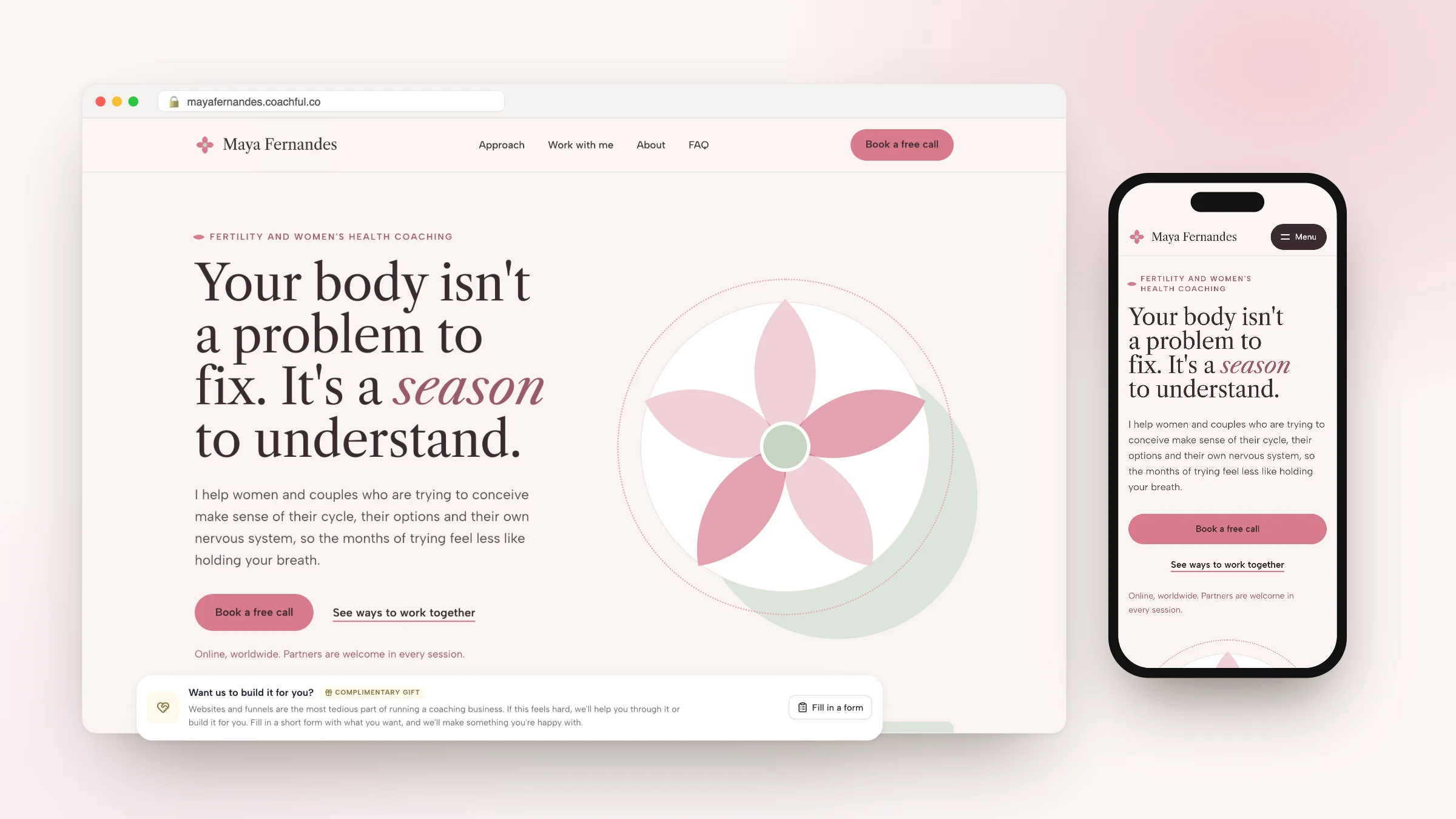
Coachful runs the independent side in one account: a website, booking, programs with habits and check-ins in a client app, and payments through your own Stripe account with a 0% Coachful platform fee, all included in your membership. See the Coachful page for health coaches. The website is where most new coaches stall, so the Coachful team builds it for free on every plan. Open Website, click Fill in a form, and describe your pages and what visitors should do. The team replies by email with next steps, usually within about 24 hours, which is typical rather than guaranteed. Nothing is invented, including health claims you haven't made, and the team doesn't design logos, record videos or run ads. See what the free build covers.

The bottom line
Health coaching rewards people who like the slow, practical work of helping someone change a habit, and it punishes overpromising. Know that your clients need follow-through more than facts, that habits outlast programs, that scope and marketing claims have real limits, and that the credential you need depends on whether you'll be employed or independent. Then read the companion list of mistakes new health coaches make before you launch.
Frequently asked questions
What should I know before becoming a health coach?
Know that the job is behavior change rather than nutrition teaching, that you can't diagnose, prescribe or give restricted nutrition advice, and that most clients pay directly rather than through insurance. Decide early whether you want employed work, where board certification often matters, or your own practice.
Is health coaching a good career?
It can be, especially with a specialty. Coachful's 2026 report puts health and wellness coaches at $52,000 to $77,000 a year (PayScale, ZipRecruiter, Glassdoor) and $75 to $200 an hour, but also rates the field as very crowded and competing with apps. Specialists, such as women's health coaches, face less competition.
Do I need to be certified to be a health coach?
No law requires it in most places. NBC-HWC board certification, which needs an NBHWC-approved program, 50 logged sessions, an associate degree or 4,000 hours of work experience, and an exam, matters most if you want to work with clinics, employers or digital health companies.
Can health coaches give meal plans?
It depends on where you and your client live. In some US states, individualized nutrition advice or meal plans for a medical condition are limited to licensed dietitians or nutritionists. General healthy-eating guidance and help sticking to a clinician's plan are usually within a coach's scope. Check your state's rules.
Can a health coach bill insurance?
Rarely, for now. Category III CPT codes exist for health and well-being coaching, mainly for tracking use, and a CMS proposed rule in July 2026 included the first Medicare reimbursement pathways, pending a final rule. Most health coaches are paid directly by clients or employers.
How long does it take to become a health coach?
Training programs commonly take several months to a year. For board certification you also need 50 qualifying sessions after your program's skills assessment, then the exam. Our guide to becoming a health coach has a timeline.
Will Coachful build my health coaching website for free?
Yes. Coachful's team builds health coaching websites, program pages and free-guide funnels for free on every plan, inside your own account. Coachful itself is a paid subscription with a free trial. Fill in the form from the Website page, and the team replies with next steps, usually within about 24 hours.












