
How to Get Clients as a Career Coach: LinkedIn and Beyond
How to get clients as a career coach, in short: career coaching is bought at moments of urgency, such as a layoff, a stalled promotion, a graduation or a bad performance review, so the channels that work put you in front of people at those moments. For most career coaches that means LinkedIn, alumni networks and university career offices, employers and outplacement firms that pay for departing staff, and recruiters and HR people who meet job seekers every week. Pair one main channel with a small free tool, such as a career clarity scorecard, and sell short, defined packages rather than open-ended sessions.
The urgency cuts both ways. It makes career coaching easier to sell than most coaching, and it makes engagements short, so a career coach needs a steadier flow of new clients than a life coach does. Coachful's 2026 Coaching Business Report puts it plainly: career coaching is "bought at a moment of urgency, which supports a high single-session price but rarely a long engagement." This guide covers the channels, the messages to send, the packages that match the urgency and a 30-day plan. If you are still setting up, start with how to become a career coach; every Coachful plan also includes a free build of your website or funnel by our team, covered below.
The channels that bring career coaches clients
| Channel | Who you reach | Who pays | Speed |
|---|---|---|---|
| Professionals thinking about a move, and the HR people who hire coaches | The individual, sometimes the employer | Weeks to months | |
| Alumni networks and university career offices | Graduates and alumni changing direction | The individual or the institution | Weeks |
| Employers and outplacement | Staff leaving in a restructure, or moving internally | The employer | Months, then steady |
| Recruiters and HR contacts | Candidates they cannot place, or who need interview help | The individual | Weeks |
| Professional associations and job-seeker groups | People in one field, often mid-search | The individual | Weeks |
| Search and a free tool | People typing "how to change careers at 40" | The individual | Months, then compounding |
Pick one main channel and give it 90 days. LinkedIn is the default for mid-career professionals; alumni and university work suits early-career coaches; employer and outplacement work suits coaches with an HR or recruiting background.
Map the moments your clients are in
| The moment | What they are thinking | What to offer |
|---|---|---|
| Laid off or about to be | "I need a job in three months." | A four-session job search sprint with CV and LinkedIn review |
| Interview next week | "I can't blow this one." | A single mock interview session with written feedback |
| Passed over for promotion | "Do I push here or leave?" | A decision session, then a promotion or exit plan |
| Wants a different field | "I don't know what else I'd do." | A three-month career change program |
| Recent graduate | "Everyone else seems to know what they're doing." | A short first-job program, often in a group |
Your content, your free tool and your packages should each name one of these moments. "Career coaching" in general is hard to buy; "a mock interview before Thursday" is easy.

Channel 1: LinkedIn, done the career coach's way
LinkedIn is where your buyers already think about their careers, which makes it the natural home channel. Our guide to getting coaching clients on LinkedIn covers the general steps; these are the parts specific to career coaching.
- A headline that names the moment. "I help mid-career engineers move into product roles" beats "Career Coach | Helping You Thrive".
- Post what recruiters and hiring managers actually do. How a hiring manager reads a CV in the first pass, what a recruiter's screening call is really for, why the "tell me about yourself" answer goes wrong. Specific, insider and useful.
- Comment where job seekers gather. Posts about layoffs, hiring freezes and interview horror stories attract exactly the people you help. A thoughtful comment there does more than another post of your own.
- Turn comments into conversations, not pitches. When someone replies with their situation, offer something useful first, such as your scorecard or a CV checklist.
- Post the week after big layoff news in an industry you know. "If you were affected at [company] this week, here are the first three things I'd do" is help, not ambulance-chasing, as long as it is genuinely useful.
Channel 2: alumni networks and university career offices
Alumni are a warm audience: they share a background with you and often with each other. Three routes in:
- Your own alumni association. Offer a talk or webinar for alumni changing careers. Many associations run regular career events and need speakers.
- Career services offices. Some colleges extend career services to alumni as well as students, and some bring in outside coaches for workshops or overflow. Ask what they need.
- Alumni groups on LinkedIn and in your industry. Share useful posts there rather than ads.
"Hi Dana, I'm a 2009 graduate and now a career coach working with alumni who want to change fields in their thirties and forties. Would a 45-minute online session on 'testing a new career before you quit' be useful for your alumni events this term? I can send an outline."

Channel 3: employers and outplacement
Outplacement is career support that a former employer pays for when people leave. Wikipedia describes it as "a support service provided by some organizations to help former employees transition to new jobs", usually delivered by a consultancy and paid for by the employer (Wikipedia). Firms such as LHH and Challenger, Gray & Christmas sell outplacement programs to employers. Some providers hire career coaches directly and some work with associates, so it is worth asking how they bring in coaches: it is paid work, regular hours toward an ICF credential, and a close look at what employers buy.
You can also sell to employers directly. Smaller companies going through a restructure often have no outplacement contract and an HR lead who wants to treat people well.
"Hi Sam, if your team is planning any role changes this year, I run a four-session transition package for departing staff: CV, LinkedIn, job search plan and interview practice, invoiced to the company. It helps people land well and protects how the company is remembered. Happy to share the outline."
Internal moves are a second employer market: promotions, new managers and people moving between functions. Our guide to pitching an employer-paid pilot covers the proposal.

Channel 4: recruiters, HR people and associations
Recruiters talk to dozens of candidates a week and can place only a few. The rest need exactly what you sell: a better CV, interview practice, a clearer target. Offer to be their referral for candidates who are not ready yet, and send useful candidates back their way when you meet them. Former colleagues in HR are the same kind of partner.
Professional associations in your field run job boards, mentoring programs and events for members mid-search. A talk at one is often the fastest way to five consultations. For career practitioners themselves, the National Career Development Association is the main professional body, and its credentials come up in career coach certification.
One line to hold in every channel: never present yourself as someone who can place people in jobs. The FTC warns that honest placement firms do not typically charge job candidates, because the hiring company pays them (FTC). Be clear that you are a coach, what you do, and that no one can guarantee a job.
A free tool that leads to a call
A small free tool turns interest into an email address and a booked call. The best ones for career coaches answer one question in under ten minutes:
- A career clarity scorecard: ten questions that show whether to stay, adjust or leave.
- A one-page CV checklist built from how hiring managers actually scan.
- The ten interview questions for a specific role, with what a strong answer covers.
Our guide to lead magnets for career coaches has templates. Follow every download with three short emails and an invitation to a 30-minute call.

Packages that match the urgency
Coachful's 2026 Coaching Business Report gives these career coaching packages, from practitioner reports and a sample of 35 coaches' published rates on one marketplace:
| Package | What it includes | Typical price |
|---|---|---|
| Single session, 50 minutes | Session and prep from an intake form | $99 to $280 |
| Job search sprint, four sessions | Sessions, CV review and LinkedIn audit, over four to six weeks | $500 to $1,000 |
| Career transition, eight sessions | Sessions, interview prep and negotiation coaching, over three months | $1,200 to $2,500 |
US dollars, Q2 2026. Details on coachingrates.com and in how much career coaches charge.
A paid single session is a good first step for urgent buyers, with a clear upgrade into the sprint. A group job-search cohort lets you serve more people at a lower price; our group career coaching pilot plan shows how to launch one. For program structure, see how to create a career coaching program.

Messages you can copy
After someone comments about a layoff:
"Sorry to hear that, Priya. If it's useful, I have a one-page checklist for the first two weeks after a layoff: what to do with your CV, LinkedIn and network, in order. Want me to send it?"
To someone who downloaded your scorecard:
"You scored 'adjust' on the scorecard, which usually means the job fits but the role around it doesn't. If you'd like to talk through what that could look like, I have a couple of 30-minute slots this week: [link]."
Asking for a referral after an offer:
"Congratulations on the offer. Seriously, the negotiation was great. Is there anyone from your old team who's still looking? I'd be glad to help them too, and I can send a note you could forward."
A 30-day plan to get career coaching clients
| Days | Focus | Done when |
|---|---|---|
| 1 to 3 | Pick your client moment and rewrite your LinkedIn headline and About section around it. | A stranger knows who you help in one line |
| 4 to 8 | Build one free tool, its page and three follow-up emails. Set up a paid single session and a 30-minute call. | Someone can download, book and pay on a phone |
| 9 to 14 | Post three times a week and leave five useful comments a day on job-search posts. | Your first conversations start |
| 15 to 20 | Contact your alumni association, two recruiters and two HR contacts. | One talk or partnership agreed |
| 21 to 26 | Send 20 personal messages to former colleagues and alumni. | Five calls booked |
| 27 to 30 | Count leads, calls and clients by source, and ask every client for one referral. | You know which channel to keep |

Running it on Coachful
Coachful's Career Coaching power-up gives each client a private tracker that you can see and edit: networking connections, job applications and interviews, a LinkedIn content plan and their CV, with reminders for follow-ups, interviews and planned posts, and a coach overview of what is due across every client. Around it:
- Booking for paid single sessions and mock interviews, with intake questions on the booking form. See booking software.
- Funnels and email sequences for the scorecard and its follow-up, with the source recorded on every lead. See funnel software.
- Sponsors: add an employer as a sponsor on a client's profile and send invoices or agreements to them, while the coaching stays with the client and the sponsor cannot see the client's workspace.
- Programs and groups for job-search cohorts, with a group space created when clients enroll.
- Find a Coach, Coachful's public directory, where job seekers search by topic and book a call from your profile.
Our page for career coaches has the full setup, and best software for career coaches compares the options.

Get your website and scorecard funnel built for you
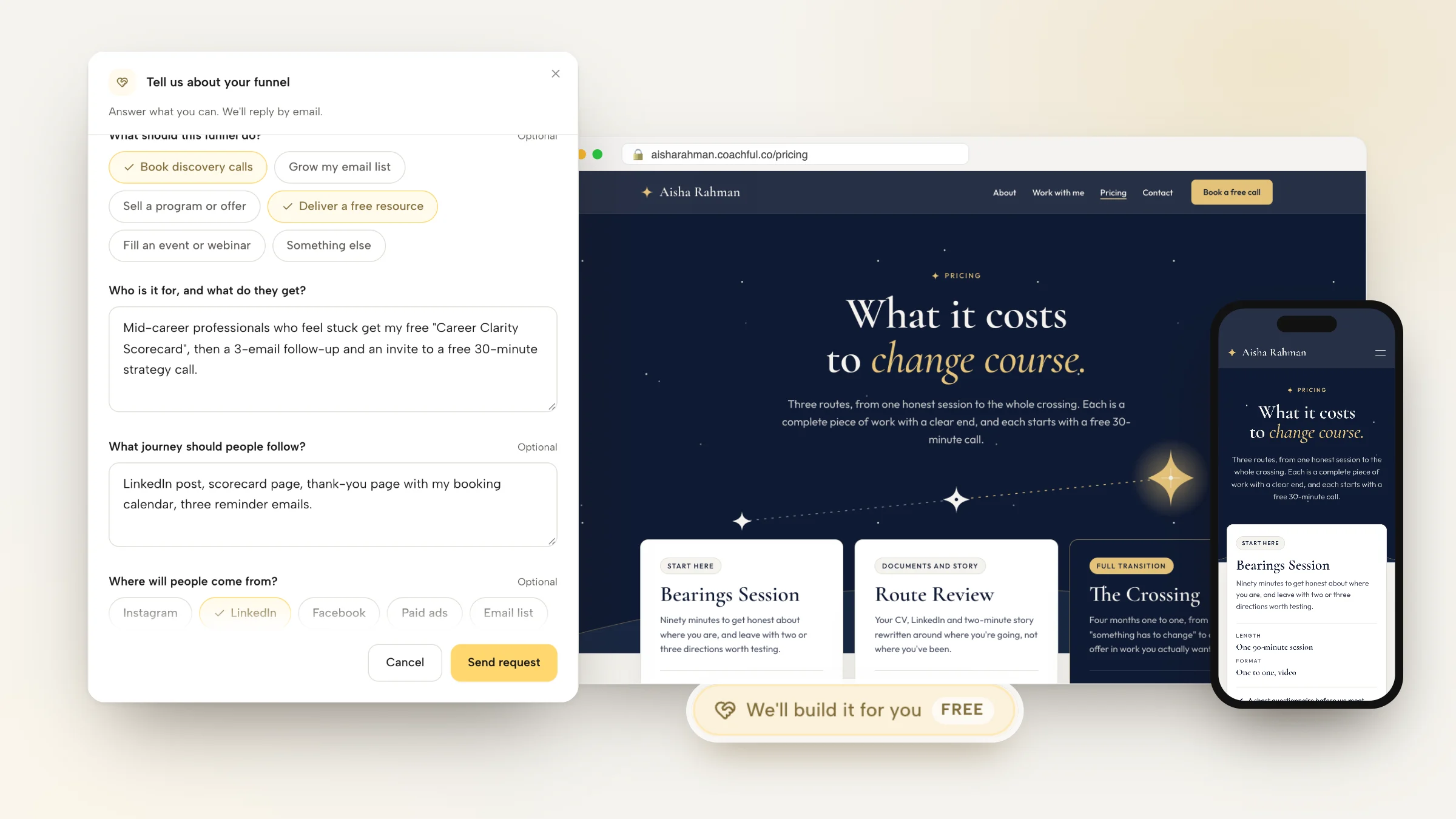
Every Coachful plan includes a free white-glove build. Choose "We'll build it for you" from Create, or the "Want us to build it for you?" card on Website or Funnels, and fill in a short form. For a funnel, say what it should do, who it is for, the journey people follow and where traffic comes from, such as LinkedIn. For a website, list the pages and what visitors should do. Add up to eight reference links and ten files. The Coachful team replies by email, usually within about 24 hours, and builds everything in your account. Nothing gets invented, so missing testimonials or prices are left for you to fill in. See website for career coaches for the pages that work.

Frequently asked questions
Where do career coaches find clients?
Mostly on LinkedIn, through alumni networks and university career offices, from employers and outplacement firms paying for departing staff, and through recruiters, HR contacts and professional associations. A small free tool, such as a career clarity scorecard, turns interest from any of these into booked calls.
How do I get my first career coaching client?
Message 20 former colleagues and alumni with one sentence on who you help and the moment you help them in, and offer a paid single session or a mock interview. People mid-search buy quickly when the offer matches their deadline.
Is LinkedIn the best place to get career coaching clients?
For mid-career professionals, usually. Your buyers are already there thinking about their careers, and so are the HR people who hire coaches. It works best when your headline names a specific moment and you spend as much time commenting as posting.
Can career coaches work with outplacement firms?
Yes. Outplacement firms such as LHH and Challenger, Gray & Christmas sell career transition support to employers. Some hire coaches directly and some use associates. It is steady, employer-paid work and a useful way to build hours.
How much should a career coach charge?
Coachful's 2026 Coaching Business Report puts single 50-minute sessions at $99 to $280, a four-session job search sprint at $500 to $1,000 and an eight-session transition at $1,200 to $2,500. Lead with a defined package matched to the client's deadline.
Can Coachful build my career coaching website for free?
Yes. Every Coachful plan includes a free white-glove build. Describe the website or funnel in a short form, attach your logo and copy, and the team builds it in your account, usually within about 24 hours. You can edit everything afterwards.
Do I need a certification to get career coaching clients?
No. Most individual clients care about your experience in hiring or their field. Employers and outplacement firms are more likely to ask for a credential such as an ICF credential or NCDA's CCSP.












