
9 Things to Know Before Becoming a Career Coach
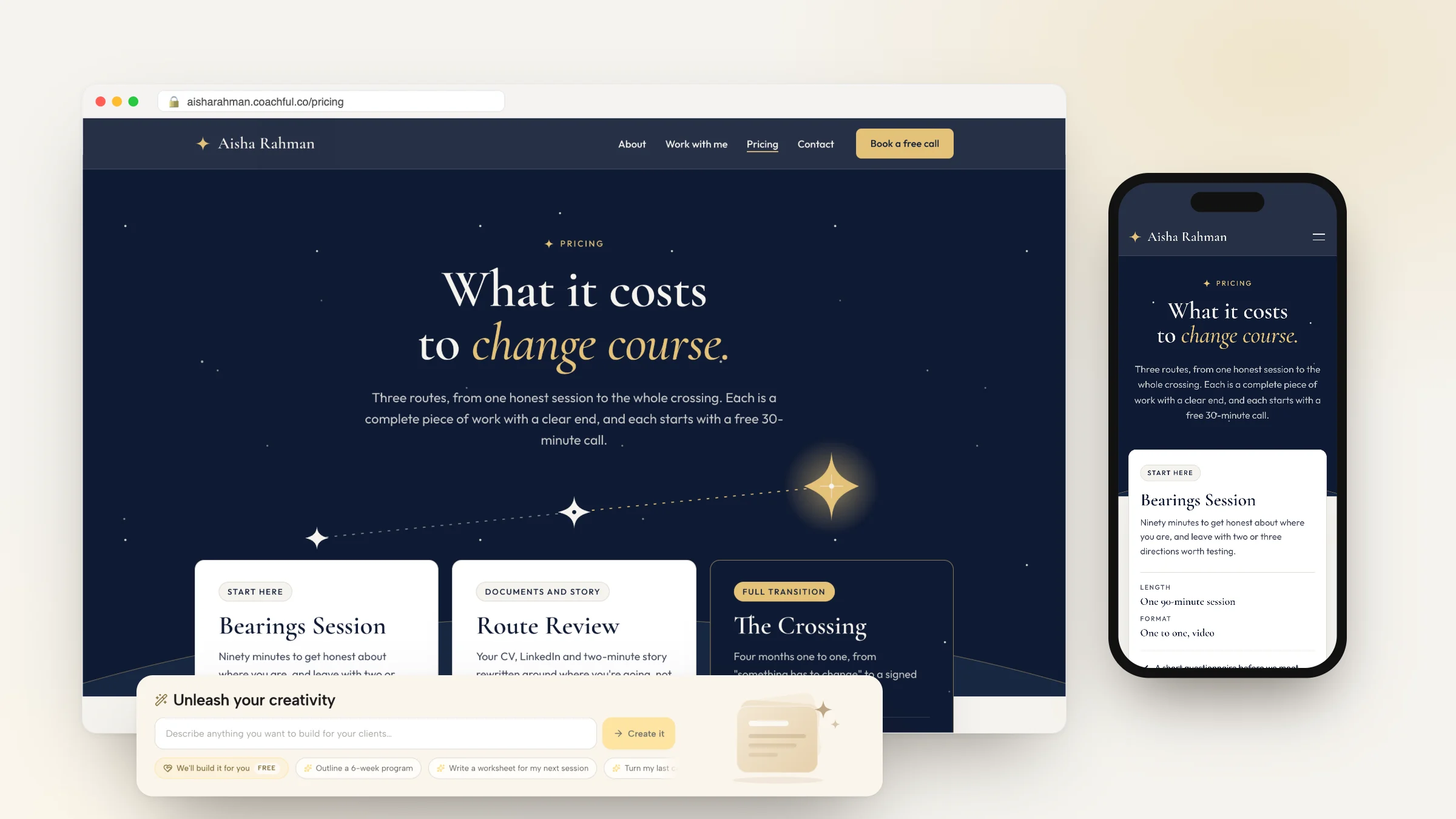
The main things to know before becoming a career coach: clients arrive in a hurry and leave the moment they land, you're judged partly on a job market you don't control, and the document half of the work has changed now that anyone can draft a CV with AI. The work is concrete and satisfying, and clients can see the result, but the business has to be built for short engagements and a constant flow of new people.
Think of this as the field notes that go with our step-by-step guide to becoming a career coach, which covers training, credentials, niches and first offers. Here we cover what new career coaches wish someone had told them. When you're ready to sell, Coachful's team will build your career coaching website or offer page for free on every plan (see item 9).
The 9 things at a glance
- Clients arrive in a hurry and leave when they land, so you need a steady flow of new ones.
- You're judged on outcomes you don't fully control, which is why you define success in terms of actions.
- Half the work is documents, and AI changed that half.
- Recruiting or HR experience helps, and some of it must be unlearned.
- Layoffs bring grief, not just logistics.
- Free help is everywhere, so your value has to be obvious.
- Negotiation is where clients feel the return.
- The search lives in spreadsheets you can't see unless you build a shared tracker.
- The first sale is usually small, so design the next step before you need it.
1. Clients arrive in a hurry and leave when they land
Coachful's 2026 Coaching Business Report describes career coaching as "bought at a moment of urgency, which supports a high single-session price but rarely a long engagement," and its niche table sums it up as "urgency-driven, short engagements." In plain terms: someone gets laid off on Tuesday and books you on Wednesday. Ten weeks later they accept an offer, thank you warmly, and stop paying. That's a success, and it's also a gap in your calendar.
A life coach can keep a client for a year. A career coach usually can't, so the business depends on replacing clients constantly. That shapes everything else: you need a reliable source of new conversations, a short path from first contact to first session, and a reason for past clients to send people your way.
What to do: build one steady lead source early, such as a free tool or checklist your niche actually wants, plus a simple booking path. Ask every client who lands a role for an introduction while they're celebrating. Our guide to lead magnets for career coaches has examples, and this discovery call funnel shows the booking path.

2. You're judged on outcomes you don't fully control
Your client wants a job offer. You can't make anyone hire them. Hiring freezes, a reorganization at the target company, or a sector slowing down can stall a search that's being run perfectly. For context, the US Bureau of Labor Statistics reported a median unemployment spell of 11.5 weeks in September 2026, with about 1.9 million people unemployed for 27 weeks or longer (BLS, seasonally adjusted). Those are averages across everyone, not career coaching results, but they're a useful reality check on timelines.
New career coaches feel this pressure personally and start overpromising: "We'll get you hired in 30 days." That promise invites refund disputes and makes you responsible for decisions you'll never see.
What to do: define success in your agreement as things the client controls with your help: a clear target, finished materials, a number of real conversations each week, interviews prepared for properly. Say plainly that you don't guarantee a job. Our coaching agreement template has the clauses, and our career coaching questions help set targets the client can act on.
3. Half the work is documents, and AI changed that half
A lot of career coaching has always been about the CV (résumé), the LinkedIn profile and the cover letter. Clients now arrive with a draft an AI tool wrote in thirty seconds. It's often tidy, generic and missing the two or three achievements that would make a hiring manager stop scrolling.
That shifts what you sell. Typing up a résumé is no longer scarce. Judgment is: deciding which story this person should tell for this role, pulling specific results out of a client who says "I just did my job," cutting the parts that undersell them, and preparing them to tell the same story out loud in an interview. The documents become the visible proof of the strategy rather than the whole service.
What to do: price and describe your document work as positioning, with interview practice attached, rather than as writing by the page. Ask clients to bring their AI draft; editing it together is a good teaching session. If you want the career-coaching tools that sit around this work, our roundup of software for career coaches covers them.
4. Recruiting or HR experience helps, and some of it must be unlearned
Many career coaches come from recruiting, HR or management. That background is valuable: you know how hiring decisions get made, what a hiring manager skims for and how salary bands work. It also brings habits that work against coaching.
A recruiter is paid by the employer to fill a role and is trained to judge fit quickly and move on. A coach is paid by the client to help them decide and act. When a former recruiter coaches, the pull is to assess ("you're not a fit for product roles") and tell ("put your metrics first"). Sometimes telling is exactly right, especially on documents. On direction, though, a client who is told what they want tends to drop the plan as soon as it gets hard.
What to do: be explicit about which hat you're wearing in each session. "For the next ten minutes I'm going to put my recruiter hat on and tell you how this reads" is honest and useful. Then switch back to questions for the decisions. Coach training, even a Level 1 program, helps more here than another HR qualification. Our career coach certification guide compares the routes.

5. Layoffs bring grief, not just logistics
A client who has just been laid off often isn't ready to optimize their LinkedIn headline. They may be angry, ashamed, worried about money, or grieving an identity they built over fifteen years at one company. Some will cry in the first session. Some will insist they're fine and then miss every action you agreed.
Coaching can help a person move through that, and it has limits. If the low mood goes on for weeks, if sleep and appetite collapse, or if they mention not wanting to be here, that's the point to suggest a doctor or therapist, and to keep coaching alongside only if that's appropriate. Have a referral list ready, and in the US know that the 988 Suicide and Crisis Lifeline takes calls and texts.
Money pressure also changes the sale. A person without a paycheck is weighing your fee against rent. What to do: give the first session room for the story, set smaller first actions, and offer a payment plan on your packages so price doesn't keep the people who need you most away. Our guide to career change coaching covers the emotional side of transitions from the client's view.
6. Free help is everywhere
Your prospects can get career help without paying you. The US Department of Labor counts approximately 2,300 American Job Centers that offer job search help and placement assistance (DOL). Universities run career centers for students and often alumni. LinkedIn is full of free advice, and AI tools will rewrite a résumé on request.
Clients who pay a career coach anyway are buying something those sources don't give: someone who knows their specific field, a plan built around them, honest feedback, and weekly accountability through a stressful search. If your marketing sounds like generic job-search tips, you're competing with free and losing.
What to do: be specific about who you help and what changes. "I help engineers move into product management within a year" can't be replaced by a free webinar. Show the depth in your content: a teardown of a real (anonymized) résumé, the five interview questions your niche always gets. The Coachful page for career coaches shows how the practice side fits together.
7. Negotiation is where clients feel the return
Clients often hire a career coach for the job search and are surprised by how much the offer stage matters. That's where a coach helps them ask about the full package (base, bonus, equity, title, start date, remote days), hold a silence instead of accepting on the spot, and compare two offers on what they actually want rather than which came first.
It's also where clients can see the value of coaching in their own numbers. You don't need a statistic to make that point; the client does the math themselves when the second number is higher than the first.
What to do: include negotiation in every search package rather than selling it as an extra. Role-play the call at least once, with you playing a hiring manager who says "that's the top of the band." Write down the client's walk-away point before the offer arrives, when they're thinking clearly. Our guide to interview coaching covers the practice formats that transfer to negotiation calls.
8. The search lives in spreadsheets you can't see
A job search is mostly logistics: target companies, contacts, applications, follow-ups, interview dates, thank-you notes. Clients keep this in their heads, their inbox or a spreadsheet you never see. Then the session starts with fifteen minutes of "where are we?" and you find out the follow-up you agreed two weeks ago never went.
The coaches who get better results tend to make the search visible. A shared tracker means each session starts from facts: twelve applications, three conversations, one interview on Thursday. It also shows the client their own effort on the weeks the market feels like a wall.
What to do: agree on one tracker in the first session and review it every time. In Coachful, the Career Coaching power-up gives each client a private tracker for connections, job applications and interviews, a LinkedIn content plan and their CV, with reminders for follow-ups and interviews and a coach overview of what's due across clients. Everything else, from sessions to the client's "what to do next" list, sits in the same client app.

9. The first sale is usually small
Because career clients are urgent and cautious with money, the first purchase is often a single session or a CV review rather than a three-month package. Coachful's report shows the shape. A verified sample of published career coach rates from one marketplace runs $99 to $280 for a single session. Practitioner reports put a four-session job search sprint with CV review and LinkedIn audit at $500 to $1,000, and a three-month career transition package with interview prep and negotiation coaching at $1,200 to $2,500. Across career coaching the report gives $100 to $250 an hour (PayScale and practitioner reports) and $49,000 to $72,000 a year (PayScale, ZipRecruiter, Glassdoor).
New coaches often sell the single session and stop there. The better move is to treat it as a door: end the session with a written plan and a clear offer for the sprint or the full transition package, with the session fee credited if they continue within a week.
What to do: build a three-step ladder (one session, a sprint, a full package) and put all three on one page. Our breakdown of what career coaches charge and career coach salary go deeper on numbers, and coachingrates.com keeps the benchmarks in one place.

Have your offer page built for free
Coachful's team builds career coaching websites, offer pages and funnels for free on every plan, inside your own account, so the ladder above can be live without you learning a page builder. Coachful itself is a paid subscription with a free trial. Open Website or Funnels, click Fill in a form, and describe your pages, offers and where visitors should go. Add up to 8 links and 10 files. The team replies by email with next steps, usually within about 24 hours, which is typical rather than guaranteed. Nothing is invented: no credentials, testimonials or prices you haven't given. See what the free build covers.


The bottom line
Career coaching suits people who like practical, visible progress and can live with short engagements. Know that you'll replace clients constantly, that you can't promise the job, that AI has made your judgment more valuable than your typing, and that a visible tracker and a strong negotiation stage are where clients feel the difference. Read our guide to getting clients as a career coach next, because item 1 makes that the skill you'll use most.
Frequently asked questions
What should I know before becoming a career coach?
Know that engagements are short and urgent, so you need a steady flow of new clients; that you can't guarantee a job offer and shouldn't promise one; and that clients pay for judgment, strategy and accountability more than for document writing, which AI tools now do cheaply.
Is career coaching a good career?
It can be. Coachful's 2026 report rates career coaching as medium on income, saturation and difficulty to enter, with typical rates of $100 to $250 an hour (PayScale and practitioner reports). The main challenge is that clients leave once they land a role, so marketing never stops.
Do I need HR or recruiting experience to be a career coach?
No, but experience inside hiring helps, especially for document and interview work. Many career coaches come from HR, recruiting or management, and many come from the field they now coach in. Coach training matters either way, because advising and coaching are different skills.
How long do career coaching clients usually stay?
Often weeks to a few months, until they land a role or make their decision. Coachful's report describes the niche as urgency-driven with short engagements, which is why many career coaches sell a single session, a short sprint and a longer transition package.
Can a career coach guarantee a job?
No, and a coach who promises one is a red flag. Hiring decisions belong to employers. A good career coach defines success as what the client controls: a clear target, strong materials, regular conversations and well-prepared interviews.
What is the difference between a career coach and a career counselor?
A career counselor often has a counseling degree and, in some US states, a license, and may use formal assessments. A career coach usually focuses on planning and carrying out a career move and doesn't need a license. Our guide to career coaching explains the difference for clients.
Will Coachful build my career coaching website for free?
Yes. Coachful's team builds career coaching websites, offer pages and funnels for free on every plan, inside your account. Coachful is a paid subscription; the build costs nothing extra. Fill in the form from Website or Funnels, and the team replies with next steps, usually within about 24 hours.












